

The “Bank Repo” Story Falls Apart: That’s Not How Vehicle Repossession Works
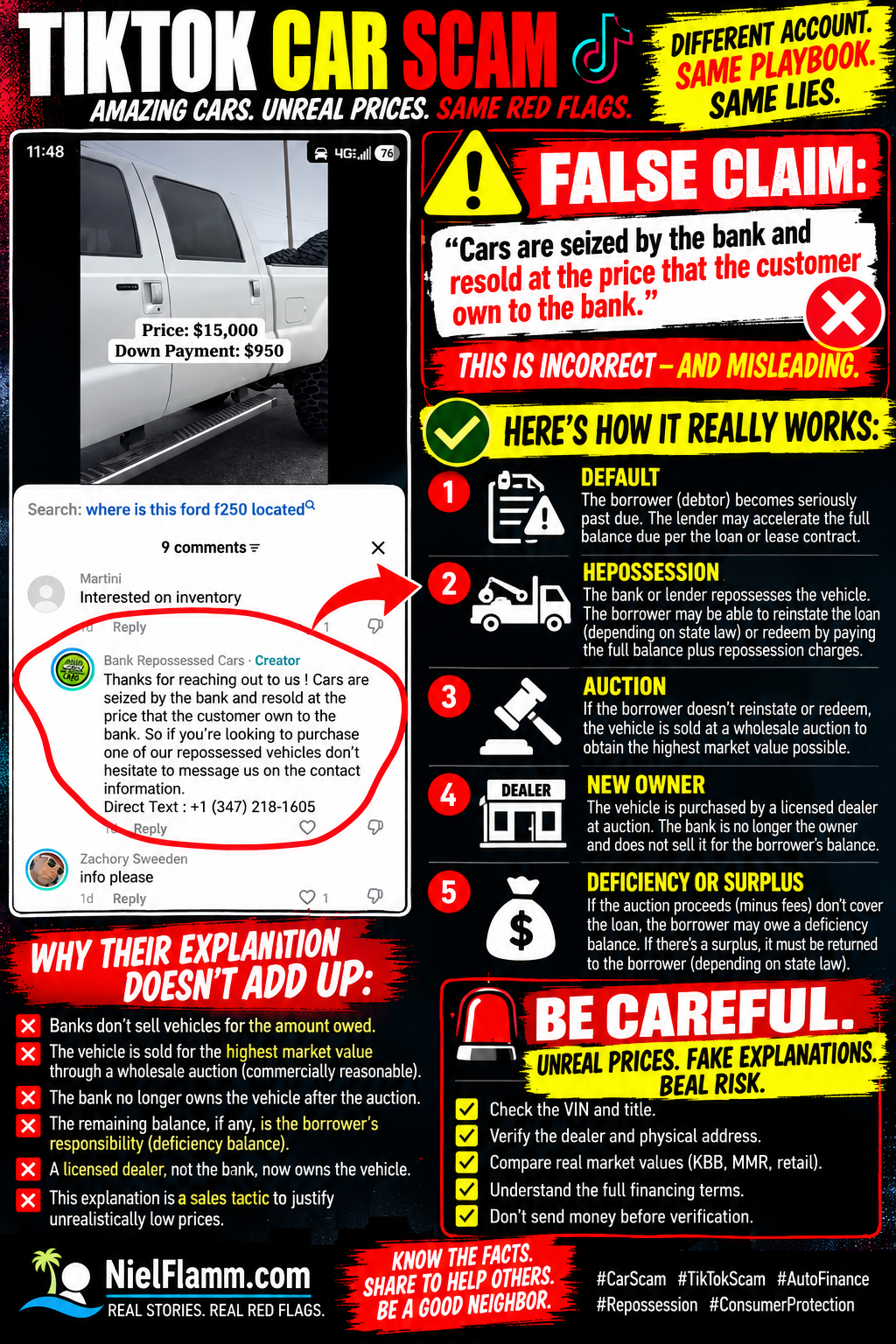
I've been following another TikTok account advertising remarkably inexpensive “bank repossessed” vehicles. This time, I noticed something in the comments that deserves its own post.
The account responded to someone interested in a vehicle with this explanation:
“Cars are seized by the bank and resold at the price that the customer own to the bank.”
In other words, the account appears to be telling potential buyers that banks repossess vehicles and then sell those vehicles for whatever balance the previous customer owed.
That's not an accurate description of the normal repossession and disposition process.
This is an area where I have quite a bit of professional experience.
First, Let's Talk About What Repossession Actually Is
A bank, credit union, captive automotive finance company or other lender doesn't generally repossess a vehicle because it suddenly wants to become a discount used-car dealership.
The vehicle is collateral securing a financial obligation.
When a borrower—often called the debtor—defaults under the retail installment contract or lease, the lender may have the contractual and legal right to repossess the vehicle. Exactly when that can happen and what notices are required depend on the contract and state law. The FTC notes that in many states, a lender may repossess once the borrower defaults, and missed payments are a common form of default. Consumer Advice
State laws vary significantly, so I'm not presenting one procedure as universal across all 50 states.
But the TikTok explanation isn't how the basic economics work.
Reinstatement and Redemption Come Before the Sale
After repossession, the borrower may still have rights.
Depending upon state law and the contract, a borrower may have an opportunity to reinstate the loan by bringing the delinquency current and paying allowable repossession-related expenses.
In other circumstances, the borrower may have the right to redeem the vehicle by paying the full amount required, along with applicable repossession expenses.
The CFPB specifically distinguishes these concepts. Some states permit curing or reinstating a loan after repossession, while redemption generally involves paying the full loan amount plus repossession costs before the vehicle is sold. Consumer Financial Protection Bureau
So repossession doesn't automatically mean:
Bank takes car → bank reviews the remaining balance → a random person gets a screaming deal.
There's a process.
Then Comes the Disposition of the Vehicle
If the borrower doesn't reinstate or redeem where those options apply, the lender may dispose of the collateral.
F
In the automotive finance world, repossessed vehicles commonly move through wholesale channels, including dealer auctions. But to be precise, federal guidance notes that a lender can sell a repossessed vehicle through a public or private sale, depending on applicable law and circumstances. Consumer Advice
Under Article 9 of the Uniform Commercial Code, every aspect of a secured creditor's disposition of collateral must be commercially reasonable. A sale may qualify when it's conducted in the usual manner in a recognized market, at the prevailing market price, or in accordance with reasonable commercial practices among dealers in that type of property. Legal Information Institute
That's an extremely important distinction.
The objective isn't:
“Bob owes $5,850, so let's sell Bob's $35,000 car for $5,850.”
The unpaid loan balance and the vehicle's market value are two different numbers.
That's Where the TikTok Explanation Really Falls Apart
Think about the implications of what this account is saying.
Suppose someone financed a $60,000 vehicle.
Years later, the vehicle is still worth $30,000.
But the borrower happens to owe only $6,000 when the vehicle is repossessed.
According to the explanation in this TikTok comment, the bank would essentially resell the vehicle for what the customer owed.
Why would a lender voluntarily turn a $30,000 asset into $6,000?
That's not how a commercially reasonable disposition works.
The vehicle is sold, the proceeds are applied according to the applicable rules, and then the account is reconciled. Under UCC Article 9, reasonable disposition expenses generally come out of the proceeds, followed by satisfaction of the secured obligation and certain other permitted claims. Legal Information Institute
And then we find out whether there's a deficiency or a surplus.
What's a Deficiency Balance?
Here's where my former world comes into play.
Suppose the borrower owes:
$25,000
The vehicle is repossessed and ultimately sells for:
$18,000
There are also allowable repossession, storage, auction or other disposition expenses.
After applying the proceeds, money is still owed.
That's the deficiency balance.
The CFPB defines a deficiency as the difference between the amount remaining on the loan, plus applicable repossession fees, and what the lender receives from selling the vehicle. Depending on state law and whether the lender complied with applicable requirements, the borrower may remain responsible for that balance. Consumer Financial Protection Bureau
The reverse can also happen.
If the disposition produces more money than the debt and allowable expenses, there can be a surplus, which generally must be returned to the debtor. Legal Information Institute
That's another reason the statement in the TikTok comment doesn't make sense.
The balance owed doesn't establish the vehicle's resale price.
How Do I Know This?
This isn't something I learned yesterday from Google.
In a previous professional life, I worked for a captive automotive finance company—the finance subsidiary of a major European import automobile manufacturer.
I held several different roles there.
I started in primary collections, working delinquent retail contracts at different stages and statuses.
I managed an inbound customer-service team.
I helped set up a predictive dialer.
I worked in retail credit, extending credit through franchised dealership partners.
And one of my other roles was in the loss/deficiency area.
That meant dealing with total losses, collecting total-loss and repossession deficiency balances, and handling post-repossession calls after the lender had taken possession of the collateral.
So when I read:
“Cars are seized by the bank and resold at the price that the customer owe to the bank.”
I don't just see questionable grammar.
I see an explanation of automotive finance that doesn't match the process I spent years working with.
There's Another Problem: “Bank Repossessed” Doesn't Explain a Huge Discount
This matters because the account uses the repossession story to explain prices that appear dramatically below normal market values.
If someone tells me:
“It's cheap because it's bank repossessed.”
That's not enough.
Repossession doesn't erase the market value of an automobile.
Neither does the word auction.
Wholesale values are generally lower than retail values—that's how dealers can acquire inventory, recondition it, cover overhead, and hopefully earn a profit.
But wholesale isn't synonymous with whatever the previous borrower owed.
Those are completely different concepts.
That's why I've been comparing these TikTok prices with KBB retail values and, when reliable vehicle-specific information is available, wholesale/MMR-type benchmarks.
And About That $15,000 F-250...
The video containing this comment shows a Ford F-250 advertised at:
Price: $15,000
Down payment: $950
The TikTok search prompt even asks:
“where is this ford f250 located”
Before anybody sends $950, I'd want a lot more information.
What's the year?
Trim?
Engine?
Mileage?
VIN?
Title status?
Accident history?
Physical location?
Dealer's legal business name?
Dealer license number?
Who actually owns the truck?
What are the complete financing terms?
And if this vehicle was supposedly repossessed by a bank, I'd especially like to know how the seller obtained it and why its current price is what it is.
“Because that's what the previous customer owed” isn't a satisfactory explanation.
A Reputable Lender Has Another Obligation: Commercial Reasonableness
This part shouldn't be overlooked.
A lender can't necessarily dump repossessed collateral for an arbitrary amount and then simply hand the enormous difference to the former borrower as a deficiency.
The disposition must meet applicable legal requirements, including the UCC's requirement that it be commercially reasonable. Legal Information Institute
That protects more than the lender.
It matters to the borrower, too.
Imagine owing $30,000 on a vehicle worth $28,000.
If the lender could arbitrarily sell it to somebody for $5,000 and then demand approximately $25,000 from the borrower, that would create an obvious problem.
That's one reason the manner in which repossessed collateral is disposed of matters.
Be Careful When the Explanation Is Part of the Sales Pitch
I want to make an important distinction.
A questionable explanation in a TikTok comment doesn't, by itself, establish every fact about the person or account behind it.
But I can evaluate the statement they published.
And the statement that repossessed cars are simply resold “at the price that the customer owes to the bank” is materially inconsistent with how reputable lenders generally dispose of repossessed vehicles.
That's significant when that very explanation is being offered to people asking about unusually inexpensive automobiles.
It's one more reason I would verify everything independently before sending a deposit.
Don't rely on the seller to explain why the seller's incredible deal is legitimate.
Check the VIN.
Check the title.
Check the dealer.
Check the physical address.
Check the dealer license.
Check the market value.
Check the financing.
And if the explanation of how repossession works doesn't make sense?
Ask more questions—not fewer.
I've actually worked this process from collections through repossession deficiencies.
So this time, the TikTok algorithm wandered directly into my old office.
Have a question about repossessions, deficiency balances, automotive financing, or one of these suspicious social-media car offers? Reach out by DM or email me at niel@nielflamm.com.

A Thank You to My Readers—and a Free Advertising Opportunity

To everyone visiting NielFlamm.com: thank you for reading, sharing, and enjoying my content! A special thank you to my readers in China, where most of the site’s visits come from.
As a short-term experiment, I’m offering free advertising on NielFlamm.com to business owners everywhere. That’s $0—no cost. A limited number of advertising opportunities are available, and I’m curious to see what impact these ads can have.
Maybe you’d like to reach customers in China, introduce your goods or services to the United States market, or connect with people elsewhere. Wherever your business is based, you’re welcome to participate.
Interested? Email me at niel@nielflamm.com and tell me a little about your business and the audience you’d like to reach.
Let’s connect and explore how I can help your business grow!
Caring for My Mother Without Running the Show
Yesterday, during meditation, I felt a conscious contact with a Power Greater than myself. I felt grounded and right-sized.
Then, before a conversation with another alcoholic, a few questions came up.
Are my motives pure when it comes to my mother? Am I doing God’s will?
Without a doubt, I want my mother to have the best experiences she can with whatever time she has here on Earth before moving on to the next dimension. I want her to have care, comfort, choices, and things to look forward to.
That part is clear to me.
But another question followed: Am I trying to exert my own will? Am I taking control? Is my ego involved?
Apparently, my ego also attended the meditation and hoped nobody would take attendance.
After prayer and discussion, I could acknowledge it: I am trying to run the show.
That is uncomfortable to admit, especially after writing so openly about my frustrations with my father. But if I’m willing to share my anger, I need to be willing to share my self-reflection, too.
I can deeply love my mother and still get caught up in wanting everything done my way. I can have good intentions and become attached to being the person who makes the decisions.
My concern for her is real. So is my responsibility to examine how I act on that concern.
I’ve written about money and control, and how I’ve experienced my father’s responses. Now I need to look at my own desire for control.
Whether my father is trying to run the show, appease his ego, or act from some other motive is not mine to judge. I don’t know everything going on inside him.
I am responsible for my actions.
That gives me plenty to work on without taking on a second job managing his spiritual condition.
For the moment, I’m going to relent. I’m going to loosen my grip on how this has to happen.
My mother has expressed that she wants assisted living. After that, the plan is Thailand with me for the 6+6. As long as her care and those plans are being funded, who manages the finances or makes the payments does not need to be the thing I fight over.
The resources need to be there. The bills need to be paid. My mother’s wishes need to remain part of the decisions about her life.
I can do my part: show up, listen, help with arrangements, ask questions, and follow through on my responsibilities.
Then I need to let God control the result.
I would love to report that I have mastered this and will never mentally grab the steering wheel again. Unfortunately, I know the driver.
This will take practice. More prayer. More honest conversations. More willingness to pause when I start confusing helping with directing every detail.
My boundaries with my father remain.
I have identified what I will accept in that relationship and what I won’t tolerate. Letting go of an outcome doesn’t erase those boundaries. I am still responsible for how I participate, what I agree to, and when I need to step back.
I won’t let fear of people or economic insecurity make those decisions for me. When fear shows up, I can bring it into prayer and talk about it honestly instead of giving it control over my behavior.
Today, I feel clearer about where my work is.
I love my mother. I want to help her have a life she enjoys. I can act with care and hold my boundaries while leaving room for things to happen without my direction.
I’ll do my part—and keep practicing the part where I let go.

Day 101: Our Data Is a Commodity. Why Are We Giving It Away?

Day 101.
Today I want to strip this Nextdoor discussion down to basic economics.
If I have something of value, another party uses it, and that use generates revenue, why shouldn't I share in the value created?
In this case, the commodity is information.
Reviews are information.
Recommendations are information.
Posts, comments, neighborhood observations, business experiences, and local knowledge are information.
Collectively, that's user-generated content.
And when a platform can aggregate, organize, analyze, and monetize that information, those individual contributions can become economically valuable.
We Call It “Content.” But It's Also an Economic Input.
Suppose I recommend a plumber on Nextdoor.
I supplied the experience. I paid to hire the plumber. I evaluated the work. I spent my time writing the recommendation.
Another neighbor reads it.
The plumber potentially gets business.
Nextdoor gets engagement and another piece of local knowledge stored within its platform.
Now multiply that by millions of neighbors and years of participation.
Suddenly, what looks like individual posts becomes something much more interesting:
An asset.
And with AI making it increasingly possible to organize, summarize, and extract useful information from enormous collections of human-created knowledge, that accumulated information may become even more useful.
I'm Not Saying Nextdoor Shouldn't Profit
Quite the opposite.
I'm a shareholder. I want Nextdoor to make money.
Nextdoor built the technology. It operates the platform. It employs people, develops products, sells advertising, and assumes the financial risk of running the business.
Nextdoor should benefit from the value it creates.
My question is:
Why does that automatically mean the neighbor gets zero?
If my contribution becomes part of something commercially valuable, why couldn't there be a model where:
Nextdoor wins.
Shareholders win.
Businesses win.
And the neighbors supplying the information win too.
I'm not suggesting every post deserves a royalty check.
But reviews, recommendations, local knowledge, research participation, and other user-generated information that contributes to commercial value?
Let's have that conversation.
Until Then, Maybe We Stop Supplying the Commodity
That's the idea behind my Neighbor Value-Sharing Petition.
The petition asks Nextdoor users to voluntarily stop providing new routine data, business reviews, recommendations, and other commercial user-generated content until Nextdoor develops a meaningful way for neighbors to participate in the revenue and value their contributions help generate.
It's not about withholding emergency information, safety alerts, missing-person information or other important community communication.
It's about the commodity.
If our information has value, perhaps we should stop giving that value away for free until there's a conversation about sharing it.
Read and sign the petition:
Then share it with another Nextdoor user.
Nextdoor Built the Container. Neighbors Keep Filling It.
A platform without people is software.
A review platform without reviews is an empty database.
A neighborhood network without neighbors sharing neighborhood knowledge isn't much of a neighborhood network.
Nextdoor built the container.
Neighbors keep filling it.
If what's inside that container can be monetized, I think it's reasonable for the people supplying it to ask:
Where's our share?
Until Nextdoor is willing to have that conversation, I'm asking neighbors to consider something incredibly simple:
Don't provide the commodity.
No new routine reviews.
No new business recommendations.
No additional commercial data.
Then let's see how valuable the commodity becomes when the people producing it decide they want to share in its value.
Our data. Our knowledge. Our time. Our value.
👉 Sign the petition:
https://c.org/GkNWmffgg9
👉 More of my continuing Nextdoor case study:
NielFlamm.com/blog

Another “Bank Repossessed” TikTok Car Deal — And the Phone Numbers Don’t Even Match
TikTok apparently still thinks I need a ridiculously inexpensive performance car.
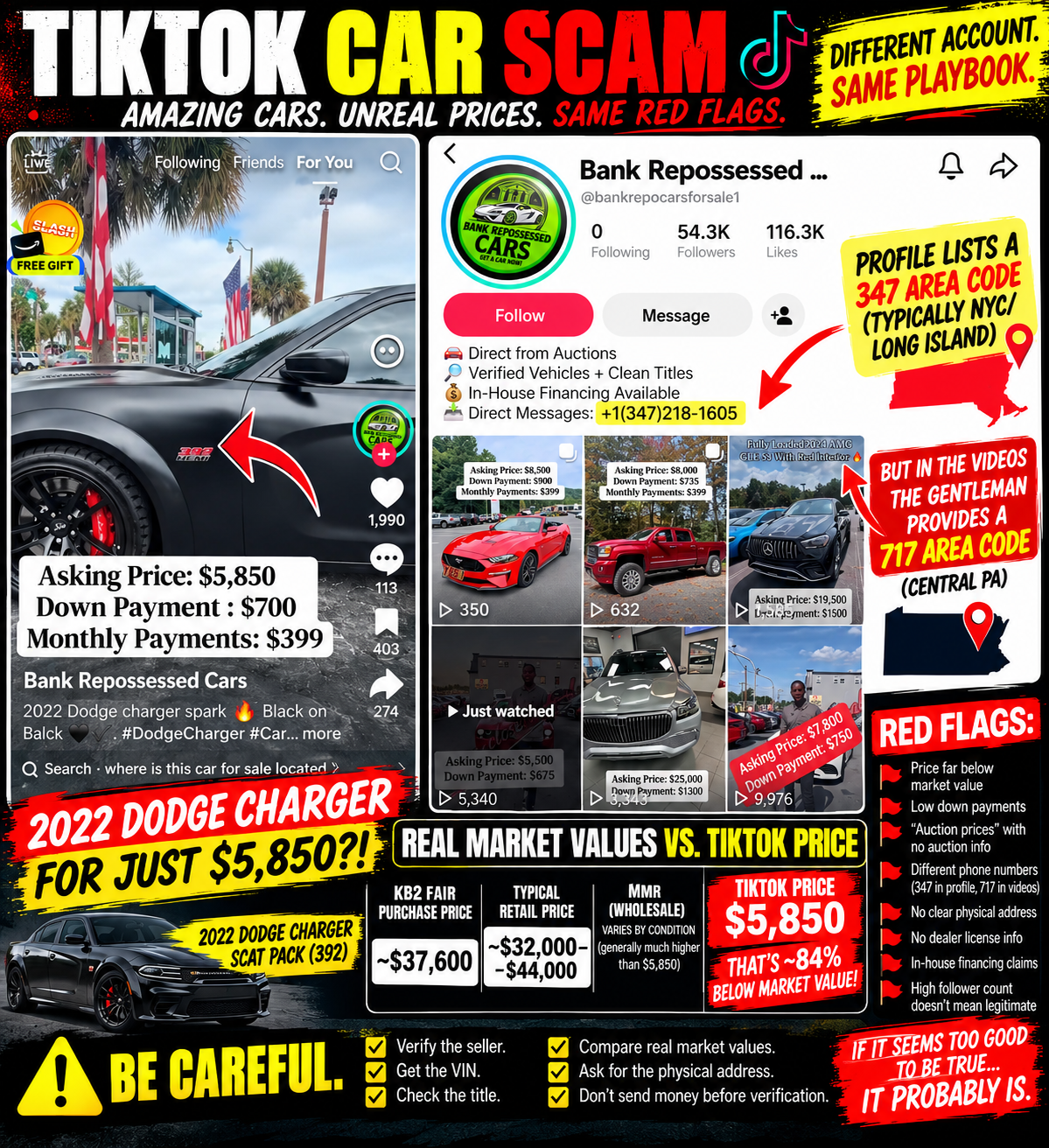
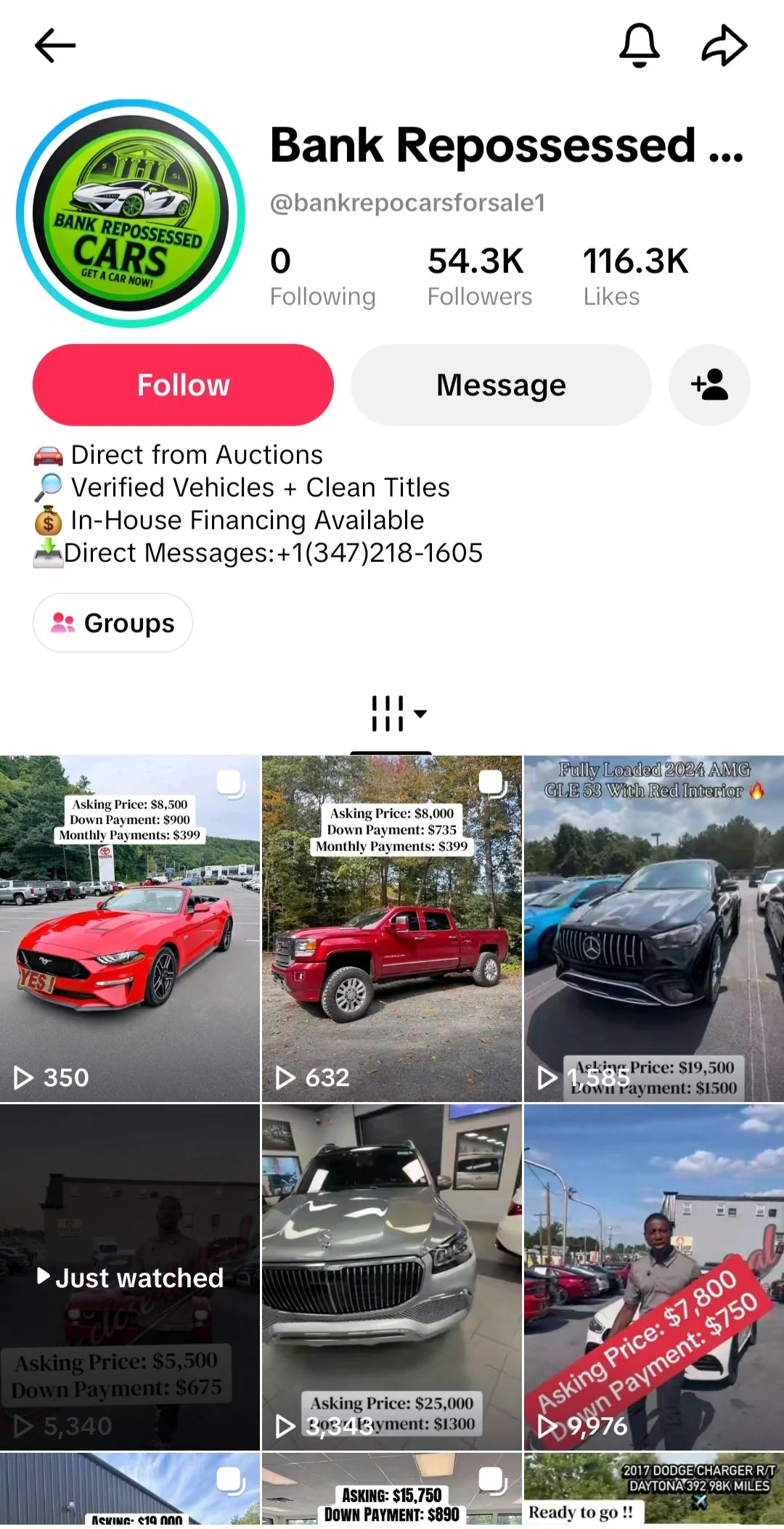
The latest account to appear in my feed calls itself “Bank Repossessed Cars” and uses the handle @bankrepocarsforsale1.
At the time of my screenshot, the account had:
54,300 followers.
116,300 likes.
That's substantially larger than several of the questionable car accounts I've written about before.
The profile says:
🚗 Direct from Auctions
🔎 Verified Vehicles + Clean Titles
💰 In-House Financing Available
And then there's a telephone number for direct messages:
+1 (347) 218-1605
Sounds impressive.
Then I started watching the videos.
And once again, I have questions.
🚗 Today's Deal: A 2022 Dodge Charger for $5,850
The video that caught my attention shows what is described as a 2022 Dodge Charger with the following offer:
Asking Price: $5,850
Down Payment: $700
Monthly Payments: $399
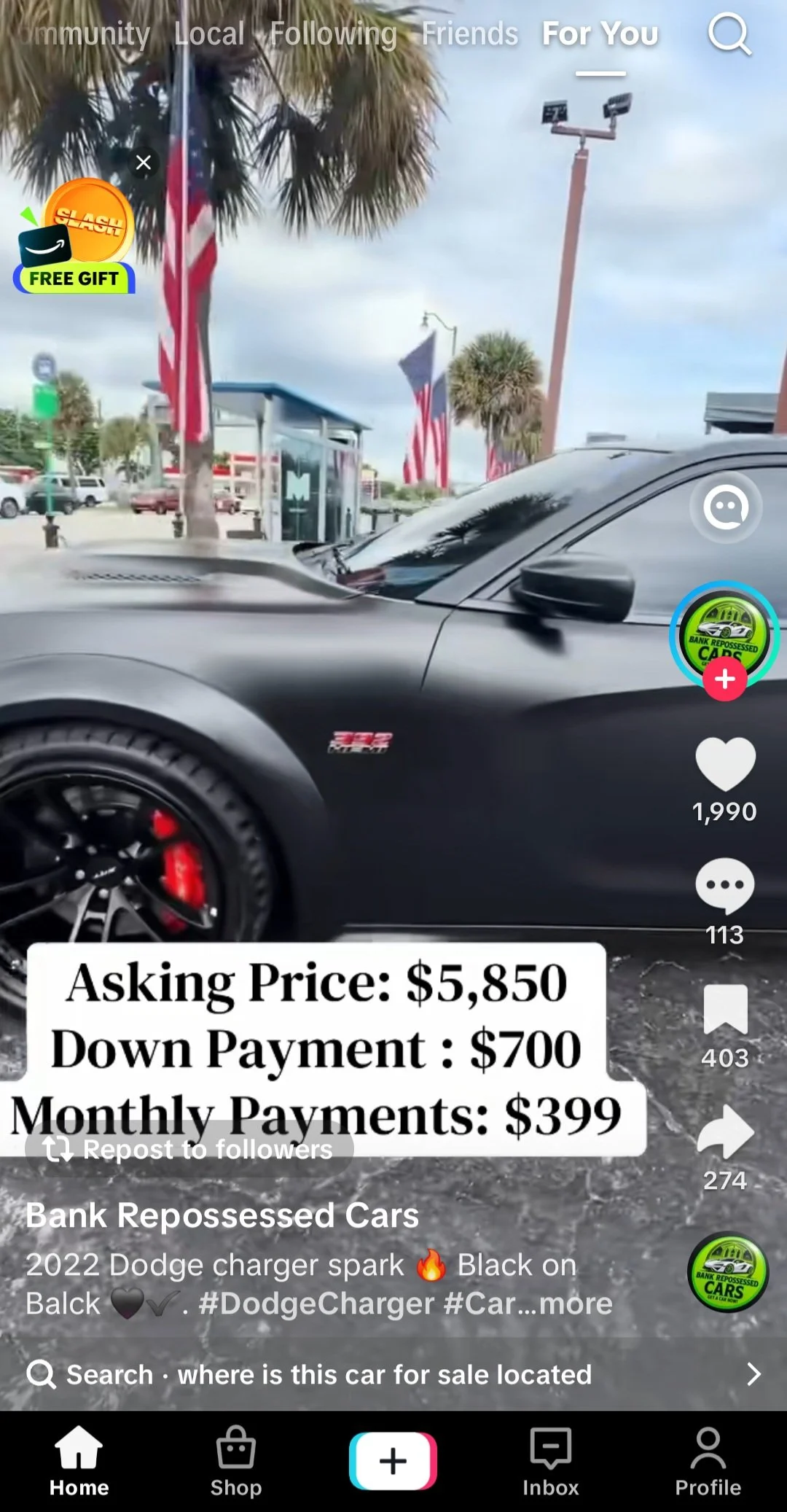
The caption describes it as a “2022 Dodge Charger spark”, although the vehicle shown appears to carry a 392 badge.
If this is actually a 2022 Charger Scat Pack/392, that $5,850 advertised price deserves a very close look.
Why?
Because the market numbers aren't even in the same neighborhood.
💰 Kelley Blue Book Says About $37,000 — Not $5,850
Kelley Blue Book currently puts the national Fair Purchase Price of a 2022 Dodge Charger Scat Pack around $37,600. KBB lists roughly $31,900 trade-in, $34,800 private-party, and $37,600 Fair Purchase Price for a good-condition example, while a Scat Pack Widebody is higher still at about $44,100 Fair Purchase Price. Exact values vary with mileage, condition, options, and location. Kbb.com
Edmunds tells a similar story: its current dealer-retail estimate for a regular 2022 Scat Pack ranges from roughly $32,300 in rough condition to $39,500 in outstanding condition. Edmunds
CARFAX's current listings put 2022 Charger Scat Packs at an average listing price of about $44,347, with its displayed range running roughly $36,747–$52,950. Carfax
TikTok?
$5,850.
That's roughly 84% below KBB's $37,600 Fair Purchase Price.
Maybe there's an explanation.
Fantastic.
I'd like to hear it.
🔨 But What About MMR and “Auction Prices”?
This account specifically promotes the vehicles as coming “Direct from Auctions.”
That's where the Manheim Market Report—or MMR—comes in.
MMR isn't the same thing as KBB retail value. Manheim describes MMR as a wholesale-market valuation based on actual vehicles sold through Manheim, with values that can be adjusted for factors such as odometer reading, selling region, condition grade and even color. Manheim
That's why I'm not going to invent an exact MMR for the Charger in this video.
I don't have its VIN.
I don't have verified mileage.
I don't have its condition report.
I don't have its auction location.
I don't have a current vehicle-specific Manheim report.
Without those things, saying, “The MMR is exactly $XX,XXX,” would be pretending to know something I don't.
But here's what we can compare.
KBB puts the Scat Pack's trade-in value around $31,900. JD Power estimates a trade-in base of around $31,250–$33,250, depending on condition. Those aren't MMR, but they're useful wholesale-side reference points. Kbb.com
So if this really is a clean-title 2022 Scat Pack being sold for $5,850, the question isn't simply:
“Is it cheaper because it came from an auction?”
The question is:
How did someone acquire a vehicle worth tens of thousands of dollars cheaply enough to retail it for $5,850?
“Auction” isn't a magic word that makes vehicle economics disappear.
📞 Then I Noticed the Phone Numbers
Here's where things became even more interesting.
The TikTok profile lists:
+1 (347) 218-1605
The 347 area code is associated with New York City, including the boroughs of Brooklyn, Queens, the Bronx and Staten Island. It's commonly encountered around the broader NYC/Long Island market, although an area code obviously doesn't establish where somebody currently lives or operates a business.
But I watched several of the account's videos.
The gentleman appearing in those videos provides a different telephone number—with a 717 area code.
The 717 area code serves south-central Pennsylvania, including Harrisburg, Lancaster, and York.
Again, people keep phone numbers after moving. Businesses can have multiple telephone numbers. VOIP numbers exist. None of this, by itself, proves anything improper.
But when I'm supposedly dealing with a business selling cars online, it's another question I'd want answered:
Why does the profile give me one phone number while the person in the videos gives me another?
And, more importantly:
What's the actual dealership?
Where is it physically located?
Which number belongs to that dealership?
Those should be remarkably easy questions for a legitimate automobile dealer to answer.
👀 And Look at the Rest of the Inventory
The Charger isn't alone.
The profile shows a Mustang advertised for:
$8,500 — $900 down — $399/month
A GMC pickup:
$8,000 — $735 down — $399/month
A Mercedes-AMG GLE 53 appears to be advertised around:
$19,500 — $1,500 down
Another vehicle:
$5,500 — $500 down
Another:
$7,800 — $750 down
There's even a vehicle shown around $25,000 with $1,300 down.
The scenery changes.
The dealerships and lots visible in the videos appear to change.
The vehicles range from ordinary transportation to expensive luxury and performance models.
Yet the formula remains remarkably familiar.
🚩 “Verified Vehicles + Clean Titles”
Great.
Verified by whom?
That's not sarcasm. That's an actual question I'd ask before buying.
If I'm buying one of these cars, give me the VIN.
Then I can verify the vehicle myself.
If it has a clean title, provide the documentation I need to confirm it independently.
If it came from an auction, tell me which auction.
If you're a licensed dealer, give me the legal business name, physical address, and dealer-license information.
If you're offering in-house financing, give me the written financing terms.
I don't need a green checkmark emoji.
I need documentation.
💳 $700 Down and $399 a Month — What's the Loan?
There's another mathematical problem worth examining.
The Charger is advertised at:
$5,850 purchase price
minus
$700 down
which leaves:
$5,150
If the payments really are $399 per month, $5,150 divided by $399 is only about 12.9 payments, before interest, taxes, fees, or anything else.
So what's the actual term?
What's the APR?
What's the amount financed?
What's the total of payments?
Who's extending the credit?
Are there additional fees?
If the actual vehicle costs $5,850, those should be straightforward questions.
If $5,850 isn't actually the total cash price, then I'd like to know what that number represents.
🚩 54,000 Followers Don't Answer Any of This
This account is bigger than many I've previously documented.
54,300 followers.
That's meaningful social proof.
Someone encountering the account might reasonably think:
They have 54,000 followers. They must be legitimate.
But we've been through this before.
Followers aren't a dealer license.
Likes aren't a title.
Views aren't a VIN.
A green checkmark emoji isn't vehicle verification.
And a real person standing beside a real automobile doesn't establish that the TikTok account displaying the footage owns that automobile or is authorized to sell it under the advertised terms.
🚗 A Real Car Still Doesn't Automatically Make the Offer Real
This has become a recurring theme in this series.
Some of these videos clearly contain actual cars.
Some appear to have been filmed at actual dealerships.
There are real salespeople.
Real parking lots.
Real transporters.
Real dealership signs.
That's persuasive imagery.
But the question isn't:
“Does the car in this video exist?”
It's:
“Does this TikTok account own or have authority to sell this exact vehicle for this exact price under these exact terms?”
Those are very different questions.
I'm not claiming the footage on this account was copied from somewhere else. I haven't established that.
But before sending a $700 deposit, I'd want to establish where the footage came from and whether the seller I'm communicating with is actually connected to that vehicle.
🏡 Be Careful — and Be a Good Neighbor
This is the part that matters most.
Imagine someone who has terrible credit.
Their car just died.
They need transportation Monday morning, or they risk losing their job.
Traditional dealerships have turned them down.
Then TikTok serves them:
2022 Dodge Charger
$5,850
$700 down
$399/month
In-house financing available
That doesn't necessarily look suspicious to someone in that situation.
It looks like hope.
That's why, if somebody you know is considering one of these deals, don't ridicule them.
Help them investigate.
Before sending money, get the VIN. Verify the title. Find the dealership's legal name and physical address independently. Verify the dealer license with the appropriate state regulator. Call a publicly listed number—not simply the number supplied in a TikTok profile. Get the complete financing agreement. Have the vehicle independently inspected. And compare the asking price with retail and realistic wholesale values.
If the seller won't let you do those things before sending a deposit?
Keep your $700.
Different Account. Same Questions.
I'm seeing this pattern often enough that I can practically write the checklist before opening the profile.
Extremely inexpensive desirable car.
Small down payment.
Low monthly payment.
“Direct from auction.”
“Clean title.”
“In-house financing.”
Private messages.
Phone numbers that raise additional questions.
And prices that appear wildly disconnected from ordinary retail values.
Maybe this account has a perfectly reasonable explanation for it all.
I'd be interested in hearing it.
Because based on the screenshot, a $5,850 2022 Charger that appears to be a 392, compared with a KBB Fair Purchase Price around $37,600 for a Scat Pack, is one heck of an explanation. Kbb.com
Until then:
Be careful. Verify everything. And don't let a $700 down payment make a $30,000 question disappear.
Follow the continuing series at NielFlamm.com/blog.