
Donna Woods Has My Number. Let the Games Begin.

I showed up at the skilled nursing facility around 3 p.m., bringing Mom the lunch from Somerby.
I hadn’t eaten all day. Mom and I had food to try, and I was ready to sit down and share it with her.
But first, someone had one final piece of business before leaving.
The Donna Woods.
She wanted my phone number or Mom’s phone number. If you read my previous post, you know I had been gently campaigning for Mom’s.
Negotiations had apparently reopened.
Donna initially wanted me to follow her to her room so she could get her phone.
I made a decision: I was staying with Mom and the food. I was hungry, and sharing that meal with her was more important to me than making a trip down the hall.
So I asked Donna for her number instead.
She gave it to me, and I called her.
And just like that, my carefully considered plan to avoid giving Donna my number was defeated.
By me.
Then I asked, “Donna Woods! Do you do the text?”
She said yes
So I texted her, too.
Apparently, I wasn’t satisfied with opening one line of communication. I needed to confirm that the entire system was operational.
Calls? Connected.
Texts? Delivered.
Boundaries? Undergoing a brief internal review.
This is the same Donna Woods who can cover Pensacola, bacon, pets, prosthetics, and hot tea before I’ve finished forming a follow-up question. The woman who gathers people for Coffee Chats, greets the nurses,
es, and somehow found time to approve my light blue Hokas with pink laces.
She now has a direct line.
I can already imagine looking at my phone, seeing “Donna Woods,” and wondering whether I have enough battery for the full update.
-But I’m also glad we exchanged numbers.
She made a point of stopping before she left. She wanted to stay connected with people she had met, and Mom and I were among them.
I’ve spent these visits writing about making time for people. Donna has been doing her part to make sure we have the opportunity.
I could stay with Mom, share lunch, and still help Donna leave with a way to reach us. It turned out to be a pretty simple solution, despite my earlier attempts to protect myself from unlimited conversational access.
Now the question is: what’s the over/under on calls and texts for the rest of the week?
And does one story sent across seventeen separate texts count as one message or seventeen?
I need the rules established before the first update from Pensacola.

Donna Woods Has My Number. Let the Games Begin.

I showed up at the skilled nursing facility around 3 p.m., bringing Mom the lunch from Somerby.
I hadn’t eaten all day. Mom and I had food to try, and I was ready to sit down and share it with her.
But first, someone had one final piece of business before leaving.
The Donna Woods.
She wanted my phone number or Mom’s phone number. If you read my previous post, you know I had been gently campaigning for Mom’s.
Negotiations had apparently reopened.
Donna initially wanted me to follow her to her room so she could get her phone.
I decided: I was staying with Mom and the food. I was hungry, and sharing that meal with her was more important to me than making a trip down the hall.
So I asked Donna for her number instead.
She gave it to me, and I called her.
And just like that, my carefully considered plan to avoid giving Donna my number was defeated.
By me.
Then I asked, “Donna Woods! Do you do the text?”
She said yes.
So I sent her a text, too.
Apparently, I wasn’t satisfied with opening one line of communication. I needed to confirm that the entire system was operational.
Calls? Connected.
Texts? Delivered.
Boundaries? Undergoing a brief internal review.
This is the same Donna Woods who can cover Pensacola, bacon, pets, prosthetics, and hot tea before I’ve finished forming a follow-up question. The woman who gathers people for Coffee Chats, greets the nurses, and somehow found time to approve my light blue Hokas with pink laces.
She now has a direct line.
I can already imagine looking at my phone, seeing “Donna Woods,” and wondering whether I have enough battery for the full update.
But I’m also glad we exchanged numbers.
She made a point of stopping before she left. She wanted to stay connected with people she had met, and Mom and I were among them.
I’ve spent these visits writing about making time for people. Donna has been doing her part to make sure we have the opportunity.
I could stay with Mom, share lunch, and still help Donna leave with a way to reach us. It turned out to be a pretty simple solution, despite my earlier attempts to protect myself from unlimited conversational access.
Now the question is: what’s the over/under on calls and texts for the rest of the week?
And does one story sent across seventeen separate texts count as one message or seventeen?
I need the rules established before the first update from Pensacola.
My First Assisted Living Tour—and a Mom-Approved Dinner
Today was a full day.
I started with a 10:15 a.m. cardiology appointment and left with some action items of my own. Taking care of Mom doesn’t take my health off the calendar.
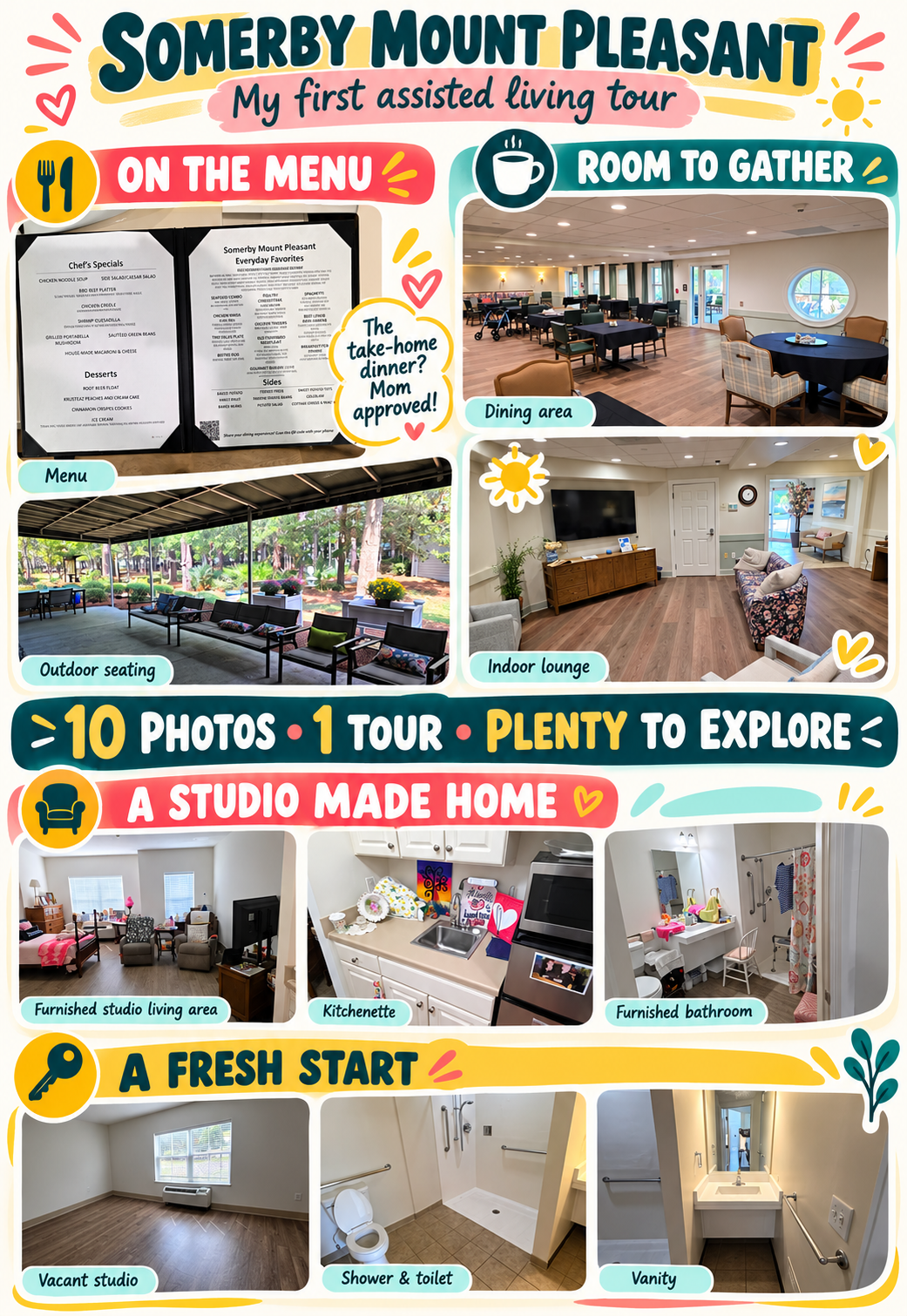
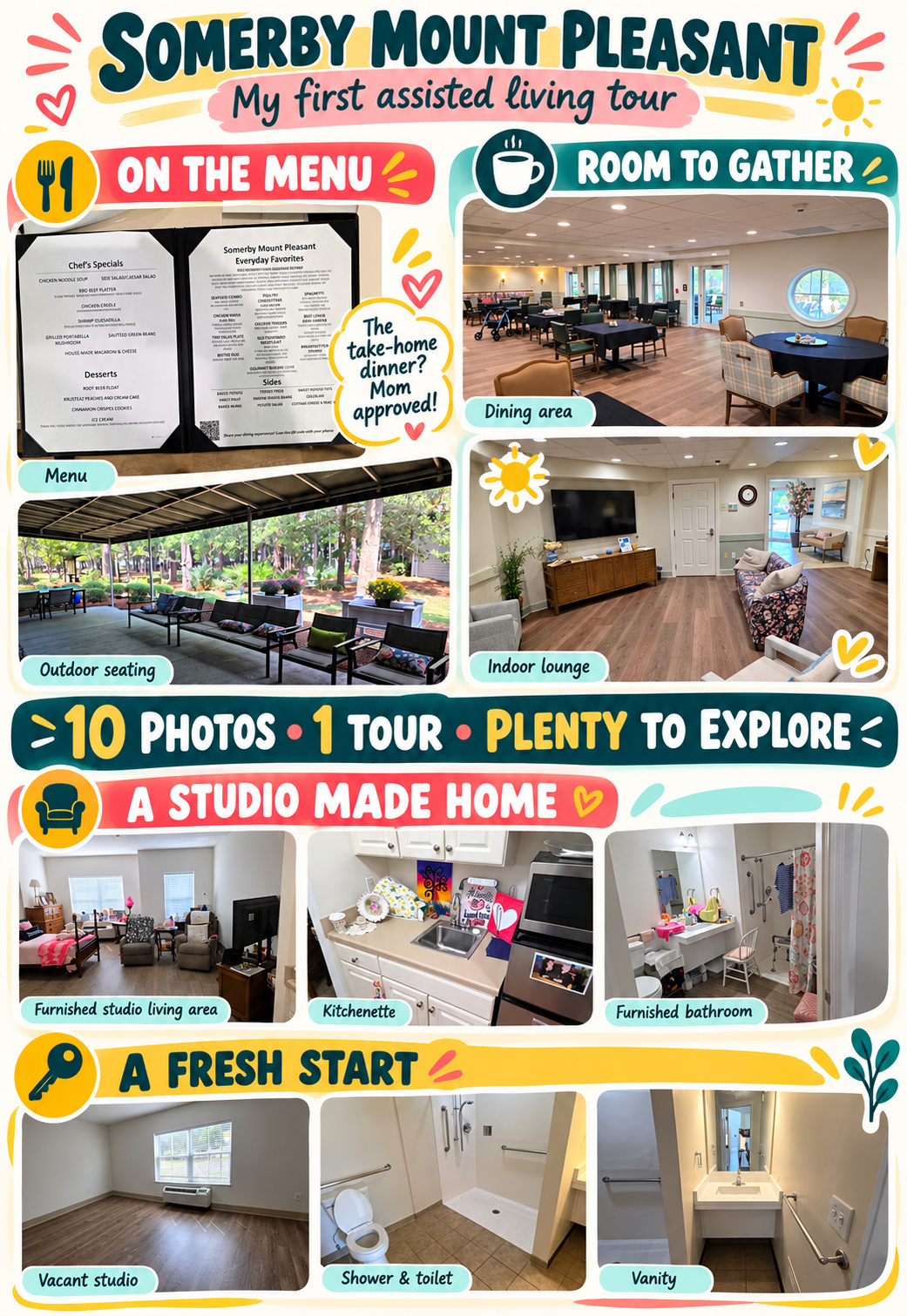
Then I went to an afternoon recovery meeting before heading to Somerby in Mount Pleasant for my first assisted living tour.
I’ve been scheduling these visits, thinking through questions, and trying to understand what the next step could look like for Mom. Today, I got to walk through a place and start putting that information into context.
There was a lot to take in.
We discussed what Mom would need to qualify for assisted living, what’s included in the residence, activities, security, and more. I’m learning how much there is to understand beyond whether a room looks nice.
I want to know how the place would work for her day-to-day. What would she have access to? What could she participate in? Would it feel like somewhere she could settle in and enjoy herself?
I saw lounges, dining and activity spaces, coffee areas, and outdoor spaces. Walking through helped me picture where Mom might spend time beyond her own room.
I also asked whether I could take pictures and made a point of saying I wouldn’t include residents. This is their home. I wanted to document the spaces while respecting the privacy of the people living there.
Then came the part of the tour I had been particularly interested in.
The food.
If you’ve been following along, you know I’ve been requesting tastings. Choosing somewhere Mom might eat every day deserves a little investigation. A brochure can describe dinner beautifully, but Mom has never eaten a brochure.
I left with two to-go boxes.
One had a fish combination with shrimp and flounder, a baked potato, and sautéed green beans. The other had a shrimp quesadilla. There were also two green salads, tartar sauce, fruit salad, and two peach cake desserts.
I had arrived for information and left carrying dinner. This is a meeting format I can support.
Of course, my opinion was only part of the process. The food needed to make it to Mom.
And it was Mom-approved.
If you're following her recent reviews of hospital and facility meals, you know this is meaningful news. We have encountered wraps that did not survive the review process.
This meal got her approval. I was glad to bring her something she enjoyed—and to have her take part in this step toward a possible next home.
One tour and one meal are a beginning. I still have information to work through and more to learn about what will fit her needs.
But I left this first visit with a clearer understanding of assisted living, a lot to think about, and something concrete to share with Mom.
After a day of my own medical responsibilities, recovery, and planning for her care, it felt good to have a simple, positive moment.
Mom liked dinner.
I’ll take that win—with a side of peach cake.

Nextdoor’s Good Neighbor Awards Get the Spirit Right. I Still Have Questions About the Selection Process.

Nextdoor is highlighting the honorees from its 2026 Good Neighbor Day program, and I want to start somewhere that may surprise people who have followed my ongoing Nextdoor posts:
Bravo. Seriously.
Nextdoor says it received more than 1,300 nominations and ultimately selected five honorees from different regions of the country. The stories are exactly the kinds of things I think deserve recognition: cooking meals for neighbors, helping someone recover after hospitalization, maintaining a neighbor's property during a difficult time, and years of service to a community. Nextdoor Blog
I love this stuff.
Being of Service Matters to Me
Being of service is an important part of my own recovery program.
Help somebody.
Extend my hand.
Be available when somebody needs me.
Do something for another person without constantly calculating what I'll get in return.
That's why I genuinely enjoy reading about these neighbors.
And I'll give Nextdoor additional credit for something else: the stories largely allow the neighbors' actions to stand on their own.
They're not simply commercials screaming, LOOK WHAT NEXTDOOR DID!
The people did these things.
The people deserve the recognition.
That's how it should be.
But Here Comes Niel With Another Question
I know. Shocking. 😂
Nextdoor has provided more information about the process than it did when I first started asking about the program.
The original nomination announcement said a committee of Nextdoor employees would select winners, with one winner per region. It said a panel would review the strongest nominations and score them based on how specific, sustained, and impactful the stories were. Nextdoor Blog
The final announcement provides a little more detail. Nextdoor says it scored nominations using a consistent rubric and reviewed them with Nextdoor employees. They selected the five honorees based on how specific and lasting the acts were and the difference they made. Nextdoor Blog
That's useful information.
But I still have questions.
Who was on the committee?
What roles did they hold at Nextdoor?
How were committee members selected?
What qualifications or experience did they bring to evaluating the nominations?
What did the scoring rubric actually look like?
Were nominations scored independently by multiple people?
Were scores averaged?
Did committee members discuss finalists and reach consensus?
Could someone recuse themselves if they knew a nominee?
Were there conflict-of-interest rules?
How did Nextdoor get from 1,300+ nominations to five people?
Those aren't accusations.
They're questions about process.
Even Reality Television Shows Us the Judges
Think about it.
American Idol doesn't tell viewers, “A committee listened to everybody. Trust us.”
We know who the judges are.
Dancing With the Stars doesn't hide the judging panel behind the ballroom curtain.
We see the judges. We see scores. We understand that there is a process.
Even competition programs built primarily for entertainment recognize that when people are being evaluated, the credibility of the process matters alongside the outcome.
I'm not suggesting Nextdoor needs Ryan Seacrest standing next to a giant scoreboard while an employee holds up a 9.5 for snow shoveling.
Although I'd probably watch that. 😂
I'm saying transparency makes recognition more credible.
Who Judges the Judges?
Here's the uncomfortable hypothetical.
Suppose someone selecting recipients of a community-service award had previously been convicted of embezzling money from a charity or employer.
Would that automatically mean that person couldn't recognize a good deed?
No.
But wouldn't people reasonably want to know who was making the decision?
I'd certainly want to know.
That's why an awards committee's identities, relevant qualifications, and conflict-of-interest standards can matter.
I'm not suggesting anyone on Nextdoor's committee has that kind of history. I don't know who the committee members were—that's precisely the point.
If Nextdoor wants people to trust a selection process, giving people enough information to understand that process would strengthen it.
Nextdoor Is Actually Close Here
This may be one of the stranger conclusions in my continuing Nextdoor case study:
I think Nextdoor got a lot right.
More than 1,300 neighbors apparently took the time to recognize someone else. Nextdoor Blog
Nextdoor established criteria.
It divided recognition geographically.
It published descriptions of how the honorees helped others.
It disclosed that employees participated in the selection.
And, most importantly to me, it largely kept the spotlight on the people actually doing the work.
That's good.
My issue is that Nextdoor stops just short of the transparency I'd like to see.
It tells us there was a committee.
Great. Who was on it?
It tells us there was a rubric.
Great. Show us the rubric.
It tells us nominations were scored.
Great. Explain how.
It tells us five people emerged from more than 1,300 nominations.
Great. Show us how the process got from Point A to Point B.
This Is Becoming a Familiar Theme
That question fits rather neatly into what I've been writing about Nextdoor under CEO Nirav Tolia for months.
Research methodology.
Detailed Insights data.
Communication.
Moderation.
Metrics.
Awards.
Again and again, I find myself arriving at essentially the same place:
Show us the process.
That's where I think Nextdoor's leadership continues to leave an opportunity on the table.
Transparency doesn't diminish these awards.
It could make them stronger.
Publish the committee.
Publish the rubric.
Explain the scoring and consensus process.
Explain conflict-of-interest safeguards.
Then get out of the way and let these neighbors enjoy the recognition they've earned.
Because on the most important part of this story, I have no complaints at all.
People helping other people deserve a spotlight.
As someone whose own recovery reminds me of the importance of extending a hand and serving others, I celebrate every one of them.
Bravo to the neighbors.
Now, Nextdoor, show us how you chose them.
👉 Read my continuing Nextdoor case study at NielFlamm.com/blog

Apparently, the Scammers Still Haven’t Started Writing Emails
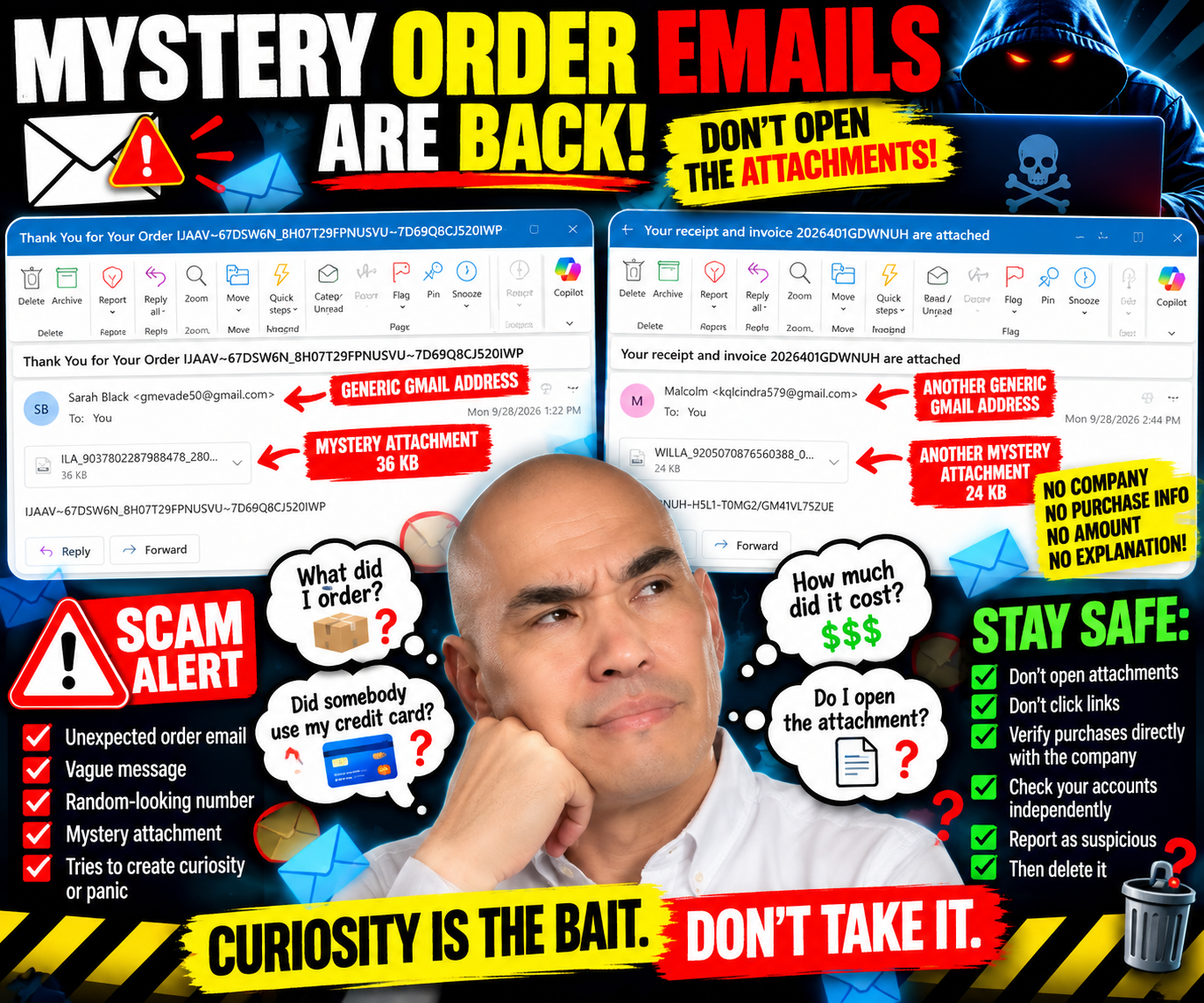
Just when I thought the mystery-order-email department might have run out of ideas, two more showed up.
Apparently, writing an actual email is still too much work.
No company introduction. No explanation of what I supposedly purchased. No recognizable merchant. No dollar amount. No useful order details.
Just a mysterious attachment and the digital equivalent of:
“You bought something. Trust me. Open this.”
Yeah, I’ll get right on that.
Mystery Order #1: Thank You for…Whatever I Ordered
The first email arrived with this rather catchy subject line:
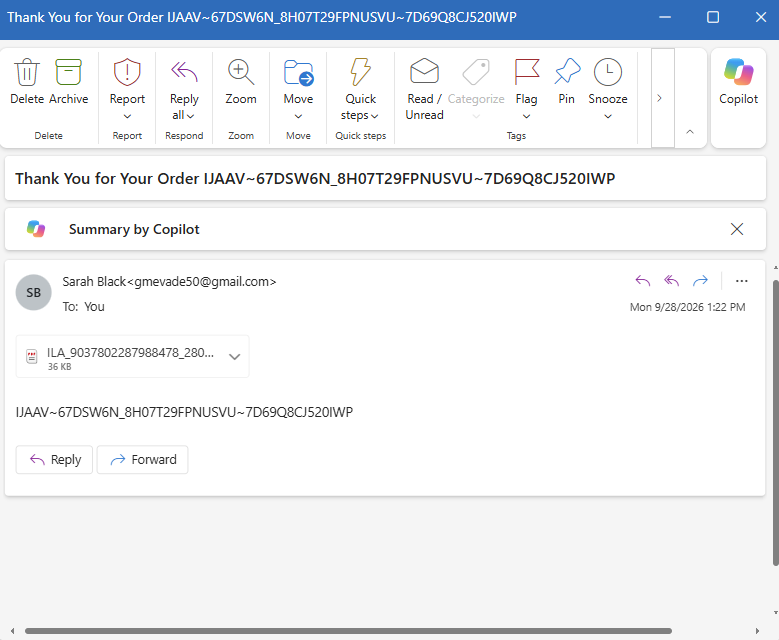
“Thank You for Your Order IJAAV~67DSW6N_8H07T29FPNUSVU~7D69Q8CJ520IWP”
Well, that certainly clears things up.
It came from someone named Sarah Black, using a Gmail address.
Inside the email?
Almost nothing.
There's another long collection of letters and numbers and a 36 KB attachment.
That's it.
No store.
No product.
No purchase price.
No credit card information.
No shipping address.
No customer-service information.
Nothing explaining what this alleged order actually is.
To see what I bought, I need to open the attachment.
Nope.
Mystery Order #2 Arrives the Next Day
Then another one arrived.
This time the subject was:
“Your receipt and invoice 2026401GDWNUH are attached”
Now we're getting fancy.
We've upgraded from a mysterious “order” to a mysterious receipt AND invoice.
This one came from someone named Malcolm, also using a Gmail address.
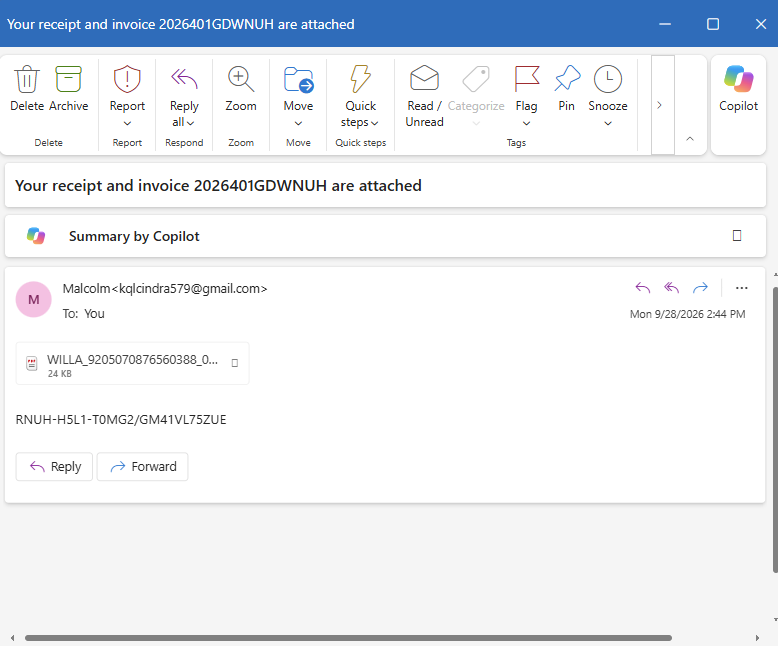
The body of the email contains another random-looking code:
RNUH-H5L1-I0MG2/GM41VL75ZUE
And, naturally, there's another attachment—this one is 24 KB.
Again, the message doesn’t identify a recognizable business.
No explanation of what I purchased.
No price.
No payment information.
No description.
Just an attachment.
🚩 The Attachment Is Still the Email
I've written about this before, and apparently somebody out there wants to provide me with additional examples.
These messages aren't really trying to communicate anything useful.
The attachment is the email.
Everything surrounding it seems designed to create just enough curiosity or concern to make me open it.
Maybe my first reaction is:
What did I order?
Then:
Did somebody use my credit card?
Then:
How much did they charge me?
And finally:
I’d better open this invoice and find out.
That's precisely the reaction I don't want to have.
If I don't recognize a purchase, my first move isn't to open a mystery attachment from an unfamiliar Gmail account.
I'm going directly to my bank, credit-card company, retailer account, or whatever legitimate service supposedly processed the transaction.
Curiosity Can Be the Bait
I haven't opened either attachment, so I don't know what's inside them.
I can't claim they're malware without examining them.
And that's really the point.
I don't need to know what's inside.
Neither message gives me a reason to take that risk.
If I really made a purchase, I can verify it independently.
If there's an unauthorized charge, I can see it through my financial institution.
If a legitimate company needs to contact me about an order, I can go directly to that company's website or app rather than following instructions contained in an unsolicited email.
Opening a mystery file shouldn't cost me to find out whether I supposedly spent money.
Two Emails, Same Basic Formula
These arrived on consecutive days from different Gmail addresses with different names, different order numbers, and different attachments.
But look at the structure:
Unexpected purchase notification → vague message → meaningless-looking number → attachment → curiosity.
That's what catches my attention.
They don't need me to believe the email for very long.
They need me to think:
“What the heck did I buy?”
…and click.
Don't Let the Email Create the Emergency
That's another lesson I've learned from documenting these messages.
A suspicious email shouldn't create a problem and then dictate how I investigate it.
If an email tells me there's an order I don't recognize, I'll check my accounts independently.
If it says there's a PayPal charge, I'll log in to PayPal independently.
If it says there's a credit-card transaction, I'll check that card myself.
If it claims there's an Amazon order, I'll open Amazon myself.
I don't need the mystery attachment.
Be a Good Neighbor
These emails may look ridiculous to someone who's seen hundreds of them.
Not everyone has.
Someone else might see “Thank You for Your Order” and immediately panic.
Maybe they're worried someone stole their credit card.
Maybe they're afraid hundreds of dollars just disappeared from their checking account.
Maybe they can't remember whether they ordered something.
That's when it's worth saying:
Don't open the attachment yet. Let's verify the supposed purchase another way.
Help someone check the real account.
Show them how to inspect the sender.
Explain why an unexpected attachment deserves caution.
Report suspicious messages.
Then delete them.
Because apparently the scammers still haven't started writing emails.
But they certainly haven't stopped sending attachments.