

The PayPal Scam That Apparently Scheduled Its Own Reminder on My Phone
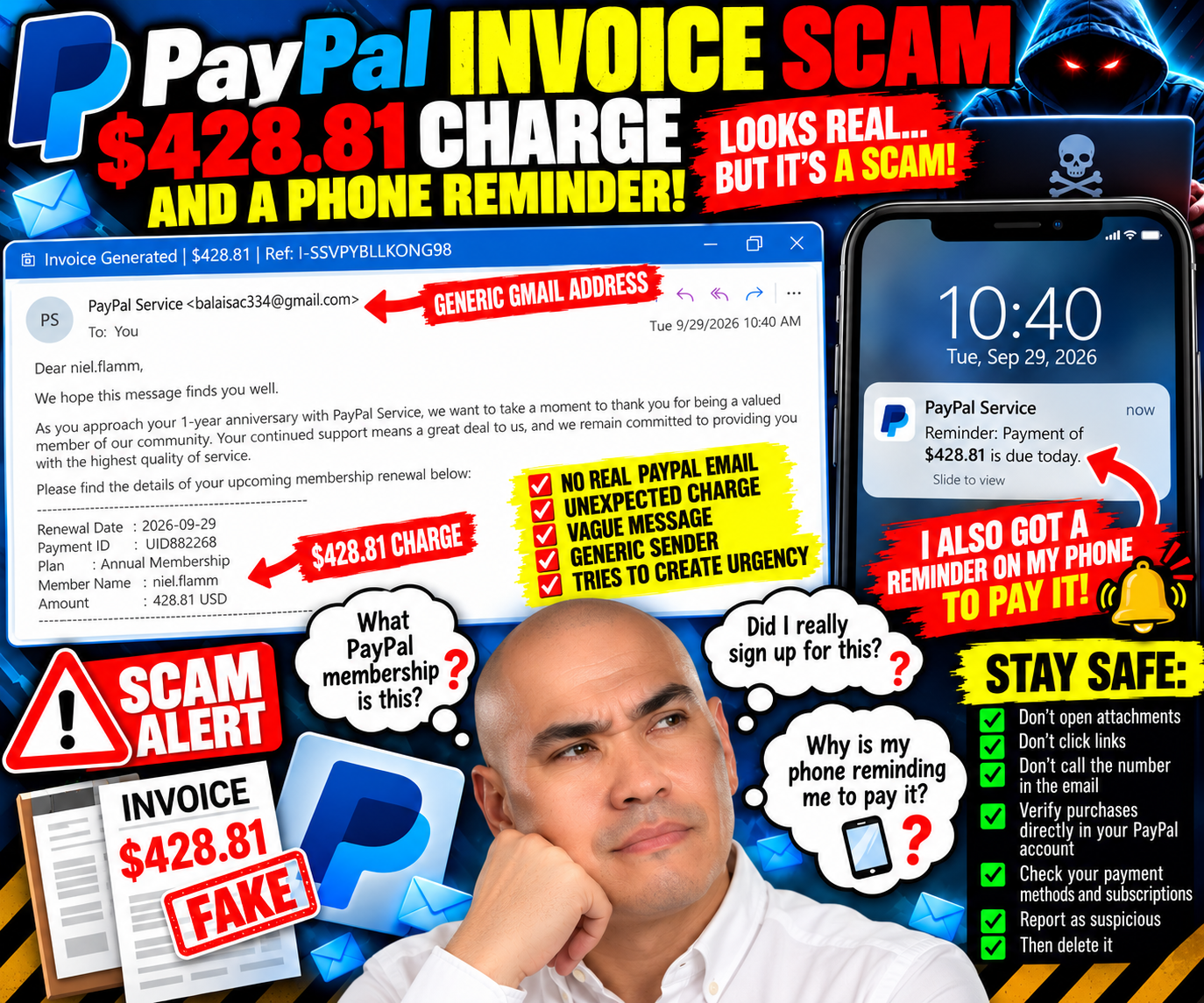
The scammers are getting ambitious.
Lately, I’ve been getting mystery order emails with almost no information. Apparently, somebody decided those weren't convincing enough.
This time, I received what looks like a much more complete invoice.
And then something happened that made this one especially interesting:
I also got a reminder on my phone telling me to pay it.
That will get my attention.
Apparently, I Have a $428.81 “PayPal Service” Membership
The subject line reads:
“Invoice Generated | $428.81 | Ref: I-SSVPYBLLKONG98”
Right away, the email gives me something the previous mystery emails didn't: a specific dollar amount.
$428.81.
The sender's display name says “PayPal Service.”
Sounds official.
Except the actual email address shown next to it is:
There's my first rather large red flag.
If someone is going to impersonate a major financial company, using a random Gmail account while displaying “PayPal Service” isn't exactly subtle.
Happy Anniversary to Me!
According to the email, I'm approaching my one-year anniversary with “PayPal Service.”
How thoughtful.
It thanks me for being a “valued member” and tells me about my upcoming membership renewal.
The supposed details include:
Renewal Date: September 29, 2026
Plan: Annual Membership
Member Name: niel.flamm
Amount: $428.81 USD
The message claims the membership will automatically renew using my saved payment method.
There's just one little problem:
What PayPal annual membership?
That question matters more to me than the email's professional appearance.
🚩 Then Comes the Phone Number
The message tells me that if I want to update my billing information, change my plan, or ask questions, I should call:
1 (816) 372-4805
And there it is.
The email creates the problem:
You're about to be charged $428.81!
Then it conveniently provides the solution:
Call us!
That's exactly when I don't call the number in the email.
If I were concerned about an actual PayPal transaction, I'd open PayPal independently—not use contact information supplied by the message that created the emergency.
But This One Had an Extra Trick
What really got my attention wasn't just the email.
I also got a reminder on my phone to pay it.
That makes the experience considerably more convincing.
Now I'm not simply looking at an unsolicited email.
My phone is also reminding me about the supposed payment.
For a moment, that can create an entirely different psychological reaction:
Wait. Did I actually schedule this?
Did I forget about something?
Did my phone pull this from somewhere legitimate?
That's precisely why I found this one worth documenting.
A reminder appearing on my phone doesn't independently authenticate the underlying invoice. Depending on the phone, email, calendar, assistant, and account settings involved, information from messages can sometimes surface elsewhere automatically.
The reminder made the claim feel more legitimate.
It didn't make the sender's Gmail address disappear.
This Is Why I Look at the Actual Sender
A familiar logo can be copied.
A company name can be typed into an email.
“PayPal Service” can appear as a display name.
A professional-looking invoice number can be invented.
An amount like $428.81 feels specific enough to seem real.
Even a reminder appearing on my phone can make the situation feel more urgent.
But I keep coming back to the basics.
Who actually sent this?
In this case, the screenshot shows:
PayPal Service balaisac334@gmail.com
That's enough for me to stop interacting with the message and verify everything independently.
The Weird Details Keep Coming
Other things make me skeptical.
The email refers repeatedly to “PayPal Service” as though I'm paying for an annual membership.
There's also some mangled text:
“we’re here to help.”
Then the signature lists:
PayPal Service
12014 Copernicus Ave
Bakersfield Ca 93312 Usa
Again, you don't need to investigate those details through the email itself.
That's an important distinction.
I don't have to prove every element is fake before deciding not to trust an unsolicited message.
I can independently verify the account that is said to owe the money.
Don't Let a $428.81 Charge Create Panic
This type of message depends on urgency.
Four hundred twenty-eight dollars and eighty-one cents isn't pocket change.
Someone sees that amount and thinks:
Please stop this charge now.
That's when judgment can disappear.
Instead, I'd do the boring thing.
Open PayPal independently.
Check my activity.
Check automatic payments and subscriptions.
Check the payment methods attached to the account.
If necessary, contact PayPal using contact information obtained independently from PayPal—not the telephone number in the suspicious email.
If the $428.81 transaction isn't there, I'm certainly not going to call a stranger and give them account information so they can “cancel” it.
The Phone Reminder Is the Best Part of This One
Not because it's funny—although something is amusing about a suspicious invoice apparently getting promoted to my personal to-do list.
It matters because it shows how context can influence trust.
An email alone?
Suspicious.
An email plus a phone reminder?
Suddenly my brain gets another signal suggesting that maybe this is something I previously knew about.
That's when I have to separate familiarity from verification.
My phone displaying information doesn't prove it’s legitimate.
A professional-looking invoice doesn't prove it's legitimate.
The exact amount doesn't prove it's legitimate.
The reference number doesn't prove it's legitimate.
And putting “PayPal Service” next to a Gmail address certainly doesn't prove it's PayPal.
Be a Good Neighbor
This is another one worth showing to someone who isn't as comfortable spotting suspicious messages.
Don't just tell them:
“That's obviously fake.”
Show them why you're suspicious.
Point to the sender address.
Ask whether they actually have the membership being described.
Show them how to open the real company's app or website on their own.
Explain why they shouldn't call the telephone number supplied by the same message claiming there's a problem.
And if their phone generates a reminder from the message, explain something else:
A reminder is a reminder. It isn't authentication.
The scammers don't need everybody to believe their story.
They need one person to see $428.81, panic, and make that phone call.
As for my alleged PayPal Service anniversary?
I don't think I'll be celebrating.
I won’t be sending a card.
Donna Woods Has My Number. Let the Games Begin.

I showed up at the skilled nursing facility around 3 p.m., bringing Mom the lunch from Somerby.
I hadn’t eaten all day. Mom and I had food to try, and I was ready to sit down and share it with her.
But first, someone had one final piece of business before leaving.
The Donna Woods.
She wanted my phone number or Mom’s phone number. If you read my previous post, you know I had been gently campaigning for Mom’s.
Negotiations had apparently reopened.
Donna initially wanted me to follow her to her room so she could get her phone.
I made a decision: I was staying with Mom and the food. I was hungry, and sharing that meal with her was more important to me than making a trip down the hall.
So I asked Donna for her number instead.
She gave it to me, and I called her.
And just like that, my carefully considered plan to avoid giving Donna my number was defeated.
By me.
Then I asked, “Donna Woods! Do you do the text?”
She said yes
So I texted her, too.
Apparently, I wasn’t satisfied with opening one line of communication. I needed to confirm that the entire system was operational.
Calls? Connected.
Texts? Delivered.
Boundaries? Undergoing a brief internal review.
This is the same Donna Woods who can cover Pensacola, bacon, pets, prosthetics, and hot tea before I’ve finished forming a follow-up question. The woman who gathers people for Coffee Chats, greets the nurses,
es, and somehow found time to approve my light blue Hokas with pink laces.
She now has a direct line.
I can already imagine looking at my phone, seeing “Donna Woods,” and wondering whether I have enough battery for the full update.
-But I’m also glad we exchanged numbers.
She made a point of stopping before she left. She wanted to stay connected with people she had met, and Mom and I were among them.
I’ve spent these visits writing about making time for people. Donna has been doing her part to make sure we have the opportunity.
I could stay with Mom, share lunch, and still help Donna leave with a way to reach us. It turned out to be a pretty simple solution, despite my earlier attempts to protect myself from unlimited conversational access.
Now the question is: what’s the over/under on calls and texts for the rest of the week?
And does one story sent across seventeen separate texts count as one message or seventeen?
I need the rules established before the first update from Pensacola.

Donna Woods Has My Number. Let the Games Begin.

I showed up at the skilled nursing facility around 3 p.m., bringing Mom the lunch from Somerby.
I hadn’t eaten all day. Mom and I had food to try, and I was ready to sit down and share it with her.
But first, someone had one final piece of business before leaving.
The Donna Woods.
She wanted my phone number or Mom’s phone number. If you read my previous post, you know I had been gently campaigning for Mom’s.
Negotiations had apparently reopened.
Donna initially wanted me to follow her to her room so she could get her phone.
I decided: I was staying with Mom and the food. I was hungry, and sharing that meal with her was more important to me than making a trip down the hall.
So I asked Donna for her number instead.
She gave it to me, and I called her.
And just like that, my carefully considered plan to avoid giving Donna my number was defeated.
By me.
Then I asked, “Donna Woods! Do you do the text?”
She said yes.
So I sent her a text, too.
Apparently, I wasn’t satisfied with opening one line of communication. I needed to confirm that the entire system was operational.
Calls? Connected.
Texts? Delivered.
Boundaries? Undergoing a brief internal review.
This is the same Donna Woods who can cover Pensacola, bacon, pets, prosthetics, and hot tea before I’ve finished forming a follow-up question. The woman who gathers people for Coffee Chats, greets the nurses, and somehow found time to approve my light blue Hokas with pink laces.
She now has a direct line.
I can already imagine looking at my phone, seeing “Donna Woods,” and wondering whether I have enough battery for the full update.
But I’m also glad we exchanged numbers.
She made a point of stopping before she left. She wanted to stay connected with people she had met, and Mom and I were among them.
I’ve spent these visits writing about making time for people. Donna has been doing her part to make sure we have the opportunity.
I could stay with Mom, share lunch, and still help Donna leave with a way to reach us. It turned out to be a pretty simple solution, despite my earlier attempts to protect myself from unlimited conversational access.
Now the question is: what’s the over/under on calls and texts for the rest of the week?
And does one story sent across seventeen separate texts count as one message or seventeen?
I need the rules established before the first update from Pensacola.
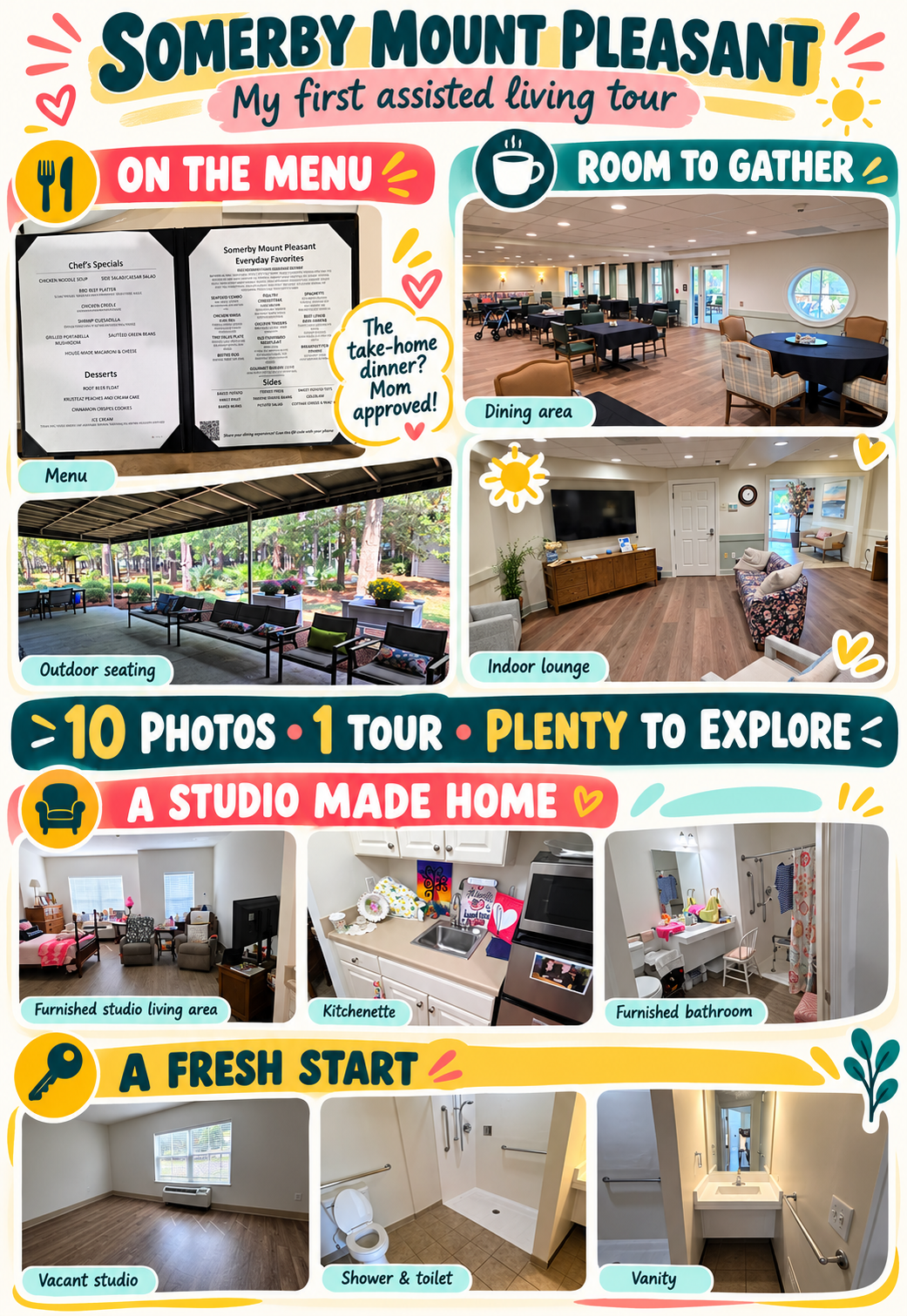
My First Assisted Living Tour—and a Mom-Approved Dinner
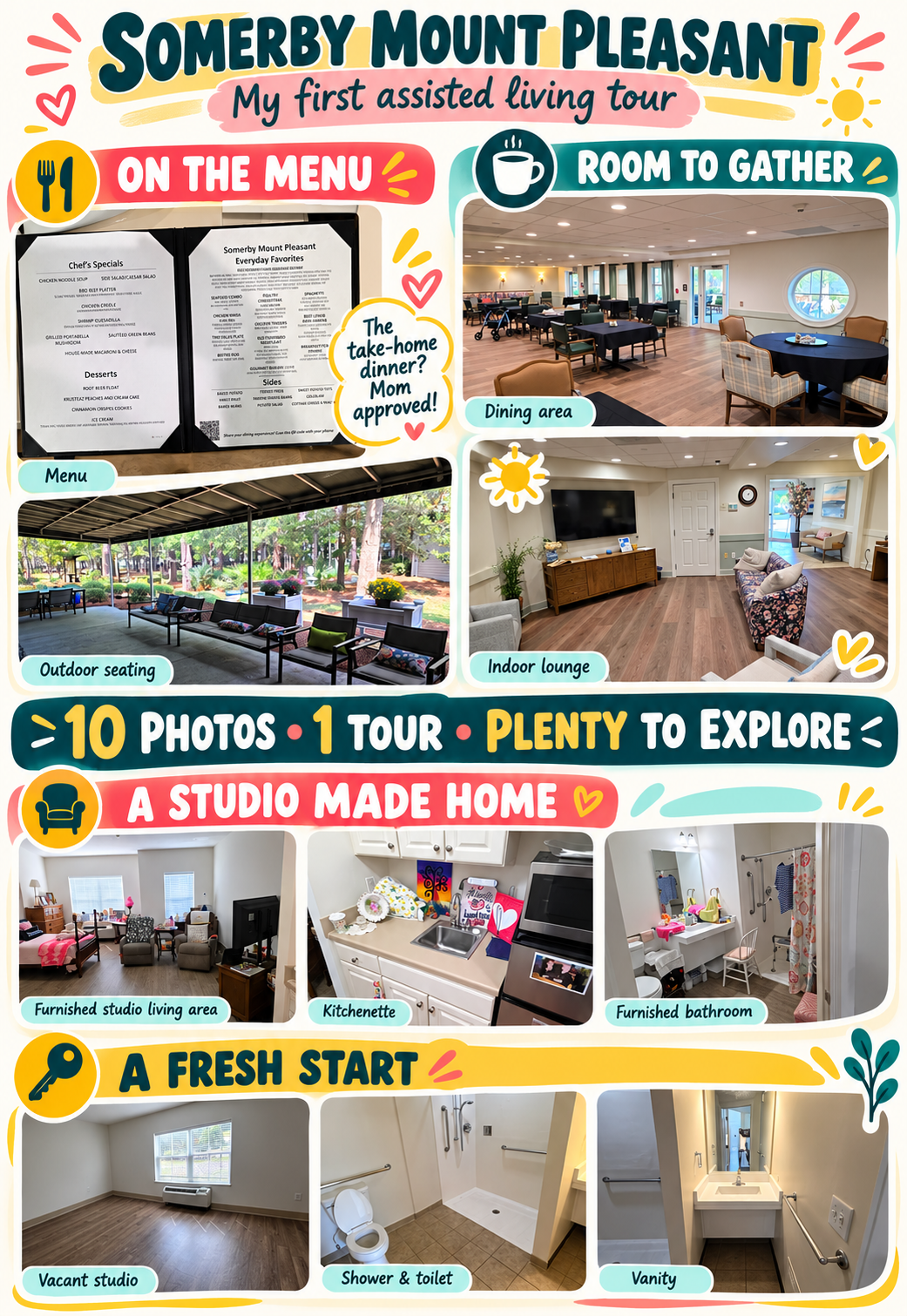
Today was a full day.
I started with a 10:15 a.m. cardiology appointment and left with some action items of my own. Taking care of Mom doesn’t take my health off the calendar.
Then I went to an afternoon recovery meeting before heading to Somerby in Mount Pleasant for my first assisted living tour.
I’ve been scheduling these visits, thinking through questions, and trying to understand what the next step could look like for Mom. Today, I got to walk through a place and start putting that information into context.
There was a lot to take in.
We discussed what Mom would need to qualify for assisted living, what’s included in the residence, activities, security, and more. I’m learning how much there is to understand beyond whether a room looks nice.
I want to know how the place would work for her day-to-day. What would she have access to? What could she participate in? Would it feel like somewhere she could settle in and enjoy herself?
I saw lounges, dining and activity spaces, coffee areas, and outdoor spaces. Walking through helped me picture where Mom might spend time beyond her own room.
I also asked whether I could take pictures and made a point of saying I wouldn’t include residents. This is their home. I wanted to document the spaces while respecting the privacy of the people living there.
Then came the part of the tour I had been particularly interested in.
The food.
If you’ve been following along, you know I’ve been requesting tastings. Choosing somewhere Mom might eat every day deserves a little investigation. A brochure can describe dinner beautifully, but Mom has never eaten a brochure.
I left with two to-go boxes.
One had a fish combination with shrimp and flounder, a baked potato, and sautéed green beans. The other had a shrimp quesadilla. There were also two green salads, tartar sauce, fruit salad, and two peach cake desserts.
I had arrived for information and left carrying dinner. This is a meeting format I can support.
Of course, my opinion was only part of the process. The food needed to make it to Mom.
And it was Mom-approved.
If you're following her recent reviews of hospital and facility meals, you know this is meaningful news. We have encountered wraps that did not survive the review process.
This meal got her approval. I was glad to bring her something she enjoyed—and to have her take part in this step toward a possible next home.
One tour and one meal are a beginning. I still have information to work through and more to learn about what will fit her needs.
But I left this first visit with a clearer understanding of assisted living, a lot to think about, and something concrete to share with Mom.
After a day of my own medical responsibilities, recovery, and planning for her care, it felt good to have a simple, positive moment.
Mom liked dinner.
I’ll take that win—with a side of peach cake.

Nextdoor’s Good Neighbor Awards Get the Spirit Right. I Still Have Questions About the Selection Process.
Nextdoor is highlighting the honorees from its 2026 Good Neighbor Day program, and I want to start somewhere that may surprise people who have followed my ongoing Nextdoor posts:
Bravo. Seriously.
Nextdoor says it received more than 1,300 nominations and ultimately selected five honorees from different regions of the country. The stories are exactly the kinds of things I think deserve recognition: cooking meals for neighbors, helping someone recover after hospitalization, maintaining a neighbor's property during a difficult time, and years of service to a community. Nextdoor Blog
I love this stuff.
Being of Service Matters to Me
Being of service is an important part of my own recovery program.
Help somebody.
Extend my hand.
Be available when somebody needs me.
Do something for another person without constantly calculating what I'll get in return.
That's why I genuinely enjoy reading about these neighbors.
And I'll give Nextdoor additional credit for something else: the stories largely allow the neighbors' actions to stand on their own.
They're not simply commercials screaming, LOOK WHAT NEXTDOOR DID!
The people did these things.
The people deserve the recognition.
That's how it should be.
But Here Comes Niel With Another Question
I know. Shocking. 😂
Nextdoor has provided more information about the process than it did when I first started asking about the program.
The original nomination announcement said a committee of Nextdoor employees would select winners, with one winner per region. It said a panel would review the strongest nominations and score them based on how specific, sustained, and impactful the stories were. Nextdoor Blog
The final announcement provides a little more detail. Nextdoor says it scored nominations using a consistent rubric and reviewed them with Nextdoor employees. They selected the five honorees based on how specific and lasting the acts were and the difference they made. Nextdoor Blog
That's useful information.
But I still have questions.
Who was on the committee?
What roles did they hold at Nextdoor?
How were committee members selected?
What qualifications or experience did they bring to evaluating the nominations?
What did the scoring rubric actually look like?
Were nominations scored independently by multiple people?
Were scores averaged?
Did committee members discuss finalists and reach consensus?
Could someone recuse themselves if they knew a nominee?
Were there conflict-of-interest rules?
How did Nextdoor get from 1,300+ nominations to five people?
Those aren't accusations.
They're questions about process.
Even Reality Television Shows Us the Judges
Think about it.
American Idol doesn't tell viewers, “A committee listened to everybody. Trust us.”
We know who the judges are.
Dancing With the Stars doesn't hide the judging panel behind the ballroom curtain.
We see the judges. We see scores. We understand that there is a process.
Even competition programs built primarily for entertainment recognize that when people are being evaluated, the credibility of the process matters alongside the outcome.
I'm not suggesting Nextdoor needs Ryan Seacrest standing next to a giant scoreboard while an employee holds up a 9.5 for snow shoveling.
Although I'd probably watch that. 😂
I'm saying transparency makes recognition more credible.
Who Judges the Judges?
Here's the uncomfortable hypothetical.
Suppose someone selecting recipients of a community-service award had previously been convicted of embezzling money from a charity or employer.
Would that automatically mean that person couldn't recognize a good deed?
No.
But wouldn't people reasonably want to know who was making the decision?
I'd certainly want to know.
That's why an awards committee's identities, relevant qualifications, and conflict-of-interest standards can matter.
I'm not suggesting anyone on Nextdoor's committee has that kind of history. I don't know who the committee members were—that's precisely the point.
If Nextdoor wants people to trust a selection process, giving people enough information to understand that process would strengthen it.
Nextdoor Is Actually Close Here
This may be one of the stranger conclusions in my continuing Nextdoor case study:
I think Nextdoor got a lot right.
More than 1,300 neighbors apparently took the time to recognize someone else. Nextdoor Blog
Nextdoor established criteria.
It divided recognition geographically.
It published descriptions of how the honorees helped others.
It disclosed that employees participated in the selection.
And, most importantly to me, it largely kept the spotlight on the people actually doing the work.
That's good.
My issue is that Nextdoor stops just short of the transparency I'd like to see.
It tells us there was a committee.
Great. Who was on it?
It tells us there was a rubric.
Great. Show us the rubric.
It tells us nominations were scored.
Great. Explain how.
It tells us five people emerged from more than 1,300 nominations.
Great. Show us how the process got from Point A to Point B.
This Is Becoming a Familiar Theme
That question fits rather neatly into what I've been writing about Nextdoor under CEO Nirav Tolia for months.
Research methodology.
Detailed Insights data.
Communication.
Moderation.
Metrics.
Awards.
Again and again, I find myself arriving at essentially the same place:
Show us the process.
That's where I think Nextdoor's leadership continues to leave an opportunity on the table.
Transparency doesn't diminish these awards.
It could make them stronger.
Publish the committee.
Publish the rubric.
Explain the scoring and consensus process.
Explain conflict-of-interest safeguards.
Then get out of the way and let these neighbors enjoy the recognition they've earned.
Because on the most important part of this story, I have no complaints at all.
People helping other people deserve a spotlight.
As someone whose own recovery reminds me of the importance of extending a hand and serving others, I celebrate every one of them.
Bravo to the neighbors.
Now, Nextdoor, show us how you chose them.
👉 Read my continuing Nextdoor case study at NielFlamm.com/blog