
🎬 Are We Losing the Middle-of-the-Road Movie?
Three Movies, One Bigger Question About Hollywood
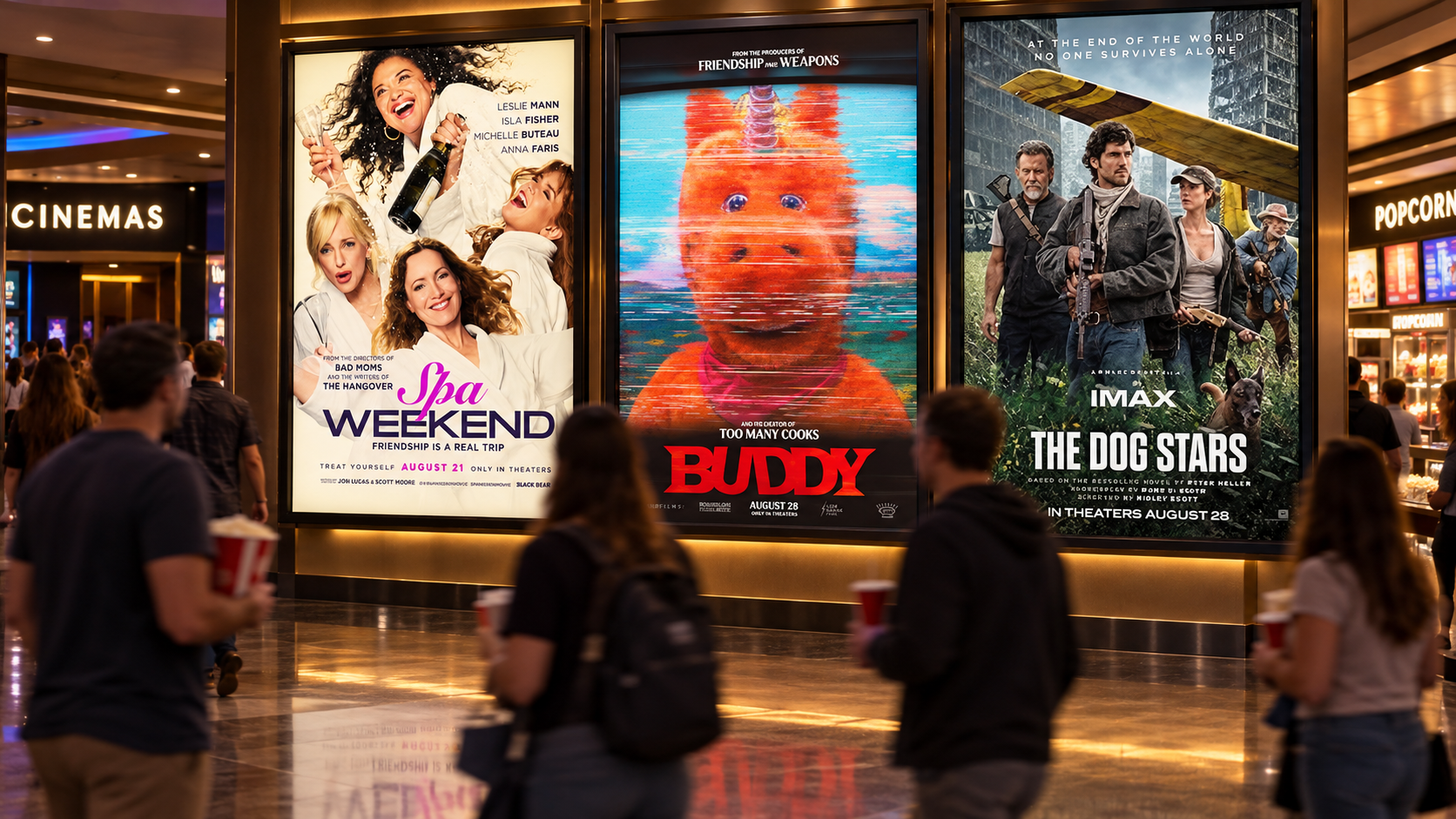
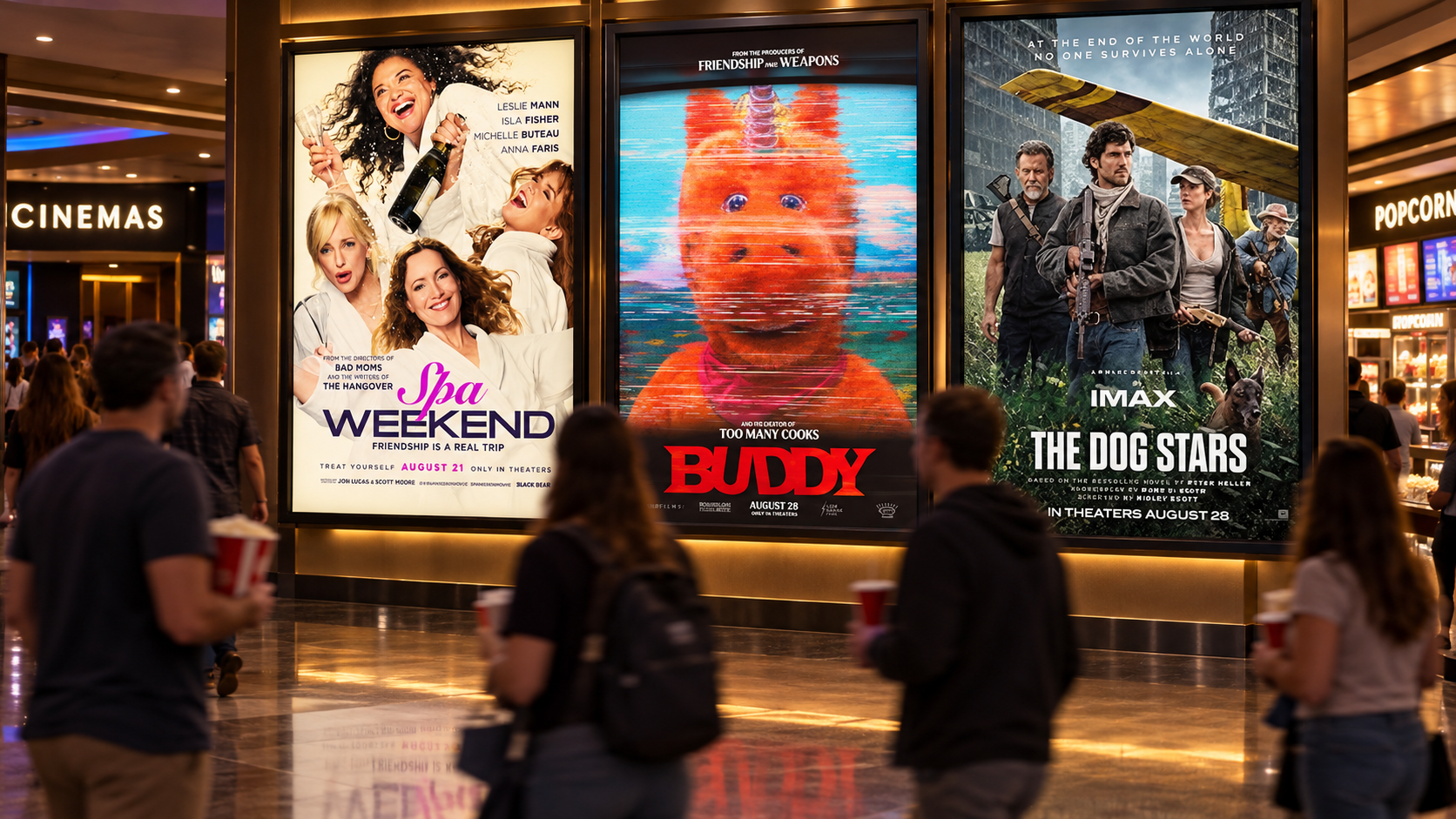
I've recently watched Spa Weekend, Buddy, and The Dog Stars. None of these movies set the box office on fire during their initial theatrical runs.
But here's the thing: I didn't think these movies were bad. I enjoyed them! I'll be sharing my reviews of all three soon on NielFlamm.com.
And that got me thinking about how much the movie business has changed.
🎟️ What Happened to the Average Movie?
Go back 20 or 30 years. A movie didn't necessarily need to be a blockbuster to find an audience. There was room for movies that were simply good, entertaining, or worth a couple of hours away from everyday life.
With the right marketing, press coverage, interviews, and promotional junkets, a movie could build awareness and attract enough ticket buyers to have a respectable theatrical run.
Not every movie needed to become a cultural phenomenon. Not every release needed to launch a franchise. Sometimes, a decent movie could just be… a decent movie.
And that was okay.
📱 Today's Entertainment Landscape Is Different
Today, movies compete with a much bigger list of options.
Streaming services offering thousands of titles at home.
Video games, social media, and YouTube competing for our attention.
Concerts, restaurants, travel, and other activities competing for our entertainment dollars.
Higher costs that make a trip to the movie theater feel like a bigger financial decision.
When you're paying for tickets, snacks, parking, and possibly a babysitter, you might think twice before spending that money on a movie you know very little about.
And in an economy where people are watching their spending, that decision becomes even more important.
💥 Franchises, Famous Names, and Built-In Audiences
The theatrical marketplace increasingly rewards movies that already have something working in their favor.
A recognizable franchise. A major director. A huge star. A devoted fan base. A built-in audience that's ready to buy tickets on opening weekend.
Those elements can make a movie easier to market and give people a reason to show up.
But what happens to movies without those advantages?
The original stories. The smaller comedies. The dramas. The movies that might not dominate the conversation but can still deliver an enjoyable experience?
They may struggle to get noticed, even when they're perfectly entertaining.

🍿 Does Every Movie Need to Be a Blockbuster?
That's the question I keep coming back to.
I enjoyed Spa Weekend, Buddy, and The Dog Stars. That doesn't mean they're perfect, and you'll hear my individual thoughts when I review them. But their box-office performance raises a bigger question: what kind of movies can survive in today's theatrical market?
Maybe the issue isn't that every movie is getting worse. Maybe it's that the marketplace has become less forgiving of movies that are simply good rather than extraordinary.
A movie can be worth watching without being the next billion-dollar franchise.
And not every movie needs to change cinema forever. Sometimes, I just want to sit down, enjoy a story, laugh a little, get emotionally invested, and walk out feeling like I spent my time well.
Is that too much to ask?
🎥 Coming Soon to NielFlamm.com
I'll be reviewing Spa Weekend, Buddy, and The Dog Stars soon. I'll share what I liked, what worked for me, and whether I think these movies deserve a second look.
Box-office numbers tell us how much money a movie made. They don't necessarily tell us whether an individual viewer enjoyed it.
If you want more good, bad, and stupid movies and beyond, you know where to find me.
👉 https://NielFlamm.com/videos
Or don't. 😉

The Hinge Experiment: What Have I Gotten Myself Into Now? 🧙♂️🌲🗽

I don't know what I did to myself. Seriously. I may come to regret this. 😂
When I started this Hinge experiment, I certainly didn't expect it to turn into road trips, Brazilian steakhouses, early-morning drives to Atlanta, Harry Potter adventures, and now... a Black Friday weekend trip to New York City.
But here we are!
It All Started With a Fraternity Brother
I've been sharing some of the time I've spent with Airica, and so far, we've had a great time together. We're exploring new places, making memories, laughing, eating entirely too much food, and seeing where this adventure takes us.
Enter one of my fraternity brothers. For this story, we'll call him Roach. That's his pledge name, among other names he's been called over the years. 🤣
Roach sent me a link to something he thought might be worth checking out:
🪄 Harry Potter: A Forbidden Forest Experience
If you're unfamiliar with it, go check out the website. It sounded like a pretty cool experience, and naturally, I mentioned it to Airica.
And guess what happened next?
We're Going to New York!
That's right. We're heading to New York City for Black Friday weekend!
Apparently, mentioning an interesting event to Airica is how I accidentally end up planning another adventure. I should probably be more careful about the links I open. 😂
Our plans are shaping up to include:
🌲 Harry Potter: A Forbidden Forest Experience — because apparently, we haven't had enough wizarding-world adventures after our trip to COSM Atlanta.
🎭 A matinee performance of The Nutcracker — a little holiday magic and culture to balance out all the Harry Potter excitement.
🍽️ Some awesome food — because let's be realistic. No trip with me is complete without figuring out where we're going to eat.
💎 A stop at a Pandora shop — because apparently, shopping is now part of the itinerary, too!
And that's how a simple link from Roach turned into a weekend in New York.
Visiting More of Airica's People
Another part of this adventure is visiting more of Airica's people.
That's a meaningful part of getting to know someone. You're not just sharing experiences with that person; you're gradually getting a glimpse into what matters to them, their places, people, and things.
I'm looking forward to the trip, the activities, the food, and making more memories together.
Of course, I also realize that traveling to New York over Black Friday weekend means dealing with holiday crowds, traffic, and the possibility that everyone else in the tri-state area has the same idea we do.
What could possibly go wrong?
I mean, I already drove more than 600 miles for Harry Potter on approximately two hours of sleep. Clearly, my decision-making process deserves further examination. 🤦♂️

Steve the Iguana Is Getting Nervous
For those following along with The Hinge Experiment, you may remember Steve the Iguana, my imaginary retirement plan for when I finally give up on dating.
Well, Steve might want to hold off on making any reservations.
Between the road trips, the food, the laughs, and now a Black Friday weekend in New York, this experiment is turning into quite an adventure.
I still don't know where this will lead. We're getting to know each other, enjoying our time together, and planning new experiences. That's enough for now.
But I do know one thing: I didn't expect Hinge to lead me to a Harry Potter forest, a Nutcracker matinee, and a trip to New York City.
Roach, if you're reading this, I'm blaming you. You sent the link!
And Airica? Start getting ready. We're going to New York!
Wish me luck. I have a feeling I'll need it. 😂
Day 128: Control Is Not the Same as Leadership — What Nirav Tolia Could Learn About Scaling Nextdoor
The interesting thing about scaling a company is that the very habits that build it can eventually hinder its growth.
Control can help establish consistency. Clear rules can help an organization operate. But when control outweighs adaptability, feedback, and accountability, a company risks losing sight of what it needs to improve.
That’s why this Inc. article caught my attention: To Scale Your Company Without Losing Control, Follow These 3 Hard-Won Lessons.
It raises a question I think is relevant to Nirav Tolia and Nextdoor:
When does maintaining control stop helping a company—and start preventing it from changing?
I can't know Nirav's personal motivations. But I can look at the public-facing decisions, communication patterns, and business challenges I've been documenting and ask whether Nextdoor is responding to feedback as effectively as it could.
Lesson 1: You Can't Control What the Market Thinks
The Inc. article emphasizes choosing investors carefully, treating them as teammates, and recognizing that raising money comes with responsibility.
That's a fair point. But control has another side.
You can control who invests in your company. You cannot control what the market thinks of it.
Nextdoor went public in 2021. Since then, the company has faced questions about growth, engagement, profitability, and the platform's reputation. When Nirav returned as CEO in 2024, he took on the challenge of moving the business forward.
You can't fix those problems by controlling the message.
They require results.
Lesson 2: Know When to Let Go
One of the most revealing points in the Inc. article is Tolia's acknowledgment that the CEO he needed to be when he returned wasn't the CEO he had been when Nextdoor was starting out.
He discussed moving from doing work himself to accomplishing work through other people—hiring the right team, aligning leadership and establishing meaningful metrics.
That's an important admission: scaling requires changing how you lead.
So here's my question: Does that same willingness to change extend to how Nextdoor handles criticism, user feedback, and accountability?
I've spent months raising concerns about moderation, communication, and transparency. I've requested detailed research that Nextdoor's own posts described as available. I've offered to talk.
Nirav has blocked me on social media. He's entitled to do that, and I can't claim to know his reasons.
But blocking an individual doesn't resolve the underlying questions.
A CEO doesn't have to answer every criticism personally for a company to have a process that addresses legitimate questions.
The test of leadership isn't whether you can keep criticism out of your feed. It's whether your organization can learn from feedback.

Lesson 3: Growth Isn't Everything
The article also emphasizes that growth alone isn't enough. A company needs a path to profitability and the ability to sustain itself.
That matters for Nextdoor.
The company has spent years building a neighborhood network, collecting recommendations and developing local advertising opportunities. Its Neighborhood Intelligence initiative is an example of trying to turn that distinctive asset into a stronger commercial business.
I want that to work.
But a new product doesn't automatically solve a business problem. Nextdoor still has to demonstrate that it can translate its reach and data into sustainable profitability and long-term shareholder value.
It also needs to retain the trust of the people who make the platform useful.
Control over a platform isn't the same as control over its future.
Day 128: Where Has Nextdoor Lost Control?
I'm not claiming Nirav has lost operational control of the company. I don't have evidence for that.
But I see several areas where Nextdoor appears to have less control than its leadership might want:
Its public narrative: Nextdoor can publish its message, but it can't dictate how customers, shareholders, and former users interpret their experiences.
Its reputation: Concerns about moderation and platform usefulness aren't automatically erased by a redesign or a new marketing campaign.
Its relationship with users: Neighbors can stop contributing, stop participating, or decide another platform better meets their needs.
Its financial future: Investors judge the business on performance and prospects, not just the story management tells.
Its feedback loop: When people raise concerns and don't see a clear resolution, those questions can persist and become a public case study of their own.
These don't prove every Nextdoor decision is wrong. They're risks any company faces when its ambition outpaces its ability to respond to feedback.
The Lesson for Nirav Tolia
Nirav, I think this article offers a useful framework:
Choose the right people. Adapt as the company grows. Focus on sustainable business results.
I'd add one more lesson:
Don't confuse control with the absence of disagreement.
A strong leader doesn't need everyone to agree. A strong organization needs ways to hear feedback, distinguish useful criticism from noise, and take action when something genuinely needs fixing.
I'm no longer a Nextdoor shareholder, but I still want to see the company succeed.
I'd like to see it become the kind of business that can accept difficult questions without treating the questions themselves as the problem.
Because sometimes, the thing a leader most needs to control is not the conversation.
It's the instinct to shut the conversation down.
👉 Read more of my ongoing Nextdoor case study at NielFlamm.com/blog
What I Can See, What I Can’t Control
I’ve written before about the struggle with my mother and her second stroke, about setting boundaries with my father, and most recently about the way his home is becoming more cluttered. I want to share what I’ve been noticing—and what I’m learning to do with it.
I’m an alcoholic in recovery. I’ve been sober for 17 years. I believe I’ve always had an addictive mind. Alcohol was my main way of dealing with life—or avoiding it—but food, television, and other things could take hold, too. At one point, I weighed at least 350 pounds. I say “at least” because that’s where the scale stopped.
I understand that alcoholism is a disease, and that genetics can play a part. We inherit genes from both parents. But recovery has also taught me not to point fingers or label someone else. Only a person can identify their own addiction. I can speak about my experience and notice similarities, but I can’t diagnose my father.
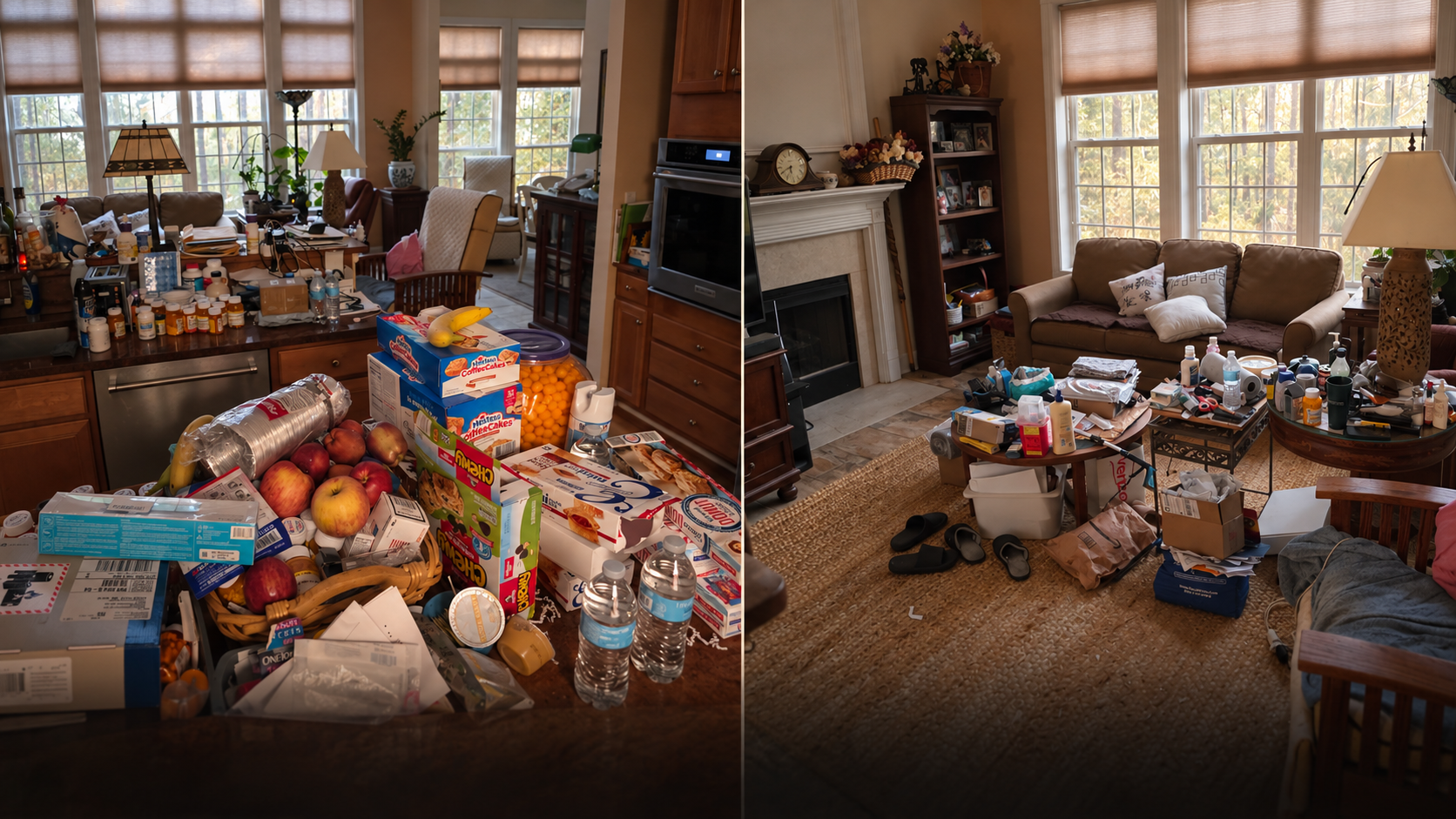
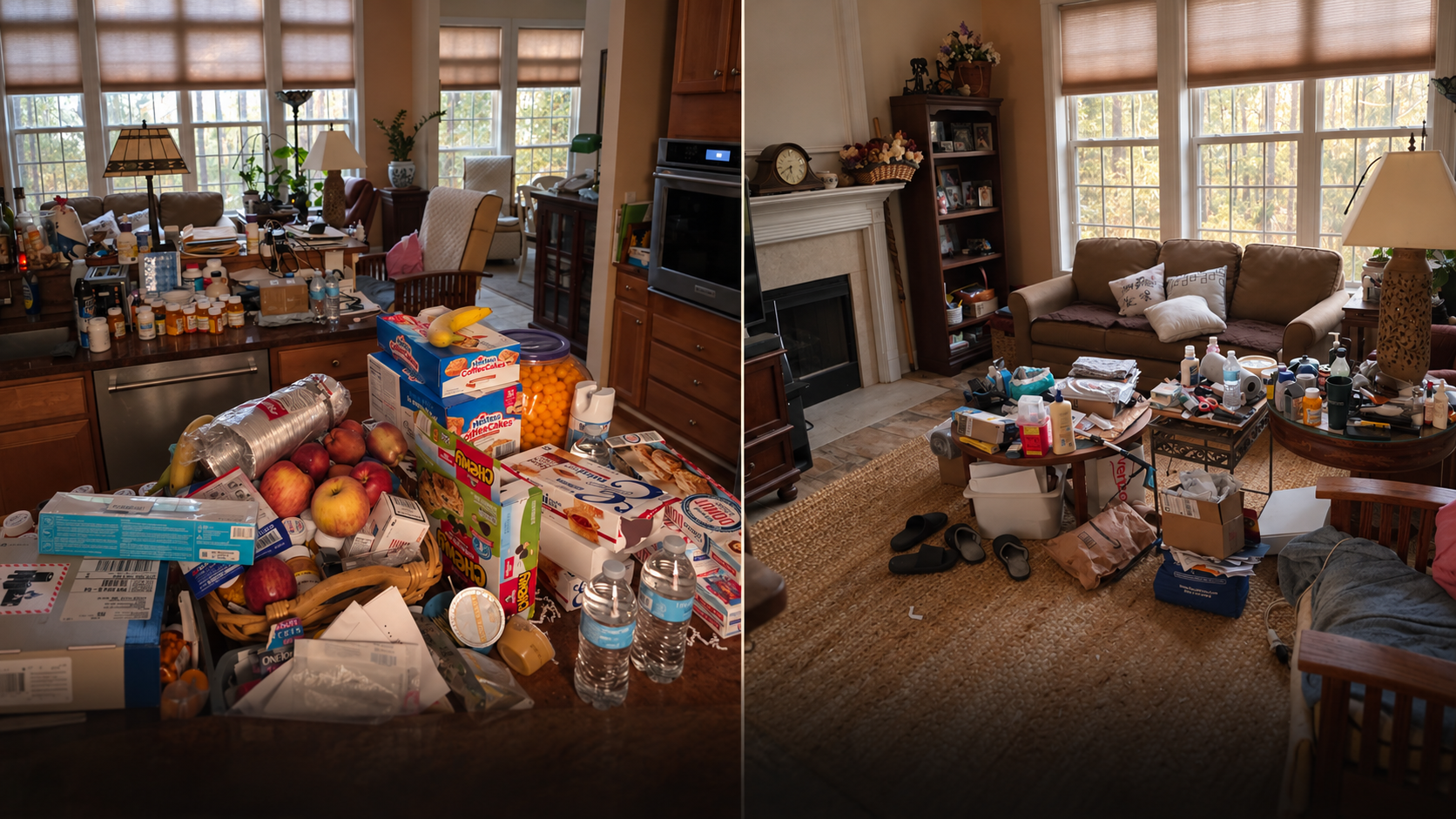
For a long time, I’ve noticed that he holds on to things “just in case.” There are expired medications, papers stacked near his computer that never seem to get looked at, and old mail. Lately, I’ve also noticed more processed food coming into the house through Amazon.
When my mother was living at home, she wouldn’t have bought this much junk food. Without her there, my father’s choices seem to be changing. I’m not going to police what he buys or try to manage his home.
This morning, I took a picture of the first floor—the kitchen and the TV area. It was never a Better Homes & Gardens photo, but it used to be tidier and stocked with healthier options. Seeing the difference was hard.
Still, noticing something doesn’t mean I can control it. I’ve set my boundary. My father’s choices are his to make, and my recovery and well-being are mine to protect.
It is what it is. I can care, be honest about what I see, and let go of what isn’t mine to manage.
A Leg Amputee Magnet
Somehow, I’ve become a magnet for leg amputees.
After my pain appointment, I visited a sister-assisted living facility in North Charleston, and as I made my way to the entrance, a resident caught up to me from behind. I don’t remember what he said first, but he noticed my prosthetic and mentioned he had one too. I was wearing shorts; he had on long pants. We chatted briefly, then he went on his way.
After touring the facility, I waited in the lobby for lunches I’d requested from the places I visited. Then another man rolled up. He also had an above-the-knee amputation. He mumbled something, showed me his residual limb, and rolled away.
Later, I delivered the lunches to Mom and waited in a main hallway. A resident who had approached me before asked how I drive. I shared my experience and offered a few suggestions.
Three encounters in one day, each with its own quick connection. I guess my prosthetic has become an unexpected conversation starter—and a way to meet people who understand a part of my life without needing much explanation.