

Bacon, Brain Nourishment, and a Little Leadership Reflection at 13.5 Knots
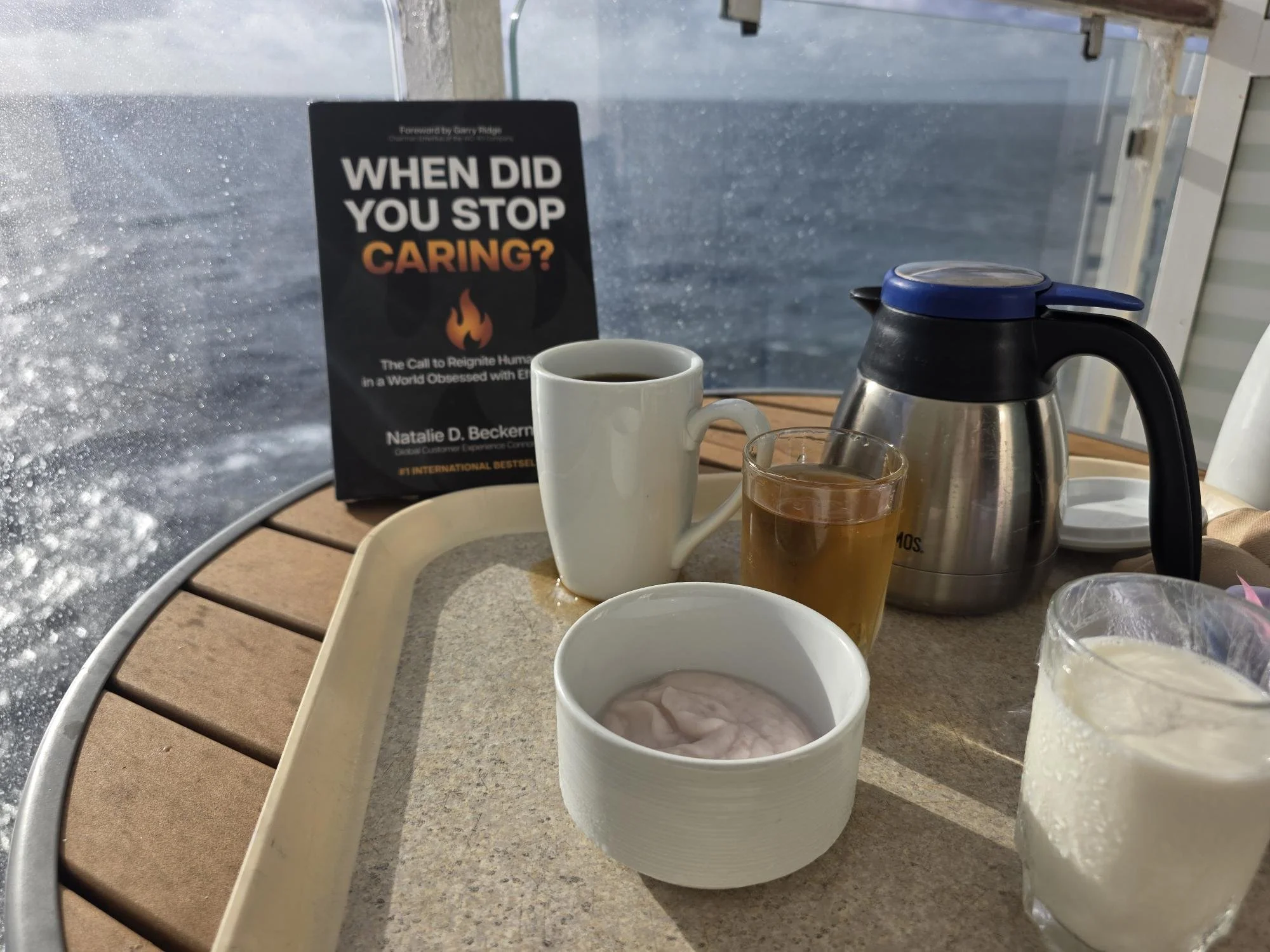
There's something special about enjoying a cup of coffee on a cruise ship balcony, watching the waves roll by, and listening to them crash against the ship. Add a little breakfast, some sunshine, and a good book, and I have a pretty wonderful way to start my day.
But I decided to combine two of my favorite things: enjoying the ocean and continuing to learn how I can become a better leader.
Not just a better leader with employees or teams, but also someone who understands customers, consumers, and the expectations they have of the brands they choose to do business with.
After all, a brand makes a promise. The customer experience is where that promise either becomes reality or falls short.
And that's where my morning reading comes in.
A Little More Than Just a Good Book
The book I'm talking about is When Did You Stop Caring? by bestselling author Natalie Beckerman.
When Did You Stop Caring?
The Call to Reignite Humanity in a World Obsessed with Efficiency.
A wake-up call for leaders to remember that businesses serve people, not spreadsheets.
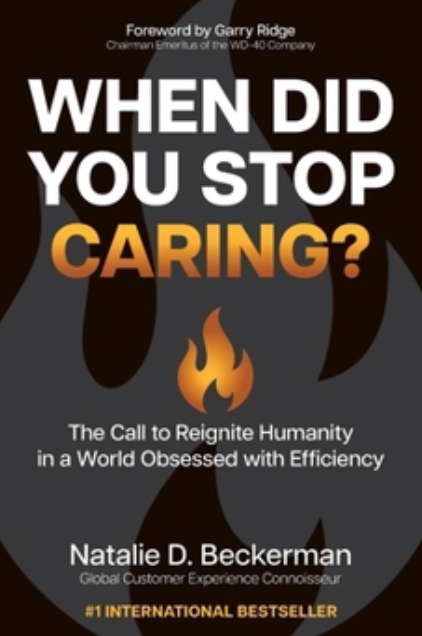
Author: Natalie Beckerman
Explore the book and its message
For anyone who hasn't come across the book, Natalie challenges the way organizations have increasingly prioritized efficiency, automation, metrics, and cost reduction at the expense of the human experience.
She explores what happens when customers become transactions, employees become numbers, and policies take precedence over judgment and empathy.
One central theme is that caring isn't a soft skill or simply a nice thing to have. It's a business strategy. It's about rebuilding trust, empowering employees, making technology work for people, and creating experiences that demonstrate that a company actually values the people it serves.
That message resonates with me.
The Brand Promise Is Only the Beginning
I've spent much of my professional life in learning and development, customer experience, and operational environments. I've seen how much effort goes into building processes, developing employees, implementing technology, and measuring performance.
But I keep coming back to a fundamental question:
What happens when the experience a company delivers doesn't match the promise it makes?
I can have the slickest mobile app, the most sophisticated technology, the best-looking website, and a beautifully written mission statement. But if I can't deliver what I promised, what have I really accomplished?
I believe the customer experience starts long before someone speaks with an employee or contacts customer service. It starts with the expectations the brand sets.
And it continues through every interaction.
When I order something, make a reservation, purchase a product, or reach out for assistance, I'm forming an expectation. When that expectation isn't met, I notice.
I also believe the reverse is true. When I encounter an employee who takes ownership, a company that follows through, or an organization that makes an experience better than I anticipated, I notice that too.
Those moments influence whether I return, recommend the company, or take my business elsewhere.
A Floating Classroom
So here I am, somewhere out on the water, cruising at 13.5 knots on a heading of 206 degrees.
I've got coffee, bacon, the sound of the ocean, and a book that challenges me to think differently about leadership.
I can't think of a much better combination.
I haven't even finished the book yet, and I'm already finding myself reflecting on how I approach leadership, customer experience, and the expectations I set for others.
My copy is still unsigned, which gives me another reason to hope I'll have an opportunity to get Natalie to autograph it.
And hopefully, this isn't the last masterpiece she shares with us.
For now, I'll keep turning pages, enjoying the view, and reminding myself that learning doesn't have to happen in a classroom, a conference room, or behind a computer screen.
Sometimes, the best professional development happens with a cup of coffee, a plate of bacon, and a good book while floating through the ocean.
Because being a better leader isn't just about knowing more. It's about caring enough to keep learning, listening, and improving.
And if I can do a little of that while enjoying the waves, I'm going to call that a pretty successful morning.
Two Encounters, One Prosthetic, and Another Cruise Ship Conversation Streak
Yesterday, after dinner aboard the Radiance of the Seas, I had two very different interactions involving my prosthetic leg. Both were unexpected, and both reminded me that sometimes my prosthetic introduces me to people before I even get a chance to introduce myself.
Encounter #1: "I Make Those"
I was approaching the entrance to the Main Dining Room when I noticed a guy coming up behind me. He turned, looked intently at my prosthetic, kept walking, then looked down again.
I said hello, and he returned the greeting.
Then came the explanation: "I make those."
Suddenly, his curiosity made perfect sense. He wasn't just looking at a guy walking with a prosthetic. He was looking at a piece of equipment he works with professionally. He was checking out the knee, the socket, and all the components that make up my artificial leg.
We struck up a conversation. He mentioned that he was also on the trip to cast his father-in-law for an upper-extremity prosthetic, specifically an arm below the elbow. Apparently, he could write off the business-related portion of his travel expenses, but not the cruise itself.
It was an interesting little encounter. Most people see my prosthetic and wonder what happened. This guy saw it and wanted to know what equipment I was wearing.

Encounter #2: "Where Did You Lose It?"
I headed toward the elevator, which was maybe ten feet away, ready to make my way back to the stateroom.
Then another guy approached me.
He extended his hand, gave me a hug, and started talking.
Now, if you've followed my adventures, you know I have a problem with strangers touching me. So the unexpected handshake-and-hug combination wasn't exactly my preferred introduction.
Then he asked, "Where did you lose it? Thank you, buddy."
It took a moment for that to register. He had apparently assumed I was a military veteran and had lost my leg while serving.
I explained that I hadn't lost my leg with quite that level of valor.
That opened up another conversation. I take military service, valor, and people misrepresenting or stealing that recognition seriously. There's a difference between appreciating someone's service and claiming something you haven't earned.
As it turned out, this gentleman had served three tours in Iraq, along with service during Desert Storm.
That put things into perspective.
I thanked him for his service, and he told me I was a strong dude. We exchanged a few more words, and I told him we'd probably see each other around the ship.
Another Day, Another Conversation
What's becoming increasingly amusing is that this isn't the first time I've had unexpected conversations with complete strangers on a cruise.
My prosthetic seems to be an icebreaker.
Sometimes it's someone who is professionally interested in the technology. Sometimes it's someone who assumes something about my background. Sometimes it's simply someone who wants to connect.
I don't mind talking about my amputation. It's part of my life, and I've never kept it a secret. But there's a difference between being approachable and assuming that physical contact or personal questions are automatically welcome.
Still, I'll give both gentlemen credit for making an otherwise ordinary evening a little more interesting.
One makes prosthetics. The other served his country.
And I apparently keep attracting conversations wherever I go.
At this rate, I might need to start keeping a cruise ship encounter counter.
`
The streak continues!
Day 136: NXDR Falls to $2.30. How Many Warning Signs Does Nextdoor Need?
Yesterday, Nextdoor celebrated fifteen years by ringing the Nasdaq closing bell. The photographs showed smiles, applause and a company celebrating its history.
Today, NXDR is down to $2.30.
That's a 7-cent decline from yesterday's $2.37 close, or approximately 3%.
I won't pretend I know exactly why the stock fell. A single day's trading doesn't tell us what every investor is thinking. But I do find the timing interesting.
Nextdoor has a fifteenth-anniversary celebration, another quarterly earnings report approaching, and a new advertising revenue opportunity on the horizon—yet the stock is moving in the opposite direction.
At some point, the market may want more than another announcement.
The Timing Is Interesting
Let's look at what Nextdoor has going on.
Fifteen years in business, celebrated with a Nasdaq closing-bell ceremony.
Third-quarter earnings approaching.
A history of stock-price movement around earnings announcements.
A new sponsored-search advertising opportunity that could expand Nextdoor's commercial reach.
Investors may be interested in the company's prospects.
But there's a difference between announcing an opportunity and demonstrating that it will generate meaningful, sustainable revenue.
And there's a difference between celebrating fifteen years and demonstrating what fifteen years of execution have delivered.
A New Revenue Opportunity: Selling Access to High-Intent Searches
I saw a recent LinkedIn announcement from Nextdoor about expanding sponsored search.
The announcement explains that when neighbors search for plumbers, veterinarians, or home services, they're often looking for an immediate solution.
Nextdoor plans to expand sponsored search into additional categories beginning in January, including:
Health care
Pet care
Real estate
Telecommunications
Financial services
The company is also inviting advertising and integration partners to begin building Nextdoor Search API integrations.
On the surface, this is a logical business opportunity.
Someone searching for a plumber or veterinarian has a specific need. Someone searching for a financial service or real estate professional may also be closer to making a purchasing decision than someone casually browsing a neighborhood feed.
Advertisers want to reach people when they're considering a purchase. Nextdoor wants to monetize those moments.
I understand the business model.
But here's the question I keep returning to:
Who created the value that makes those searches commercially attractive?
Neighbors have spent years contributing recommendations, discussing local businesses, and sharing experiences. Those contributions build the community knowledge that makes Nextdoor useful.
Nextdoor now wants to expand the commercial opportunities around that activity.
What does the neighbor receive in return?
I'm not suggesting that every recommendation should generate a payment or that every piece of user-generated content creates a legal entitlement to compensation. I'm asking whether the company should offer a more meaningful value-sharing model when community contributions become part of a commercial product.
The community supplies the knowledge. The platform organizes it. Advertisers pay to reach people who are looking for solutions.
That raises a legitimate question: how is the value distributed?

Are Small Businesses Being Squeezed?
Sponsored search has another side.
Small businesses want customers. They want to reach the people who need their services. They want neighbors to recommend them and build community relationships.
Nextdoor offers free business tools, and businesses can participate without necessarily buying advertising.
But as the company expands its paid advertising products, I want to understand whether small businesses are getting meaningful value for their money.
Are they reaching new customers? Are they generating leads? Can they measure the return on their advertising spend?
Or are they increasingly being asked to pay to reach the very community that helped make their business visible in the first place?
Advertising can legitimately grow a business. The question is whether the value exchange works for the advertiser, the neighbor, and Nextdoor.
If Nextdoor wants small businesses to invest more, it needs to show the investment is worthwhile.
Perhaps Investors Are Asking Different Questions
Why is NXDR down to $2.30?
I don't know. I haven't seen evidence establishing a single reason for today's decline, and I won't attribute it to the Nasdaq ceremony, the advertising announcement, or my own commentary.
But there are several issues that investors might consider when evaluating Nextdoor:
Can the company turn its audience and neighborhood data into sustainable revenue?
Will sponsored search produce meaningful incremental sales?
Can Nextdoor improve profitability while continuing to invest in its platform?
Can it retain users while increasing commercial content?
Does the company have a credible path to long-term shareholder value?
Nextdoor's third-quarter 2026 earnings report is scheduled for November 5, before the market opens. The company has also invited investors to submit questions for its public Q&A by November 2 at 8 p.m. Eastern.
That's an opportunity for management to discuss the numbers, the outlook, and the questions investors want addressed.
Perhaps Users Are Asking Different Questions
Investors aren't the only people who might be reconsidering their relationship with Nextdoor.
What about the neighbors who contribute the recommendations, reviews, and local knowledge that make the platform valuable?
What happens when those contributors start asking whether their information is being commercialized without a meaningful opportunity to participate in the value they create?
What happens when users repeatedly raise concerns about moderation, appeals, and communication but don't feel that their questions are being resolved?
A platform can have millions of weekly active users and still have a trust problem.
WAU is an important metric. It measures activity. It doesn't independently measure satisfaction, confidence in moderation, or whether users believe their contributions are being treated fairly.
I would like to see Nextdoor demonstrate that it understands the difference.
Perhaps Small Businesses Are Asking Different Questions, Too
Local businesses are not simply advertising inventory.
They're members of the same communities that Nextdoor serves. They're trying to solve problems for neighbors, build reputations and earn customers.
If the cost of reaching those customers keeps increasing, businesses will naturally evaluate whether the return justifies the expense.
Nextdoor needs to ensure its commercial strategy doesn't undermine the local relationships that make its advertising products attractive.
The company needs businesses to succeed, not simply to spend.

And Then There's Accountability
This brings me back to my own experience.
I've asked Nextdoor for the detailed data behind research that its public communications described as available, by contacting the right person.
I've followed up. I've contacted leadership. I've asked for a clear answer.
Today is Day 136.
I was a Nextdoor shareholder for approximately 130 of those 136 days.
I have since sold my shares, but the request remains unresolved.
I'm not asking for confidential information that the company is prohibited from disclosing. I'm asking for the detailed research that was presented as available.
If the reports cannot be shared, say so. If access is restricted, explain that. If someone else is responsible, direct me to that person.
A company preparing to discuss its performance with investors should understand that communication and accountability matter beyond the earnings call.
And this isn't just about my request. It's about whether Nextdoor has a culture and process that takes substantive questions seriously.
The Moderator Question Is Still on the Table
I've also raised concerns about unpaid community moderators, potential conflicts of interest, and protecting nonpublic information.
Consider a hypothetical situation in which a volunteer moderator disagrees with a neighbor over politics, uses moderation privileges unfairly, and then misuses information available through the moderator role to retaliate.
That is a serious scenario. I'm not claiming it happened in a particular case, but I want to know how Nextdoor prevents it.
What annual training is required? How are conflicts of interest handled? What safeguards prevent moderators from misusing access to information? How does Nextdoor investigate complaints when the moderator is the subject of the complaint?
And how does Nextdoor continuously improve its moderation program?
I've asked these questions because a neighborhood platform involves real people, real addresses, and real relationships.
The company cannot simply talk about building trust. It has to demonstrate how it protects it.
The Dam Is Showing Leaks
Here's what I see when I put all these issues together:
Business: Can Nextdoor turn its potential into sustainable profitability?
Investors: Can it create meaningful long-term shareholder value?
Small businesses: Can it deliver measurable results without making advertising feel like an endless expense?
Users: Can it recognize the value of community contributions and maintain trust?
Moderation: Can it protect neighbors from inconsistent decisions, conflicts of interest, and misuse of information?
Leadership: Can it respond to difficult questions and demonstrate accountability?
None of these questions is answered by ringing a closing bell.
None is answered by announcing another advertising category.
And none is answered simply by reporting that weekly active users or revenue have increased.
These are interconnected issues. If users lose trust, community quality can suffer. If businesses don't see value, they may reduce their spending. If investors don't see a credible path to sustainable returns, they may reconsider their investment.
A company can continue growing while these issues remain unresolved, but ignoring them creates risks that deserve attention.
Day 136: Fix the Leaks Before the Dam Breaks
I still believe there's tremendous potential in a platform that connects neighbors with local information, recommendations, and businesses.
But potential isn't the same as execution.
The company has a new sponsored-search opportunity. It has a fifteen-year history. It has a substantial user base. It has improving financial metrics.
Those are things worth building on.
But I would rather see Nextdoor spend less time celebrating what it has built and more time addressing the problems that could undermine it.
Listen to the neighbors. Give small businesses measurable value. Explain how community-generated knowledge is commercialized. Improve moderator safeguards. Protect nonpublic information. Answer legitimate questions. Deliver sustainable results for investors.
Fix what's broken. Address the leaks across the dam before the entire levee breaks.
November 5 is approaching. The earnings report will tell us more about the financial picture.
But I'll look beyond the headline numbers.
Because the question isn't simply whether Nextdoor can make more money.
It's whether it can build a business that deserves the trust of the people who make that money possible.
👉 Follow my continuing Nextdoor case study at NielFlamm.com/blog.

Radiance of the Seas: Day 1 – A Little Chaos, Some Great Food, and Sailing Under the Sunshine Skyway Bridge!

Well, I made it!
After the morning's adventures at Charlotte Douglas International Airport, including the American Airlines maintenance delay, I eventually made it to Tampa and boarded Royal Caribbean's Radiance of the Seas.
Not exactly the smooth start I had envisioned, but hey, I'm on vacation now!
Apparently, the day wasn't quite done testing me.
Getting to the Ship: The Adventures Continued
Let's just say the ride from the airport to the cruise terminal wasn't exactly confidence-inspiring.
My Uber driver drove a 2026 Honda CR-V Hybrid. From my perspective, he didn't seem particularly comfortable driving it. I wasn't thrilled, but I eventually made it to the terminal.
Then there were the missing sunglasses.
A pair of Oakleys that I really like. Gone. I have no idea where they disappeared, and I was already annoyed.
Then came the moment when I thought I had lost my cell phone.
Cue the minor freak-out.
Thankfully, it was safely tucked away in my backpack. Crisis averted!
Eventually, I made it onto the ship. Later than I wanted, but that's okay. Timing isn't always up to me, and I'm learning that I'm not in control of everything.
Sometimes you just have to roll with it.
The Key: A Pretty Nice Way to Start a Cruise
Once onboard, I took advantage of the special lunch associated with Royal Caribbean's The Key program.
My selections included:
Caesar salad
Shrimp cocktail with three absolutely enormous shrimp
Sweet and sour tofu
That tofu was awesome!
I finally sat down, ate, and started to feel like I was actually on vacation.
Muster Drill: Thank You, Modern Technology!
One thing I really appreciate about cruising these days is the muster drill.
If you've cruised before, you probably remember the old routine.
Everyone had to report to their assigned muster station, stand around in tight quarters, wait for everyone to show up, listen to the captain's instructions, and eventually get dismissed.
And there's always that ONE passenger who doesn't seem to understand that showing up is mandatory.
Thankfully, things have changed.
With the newer process, you can review the safety information and check in at your assigned station without the old-fashioned mass gathering.
Much quicker. Much easier.
On the way to my muster station, I also passed some Halloween decorations around the ship. Since today is October 29, the timing is perfect!
My Cabin, Missing Oakleys, and a Nap
After completing muster, I headed to my cabin.
Naturally, the first order of business was another search for my missing sunglasses.
I dug through the backpack, hoping those Oakleys had magically reappeared.
Nope.
Still missing.
I waited for my luggage, unpacked, met my room steward, and finally got to do something I'd been looking forward to all day.
Take a nap.
There is something wonderful about finally getting into the cabin, putting my belongings away, and knowing I don't have to drive anywhere, catch another flight, or navigate an airport.
I'm on a ship. Someone else gets me somewhere.
I like this arrangement.
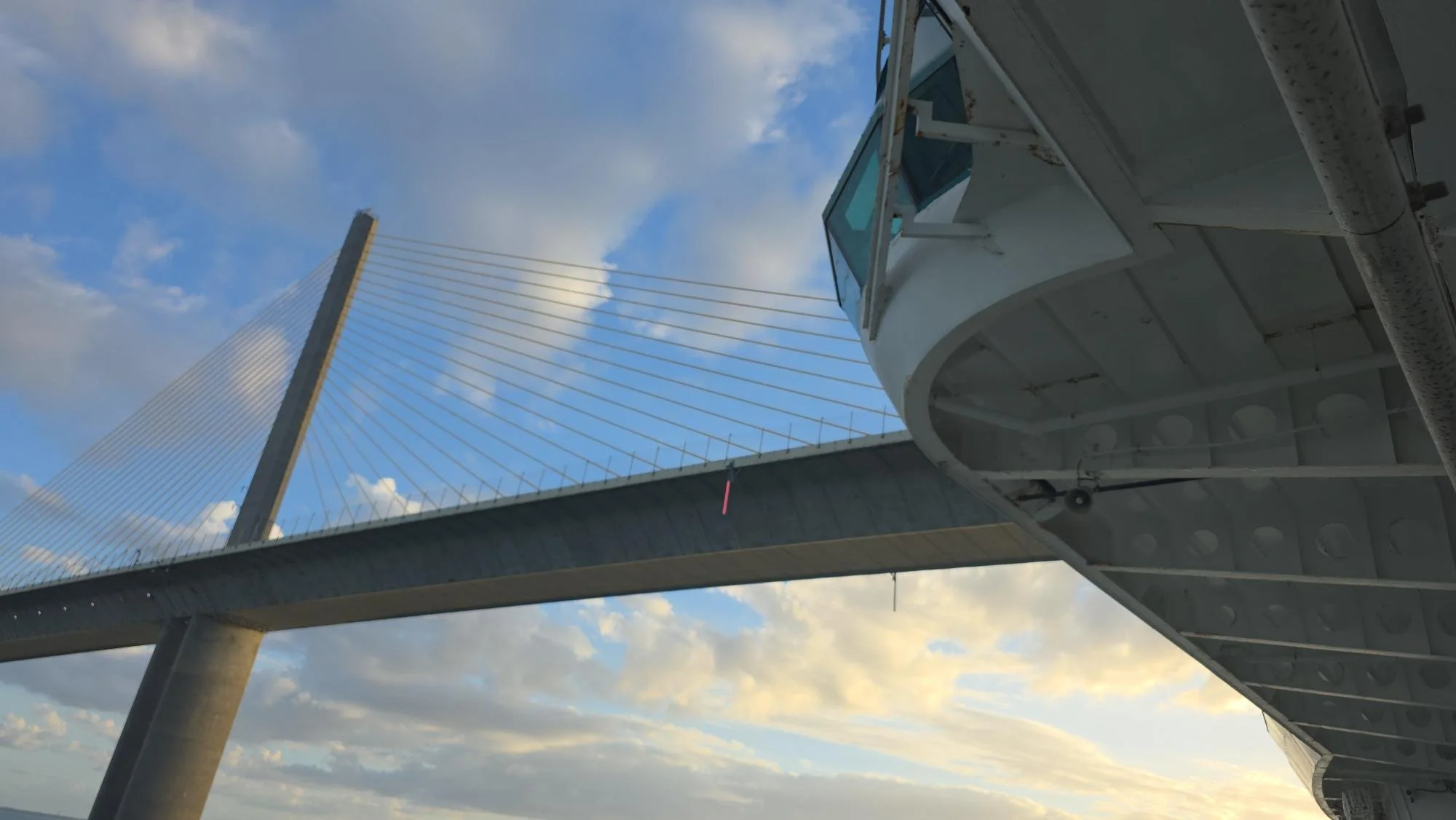
The Sunshine Skyway Bridge: A First for Me!
The captain announced we'd pass under the Sunshine Skyway Bridge at approximately 6 p.m.
He mentioned we'd have about six feet (two meters) of clearance.
Well, that got my attention!
I set an alarm for 6 p.m., got up, cleared my head, and headed outside.
What a sight!
I've driven across bridges plenty of times, but watching a cruise ship pass underneath one is an entirely different experience.
I'd never done that before, and I'm glad I made the effort to get outside and see it.
It's one of those little travel experiences that I didn’t necessarily plan for but end up remembering.
Definitely a highlight of the day.
Dinner: Let the Vacation Eating Begin!
By around 7 p.m., it was time for dinner.
And if there's one thing I intend to do on this cruise, it's enjoy the food.
Tonight's dinner lineup:
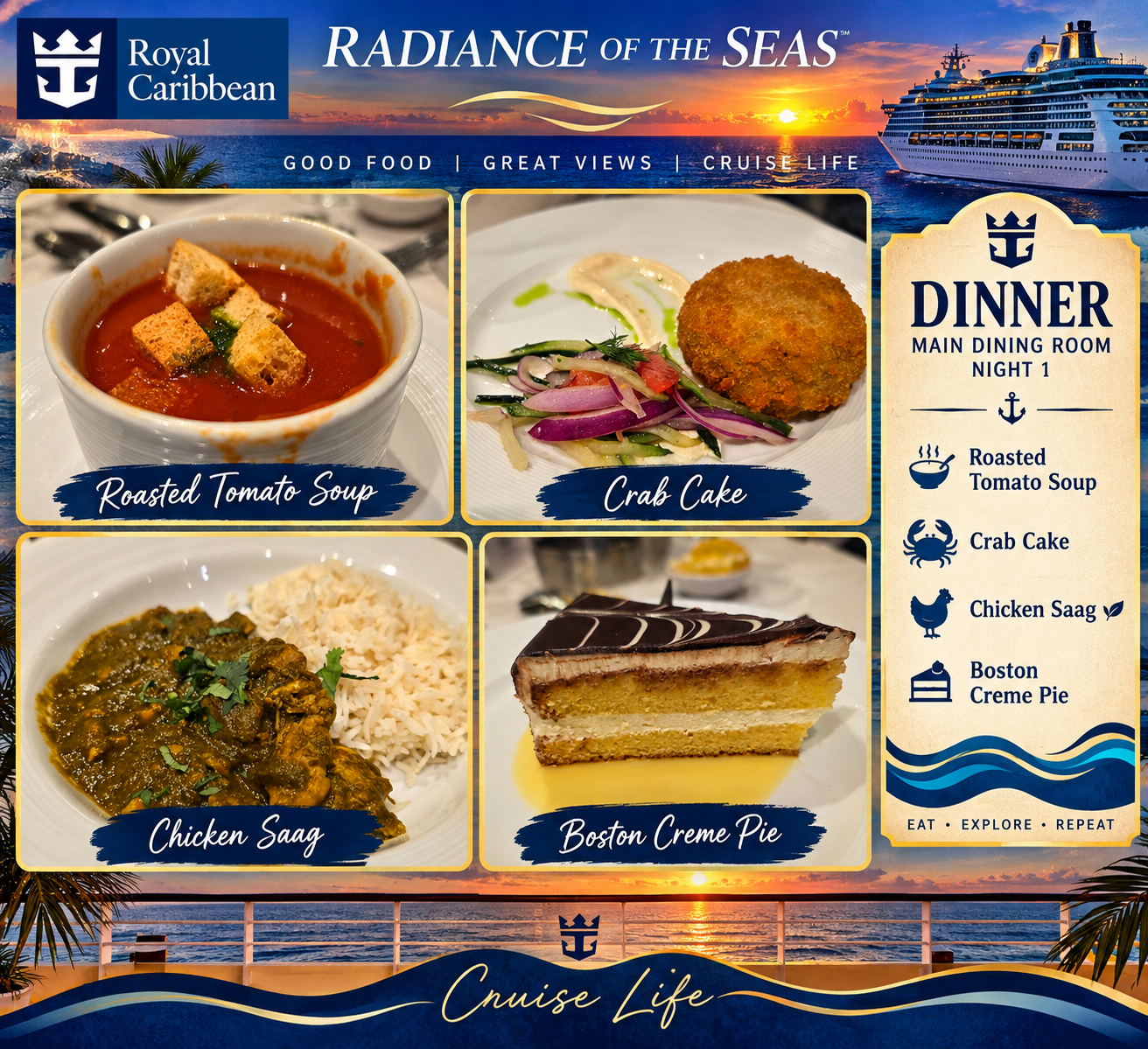
Roasted tomato soup
Crab cakes
Caesar salad
Chicken saag
Pellegrino sparkling water
And because dinner isn't complete without dessert:
Boston cream pie
Decaf coffee
A pretty good way to wrap up the evening!
Between the Key lunch and dinner, I've made a respectable start on my cruise dining adventures.
And there's still plenty of bacon to come.
Tomorrow: A Day at Sea!
Tomorrow is a sea day.
No airports. No Uber drivers. No luggage drama. No rushing to get somewhere.
Just the ocean, the ship, and whatever adventures I manage to find.
The main dining room starts serving brunch at 8:30 a.m. Will I make it? Who knows!
I'm officially on cruising time now.
Maybe I'll get up early. Maybe I'll sleep in. Maybe I'll wander around the ship, find some entertainment, eat something I probably don't need, and do a little people watching.
That's the beauty of cruising.
I don't have to plan every minute.
Today had its share of frustrations, but I made it aboard, enjoyed some great food, saw something I'd never seen before, and am finally settling in.
Tomorrow is another day, and I have absolutely no idea what I'll do with it.
Check back tomorrow to find out what I didn't do!
Fairfield Inn & Suites Charlotte Arrowood: When Free Still Isn’t Worth It
Sometimes, a hotel stay is just a place to lay a head for a few hours. After dinner with Airica, I drove about an hour and a half from Columbia, South Carolina, to the Fairfield Inn & Suites Charlotte Arrowood. The plan was simple: get some sleep and keep going in the morning.
I used Marriott Bonvoy points for this stay, so my out-of-pocket room cost was $0. Sounds like a win, right? Well, not every free night is a good deal.
Finding the Hotel and Checking In
The hotel sits back from the main road, and I actually missed the entrance on my first attempt. A quick trip around the block got me back on track.
Parking was easy. There were six accessible parking spaces, and when I arrived around 9 p.m., three were still available. I took one, leaving two for other guests who might need them.
Check-in was equally straightforward. One person was ahead of me, and the front desk staff member was friendly and efficient. She covered the usual information about Wi-Fi, breakfast, and coffee. I didn't get to experience breakfast because I left before it started at 6:30 a.m.
She wasn't particularly knowledgeable about the surrounding area, explaining that she drove about 40 minutes each way to work and wasn't from the neighborhood. Fair enough.
However, one thing immediately caught my attention: the glass partition between the two sliding entrance doors, with a pawn shop and a Chinese takeout business visible on the other side. In all my years of hotel stays, including some questionable properties, this was a first for me. It certainly wasn't the welcome I expected.
The elevator was conveniently located near reception. The hotel has three floors, and I was assigned Room 304 on the third floor.
The Cigarette Smoke Problem
Unfortunately, the experience began to go downhill before I even reached my room.
There is only one elevator, and as soon as I stepped out onto the third floor, I smelled cigarette smoke. When I opened the door to Room 304, a hearing- and wheelchair-accessible room, the odor was even more noticeable.
I wasn't interested in spending the next part of my evening negotiating for another room, so I decided to deal with it.
To give credit where it's due, the room itself was reasonably comfortable. Unlike some hotel rooms I've reviewed, this one was well lit. The bed was comfortable, the HVAC worked properly, the television functioned, and I had no trouble connecting to the Wi-Fi.
Those were the positives.
An Accessible Room That Missed the Mark
As a right above-the-knee amputee, I pay particular attention to hotel accessibility. I've written before about how businesses can technically meet accessibility requirements while still falling short of what disabled guests actually need.
This room was another example.
Yes, there were grab bars. Yes, the doorway was wide enough for wheelchair access. But accessibility involves more than checking a couple of boxes.
The bathroom had a bathtub rather than a roll-in shower. It had no removable handheld showerhead, shower chair, or stool. The bath products were mounted in the middle of the tub area, and there wasn't even any body wash.
Think about that for a moment.
Getting into and out of a bathtub can be particularly challenging for someone with a mobility disability. Without a shower chair, it becomes even harder. A handheld showerhead can also make bathing safer and more practical.
These aren't extravagant luxury requests. They're practical accommodations that can make a meaningful difference in someone's ability to use a bathroom safely and comfortably.
The room was labeled accessible, but the bathroom left me questioning how well the actual needs of disabled guests had been considered.
Checking Out Before Sunrise
I left around 5:30 a.m., well before breakfast was available. Nobody was at the front desk, so I walked out and left the checkout process to the hotel.
I've encountered this situation before, and I generally don't make a production out of it. The property can process the checkout when staff is available.
There were no major problems with the bed, television, climate control, or internet. If I were judging the room solely on those basics, the stay might have been perfectly adequate.
But the cigarette smoke and, more importantly, the shortcomings in the accessible bathroom overshadowed those positives.
Was It Worth the Points?
The room cost me $0 out of pocket because I redeemed Marriott Bonvoy points. Unfortunately, that doesn't automatically make it a good redemption.
I value my points because they can buy stays that are comfortable, convenient, and worth the effort of traveling. This experience didn't meet that standard.
The friendly front desk agent, comfortable bed, good lighting, and working amenities deserve credit. However, the smoke odor and the lack of essential bathroom features for someone with mobility limitations were significant negatives.
Would I stay here again? No. Would I pay cash for a room here? Absolutely not.
A free hotel room should still provide a reasonable experience, and an accessible room should offer more than the bare minimum.
This stay reminded me that the lowest price isn't always the best value, even when it’s zero.
Until next time, safe travels—and remember that accessibility is about more than a label on a reservation.