
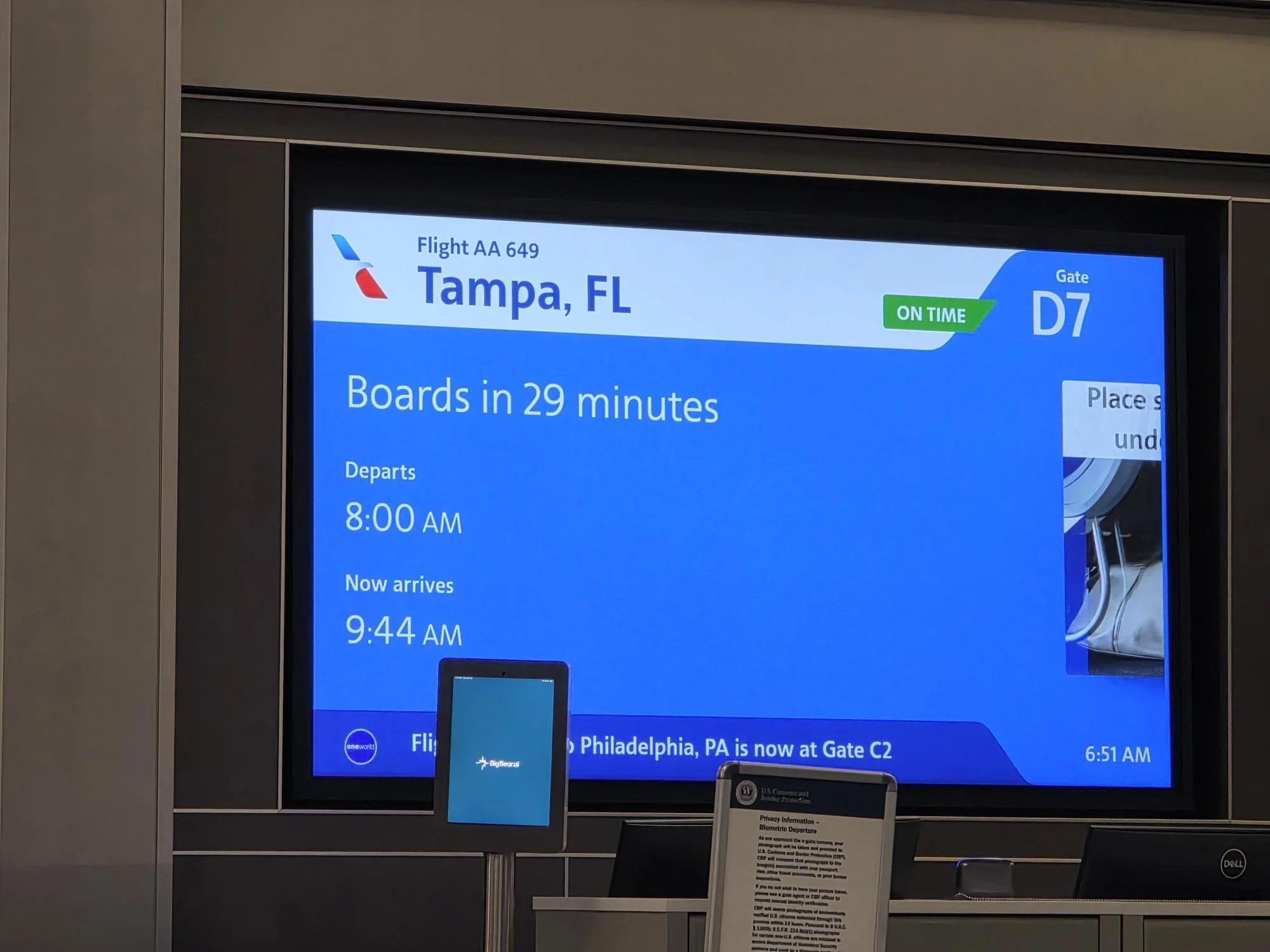
Cruise Day 1: CLT to TPA, and Then… We Have a Maintenance Issue! 🚨✈️🚢
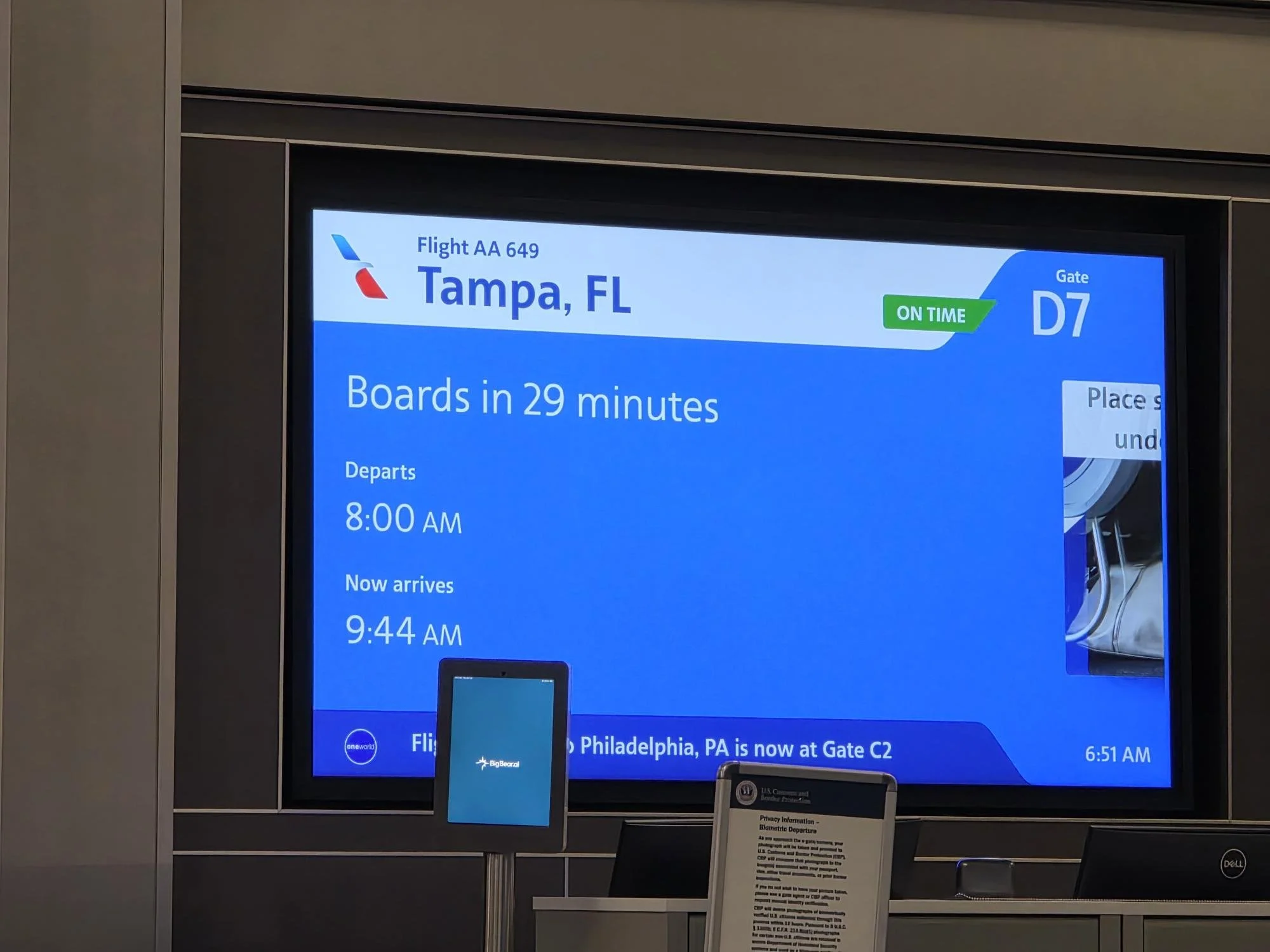
Well, folks, the adventure to Radiance of the Seas has officially begun. And apparently, a cruise vacation needs a little pre-cruise drama, so we’re starting with an unexpected twist at Charlotte Douglas International Airport (CLT).
As I mentioned in an earlier blog post, I changed my travel plans so I could spend some time with Airica. Now, I'm at CLT, headed to Tampa (TPA), where my Royal Caribbean cruise awaits.
What could possibly go wrong?
Oh, you know. The usual.
Getting to the Gate Was an Adventure in Itself
I got to the airport early, and thank goodness I did!
I've flown out of CLT fewer than a handful of times, and I've never parked there before. Naturally, I made a wrong turn. Fortunately, I got redirected and eventually made my way to where I needed to be.
Then came the bag drop.
Then TSA.
And that's where things are a little different for me these days. With a metal component attached to my leg below the knee, getting through security involves a different process than it used to.
After that adventure, I requested wheelchair assistance to the gate. No need to exhaust myself before the vacation even begins!
Once I arrived, I picked up a Coke Zero to get some caffeine into my system. Thursday started a whole lot earlier than I'm accustomed to, and I needed a little help getting my brain online.
I found a seat, opened my laptop, and started blogging.
Look at me, being productive at the airport!
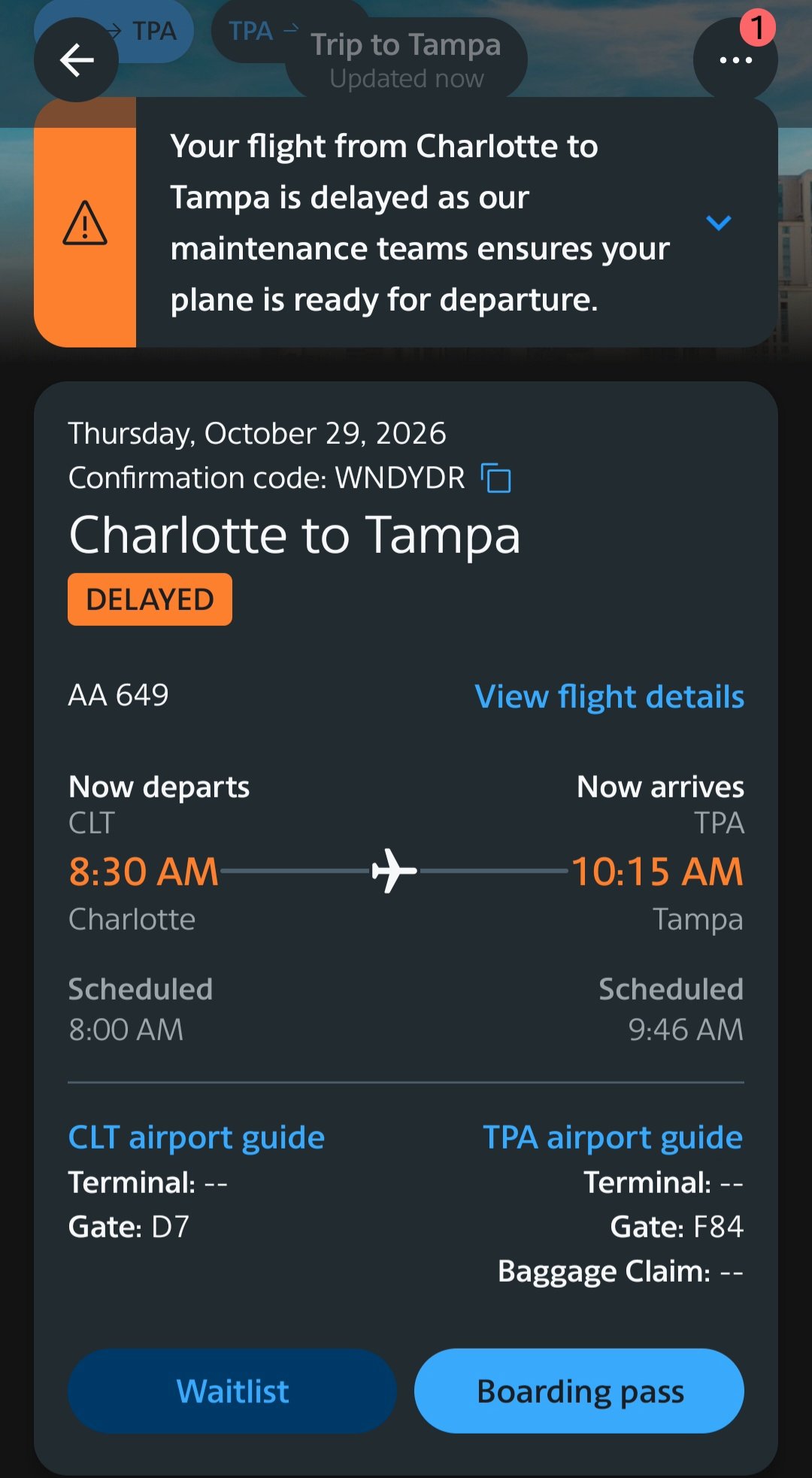
And Then… BAM!
I boarded the plane, settled into my seat, and waited for the flight attendant to take my beverage order.
I was ready to relax, enjoy my flight to Tampa, and start this cruise vacation.
Then came the announcement.
"There's a maintenance issue that's going to take longer than expected, and we're going to have you all deboard."
Well, that's a sentence nobody wants to hear after they've already boarded.
And just like that, everyone was getting off.
As I write this, we haven't been given any additional information. We don't know exactly what the maintenance issue is, how long it will take, or what happens next.
So here I sit, back on the ground at CLT, wondering when my Tampa adventure will resume.
At Least There's One Silver Lining
My ship doesn't require me to be onboard until 3 p.m.
That gives me some breathing room, assuming this maintenance delay doesn't turn into an episode of Airport: The Extended Edition.
I'm trying to keep things in perspective. I'd much rather have an airline identify and address a maintenance issue before we take off than have someone decide it's not worth the delay.
Safety first. Vacation second.
Although if the airline could hurry things along a little, that would be lovely.
I've got a ship to catch, an ocean to enjoy, bacon to eat, and people to watch.
And somewhere in Tampa, Radiance of the Seas is waiting for me.
Stay tuned. This cruise hasn't even started, and I've already got blog material. 😂
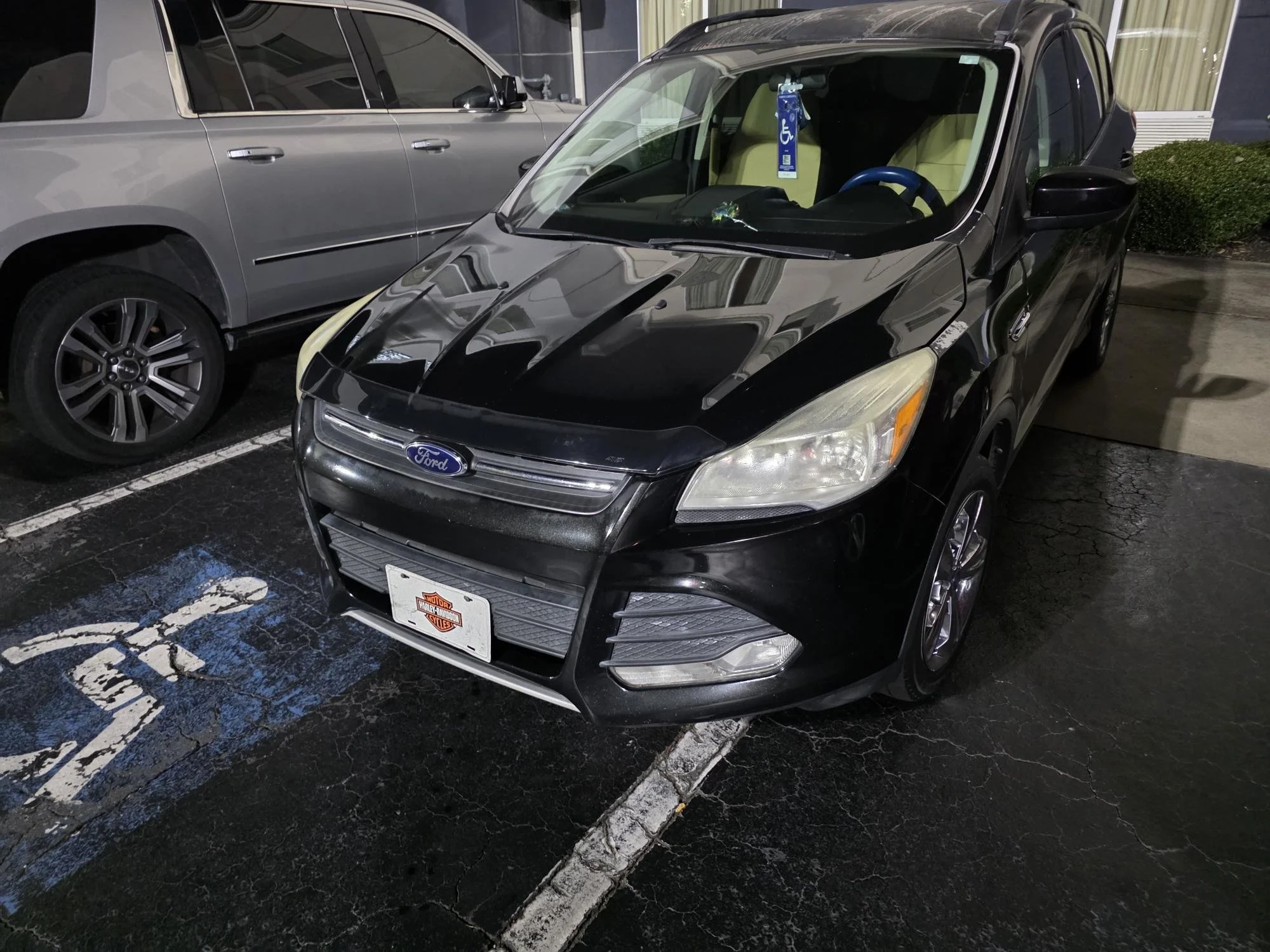
Parking Like You're Riding a Harley? This Ford Escape Missed the Mark!
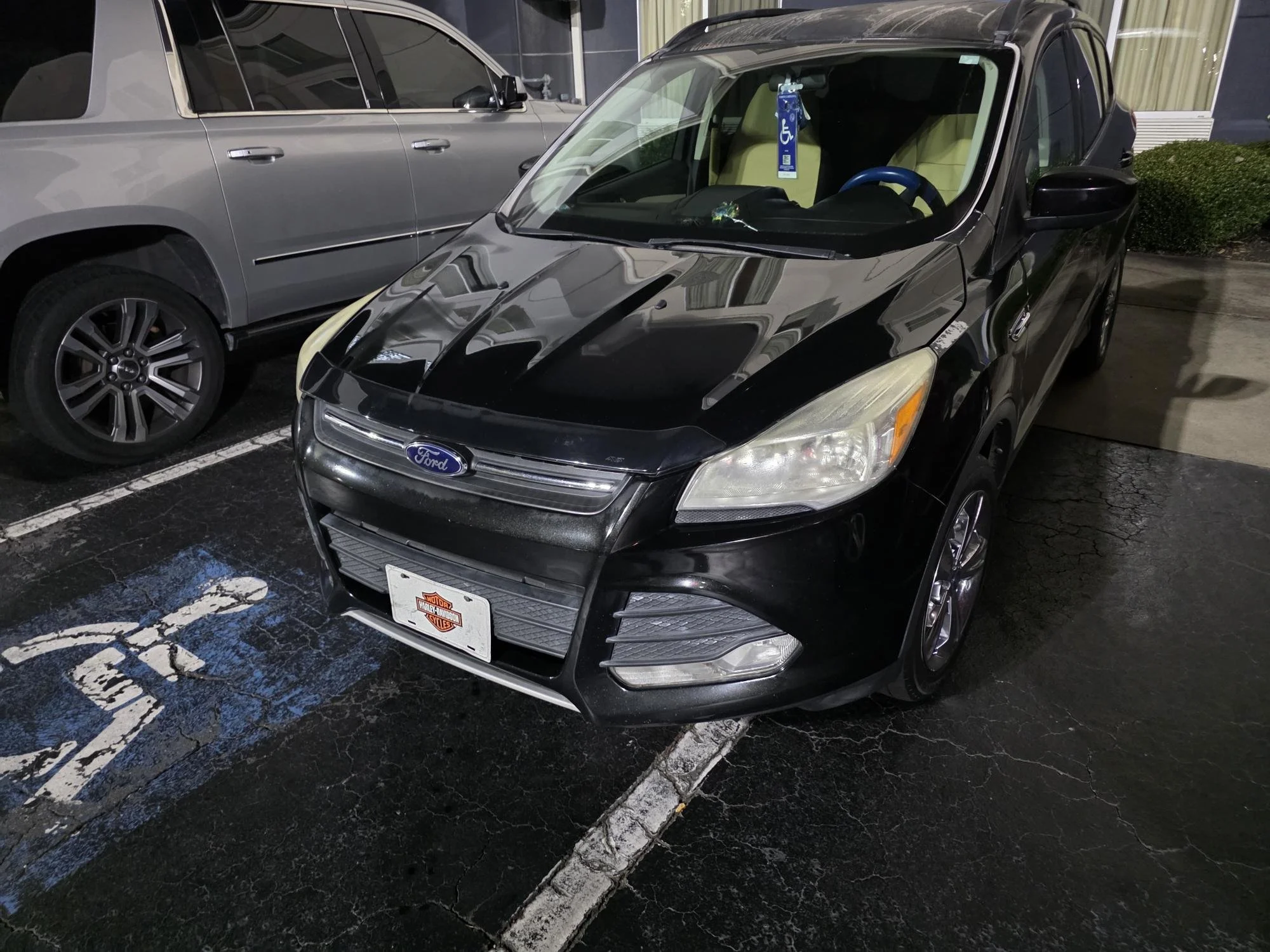
Sometimes I wonder if driver's education needs a refresher course in parking.
I was staying at a Fairfield Inn about 15 minutes from Charlotte Douglas International Airport (CLT). I'll save the details of my hotel experience for another blog post, but this little adventure happened when I got up and headed out to my car.
And then I saw this beauty of a parking job.
A black Ford Escape was parked diagonally across the parking-space line, its front end intruding into the neighboring space. A handicap symbol is even painted on the pavement nearby, making the whole scene a little more interesting.
Now, I noticed the Harley-Davidson placard on the front bumper. So naturally, my imagination started working overtime.
Maybe the driver thought they were parking their HOG and figured the passenger side was the center of the motorcycle? Perhaps they were still mentally cruising down the highway and forgot they were driving a four-wheeled vehicle.
Okay, I know. That explanation makes absolutely no sense. Neither does this parking job!
Come on, people! The lines are there for a reason. They're not decorative suggestions, and parking spaces aren't a game of automotive Twister.
As someone who lives with a disability, I pay attention to how people use parking spaces. A little consideration goes a long way, especially when accessible parking and enough room to get in and out of a vehicle matter.
I'm not suggesting every parking mistake deserves a public investigation. We've all had moments when we needed to straighten up. But there's a difference between being a little off-center and leaving your vehicle straddling a line like it owns the place.
The takeaway? Take five seconds, check your parking, and straighten the car before walking away. Your fellow drivers will thank you.
And to the driver of this Ford Escape: I hope you enjoyed your stay. Next time, let's leave the Harley-Davidson parking technique for the motorcycle!
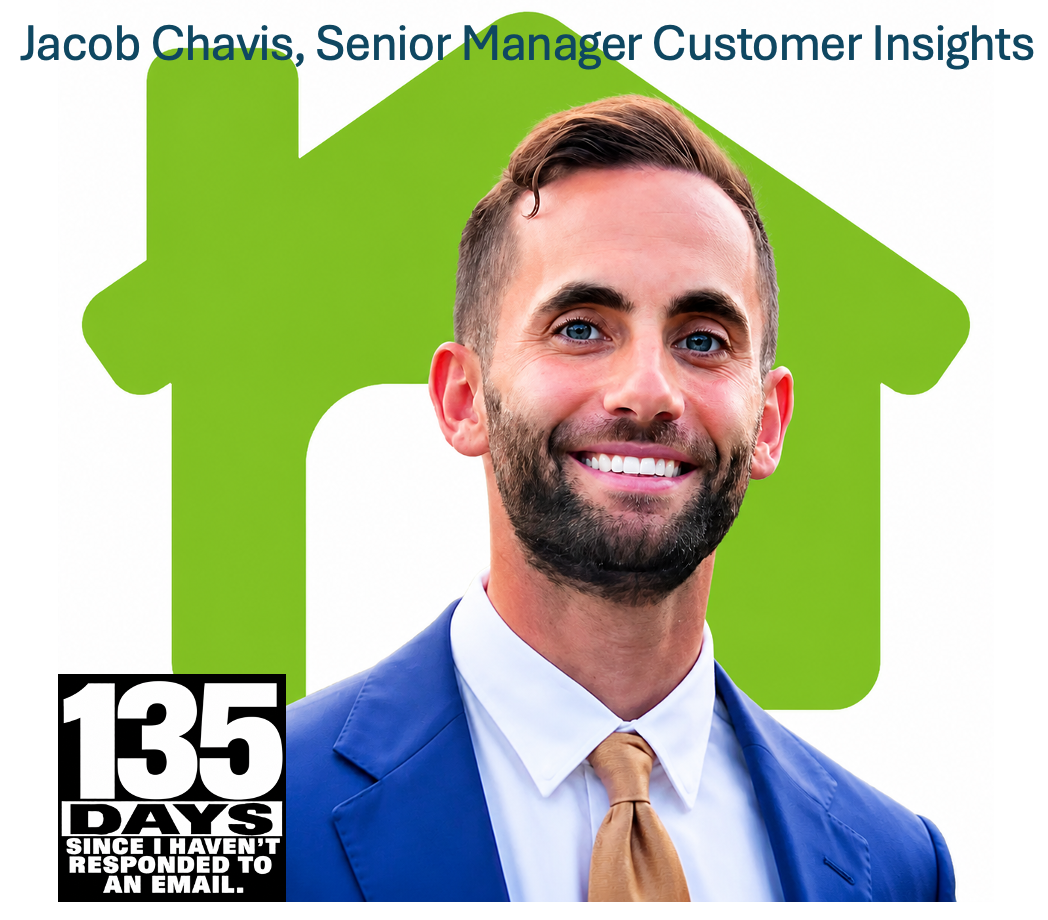
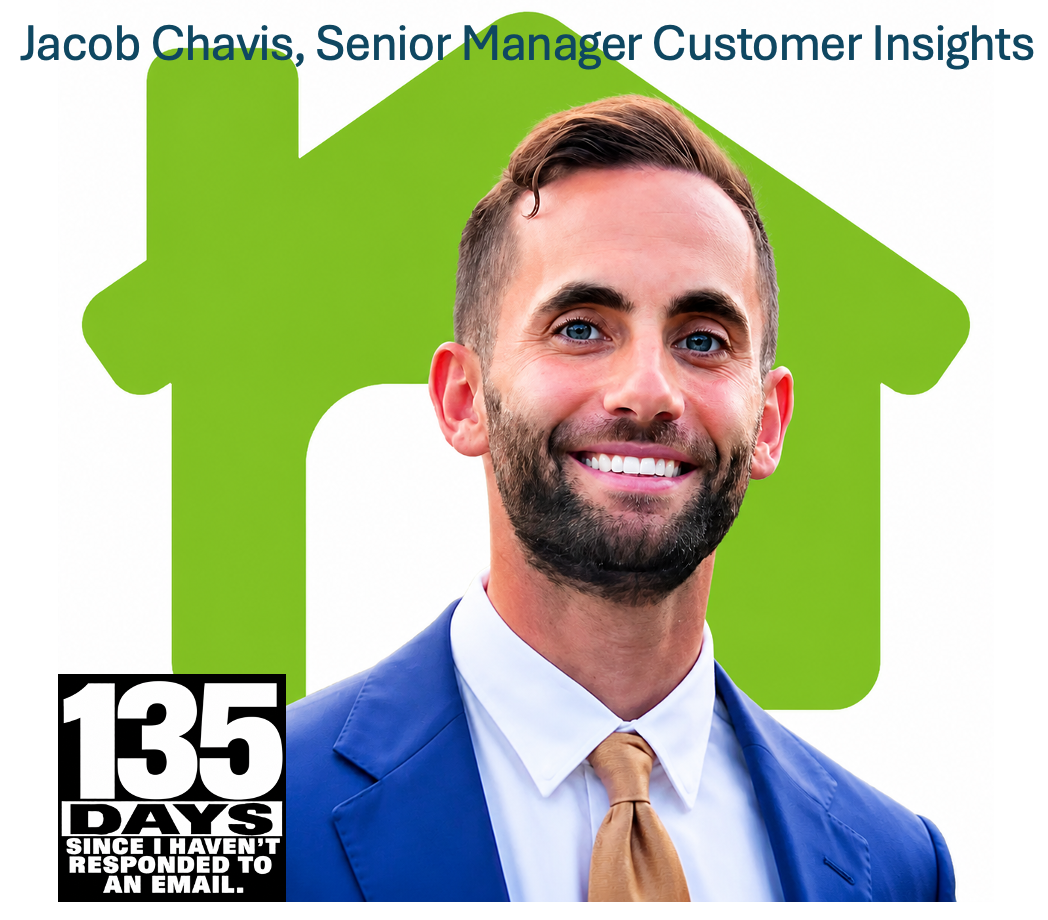
Day 135: Nextdoor Rings the Bell. The Questions Are Still Ringing.
Fifteen years of Nextdoor. A celebration at Nasdaq. A stock price of $2.37. And a research request that remains unresolved.
Today, Nirav Tolia and members of Nextdoor's leadership team celebrated the company's 15th anniversary by ringing the closing bell at Nasdaq.
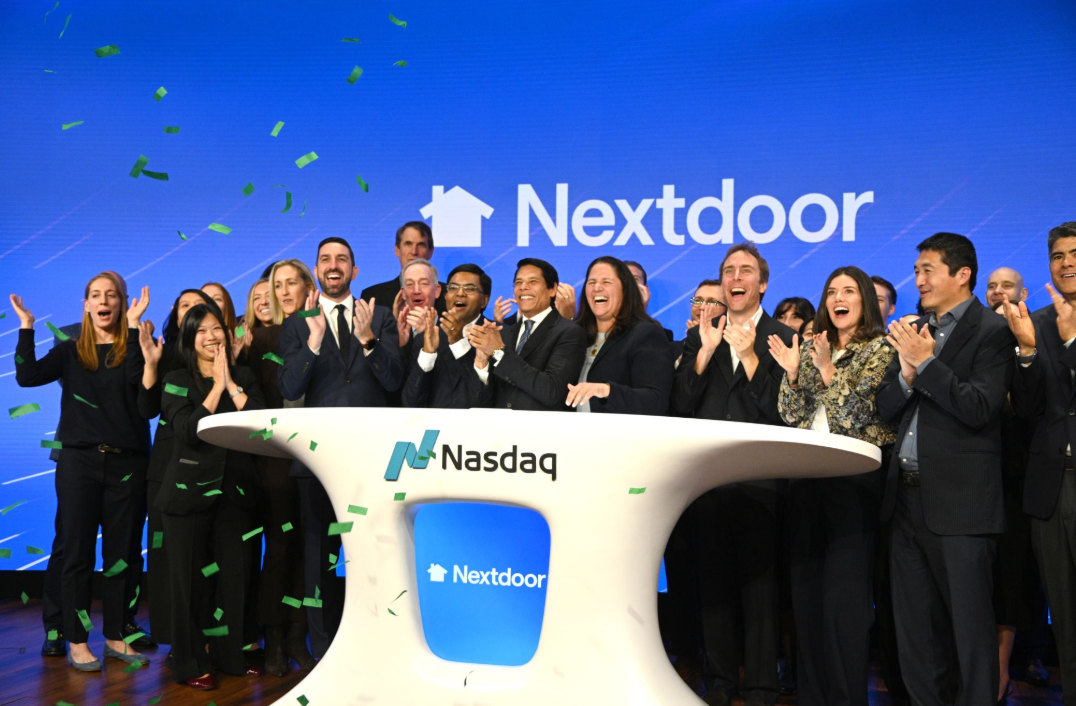
Look at the photograph. Everyone is smiling, applauding, and celebrating. The Nextdoor logo fills the background. It's a moment designed to communicate achievement, momentum, and success.
Now look at my E*TRADE screenshot.
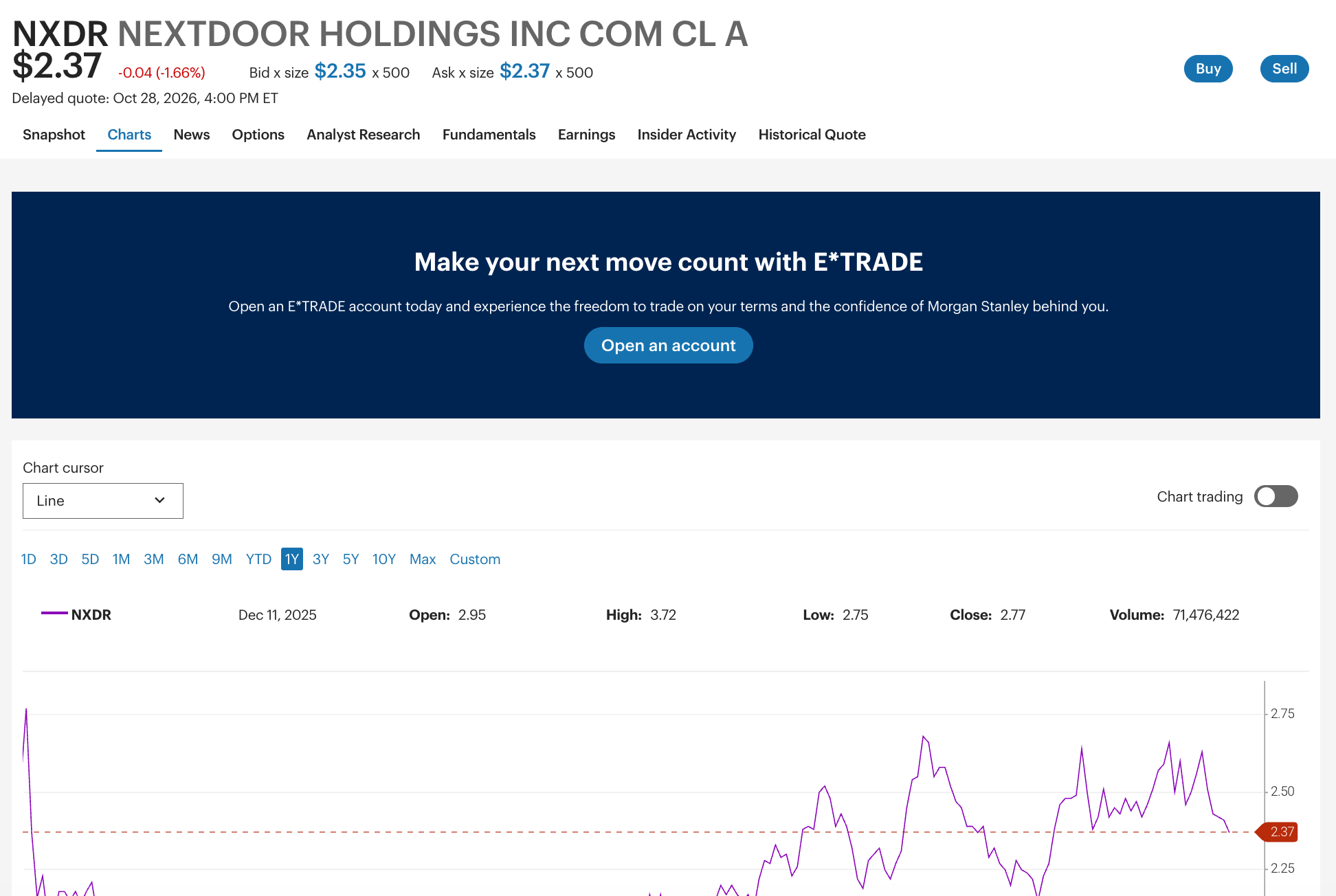
NXDR closed at $2.37 on October 28, 2026, down $0.04, or 1.66%, for the day.
Two pictures. Two very different messages.
I'm not suggesting that the ceremony caused the stock to fall. There's no evidence of that. Nor does one day's movement tell us whether Nextdoor is succeeding or failing as a business.
But I do think the contrast raises a worthwhile question:
What, exactly, are we celebrating—and how should we measure whether Nextdoor has delivered on its promise?
Day 135: A Thank-You to Nirav Tolia and Nextdoor
I'd like to thank Nirav Tolia and the Nextdoor team.
Seriously.
Thank you for not resolving my original request, made more than a year ago, for the detailed data behind Nextdoor's published research. Thank you for the subsequent communications that directed me back to public blog posts rather than providing the detailed reports I requested.
And thank you for letting that request remain unresolved for 135 days in this chapter of my case study.
I realize that sounds sarcastic. It is.
But there's a genuine point underneath it.
By not providing the information I requested—or clearly resolving the request in a way that ended the uncertainty—you gave me the opportunity to learn a great deal about the company.
I learned more about weekly active users (WAU), revenue, adjusted EBITDA, and the difference between a company's financial performance and its investors' returns.
I've taken a refresher course in stock terminology and the relationship between market performance and corporate milestones.
And today, I learned more about how a company can celebrate an anniversary with a stock-exchange bell-ringing ceremony.
That last lesson was particularly timely.
The ceremony is a public-relations opportunity. It creates photographs, social media content, and a positive story about the company's history. There's nothing inherently wrong with that. Companies use milestones to celebrate employees, attract attention and tell their stories.
But a ceremony is not proof of business success.
And a photograph of executives celebrating doesn't answer questions about users, investors, small businesses, or accountability.
Fifteen Years Later: What Does Nextdoor Have to Show for It?
Nextdoor began operating its platform in 2011. Its business has evolved, and there are real accomplishments worth acknowledging.
In its second-quarter 2026 results, the company reported $75 million in quarterly revenue, up 15% year over year; 22.9 million weekly active users on the platform, up 5%; and a net loss of about $2 million, compared with about $15 million a year earlier. Adjusted EBITDA was approximately $10 million.
Those are measurable improvements. I won't pretend otherwise.
But fifteen years in business should invite a broader examination than a list of quarterly highlights.
Here are the areas where I believe Nextdoor still has serious questions to answer.
1. The Business: Can Nextdoor Turn Its Potential Into a Durable Business?
Nextdoor has built a network spanning hundreds of thousands of neighborhoods. It has local conversations, recommendations, safety alerts, business listings, and advertising opportunities.
That is a valuable foundation.
Yet the company has also acknowledged in its regulatory filings that it is still scaling its monetization efforts and that its ongoing product transformation may not produce the engagement or monetization it expects.
My questions include:
Can Nextdoor consistently convert engagement into sustainable revenue?
Can it make the platform more useful without alienating existing users?
Can it improve trust and moderation while growing its commercial business?
Can it establish a durable path to GAAP profitability?
Can it demonstrate that its strategy produces lasting results rather than periodic bursts of optimism?
These claims don't mean Nextdoor has accomplished nothing. They're questions about whether the company has converted its substantial potential into the durable business its supporters expect.

2. Investors: Where Is the Long-Term Return?
Nextdoor became a publicly traded company in 2021. Investors have had years to evaluate the business, its strategy, and its execution.
But revenue growth and an improving operating picture don't automatically translate into strong returns for every shareholder.
My own experience led me to sell my NXDR shares on October 12. I decided I had waited long enough for the investment case to develop, and I was no longer willing to keep waiting for the outcome I had hoped to see.
Today, the screenshot shows NXDR at $2.37, down 1.66% for the session.
That single day's decline doesn't establish the company's long-term prospects. Similarly, executives ringing a bell doesn't mean shareholders have been rewarded.
The questions remain:
Has Nextdoor delivered the long-term shareholder value investors expected?
Can the company sustain revenue growth and improve profitability?
How should investors evaluate management's promises against actual results?
What milestones would demonstrate that the business has reached a new level of maturity?
A corporate anniversary is a calendar milestone. Shareholder value is measured over time.
3. Small Businesses: Are They Getting Enough Value?
Local businesses are a central part of Nextdoor's appeal. Neighbors recommend contractors, restaurants, service providers, and other local businesses. Those recommendations help people decide and can help businesses win customers.
Nextdoor has opportunities to monetize this local commercial activity through advertising and business products.
But one important question remains: how does the platform balance its commercial interests with the interests of the businesses and neighbors who make it useful?
I want to know:
Do local businesses clearly understand the value they receive from paid products?
Can they determine whether advertising generates meaningful results?
Does the platform provide a useful experience for businesses that rely on organic recommendations and free tools?
How does Nextdoor maintain trust when it monetizes local attention and community-generated knowledge?
Nextdoor offers free business tools, so it's inaccurate to say every business must pay to participate. The question is whether businesses of different sizes can understand and access meaningful value from the platform.
4. Users: Who Creates the Value, and Who Benefits?
This has been one of my central questions throughout the case study.
Neighbors create the content that makes Nextdoor useful. They recommend businesses, share local information, warn others about safety concerns, answer questions, and contribute knowledge about their communities.
Without those contributions, the platform would have far less value.
Yet users have raised concerns about content moderation, inconsistent decisions, communication, and the handling of appeals. I've documented my own experiences and the questions they have raised.
My questions include:
Are moderation decisions consistent and understandable?
Can users obtain meaningful explanations when content is removed?
Are appeals reviewed effectively?
Does Nextdoor communicate clearly when users raise substantive concerns?
Does the company recognize the value of the contributions that keep the network useful?
I don't expect every post to remain online or every appeal to succeed. A community platform needs rules.
But users should understand how those rules are applied and how they can challenge decisions.
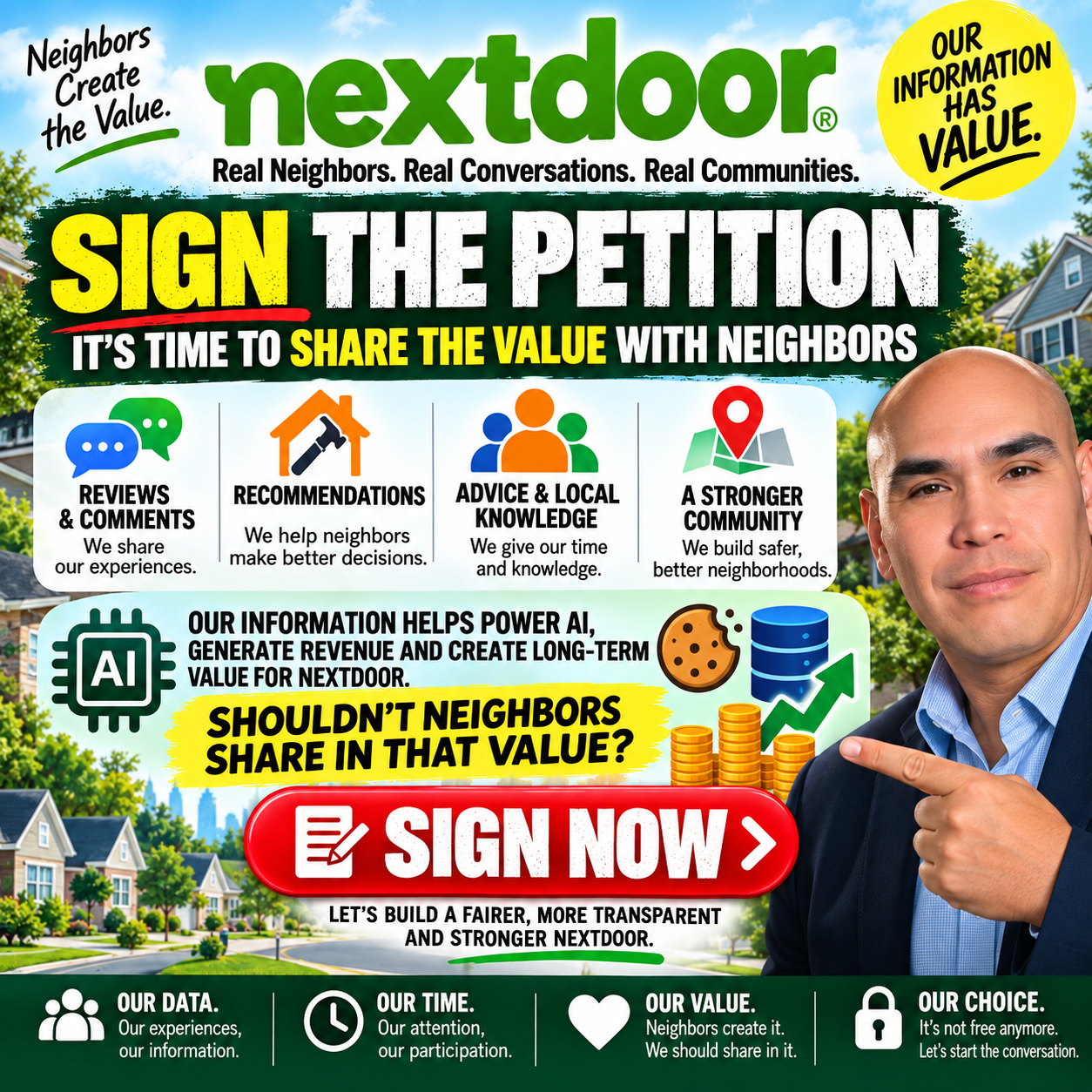
And when community-generated knowledge becomes a commercial asset, I believe it's reasonable to ask whether the people contributing that value should have more choices about how it is used.
5. Leadership and Accountability: Who Answers the Difficult Questions?
This is where my personal case study comes back into focus.
I've spent months asking questions about Nextdoor's moderation, communication, research transparency, and leadership accountability.
One unresolved issue has been my request for the detailed data behind two Nextdoor Insights studies. The public posts described additional research details as available through contact with Jacob Chavis. I asked for the underlying detailed reports—not another link to the public summaries.
I have received communications directing me to those public summaries, but I have not received the detailed reports I requested.
As of Day 135, that request remains unresolved.
I recognize that the company may have restrictions or reasons it cannot share particular materials. If so, it can explain that. It can say the reports are unavailable, access is restricted, or someone else is responsible for the request.'
A clear resolution would help.
This isn't about demanding that a CEO personally answer every question sent to the company. It's about whether an organization has a reliable process for responding to substantive requests and closing the loop.
And that’s why today's celebration feels so disconnected from my experience.
The company can coordinate a public ceremony, publish a celebratory announcement, and put its leadership team in front of cameras. Those are visible activities.
But an unresolved research request reminds us that important work also happens outside the spotlight.

6. Transparency: Publicity Is Not the Same as Accountability
The bell-ringing ceremony is a publicity opportunity. I don't mean that as an accusation of wrongdoing. Public companies routinely use ceremonies and anniversaries to celebrate their history.
But publicity and accountability serve different purposes.
Publicity tells the world what a company wants people to see.
Accountability gives people ways to evaluate whether the company is delivering on its commitments.
Nextdoor can celebrate fifteen years of connecting neighbors. It can highlight its growth, products, and financial progress. It can point to new advertising initiatives and improved operating results.
And those accomplishments deserve to be assessed on their merits.
But there are other measures of progress:
Whether users trust the platform.
Whether moderation works consistently.
Whether businesses receive meaningful value.
Whether investors can see a credible path to sustained performance.
Whether leadership responds constructively to difficult questions.
Whether the company resolves legitimate requests for information.
A closing-bell pt captures all of that.
My Suggestion: Celebrate a Milestone That Means Something
Here's my suggestion to Nirav Tolia and Nextdoor.
Rather than making the bell-ringing ceremony the centerpiece of a fifteen-year celebration, I would prefer the company set clear, measurable milestones and celebrate when it achieves them.
For example:
Sustained GAAP profitability.
Consistent user growth accompanied by stronger retention and trust.
Clear evidence that local businesses are getting meaningful value.
Transparent and effective moderation and appeals processes.
A track record of responding to substantive questions and resolving them.
Demonstrable long-term value creation for shareholders.
These are examples, not a claim that the company has made no progress toward them. Some may already be improving; others will require time and evidence.
But they are the kinds of outcomes that would make a celebration especially meaningful to me.
A bell-ringing ceremony is a moment. Building a durable, trusted, and financially sustainable company is the achievement.
And a fifteenth anniversary is a fine time to reflect on both.
Day 135: The Bell Rang. My Questions Remain.
Nirav and the Nextdoor team were smiling in the photograph. I don't begrudge them the celebration. Employees deserve to celebrate the work they've done, and a company is entitled to mark its history.
But the market closed at $2.37 that day, according to my E*TRADE screenshot, and my questions about the company remain.
I am not suggesting that the stock decline was caused by the ceremony, nor am I claiming that one closing price defines Nextdoor's future.
I'm asking for a more meaningful standard of success than the ability to arrange a public celebration.
Fifteen years after launching the platform, Nextdoor has a substantial network, growing revenue, and recent improvements in its financial results. It also still needs to demonstrate durable profitability, build user trust, deliver value to businesses and shareholders, and ensure legitimate questions get clear answers.
I will keep documenting the gap between the company's promise and its execution.
So, congratulations to the employees who helped build Nextdoor over the past fifteen years.
As for the next milestone, I'd suggest choosing one that reflects measurable progress.
Don't ring the bell just because the calendar says fifteen years. Ring it when you've built something that stands up to the questions.
👉 Follow my continuing Nextdoor case study at NielFlamm.com/blog.
The Hinge Experiment: Why It Gotta Be Black? 🐓🍷
I made it to Columbia, South Carolina!
Traffic slowed me down a little, but I still made good time. I planned to meet Airica at 6:30 p.m., and I estimated I'd arrive at 5:15 p.m.
That left me with some time to kill. I'd planned to stop at Starbucks, mess around, and see some of the sights in West Columbia.
Then came the text.
"Where are you?"
I responded through Android Auto that I was about 15 minutes away, with an ETA of 5:15.
The response?
"Go on by."
Well, okay then! Starbucks and sightseeing would have to wait. I was heading to pick up Airica.
And that brings us to the latest chapter of The Hinge Experiment, featuring a steakhouse, a cheese board, some excellent conversation, and one very important question:
Why it gotta be black?
Great Minds, Steak Alike
Earlier, while I was packing for the cruise, Airica and I talked on the phone. She was driving and using Bluetooth, and we talked about where to go for dinner.
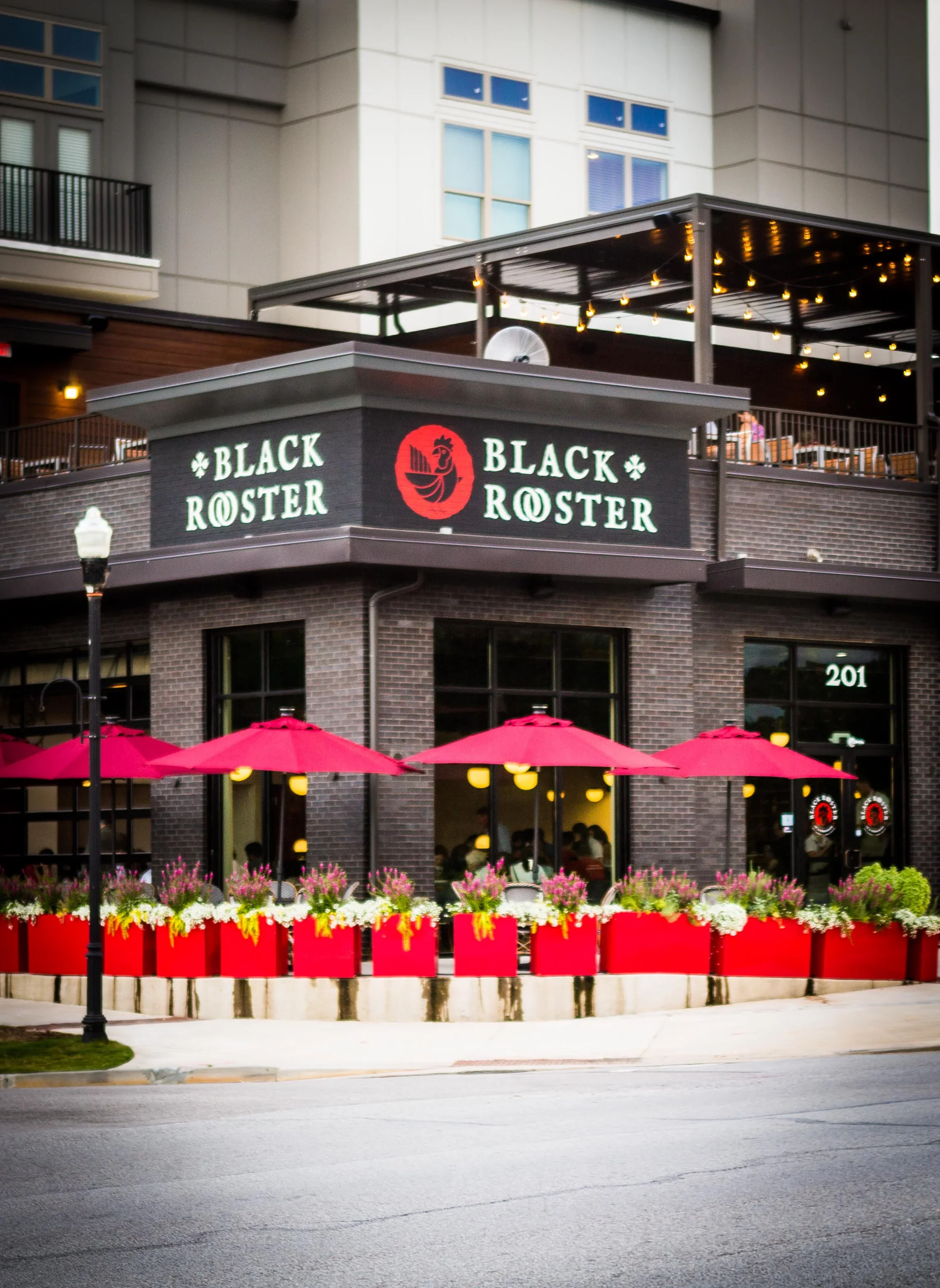
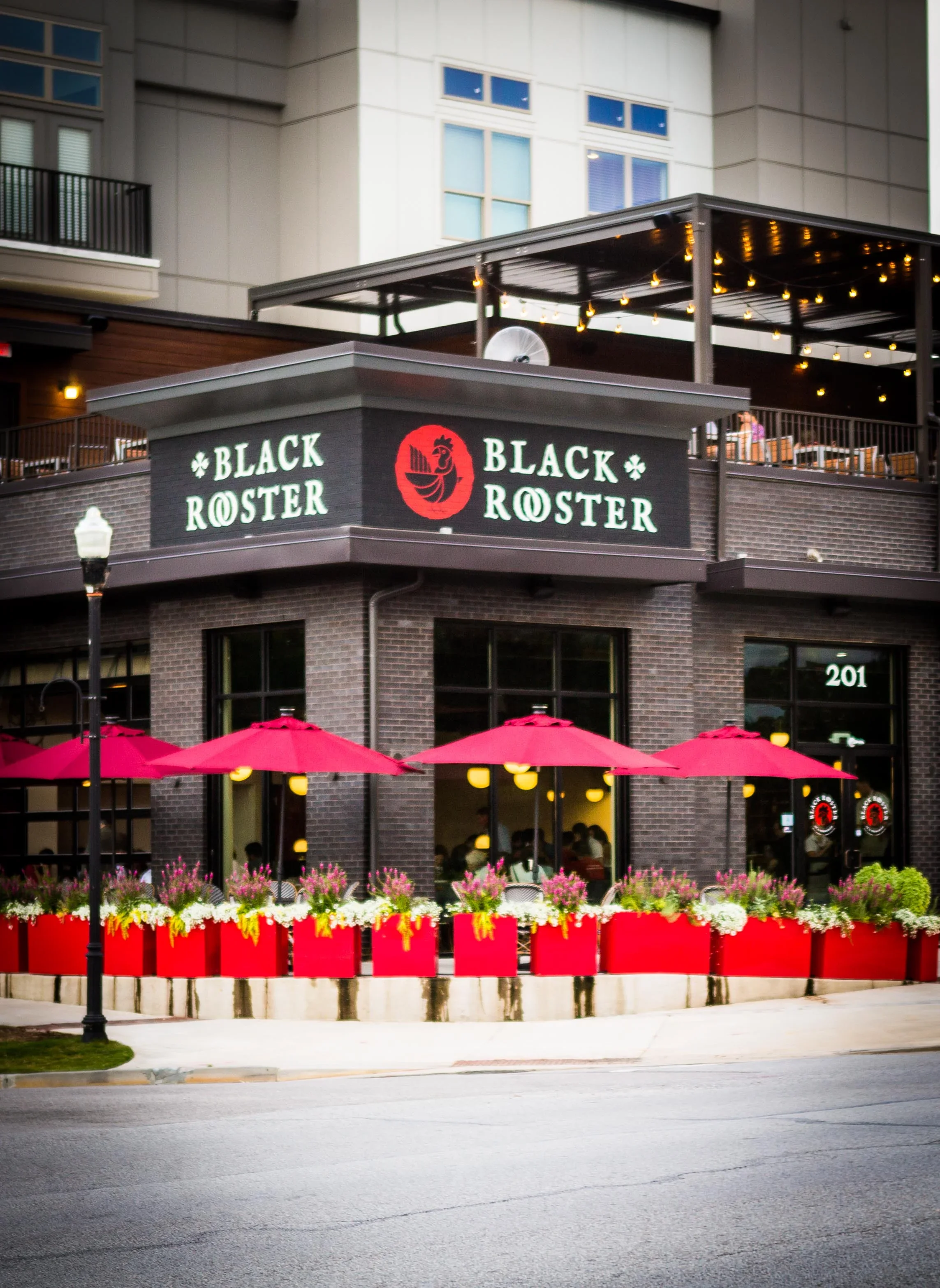
At dialysis, I'd done a little research. Airica likes steak, so I searched for steak restaurants in the Columbia area. One place kept coming up with great reviews on The Google: Black Rooster.
I mentioned it to her.
Her reaction? She was thinking the same thing!
As it turns out, she'd already been there by herself, taking herself out on a date.
I like that. Taking yourself out, enjoying a meal, and not waiting for someone else to make plans is a good thing.
But now I'm wondering: Are the planets aligned? Is the universe trying to tell me something? Did somebody at NASA change the coordinates?
Or did two people who enjoy a good meal independently come up with the same restaurant?
Let's not get carried away. I tend to overthink things, and I have a cruise to catch.
I picked up Airica, and seven minutes later, we were at Black Rooster.
Parking was easy, the interior was cool, and we were ready to eat.

The Cheese Board: A Very Important Discovery
The service was fantastic from the start.
Airica loves cheese, so we naturally ordered the cheese board.
It featured three distinctive cheeses: a soft cheese, a blue cheese, and a hard cheese. The server did an excellent job explaining and presenting everything.
I'm always impressed when someone takes the time to make the dining experience more than just putting food on a plate.
And when I’m dining with someone who appreciates cheese, I don't interfere with the cheese situation.
I just go with it.
For our entrées, Airica ordered the Steak Frites, while I chose the Shrimp and Polenta.
Both meals were enjoyable, and mine came with a little kick.
I'd asked about the heat level because one of the ingredients was a chile. I was warned, and I responded that I would "take my chances."
Famous last words.
It was bearable, but it was about as hot as I'm willing to go. Yes, I'm a wimp when it comes to spicy food. I know my limitations, and I prefer to enjoy my meal rather than have my taste buds file a formal complaint.
We also shared Brussels sprouts.
They were good, but I thought they could have used some bacon. Apparently, my culinary philosophy is that bacon can improve many vegetables.
I'm not saying that's scientifically proven.
I'm just saying the Brussels sprouts and I had a meeting, and bacon was one of the recommendations.

The Great Beverage Disappointment
Now we get to the one area where Black Rooster and I disagreed a little.
The restaurant serves Coca-Cola products, but it didn't have Coke Zero.
Strike one.
My second choice is usually San Pellegrino. No luck there, either.
Airica's preferred drink is a half-and-half. I learned that on our first date, so I already knew her go-to order.
Unfortunately, they didn't have iced tea.
Strike three!
Apparently, the beverage department and I weren't on the same page.
Of course, no restaurant can be everything to everyone. The food was good, the service was phenomenal, and we had a wonderful evening.
But if anyone from Black Rooster reads this, I'm just saying a Coke Zero would make me very happy.
And possibly a San Pellegrino.
I'm not asking for much. Just options for a man who has very specific beverage requirements.
Conversation, Connection, and a Cruise on the Horizon
The best part of the evening wasn't the cheese board or the shrimp and polenta.
It was the conversation.
We talked about our days, my upcoming cruise, all the preparation involved, and what I would be doing about dialysis while I was away.
Traveling with end-stage renal disease requires planning. Dialysis doesn't simply disappear because I want to take a vacation. I have to think about scheduling, treatment arrangements, and the potential risks involved.
I take it seriously, even when I'm joking about everything else.
We also talked about Halloween and whatever else came up naturally.
That's one of the things I've enjoyed about spending time with Airica. We can talk, laugh, ask questions, share experiences, and learn more about each other.
I'm not trying to predict the future or assign a meaning to every little thing. Well, I'm trying not to.
Sometimes I succeed.
Sometimes my brain opens a new spreadsheet.
But I appreciate that we're making time for each other and continuing to get to know one another.
The S'mores Were Calling My Name
We skipped dessert.
The S'mores dessert looked fantastic on paper, and under normal circumstances, I might have been tempted.
But after the cheese board, our entrées, and the Brussels sprouts, I had reached my food capacity.
Some moments in life require difficult decisions.
Tonight, the decision was between S'mores and being able to breathe comfortably.
I chose breathing.
The S'mores will have to wait for another day.
The Gift and My Suspicious Influence
After dinner, we headed back, and the drive was fantastic.
More conversation, more time together, and eventually, the inevitable goodbye.
Before we parted ways, I left Airica with a gift.
And here's where I'm going to be a little mysterious.
The gift was a hint that I'm beginning to introduce her to one of my addictions.
No, not anything illegal. Settle down!
I'm talking about one of those interests that can start innocently enough and then suddenly take over your life.
What is it?
You'll have to wait and see.
Let's just say that if she gets hooked, I may have created a monster.
And I accept absolutely no responsibility.
Okay, maybe a little.

The Return Trip Is Already on the Calendar
We also made plans for me to see Airica when I return from the cruise.
I'll fly back into Charlotte and land around 2:30 p.m. From there, it's roughly a two-hour drive, followed by dinner, some awesome conversation, and then the drive home.
Because apparently, I haven't driven enough miles lately.
My car is probably wondering why I keep calling it a vehicle when it has become my primary travel companion.
Still, I'm looking forward to seeing her again.
We have busy schedules, travel plans, and responsibilities. Finding time to spend together takes a little effort, but I'm grateful we're making it happen.
The Hinge Experiment continues, one dinner and one road trip at a time.
But Seriously... Why It Gotta Be Black?
Now, let's return to the most pressing question of the evening.
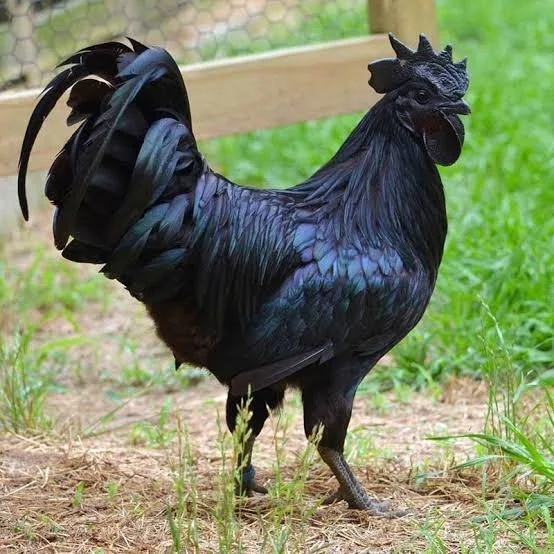
Why is it called Black Rooster?
I still don't know.
I also had no idea roosters could be black.
Of course, a quick reality check: roosters can absolutely have black feathers. Some breeds have entirely black plumage, and some even have black skin and other dark features.
So the name isn't biologically impossible.
But I still want to know the story behind the restaurant's name.
Is there a rooster involved? Was there a legendary black rooster in the neighborhood? Did somebody just think it sounded cool?
I may never know.
For now, I'll remember Black Rooster as the place where Airica and I independently thought of the same restaurant, enjoyed a great meal, had a wonderful conversation, and discovered our beverage preferences aren't entirely compatible with the menu.
Not a bad Wednesday evening!
And now, on to Tampa and the cruise.
Stay tuned. The Hinge Experiment is going places.
Literally. 🚗🚢
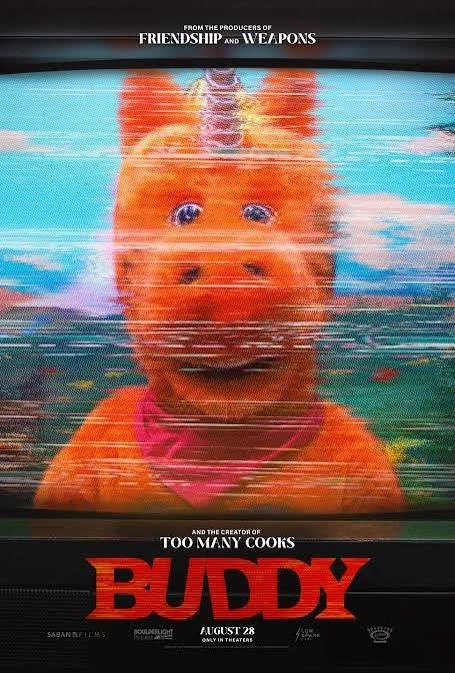
Buddy: When a Children's Movie Stops Being Child's Play 🦄
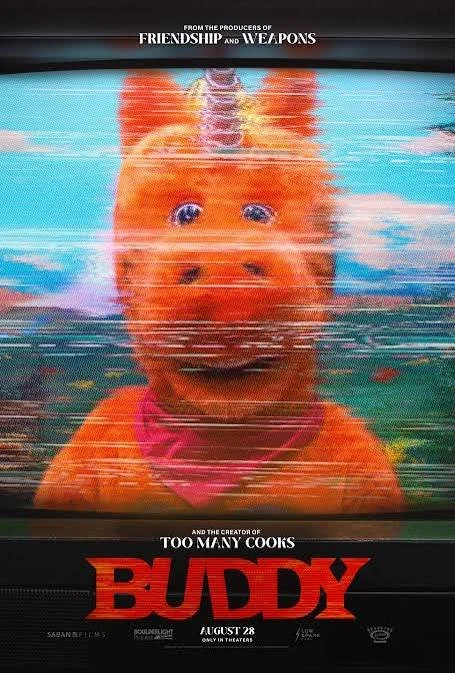
I thought Buddy was a kids' movie. An orange unicorn singing songs and teaching life lessons? I figured I knew what I was getting into.
I was wrong.
One of the movie's earliest lessons is that you have to be scared to be brave. A simple message, but worth thinking about: bravery doesn't mean not feeling fear. It means finding a way forward despite it.
But Buddy takes that cheerful beginning somewhere I wasn't expecting. The story gets increasingly unhinged, the familiar starts to feel strange, and by the end, I'm questioning what I thought I understood.
Sometimes the movies we overlook surprise us most.
🎬 Want to hear my full take on Buddy?
Watch my video review here:
👉 https://NielFlamm.com/videos
Come for the orange unicorn. Stay for the unexpected.
Or don't. 😉