
Congratulations! I’ve Apparently Bought Bitcoin, Paid a Mystery Subscription, AND Been Invited to a Scam
I have exciting financial news.
Apparently, while minding my own business, I purchased hundreds of dollars in Bitcoin.
Twice.
I also paid $398.99 for a subscription I don’t recognize.
I had no idea I was this financially active.
Even more impressive: all of these transactions were announced to me through Facebook event invitations.
Because when I think PayPal fraud department, naturally I think:
“Going” — “Maybe” — “Can’t Go.”
Nothing says urgent financial security alert quite like being asked whether I can attend my own fraudulent Bitcoin purchase.
The Scam That Keeps Inviting Me Places
Over the past couple of days, I've received several emails that look like Facebook event invitations.
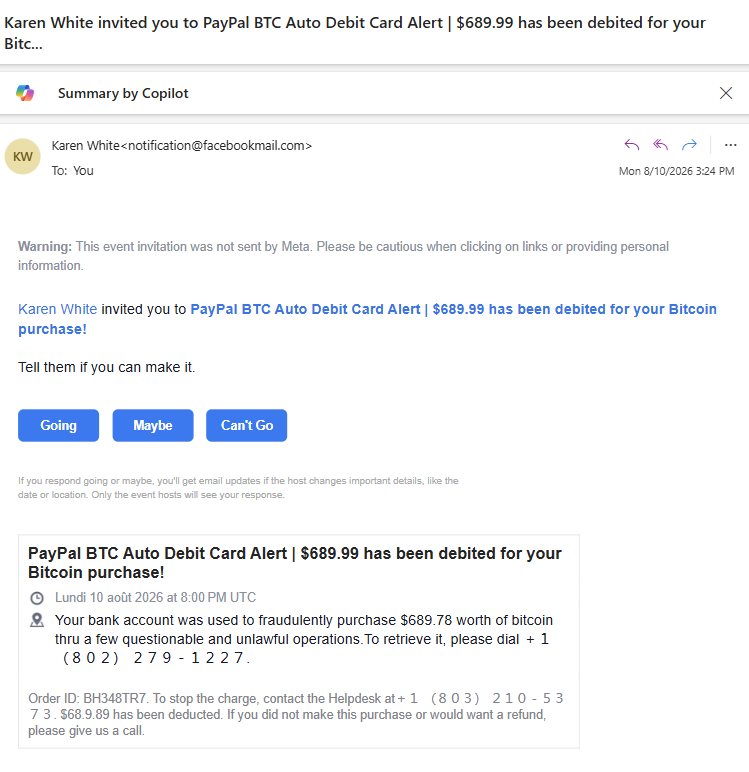
The first one came from “Karen White.”
Karen apparently invited me to:
“PayPal BTC Auto Debit Card Alert | $689.99 has been debited for your Bitcoin purchase!”
Well, Karen, thank you for thinking of me.
The invitation then gave me the traditional Facebook choices:
Going
Maybe
Can’t Go
I'm going with Can't Go.
I have plans that evening.
Also, I DIDN'T BUY ANY BITCOIN.
Then another invitation arrived.
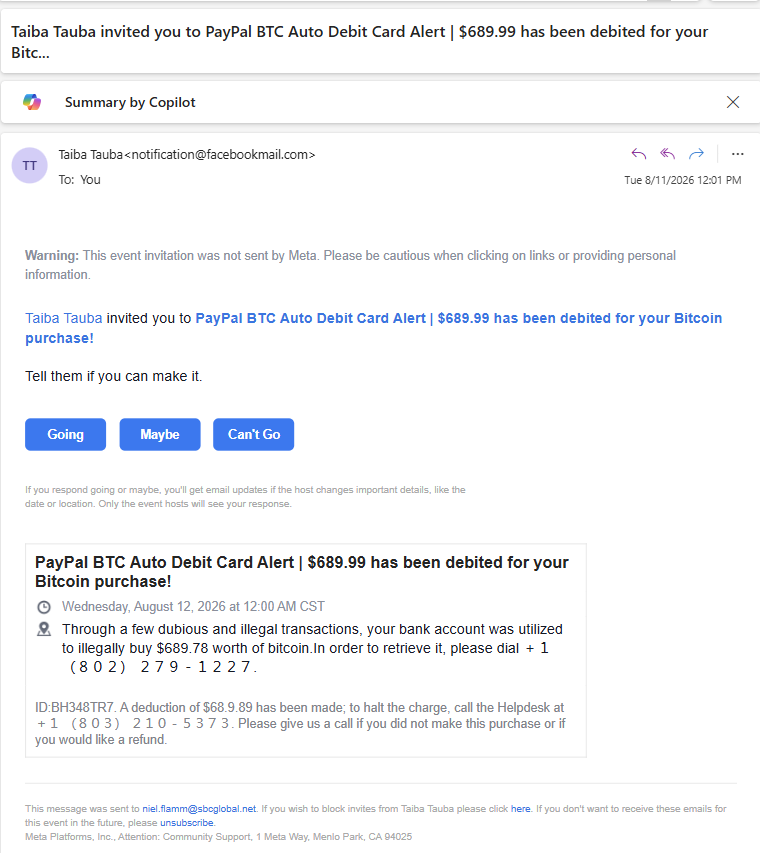
This time, my host was “Taiba Tauba,” inviting me to essentially the same $689.99 Bitcoin extravaganza.
Same general story. My bank account had supposedly been used fraudulently, and I needed to call a phone number to straighten everything out.
At this point, I'm beginning to feel bad.
Karen invited me.
Taiba invited me.
I'm turning down everybody.
This is going to destroy my social life.
Then the Scam Learned Spanish
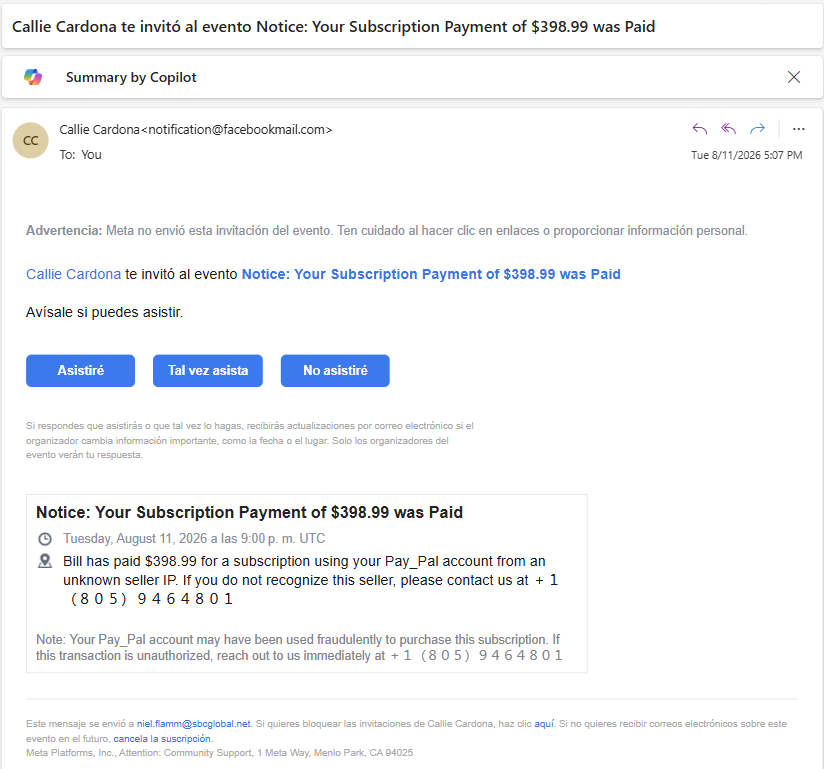
Later, I received another invitation from “Callie Cardona.”
For reasons unknown to me, Facebook presented much of this invitation in Spanish.
“Callie Cardona te invitó al evento…”
Apparently, my scam has gone international.
This time, it wasn't Bitcoin.
The subject announced:
“Notice: Your Subscription Payment of $398.99 was Paid.”
What subscription?
No clue.
Perhaps it's the premium membership to the People Who Keep Calling Random Phone Numbers From Scam Emails Club.
I was provided a phone number to call if I didn't recognize the transaction.
And that's the whole point.
They Don't Really Want the $689.99
The scammer isn't necessarily trying to convince you that you've already lost $689.99.
They're trying to make you panic about losing $689.99.
You see “PayPal.”
You see “Bitcoin.”
You see “$689.99.”
You see “fraudulent transaction.”
And then you see a phone number.
The hope is that your brain skips right over:
“Wait a minute…why is PayPal notifying me about financial fraud through a FACEBOOK EVENT INVITATION?”
…and goes directly to:
OH CRAP! CALL THE NUMBER!
Once you call, the scammer has you engaged. That's when they can try to obtain personal information, financial information, account credentials, remote access to your computer, or convince you to move money.
The fake transaction is the bait.
Your panic is the hook.
Facebook Even Warned Me
One of the funniest parts is that the emails themselves contain a warning:
“Meta did not send this event invitation. Please be cautious when clicking on links or providing personal information.”
That's a fairly significant clue.
It's basically Facebook standing in the background waving its arms:
“WE DIDN'T SEND THIS! DON'T BLAME US!”
The scammers appear to be exploiting legitimate event/invitation functionality to get their message delivered. That can make the email look more convincing because portions of the message may actually come through Facebook's notification system.
But a legitimate-looking messenger doesn't make the message legitimate.
If somebody tapes a fake IRS notice to a Domino's pizza box, it doesn't mean Domino's is collecting your taxes.
The Biggest Red Flag? The Phone Number
All three messages are designed to get me to do essentially the same thing:
Call a phone number.
No thanks.
If I receive an unexpected notice about a PayPal transaction, I won't call the number provided by the person saying my money is disappearing.
I'll open PayPal myself.
If it's supposedly my bank, I'll use my bank's official app, website, or the number printed on the back of my card.
If there's a $689 Bitcoin purchase, I'll handle it through the financial institution.
And if there isn't?
Congratulations.
I just saved myself from attending Karen's Bitcoin party.
Scam Rule of the Day
Unexpected messages involving money deserve skepticism—especially when they create urgency and immediately tell you whom to call.
Don't use the phone number in the suspicious message.
Don't click its links.
Don't give anyone a verification code.
Don't install software because the friendly “fraud department” representative tells you to.
And please don't give someone remote access to your computer so they can “process your refund.”
Verify the alleged transaction independently.
As for my three invitations?
Karen: Can't Go.
Taiba: Can't Go.
Callie: No asistiré.
Finally, I'm multilingual.
