Nextdoor Published a Study About Trust. This Is More Like It.
I have spent a lot of time providing feedback about Nextdoor's Insights reports, so when the company does something substantially better, I think it's important to say so.
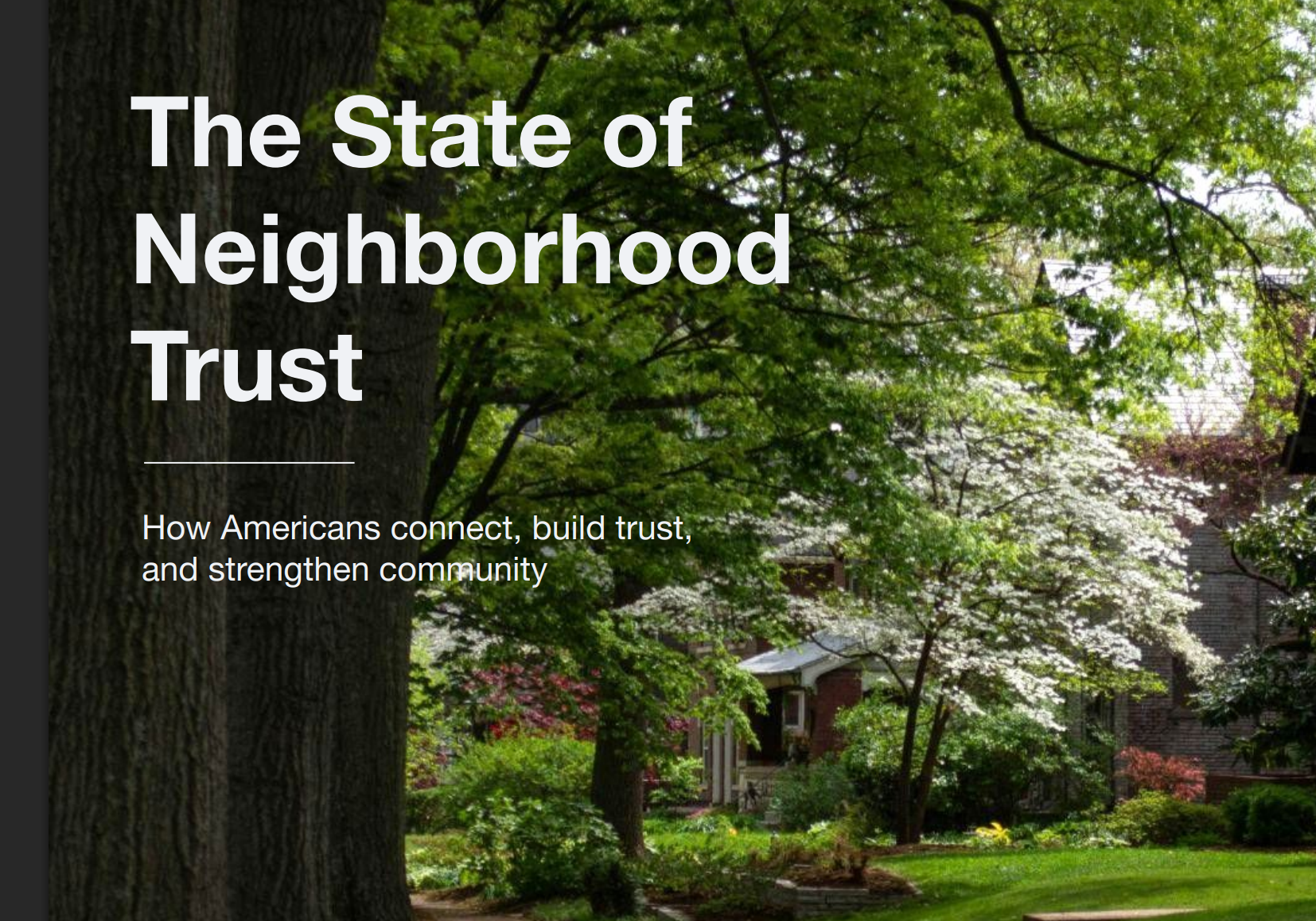
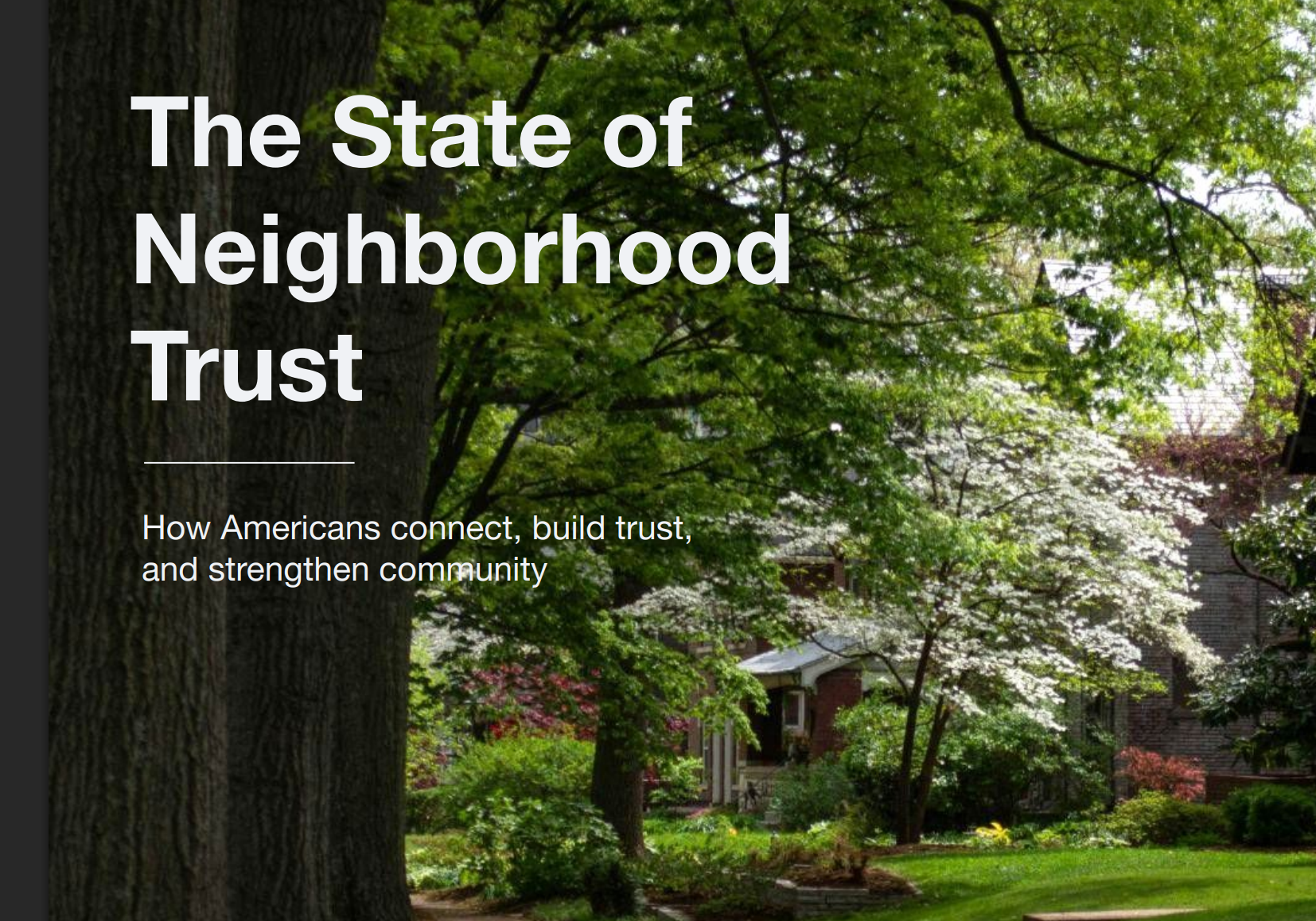
Nextdoor's new “The State of Neighborhood Trust” report, produced with The Harris Poll, is much closer to what I've been asking to see.
This looks and reads like an actual research report.
Not simply a blog post with percentages and a statement that more information exists somewhere else.
The report is 24 pages long. It identifies the research partner, describes the sample, discusses methodology, presents findings in context, includes statistical analysis, identifies outside sources, and provides a research contact. Nextdoor Blog
Read Nextdoor and The Harris Poll's full Neighborhood Trust study
Bravo, Nextdoor.
Yes, I actually said that.
Screenshot it before somebody blocks me. 😂
This Is What I've Been Asking For
Nextdoor commissioned the research, and The Harris Poll fielded it in April 2026 among about 1,000 U.S. adults age 18 and older. Respondents came through The Harris Poll's online panel and were weighted to reflect the U.S. adult population. Nextdoor says it then analyzed the findings and conducted statistical modeling examining factors associated with trust and outcomes including safety, belonging, civic participation and reliance on neighbor recommendations. Nextdoor Blog

The accompanying Nextdoor article provides even more methodological detail: the survey was conducted April 16–20 among 1,003 adults, weighting included age within gender, region, race/ethnicity, marital status, household size, income, education and political affiliation where necessary, and the reported Bayesian credible interval is ±3.8 percentage points at a 95% confidence level. Nextdoor also acknowledges other potential sources of survey error. Nextdoor Blog
That's transparency.
Could there be more?
Sure.
I'd love to see an appendix containing the questionnaire, complete crosstabs and additional demographic breakouts. Since The Harris Poll fielded the survey, it would also be useful to provide a Harris Poll contact or link explaining whether additional demographic information, questionnaires or crosstabs can be obtained.
But that's me asking for the cherry on top rather than wondering where the sundae went.
This report gives readers enough information to begin understanding where the numbers came from and how the research was conducted.
And the Subject Is…Trust
This is where things become particularly interesting given my recent experience with Nextdoor.
The entire report revolves around trust.
One finding says 66% identify friendly day-to-day interactions as something that builds neighborhood trust. Meanwhile, the leading factor respondents identified as weakening neighborhood trust was lack of communication, at 46%. Nextdoor Blog
Read that again.
Lack of communication: 46%.
I've been writing about communication for more than 100 days.
You couldn't script this better.
The study says trust grows through regular opportunities to communicate, interact, and rely on one another. It also says the strongest predictors include how easy people feel reaching their neighbors and how often they actually interact. Nextdoor Blog
That's not my interpretation of what Nextdoor should believe.
That's in Nextdoor's own report.
Then Nirav Tolia Says This
The report includes a statement from CEO Nirav Tolia:
“The difference between a neighborhood and a community is trust.”
That's a powerful statement. Nextdoor Blog
And that's precisely why I can't ignore the contrast with my experience.
Yesterday I discovered that Nirav had blocked me on X.
Again.
For the second time in roughly six months.
I don't know why Nirav blocked me. Only he knows his reason, and I'm not going to pretend otherwise.
He also doesn't have an obligation to personally engage with every person who comments on his social media account.
But I'm allowed to ask what message the action sends to me.
Because I'm not some anonymous account that appeared yesterday screaming at the CEO.
I'm a shareholder.
I've spent months publicly documenting questions about Nextdoor.
I've repeatedly offered to have an actual conversation.
I've said I'd rather talk than type.
And for more than 100 days I've been pursuing detailed research that Nextdoor itself told readers was available by contacting its Insights representative.
Now I'm reading a Nextdoor report telling me:
Trust depends on communication.
You can't make this stuff up.

Trust Has to Work in Both Directions
Another line in the report fascinates me.
Nextdoor writes that trust is built through repeated interactions, communication, and confidence that others will respond when it matters. Nextdoor Blog
Exactly.
That shouldn't only apply neighbor to neighbor.
I think it's a valuable principle for company-to-customer, leadership-to-shareholder, platform-to-user, and executive-to-stakeholder relationships too.
Trust isn't created by saying the word trust repeatedly.
It isn't created by putting trust in the title of a 24-page PDF.
And it isn't automatically created because a company commissions a reputable polling organization.
Trust grows when words and experiences begin matching.
That's what makes this new report simultaneously encouraging and fascinating to me.
The Research Is Actually Helping Build Trust
Here's where I give Nextdoor genuine credit.
This report increases my confidence in these findings because Nextdoor told me how the research was conducted.
That's exactly how transparency builds trust.
Compare:
“67% of Americans say, X.”
Okay. Where did that number come from?
Versus:
Here's who conducted the survey. Here's when it was conducted. Here's the population. Here's the sample. Here's how respondents were recruited. Here's how weighting worked. Here's the statistical approach. Here are limitations. Here are outside sources. Here's a research contact.
Now we're talking.
Interestingly, the PDF once again lists Jacob Chavis, Senior Manager, Customer Insights, along with his Nextdoor email address as the research contact. Nextdoor Blog
Jacob and I already have some history.
😂
Maybe This Is Progress
I've said throughout this case study that if Nextdoor does something I think is good, I'll say it's good.
This report is progress.
I don't know whether my months of posts had anything whatsoever to do with the format. I have no evidence that they did, so I'm not taking credit.
Maybe Nextdoor was already moving toward more comprehensive research reports.
Maybe working with The Harris Poll resulted in a more rigorous presentation.
Maybe somebody inside Nextdoor independently said, We should probably show people how we got these numbers.
Whatever the reason:
Keep doing this.
And take it one step further.
Provide a Harris Poll link or research contact.
Make additional demographic tables available.
Publish questionnaires where appropriate.
Provide downloadable crosstabs.
Let researchers, journalists, advertisers, shareholders, and curious bald bloggers dig deeper.
That's how confidence in research grows.
Now Apply the Research to Leadership
That's my bigger challenge to Nextdoor.
The report says communication matters.
It says repeated interaction matters.
It says accessibility matters.
It says trust helps communities function.
And its CEO says the difference between a neighborhood and a community is trust. Nextdoor Blog
Great.
Apply those principles internally and externally.
When somebody asks a difficult question, communicate.
When somebody provides feedback, listen.
When somebody requests information that you've advertised as available, answer.
When a shareholder repeatedly offers to have a conversation, perhaps conversation is more consistent with the company's message than another block button.
Nirav doesn't have to agree with me.
Nextdoor doesn't have to agree with me.
Jacob doesn't have to agree with me.
Nobody has to like my posts.
But if we're going to talk about rebuilding trust through communication and interaction, then I think it's fair to ask Nextdoor's leadership to demonstrate the same behavior it celebrates in its research.
Trust is a great research topic.
It's an even better leadership practice.
And this time, Nextdoor, on the research itself:
Bravo. Keep going.
👉 Read my continuing Nextdoor case study at NielFlamm.com/blog
Day 107: Nirav Tolia Blocked Me Again. Apparently, We’re Doing This Twice.
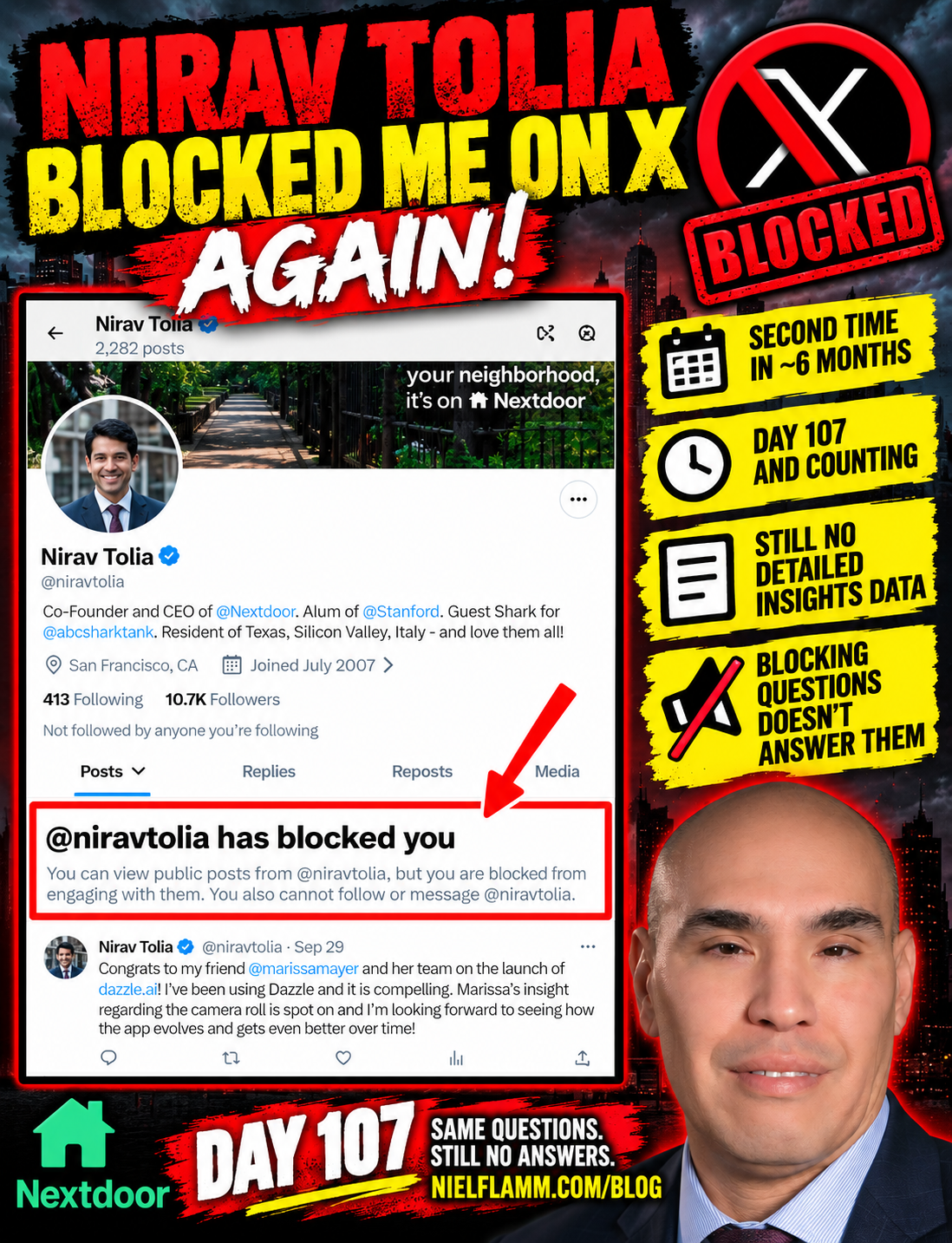
Nirav, you got me. 😂
I've been posting about my request for the detailed Nextdoor Insights research that the company said readers could get by contacting Jacob Chavis.
While making my rounds across the various platforms and Nextdoor accounts, I came across CEO Nirav Tolia's X profile.
And there it was:
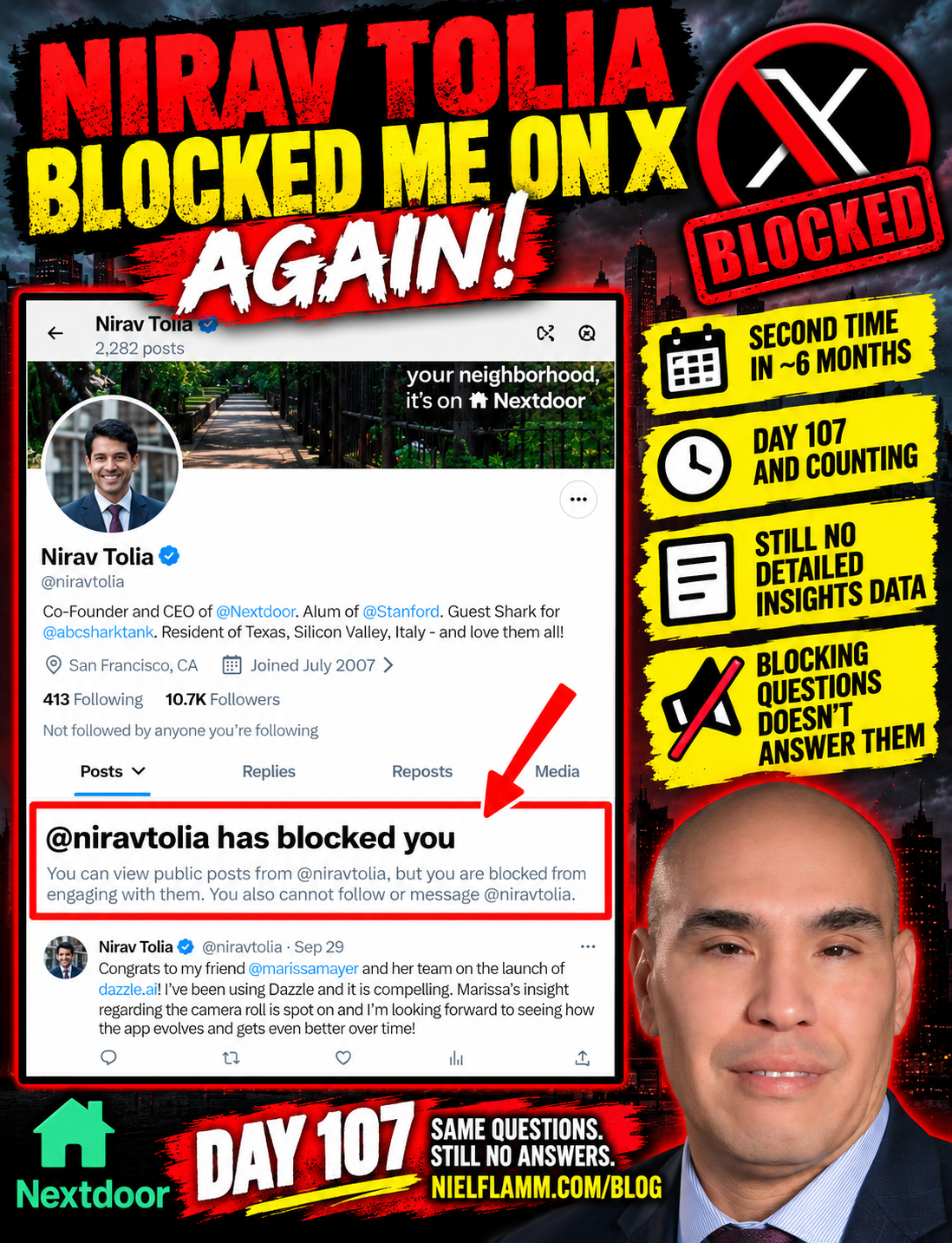
“@niravtolia has blocked you.”
Again.
Yes, again.
This is the second time in roughly six months that I've found myself blocked by Nextdoor's CEO.
I have to admit, that's almost impressive.
A Speed Bump, Not a Roadblock
The screenshot says I can still view Nirav's public posts, but I can't engage with them, follow him, or message him from that account.
Okay.
I'm resourceful.
This is a speed bump. It won’t end the conversation.
More importantly, blocking me doesn't answer the question I've been asking.
And this story didn't actually begin 107 days ago.
How Did I Even Get Here?
Long before the Insights report became part of this case study, I was a Nextdoor user in my local neighborhood.
I was eventually banned.
One issue involved my posting multiple personal items for sale. I questioned where the applicable restrictions appeared in Nextdoor's terms and policies and sought clarification.
From my perspective, meaningful communication eventually stopped.
So I started writing about my dissatisfaction on LinkedIn.
Then the discussion expanded.
I started looking more closely at Nextdoor's moderation model, communications, small-business experience, research, leadership, shareholder value, and other aspects of the company.
Eventually I came across Nextdoor's Home Insurance Insights research.
That’s where things got almost comical.

Nextdoor Told Readers to Contact Jacob
The June 15 Home Insurance Insights article says the research came from a survey of 1,000 U.S. adults.
Other Nextdoor Insights articles have been even more explicit about how to get additional research. For example, its summer-travel report tells readers who want the complete findings and detailed data to contact Jacob Chavis, Customer Analytics & Insights Manager.
So I did what Nextdoor told readers to do.
I contacted Jacob.
And then I followed up.
And followed up.
And followed up.
We're now at Day 107 of this particular chapter.
Communications eventually responded, and I've publicly acknowledged that. I didn't receive the complete, detailed material I requested.
Last week, I expanded my email to Nextdoor's Executive Team.
Now, as I continue to post about the experience, I discovered that Nirav has blocked me on X again.
Blocking Is Certainly an Option
Let's be fair about something.
Nirav has every right to decide whom he wants to interact with on his social media accounts.
Being CEO of a public company doesn't mean he owes me a personal conversation every time I have a question.
And I can't tell you why he blocked me.
Maybe he's tired of seeing my posts.
Maybe he thinks they're repetitive.
He may not like my approach.
Maybe he doesn't want to engage.
Only Nirav knows.
But here's where I think this becomes interesting from a leadership perspective.
Nextdoor's own leadership page identifies Nirav as its CEO, President, Chairperson of the Board, and co-founder.
That's a lot of leadership hats.
So when the person wearing all those hats blocks a shareholder who has been publicly questioning the company's communication, I think it's fair for me to write about the experience.
I'd Rather Have a Conversation
I've said this repeatedly:
I would rather talk than type.
Phone.
Video.
Virtual coffee.
An actual conversation.
I'm not asking Nirav to agree with me.
I'm not expecting Nextdoor to implement every idea I throw at it.
I'm not even expecting Nextdoor to enjoy my posts.
Some of them probably aren't particularly enjoyable from their side of the screen.
But if you're going to lead a company built around neighbors communicating with neighbors, criticism and uncomfortable questions come with the territory.
That's leadership.
I've Got Time
I've also joked before that Nextdoor may have picked the wrong person for a waiting contest.
My medical circumstances mean I have more downtime than I once did.
I can write.
I can research.
I can ask questions.
I can follow up.
And apparently I can periodically discover that I've been blocked again. 😂
I prefer Nextdoor to focus on building the business, improving the product, and creating long-term shareholder value.
Yesterday I wrote about NXDR closing at $2.43.
As a shareholder, I'd love to see the company deliver the kind of sustained performance that sends that number substantially higher.
I'd like to see a business return capital to shareholders through a dividend, if and when its financial position and board determine that makes sense.
That's a much more interesting use of corporate energy than this 107-day saga.
Leadership Includes Taking Some Heat
I don't think a CEO needs to respond personally to every critic on social media.
That's unrealistic.
I also don't think blocking someone proves their criticism is correct.
It doesn't.
Leaders of public-facing companies should expect scrutiny.
Especially when they're highly visible themselves.
Especially when they're talking publicly about community, connection, listening, and the “power of we.”
Sometimes leadership means standing behind the product and the rhetoric when somebody says:
“Okay. I have some questions.”
And sometimes those questions aren't flattering.
I don't prefer Nirav to have “thicker skin” because I have no insight into how he personally feels. I don't.
My point is about the leadership behavior I'd prefer to see:
Engage with difficult questions.
Delegate them to someone who will.
Answer them.
Disagree with them.
Explain why they're wrong.
Or say, “We're not providing that information.”
Any of those outcomes would be more interesting than another block button.
So, Nirav, You Got Me
Blocked for the second time.
I laughed when I saw it.
Then I took a screenshot.
And now, naturally, I'm writing about it.
Because after everything I've documented, this has become part of the case study too.
Day 107.
The detailed research question remains.
The Executive Team has my latest email.
And Nirav Tolia has blocked me on X.
Again.
I'm still here.
👉 NielFlamm.com/blog
Day 105: “The Power of We” Sounds Great. I’m Still Waiting for the “We.”
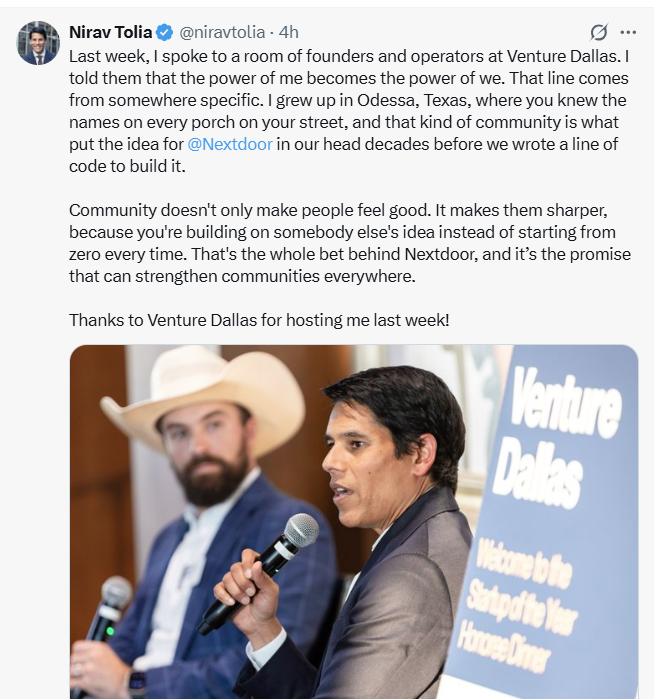
Today, Nextdoor CEO Nirav Tolia posted about speaking to a room of founders and operators at Venture Dallas.
One line immediately caught my attention:
“The power of me becomes the power of we.”
That's a pretty good line.
Actually, it fits remarkably well with what I've been writing about for the past 105 days.
Nirav went on to describe growing up in Odessa, Texas, where knowing the names of people on the street helped shape the idea behind Nextdoor. He wrote that community makes people sharper because they're building on other people's ideas instead of constantly starting from zero.
Then came another line that caught my attention:
“That's the whole bet behind Nextdoor.”
Venture Dallas itself describes its mission in similar terms: connecting innovators and investors while building collaboration and a stronger entrepreneurial community.
Great.
So let's talk about the “we.”
I've Been Trying to Join the Conversation for 105 Days

For 105 days, I've been asking Nextdoor about detailed data referenced in two of its Insights posts.
This hasn't been 105 days of demanding that somebody agree with me.
It hasn't been 105 days of demanding that Nextdoor change its business because one small shareholder has an opinion.
I've asked a question.
I've provided feedback.
I've emailed.
I've followed up.
I've publicly documented the experience.
Communications eventually responded, and I acknowledged that response. I didn't receive the complete, detailed material I requested.
Yesterday, I expanded the email to Nextdoor's Executive Team.
Those emails did not bounce.
I also attempted to CC members of the Board of Directors. Every one of those attempted Board addresses came back undeliverable.
I’m waiting to see if anyone on the Executive Team responds.
My prediction is still that nobody will.
I would love to be wrong.
“Building on Somebody Else's Idea”
This is where Nirav's post gets especially interesting to me.
He talks about the value of building on somebody else's idea.
That's exactly what feedback can be.
Sometimes feedback is wrong.
Sometimes it's annoying.
Sometimes the person providing it has misunderstood something.
Sometimes it's brilliant.
Sometimes it's somewhere in between.
But an organization doesn't figure out which it is by ignoring it.
My Learning & Development brain immediately goes to the difference between hearing and listening.
Hearing is receiving the message.
Listening requires doing something with it—even if the eventual response is:
“We heard you. We disagree, and here's why.”
That's still communication.
What Does “We” Mean When Someone Disagrees?
The “power of we” is easy when everyone in the room is nodding.
It's harder when somebody keeps raising his hand.
For 105 days.
😂
That's where community becomes much more interesting.
If Nextdoor believes communities become stronger by building upon the knowledge and ideas of other people, shouldn't that philosophy apply when the ideas are uncomfortable?
Shouldn't it include shareholders asking questions?
Small businesses providing feedback?
Neighbors questioning policies?
People challenging research methodology?
People asking how their contributions are being monetized?
People saying, “I think there's a better way to do this”?
I'm not suggesting every piece of feedback deserves implementation.
That would be ridiculous.
But feedback can at least deserve consideration and, when appropriate, an answer.
And Then There's the Other “We”
There's another reason the phrase jumped out at me.
I've recently been writing about the economic value of the information neighbors contribute to Nextdoor.
Recommendations.
Reviews.
Local experiences.
Business information.
Questions.
Answers.
Years of neighborhood knowledge.
Nextdoor provides the technology, infrastructure, and distribution.
Neighbors provide most of what's inside it.
That's a pretty literal example of “me” becoming “we.”
And if that collective knowledge becomes increasingly valuable—particularly as AI makes it easier to organize, search, and commercialize enormous amounts of information—I think there's a legitimate conversation about whether the people supplying that knowledge should share in some of the value it creates.
That's why I started my petition calling for a Neighbor Value-Sharing model.
It currently has one signature.
Mine.
I'm apparently dominating the polling. 😂
But I'm still asking the question.
Community Can't Just Be a Stage Message
I like what Nirav wrote.
I genuinely do.
Community can make ideas better. Collaboration can create things an individual never could. Venture Dallas itself is built around connecting entrepreneurs, investors, and innovators.
But that's also why I'm going to keep comparing the message with the experience.
“The power of me becomes the power of we.”
Okay.
I'm here.
I've been here for 105 days.
I've provided feedback, asked questions, and repeatedly offered to connect—phone, video, or virtual coffee, whatever works.
Yesterday, my email appears to have successfully reached the addresses for members of Nextdoor's Executive Team.
So perhaps Day 105 is the perfect day to test the philosophy.
Does the “we” include people who ask uncomfortable questions?
I hope so.
Because if community really is the whole bet behind Nextdoor, then listening to the community shouldn't be the difficult part.
Day 105.
Now I wait.
👉 Read the continuing case study at NielFlamm.com/blog
Day 104: The Emails Made It. Now We Wait.
Day 104.
Yesterday, I expanded the audience for my ongoing request for Nextdoor’s detailed Insights reports.
Today, I have a little more clarity about what actually made it through.
Every Board email I attempted was returned as undeliverable.
I couldn’t reach the Nextdoor Board through those addresses. I used what seemed like a reasonable first-name@nextdoor.com format. It didn't work.
The Executive Team was different.
None of those emails bounced back.
That doesn't prove anyone read my email. It doesn't prove it reached a particular executive's inbox instead of getting filtered somewhere along the way.
But unlike my attempted Board emails, I received no delivery-failure messages.
So now?
I wait.
Will Anyone Answer?
My guess?
No.
But that's only a prediction based on my experience over the previous 103 days—not a fact. I'd actually be delighted to be wrong.
The request remains remarkably simple.
Nextdoor previously published Insights posts telling readers that additional findings and detailed data were available if they contacted the company.
I've been asking for that material.
Communications eventually responded, but the materials I received weren't the complete, detailed set I requested.
Yesterday, I put the question in front of a broader group of Nextdoor executives:
Can you provide the detailed reports/data—or tell me they aren't available?
That's it.
No 50-page shareholder proposal.
No demand for a seat in the boardroom.
No decoder ring required.
Send it, say no, explain the restrictions, or tell me who owns the request.
Any of those answers works.
Day 104 Is Now About the Response
The email appears to have reached the Executive Team addresses.
My attempted Board emails didn't.
I've documented both.
Now there's nothing more to add until Nextdoor decides what it wants to do with the question.
Maybe someone responds tomorrow.
Maybe someone responds next week.
Maybe nobody responds at all.
If they answer, I'll publish that too.
For now, the ball is in Nextdoor's court.
Day 104.
The email was sent.
The Executive Team addresses didn't bounce.
Now we find out whether delivery leads to communication.
👉 Follow the continuing case study at NielFlamm.com/blog
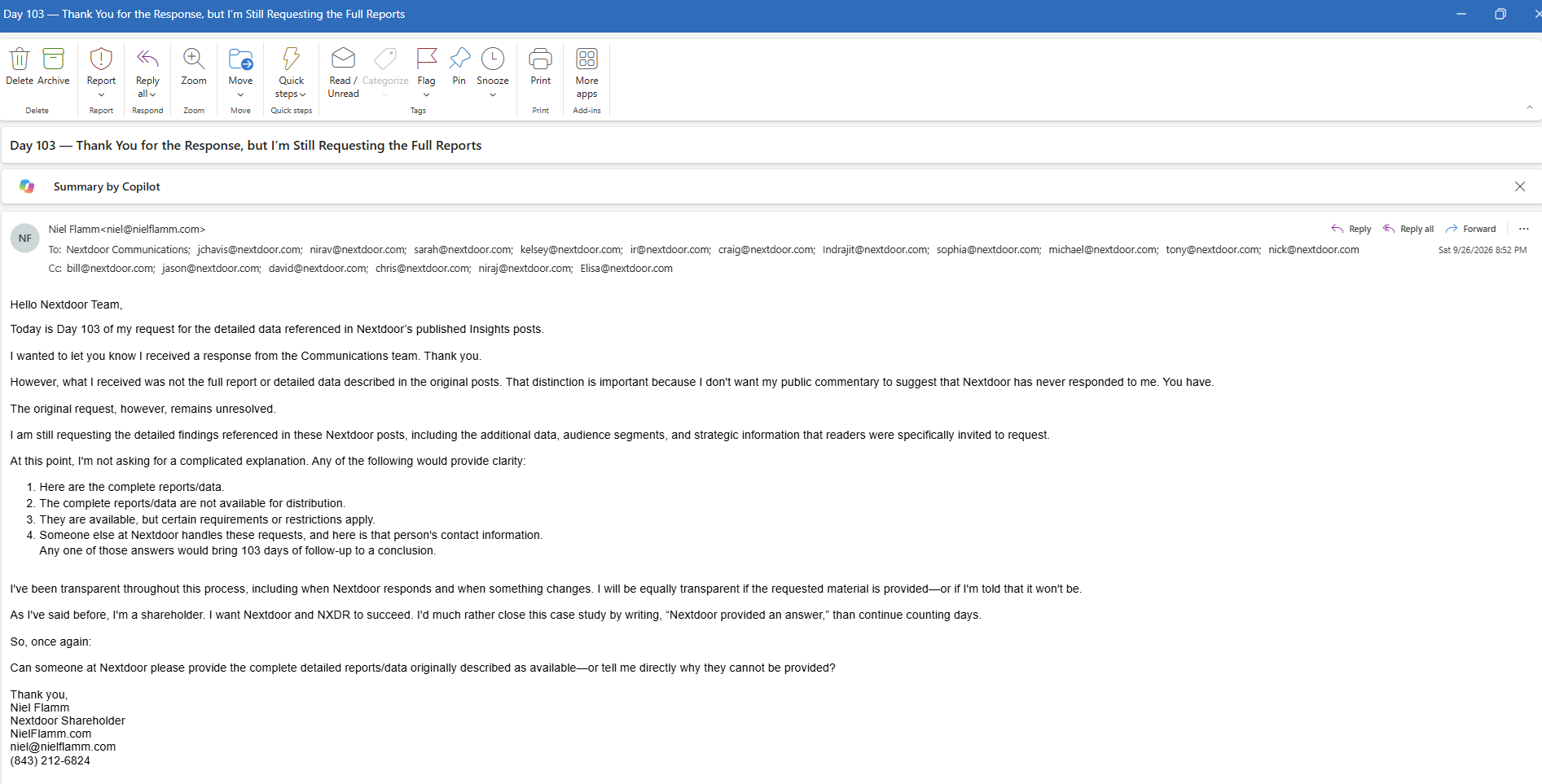
Day 103: I Expanded the Email List. The Board Emails Didn’t Cooperate.
Day 103.
Today, I sent another email to Nextdoor.
After 103 days, I decided to expand the audience.
I put the Nextdoor Executive Team in the “To” field, along with the people who have already been part of this conversation.
I also attempted to include members of the Nextdoor Board of Directors in the CC field.
There was just one problem.
Apparently, my attempt at figuring out the board members' Nextdoor email addresses wasn't particularly successful. 😂
The Board Emails Bounced
I tried the fairly obvious formula: first name@nextdoor.com.
No such luck.
I received failed-delivery notices for the addresses I attempted for:
Michael Kiernan, Jason Pressman, Tony Castellanos, Niraj Shah, Chris Varelas, Elisa Steele, David Sze, and Bill Gurley.
I don’t have confirmation that the board members received today's email.
They apparently didn't.
I’ll research whether there are publicly available professional contact addresses through the companies or organizations they represent.
Interestingly, I haven't received bounce-back notices for the Executive Team addresses included in the “To” field so far. That doesn't prove anyone personally read the email, but at least I haven't received a delivery-failure notification.
What Did I Ask This Time?
The email itself is published in full on this blog, but the short version is remarkably simple.
I acknowledged that Nextdoor Communications did respond to me. I want to be fair and accurate.
The problem is that what I received wasn't the complete report or detailed data described in the original Nextdoor Insights posts.
So I asked again.
Send the complete reports.
Please let me know if they aren't available for distribution.
Tell me what restrictions or requirements apply.
Could you tell me who at Nextdoor is responsible for providing them?
Any of those answers creates closure.
That's really it.
This Shouldn't Require 103 Days
That's what continues to fascinate me about this entire experience.
The request hasn't become more complicated.
The distribution list has.
This started as a request for research referenced as available and has now moved through Communications, members of the Executive Team, and—once I have the working contact information—potentially the Board.
I'm not trying to make it look like people received something when they didn't.
That's why I'm publishing the bounce-backs too.
Transparency works both ways.
If Nextdoor responds, I'll say it responded.
If the response doesn't contain what I requested, I'll say that too.
If my emails to the Board don't work, I'll tell you that.
And if tomorrow Nextdoor sends me the complete reports—or says, “Niel, we're not giving them to you”—I'll publish that, too.
At least we'd finally have an answer.
For now:
Day 103.
The Executive Team email appears to have gone through.
My first attempt at reaching the Board?
Not so much. 😂
The full email I sent is included below,
👉 NielFlamm.com/blog