
Day 107: Nirav Tolia Blocked Me Again. Apparently, We’re Doing This Twice.
Nirav, you got me. 😂
I've been posting about my request for the detailed Nextdoor Insights research that the company said readers could get by contacting Jacob Chavis.
While making my rounds across the various platforms and Nextdoor accounts, I came across CEO Nirav Tolia's X profile.
And there it was:
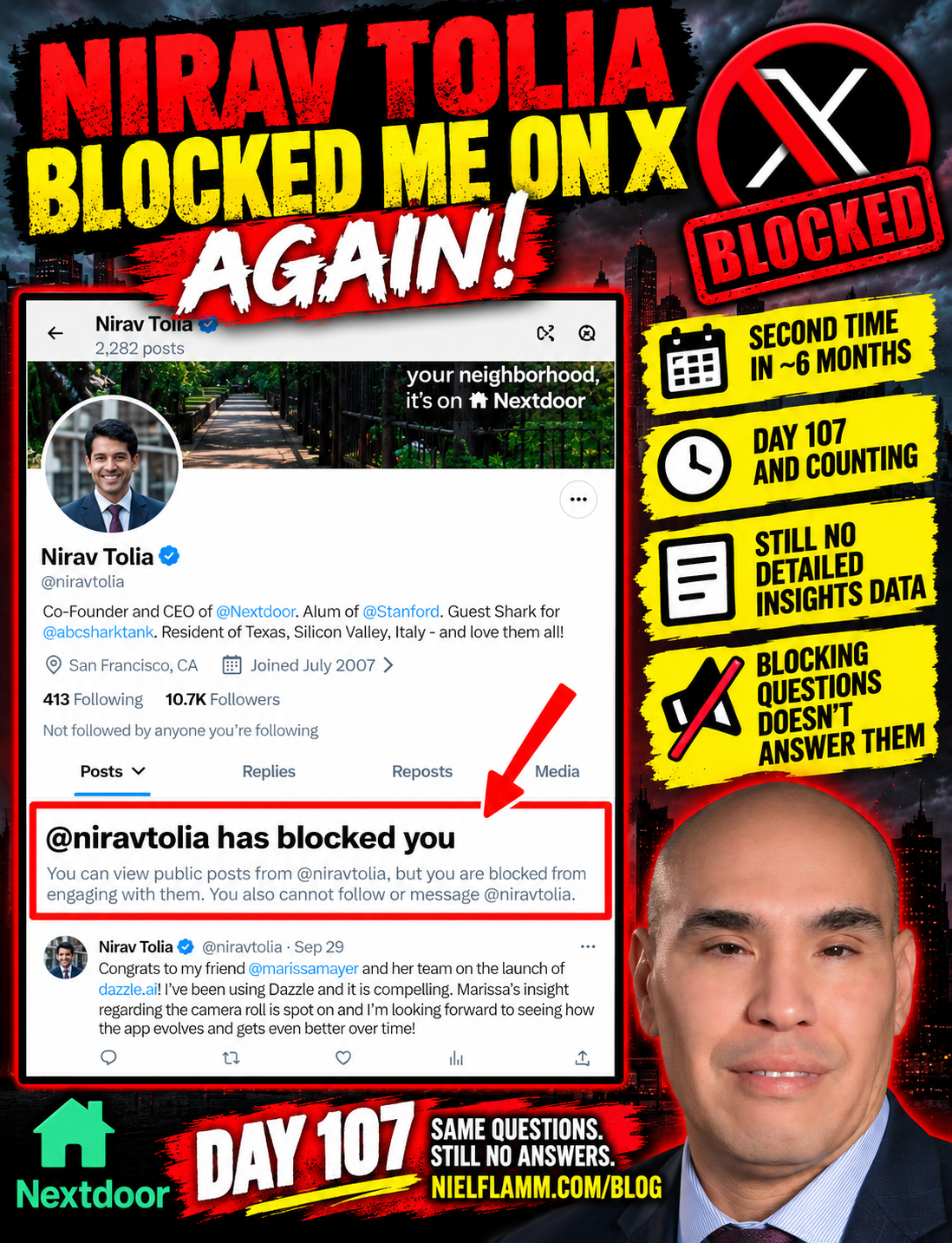
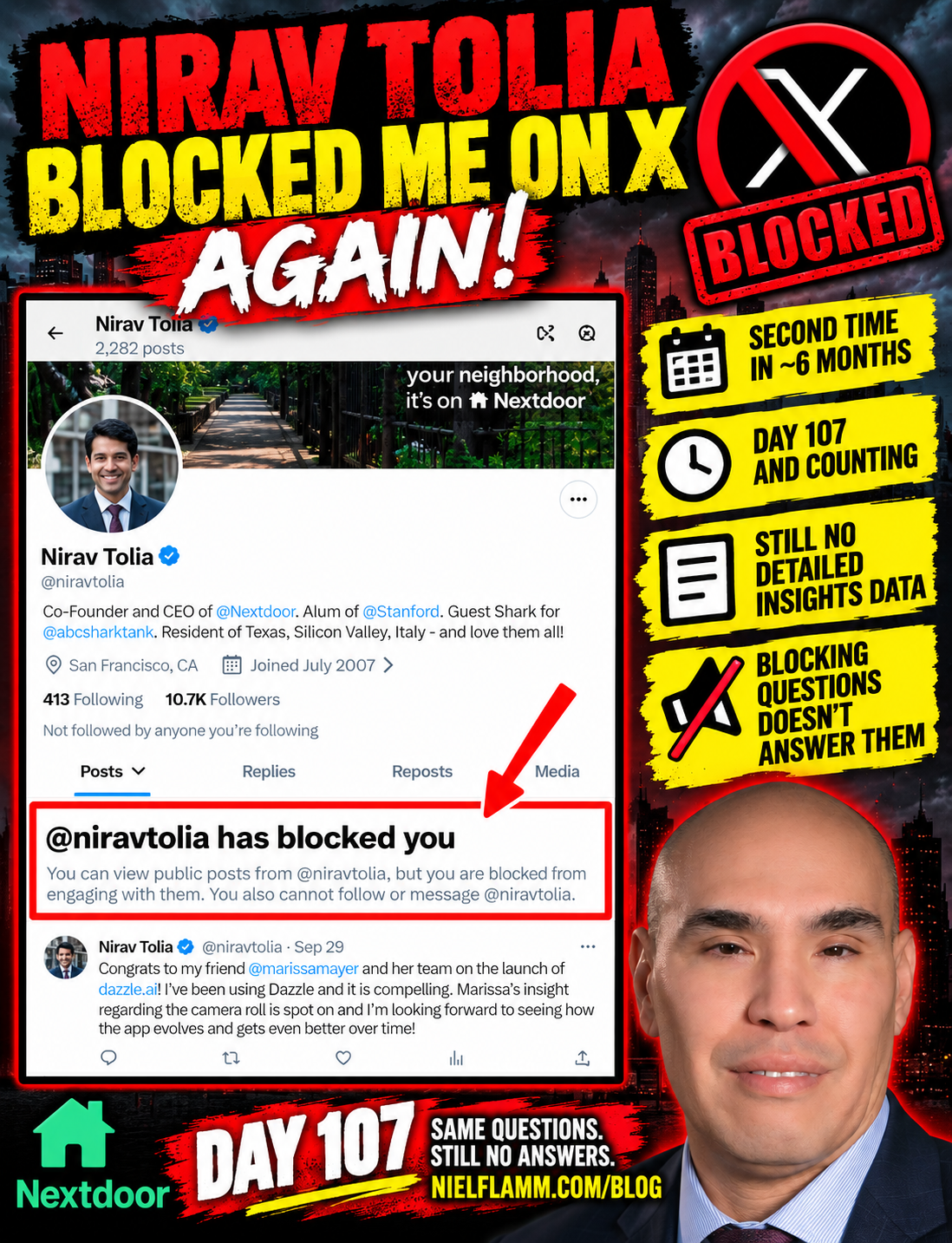
“@niravtolia has blocked you.”
Again.
Yes, again.
This is the second time in roughly six months that I've found myself blocked by Nextdoor's CEO.
I have to admit, that's almost impressive.
A Speed Bump, Not a Roadblock
The screenshot says I can still view Nirav's public posts, but I can't engage with them, follow him, or message him from that account.
Okay.
I'm resourceful.
This is a speed bump. It won’t end the conversation.
More importantly, blocking me doesn't answer the question I've been asking.
And this story didn't actually begin 107 days ago.
How Did I Even Get Here?
Long before the Insights report became part of this case study, I was a Nextdoor user in my local neighborhood.
I was eventually banned.
One issue involved my posting multiple personal items for sale. I questioned where the applicable restrictions appeared in Nextdoor's terms and policies and sought clarification.
From my perspective, meaningful communication eventually stopped.
So I started writing about my dissatisfaction on LinkedIn.
Then the discussion expanded.
I started looking more closely at Nextdoor's moderation model, communications, small-business experience, research, leadership, shareholder value, and other aspects of the company.
Eventually I came across Nextdoor's Home Insurance Insights research.
That’s where things got almost comical.

Nextdoor Told Readers to Contact Jacob
The June 15 Home Insurance Insights article says the research came from a survey of 1,000 U.S. adults.
Other Nextdoor Insights articles have been even more explicit about how to get additional research. For example, its summer-travel report tells readers who want the complete findings and detailed data to contact Jacob Chavis, Customer Analytics & Insights Manager.
So I did what Nextdoor told readers to do.
I contacted Jacob.
And then I followed up.
And followed up.
And followed up.
We're now at Day 107 of this particular chapter.
Communications eventually responded, and I've publicly acknowledged that. I didn't receive the complete, detailed material I requested.
Last week, I expanded my email to Nextdoor's Executive Team.
Now, as I continue to post about the experience, I discovered that Nirav has blocked me on X again.
Blocking Is Certainly an Option
Let's be fair about something.
Nirav has every right to decide whom he wants to interact with on his social media accounts.
Being CEO of a public company doesn't mean he owes me a personal conversation every time I have a question.
And I can't tell you why he blocked me.
Maybe he's tired of seeing my posts.
Maybe he thinks they're repetitive.
He may not like my approach.
Maybe he doesn't want to engage.
Only Nirav knows.
But here's where I think this becomes interesting from a leadership perspective.
Nextdoor's own leadership page identifies Nirav as its CEO, President, Chairperson of the Board, and co-founder.
That's a lot of leadership hats.
So when the person wearing all those hats blocks a shareholder who has been publicly questioning the company's communication, I think it's fair for me to write about the experience.
I'd Rather Have a Conversation
I've said this repeatedly:
I would rather talk than type.
Phone.
Video.
Virtual coffee.
An actual conversation.
I'm not asking Nirav to agree with me.
I'm not expecting Nextdoor to implement every idea I throw at it.
I'm not even expecting Nextdoor to enjoy my posts.
Some of them probably aren't particularly enjoyable from their side of the screen.
But if you're going to lead a company built around neighbors communicating with neighbors, criticism and uncomfortable questions come with the territory.
That's leadership.
I've Got Time
I've also joked before that Nextdoor may have picked the wrong person for a waiting contest.
My medical circumstances mean I have more downtime than I once did.
I can write.
I can research.
I can ask questions.
I can follow up.
And apparently I can periodically discover that I've been blocked again. 😂
I prefer Nextdoor to focus on building the business, improving the product, and creating long-term shareholder value.
Yesterday I wrote about NXDR closing at $2.43.
As a shareholder, I'd love to see the company deliver the kind of sustained performance that sends that number substantially higher.
I'd like to see a business return capital to shareholders through a dividend, if and when its financial position and board determine that makes sense.
That's a much more interesting use of corporate energy than this 107-day saga.
Leadership Includes Taking Some Heat
I don't think a CEO needs to respond personally to every critic on social media.
That's unrealistic.
I also don't think blocking someone proves their criticism is correct.
It doesn't.
Leaders of public-facing companies should expect scrutiny.
Especially when they're highly visible themselves.
Especially when they're talking publicly about community, connection, listening, and the “power of we.”
Sometimes leadership means standing behind the product and the rhetoric when somebody says:
“Okay. I have some questions.”
And sometimes those questions aren't flattering.
I don't prefer Nirav to have “thicker skin” because I have no insight into how he personally feels. I don't.
My point is about the leadership behavior I'd prefer to see:
Engage with difficult questions.
Delegate them to someone who will.
Answer them.
Disagree with them.
Explain why they're wrong.
Or say, “We're not providing that information.”
Any of those outcomes would be more interesting than another block button.
So, Nirav, You Got Me
Blocked for the second time.
I laughed when I saw it.
Then I took a screenshot.
And now, naturally, I'm writing about it.
Because after everything I've documented, this has become part of the case study too.
Day 107.
The detailed research question remains.
The Executive Team has my latest email.
And Nirav Tolia has blocked me on X.
Again.
I'm still here.
👉 NielFlamm.com/blog
Day 107: NXDR Ends at $2.43 — What Is the Market Telling Us?

Day 107.
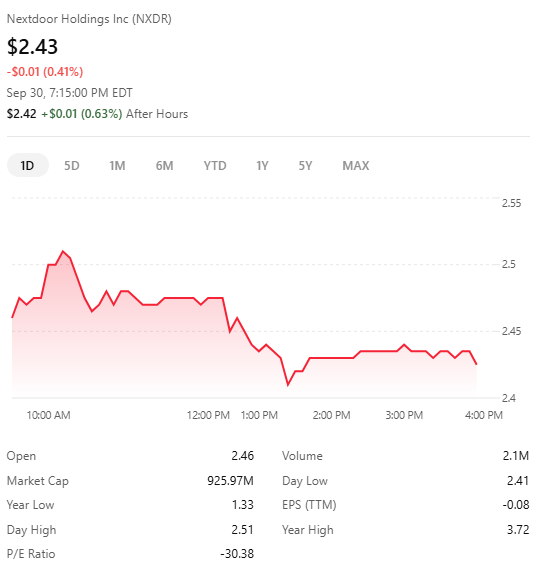
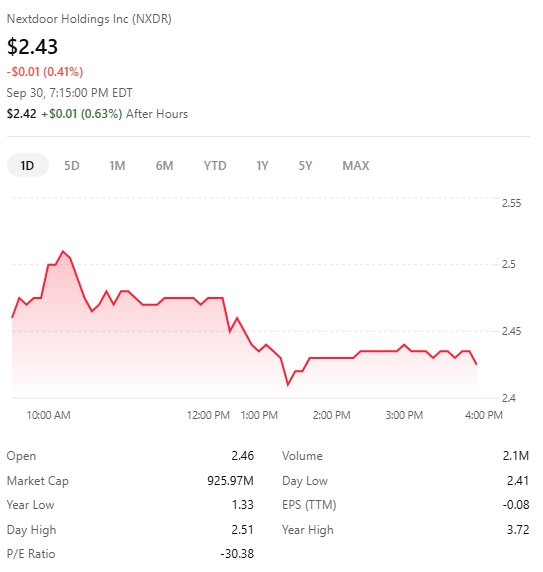
Today, Nextdoor Holdings (NXDR) finished at $2.43 per share, down slightly from Tuesday's $2.45 close. The stock traded between $2.41 and $2.52 during the session, with roughly 2.14 million shares changing hands.
One day doesn't tell the whole story.
The longer-term picture in the chart I've been watching is considerably more interesting.
A Year of Ups, Downs and Plenty in Between
Look at the one-year chart I included with this post.
NXDR has spent portions of the period down around the $2 range, while at other points it approached the upper $2.60s.
More recently, the movement has been just as interesting.
NXDR closed at $2.15 on September 9. By September 21, it had climbed to $2.64. It then fell to $2.38 on September 23, recovered to $2.51 on September 25, and finished September at $2.43.
That's quite a ride for a stock trading for less than $3.
And as a shareholder, it raises a question I've been asking throughout this Nextdoor case study:
What ultimately moves confidence in a company?
A Stock Price Isn't a Corporate Report Card
I want to be careful here.
A stock going up doesn't automatically mean management is doing everything right.
A stock going down doesn't automatically mean management is doing everything wrong.
And I'm certainly not going to look at today's two-cent decline and announce:
“The market has spoken about Nirav Tolia!”
😂
That's not how markets work.
Stock prices can move because of company financial results, expectations about future results, analyst opinions, broader market conditions, trading activity, liquidity, news, investor sentiment, and countless other factors.
NXDR itself demonstrates how quickly those expectations can change. In August, following its second-quarter results, analysts changed their views and price targets. More recently, NXDR has continued moving around considerably from session to session.
I can't attribute a specific Nextdoor decision to a particular movement on this chart.
No one else can either without evidence connecting the two.
But Confidence Still Matters
The chart still matters for my longer-term case study.
Markets ultimately involve people deciding what they believe something is worth.
And those decisions can include much more than yesterday's closing price.
Investors can consider:
Results. Strategy. Growth. Profitability. Execution. Leadership. Communication. Governance. Risk. And expectations about what happens next.
That's where confidence comes in.
A company can announce a brilliant strategy, but eventually investors can look for evidence that it worked.
A CEO can communicate a compelling vision, but eventually shareholders can compare that vision with results.
Management can make decisions that look strange today and brilliant two years from now.
Or the reverse.
Time has an interesting way of grading decisions.

That's Why I Keep Coming Back to Results
I've spent 107 days documenting my experience with Nextdoor.
I've asked about the detailed Insights data.
I've written about communication.
I've questioned transparency.
I've discussed moderation.
I've written about small businesses.
I've questioned how awards are judged.
I've discussed the economic value of neighbor-generated information.
I've praised Nextdoor when I thought it deserved praise.
I've provided feedback when I saw room for improvement.
That doesn’t mean today's $2.43 closing price validates my opinions.
It doesn't.
Likewise, if NXDR jumps to $3 tomorrow, that wouldn't suddenly invalidate the questions I've been asking.
What matters to me as a shareholder is what happens over time.
Decisions → Results → Confidence
Maybe that's the simplest way I can describe what I'm watching.
Leadership makes decisions.
Those decisions eventually produce results.
Those results can influence expectations.
And expectations can affect how investors value the company.
Not necessarily today.
Not necessarily tomorrow.
And certainly not because of one blog post, one executive interview, one Insights report, or one awkward email exchange.
But over time, execution has consequences.
That's why I'm interested in more than whether NXDR is green or red when I open the chart.
I'm interested in the decisions underneath it.
$2.43 Is Just Today's Number
Tomorrow it could be $2.35.
It could be $2.55.
Eventually it could be considerably higher—or considerably lower.
I don't know.
What I do know is that today's number becomes another point on that purple line.
$2.43.
Another trading day.
Another data point.
And another opportunity to remember that the market doesn't permanently value a company based on what leadership says it intends to accomplish.
Over the long run, investors also get to examine what actually happened.
That's the part of the chart I'll continue watching.
Day 107.
NXDR closes September at $2.43.
Let's see where the decisions, results, and confidence take it next.
👉 NielFlamm.com/blog