

Nextdoor's Three Rules for Winning — Does the Platform Actually Follow Them?

Sometimes you wake up, take care of the morning necessities, and then hop onto X to see what's happening in the world.
That's exactly what I did.
The first thing in my feed was a post from Nirav Tolia, CEO of Nextdoor. It had been posted approximately 12 hours earlier, around 4 PM Eastern.
Naturally, I stopped scrolling.
Apparently, Nextdoor's product and engineering teams met in San Francisco this week. Nirav was energized by spending quality time with the people who build the platform. He praised their work on what he described as one of the hardest things to do in the industry: returning a consumer product to growth.
He also hosted a special guest, Bing Gordon, business leader, investor, author, and former Chief Creative Officer at Electronic Arts, to discuss his new book, Everybody Wins.
The discussion focused on lessons from game design and how to build products that people actually want to return to.
Sounds great, doesn't it?
There's just one little problem.
Does Nextdoor actually practice what Nirav is preaching?
Three lessons from game design
In Nirav's post, Bing shared three principles companies building consumer products should follow.
Let's take a look.
1. Respect the time
Nirav shared the idea that every visit should feel worth the time it took.
If someone opens an app and leaves without getting anything useful, the company loses that person a little, even if its metrics don't reflect it.
I agree with that principle.
But let's apply it to Nextdoor.
How many times have users opened Nextdoor only to find posts that have disappeared, comments that have been removed, or discussions that have been restricted?
How much time do people spend trying to understand why a post was flagged, why a comment was deleted, or why an account was suspended?
What about users who spend time creating content, providing information, answering questions, and engaging with their neighbors?
Does Nextdoor respect their time?
And what about the people who try to provide feedback to the company and receive no response?
I'm still waiting for the full research study and methodology I requested from Jacob Chavis. That's not exactly an example of respecting someone's time.
It's easy to talk about respecting users' time. It's another thing to demonstrate it through the actual product experience.
2. Earn the return
The second lesson is that people shouldn't return to an app simply out of habit.
They should return because their last visit gave them something useful: an answer, a recommendation, or a reason to come back tomorrow.
Again, I agree.
But what makes someone want to return to Nextdoor?
Is it the value of the neighborhood information?
Is it the ability to connect with neighbors?
Is it the opportunity to support local businesses?
Or is it the frustration of having a post removed, trying to appeal a moderation decision, or attempting to figure out why the platform's automated systems have restricted something?
Nextdoor has an opportunity to provide a genuinely useful service. Local information, recommendations, safety alerts, and neighborhood connections are valuable.
But those benefits can be undermined when users don't understand the rules, moderation seems inconsistent, or people feel their feedback isn't being heard.
You can't simply tell people why they should return. You have to give them a reason.
3. Build in other people
This was probably my favorite of the three principles.
Nirav shared that the best games are never solo. Connection is what makes the experience stick.
And he says that's Nextdoor's advantage: the people on the other side of the screen are your neighbors.
Exactly!
That's the entire premise of the platform.
But here's the question: are those neighbors treated as the most important part of the business, or as the source of content, engagement, and advertising inventory?
Users create the conversations. They share recommendations. They post alerts. They ask questions. They respond to other people's questions.
That activity is what makes the platform useful.
Small businesses also contribute by advertising and providing services to their communities.
If connection is Nextdoor's advantage, shouldn't the company do everything it can to protect and encourage those relationships?
That means consistent moderation, clear communication, meaningful customer support, and a willingness to listen when users provide feedback.
You can't promote community while making people feel that their voices don't matter.
A San Francisco gathering — who's picking up the tab?
Now let's talk about the other part of Nirav's post.
The product and engineering teams got together in San Francisco. Nirav was there to spend quality time with the people building Nextdoor and to host a guest speaker.
Team gatherings can be valuable. Product and engineering teams need opportunities to collaborate, discuss strategy, share ideas, and build relationships.
I'm not suggesting that companies should never bring employees together.
But these gatherings cost money.
There are flights, hotels, meals, transportation, meeting spaces, and other expenses. Depending on the arrangements, there may also be speaker or event-related costs.
And let's be realistic. I have no idea what travel arrangements were made for Nirav or the other executives. I don't know whether anyone flew first class, stayed at a luxury hotel, or received a particular meal allowance.
But I doubt the CEO of a publicly traded technology company is necessarily staying at a Red Roof Inn and flying coach just to save a few dollars.
Perhaps I'm wrong.
The point is that these are company activities, and shareholders ultimately have an interest in how the company spends its funds.
I would like to see the company succeed. I want it to invest in its people and its products. But those investments should produce results.
And that brings us to the financial side of the conversation.
No dividend, but plenty of corporate activity
Nextdoor has not established a dividend for shareholders.
To be clear, not every public company is obligated to pay a dividend. Companies need to invest in operations, maintain cash reserves, and pursue growth opportunities.
But shareholders naturally want to see a return on their investment.
Nextdoor has been working toward sustainable profitability, and its recent financial results have shown progress in some areas. Yet investors are still evaluating whether the business can turn that progress into consistent, sustainable financial performance.
Meanwhile, the company continues to spend money on its operations, including employee gatherings and executive travel.
Again, those expenses aren't automatically inappropriate. They may be legitimate business investments.
But I'd like to see the same level of attention paid to measurable outcomes.
Did the San Francisco gathering produce a better product roadmap? Did it improve the customer experience? Did the teams identify specific problems with moderation, advertising, or user retention? Will we see measurable results?
And what about executive compensation?
I don't know how Nirav's compensation or bonus is structured, and I have no evidence of what he may receive based on this year's performance. But I do think shareholders have a reasonable interest in knowing whether executive incentives are aligned with long-term profitability, customer retention, and shareholder value.
It shouldn't be enough to get everyone together, take a few pictures, publish a motivational message, and declare that the company is returning to growth.
Show us the results.

The rhetoric sounds good. The execution is what matters.
I actually like the three principles attributed to Bing Gordon.
Respect people's time.
Earn their return.
Build in other people.
Those are sound principles for building a consumer product.
But they're also principles Nextdoor needs to demonstrate consistently.
If Nextdoor wants people to return, it needs to give them a reason.
If it wants people to participate, treat their contributions and feedback as valuable.
If it wants advertisers to spend money, demonstrate measurable value.
If it wants investors to believe in the future, show a credible path to sustainable profitability.
And if leadership wants to talk about building a product that people choose to return to, perhaps it should spend some time examining why people become frustrated with the platform in the first place.
I don't need another inspirational post about what makes a great product.
I want to see those principles reflected in the actual experience of using Nextdoor.
My two cents
Nirav, I hope the San Francisco gathering was productive. I hope the teams came away energized, with new ideas and a clearer direction.
But here's something to consider.
The people who build the product are important. The people who use it are equally important. The advertisers who pay for it are important. And the investors who provide capital deserve to see results.
A successful platform needs all of them.
You can host a guest speaker, discuss the principles of successful game design, and celebrate the work of your product and engineering teams.
But at the end of the day, the product has to deliver on the promises.
Respect the time. Earn the return. Build in other people.
Those are great words.
Now, Nextdoor, let's see them in action.
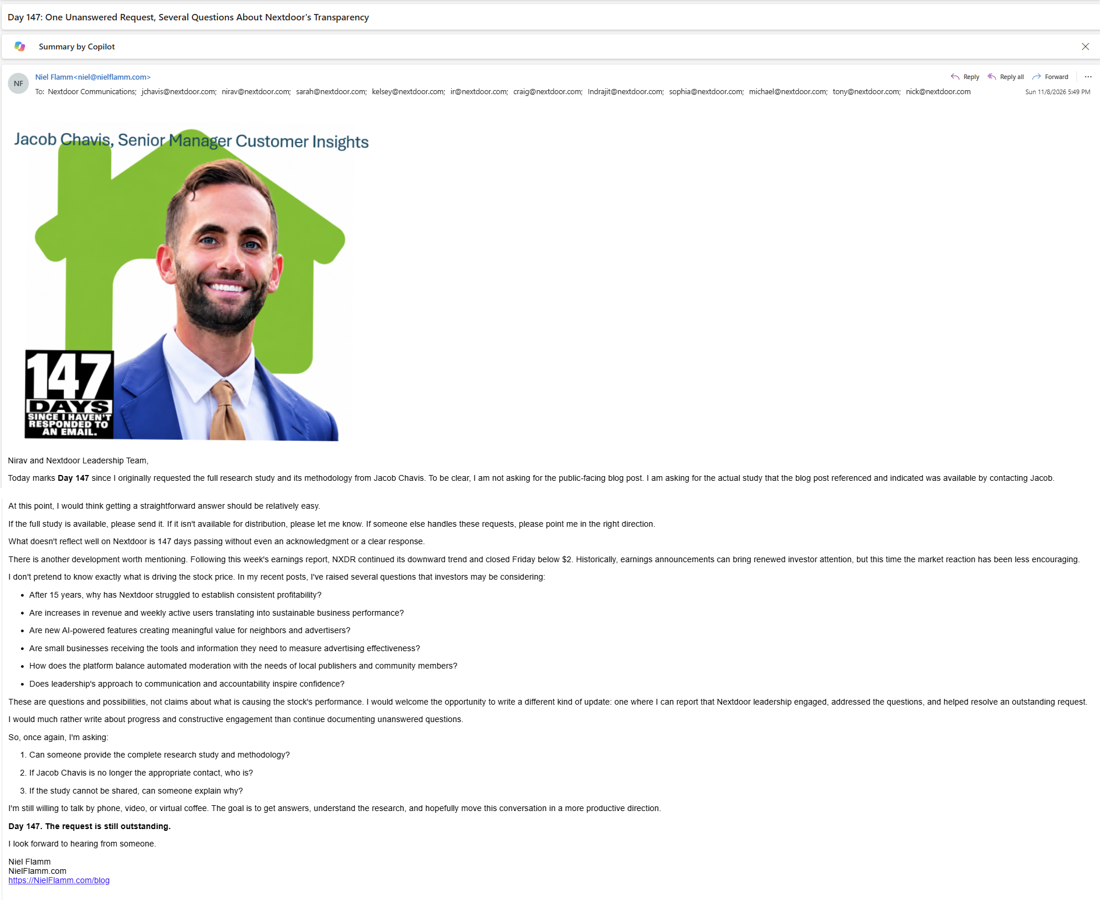
Day 147: 147 Days, One Research Request, and a Stock Price Below $2 — Is Anyone at Nextdoor Listening?
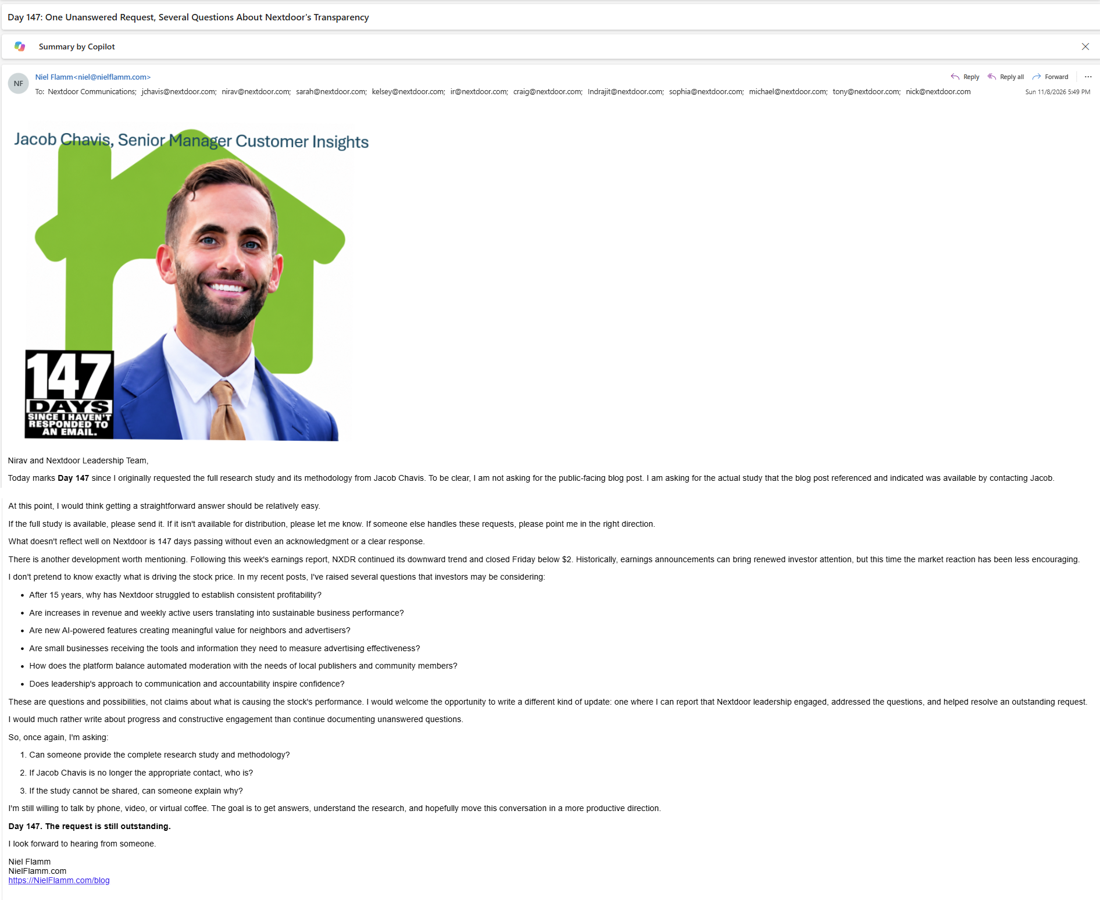
Another day, another email to Nextdoor leadership.
Today marks Day 147 since I first requested the complete research study and methodology referenced in a Nextdoor blog post. Not the public-facing article. Not another link to the same information I've already read. I'm asking for the actual study and the methodology behind it.
And here we are, 147 days later.
You would think this would be a relatively simple request. Either the study is available, or it isn't. If it is available, send it. If it isn't, say so. If Jacob Chavis is no longer the right person to contact, tell me who is.
Apparently, getting that simple answer is proving quite a challenge.
The problem isn't just the missing study.
I've said this before, but I'll say it again: the lack of a response is becoming a story of its own.
When a company publishes research and identifies someone to contact for additional information, it creates an expectation that someone will actually respond. I'm not asking for confidential information, trade secrets, or access to Nextdoor's internal systems. I'm asking for the referenced research, which was reportedly available upon request.
If there are restrictions on sharing it, explain them. If you’ve overlooked the request, acknowledge it. If someone else handles research inquiries, introduce them.
Silence doesn't answer the question. It just creates more questions about communication and accountability.
And then there's the stock price.
Following this week's earnings report, NXDR continued its downward trend, closing Friday below $2.
That's worth paying attention to.
I don't claim to know precisely why investors are reacting the way they are. A stock price can move for many reasons, and I don't have access to every investor's thinking. But I do think there are legitimate questions worth asking.
After 15 years, why has Nextdoor struggled to establish consistent profitability?
Are increases in revenue and weekly active users translating into sustainable business performance?
Are new AI-powered features creating meaningful value for neighbors and advertisers?
Are small businesses getting the tools and information they need to measure advertising effectiveness?
How does Nextdoor balance automated moderation with the needs of local publishers and community members?
Does leadership's approach to communication and accountability inspire confidence?
These are questions and possibilities, not declarations about what is driving the stock price. But investors have every reason to look beyond product announcements and user growth. They want to understand the business, its prospects, and its path to sustainable profitability.
I'd rather write a different story.
Here's the part that I think gets lost in all of this.
I would much rather write a blog post saying that someone at Nextdoor finally reached out, provided the study, answered the questions, and helped resolve the issue.
That would be a much more interesting update than another day-counting exercise.
I have offered to speak by phone, through video, or even over virtual coffee. I'm open to a constructive conversation. I want Nextdoor to succeed. I also believe that asking questions, providing feedback, and expecting companies to respond are reasonable parts of doing business.
This isn't about demanding special treatment. It's about a company following through on an invitation it made publicly.
My request, once again
So, as I sent in today's email to Nirav Tolia and the Nextdoor leadership team, I'm asking three straightforward questions:
Can someone provide the complete research study and methodology?
If Jacob Chavis is no longer the appropriate contact, who is?
If the study cannot be shared, can someone explain why?
That's it.
No elaborate presentation. No complicated negotiation. Just an answer.
Day 147. The request is still outstanding.
Nextdoor, the ball is in your court. I'd be happy to write a different ending to this story.
👉 Follow the ongoing case study and the latest updates at NielFlamm.com/blog.

Day 145: NXDR Falls Below $2 — Is Nextdoor Building a Better Platform or Just a Better Story?

Well, that didn't take long.
After Nextdoor released its quarterly earnings report, NXDR took a serious nose dive. The stock closed at $2.12 on November 5 and finished at $1.96 on November 6, falling below the $2 mark. That's another 7.55% decline on Friday alone.
So, what happened? Was it the earnings? Investor expectations? The company's long-term financial performance? Or perhaps investors are looking at the bigger picture and asking questions that Nextdoor still hasn't answered.
I have a few hypotheticals of my own.
Day 145: Still waiting for Jacob Chavis's research reports
Let's start with a recurring theme in this case study.
It's Day 145 of waiting for the research reports associated with Jacob Chavis, whom Nextdoor publicly identified as the contact for additional information.
I've sent emails. I've followed up. I've asked for the reports and the methodology behind the research.
Still waiting.
Perhaps investors are wondering how a company that promotes its research and insights can make it so difficult for someone to obtain the underlying information.
Perhaps they are wondering whether transparency is a priority when the questions become uncomfortable.
Perhaps they are wondering whether Nextdoor understands that responding to questions is part of building trust.
Just a thought.
Look at all the shiny new products!
Nextdoor published another product update:
What's New on Nextdoor: Product Updates
There's plenty to talk about.
The November 5 update highlights:
AI-powered Ask in search: Neighbors can ask questions in plain language and receive responses drawn from years of neighborhood conversations.
Local events in the feed: Events are being surfaced to nearby neighbors, with Nextdoor reporting 46% more views after the change.
Groups reaching beyond members: Group posts can now appear in feeds of neighbors who haven't joined.
A faster feed: Nextdoor reports improvements in loading speed on Android and the web.
Sponsored search expansion: More advertising categories are being added.
Neighborhood Intelligence: Advertisers can target and measure at the neighborhood level rather than just by ZIP code.
Nextdoor Blog
That's a lot of product activity.
And I'm not suggesting that these improvements have no value. Some sound useful. Others raise questions about advertising, privacy, moderation, and how neighborhood conversations are being used.
But here's my hypothetical:
Perhaps investors are wondering whether more features automatically translate into a profitable business.
Perhaps they're asking whether AI-powered search will generate enough additional advertising revenue to justify the investment.
Perhaps they're wondering whether expanding sponsored search will improve the experience for neighbors or simply put more advertisements into their feeds.
Perhaps they're asking how Nextdoor will demonstrate that neighborhood-level advertising produces better results for small businesses.
And perhaps they're wondering whether the company is measuring the success of these products by the value they create for users and advertisers—or simply by the number of new features it can announce.
A product announcement is not the same thing as a successful business model.
Fifteen years of building, but where's the profit?
Nextdoor was founded in 2011. We're now approaching 15 years of the company's existence.
And what are we still discussing?
Profitability.
The latest quarterly report showed:
Q3 2026 metric
Reported result
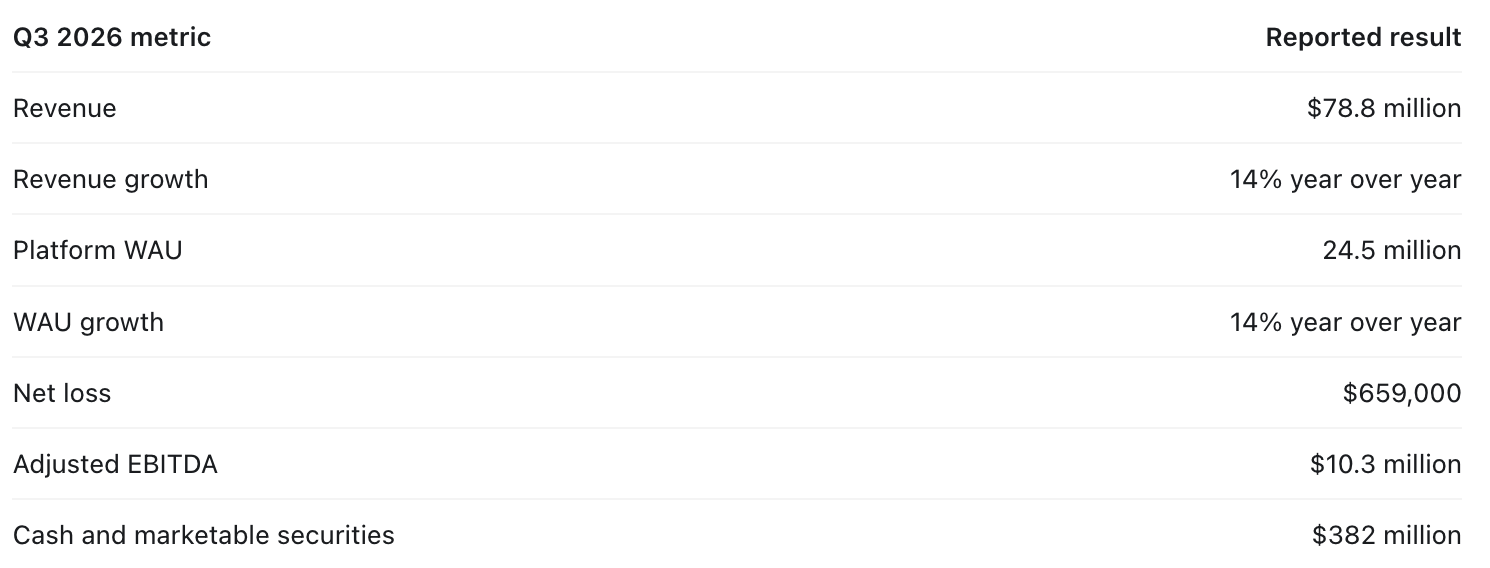
Nextdoor's net loss was considerably smaller than the $12.9 million loss reported in the same quarter last year. Adjusted EBITDA improved from $4.4 million to $10.3 million. Those are meaningful improvements.
But the company still reported a net loss.
And here's another hypothetical:
Perhaps investors are asking when all those years of building a neighborhood network will translate into consistent GAAP profitability.
Perhaps they're wondering how many more years of investment it will take before the business can stand on its own financially.
Perhaps they're asking whether the company has a clear path to sustainable profits or whether every earnings report will come with another explanation of why the next quarter will be better.
Growth is important. Revenue is important. Active users are important.
But eventually, a business needs to make money.
Will the executives get rewarded while shareholders wait?
Here's another question I've raised before.
If the company reports better numbers, does the executive team receive bonuses or other performance-tied compensation?
I don't know the details of the current bonus calculations or whether anyone received a bonus for this quarter. I'm not claiming that they did.
But it raises a worthwhile question.
If management is rewarded for increasing WAU, growing revenue, and reducing losses, how are shareholders rewarded for sticking with the company?
The earnings announcement also discussed the company's intention to continue investing while opportunistically returning capital to shareholders through its share buyback program. That's not the same as a dividend, and investors may reasonably want to understand how that approach benefits them.
Perhaps investors are asking whether executive compensation is sufficiently aligned with long-term shareholder returns.
Perhaps they're wondering whether management's performance measures should put more emphasis on profitability and the stock price.
Perhaps they're asking when the average investor gets to see a meaningful return beyond hoping the share price eventually goes up.
Just asking questions, Nirav.
Perhaps the problem isn't the products. Perhaps it's trust.
Let's put all of this together.
145 days waiting for research reports.
Questions about moderation and the treatment of local publishers.
Questions about advertising effectiveness and small-business support.
Questions about the value of verified addresses.
Questions about user-generated content and who benefits from it.
Questions about profitability and shareholder returns.
Questions about how management communicates with people who provide feedback.
Perhaps investors are looking beyond the quarterly financial statements.
Perhaps they're asking whether Nextdoor listens to its customers.
Perhaps they're wondering whether the company understands that trust is central to a neighborhood platform.
Perhaps they're asking whether the company can grow its advertising business without damaging the community experience that attracts people in the first place.
And perhaps they're wondering whether leadership is willing to address difficult questions instead of simply announcing the next product improvement.
I don't know whether any of these things contributed to the stock's decline. A stock price moves for many reasons, and I wouldn't pretend to know what every investor is thinking.
But these are questions that deserve answers.
Nirav, try something different
Nextdoor has a new product announcement. It has AI. It has Neighborhood Intelligence. It has 24.5 million Weekly Active Users. It has nearly $79 million in quarterly revenue.
Those are things worth discussing.
But the company also has a stock that closed below $2, a continuing net loss, and people asking questions about transparency, moderation, advertising, and accountability.
Perhaps it's time to spend less energy telling everyone what's new and more time explaining how it all creates sustainable value.
And while we're at it, perhaps someone could answer my email.
Jacob, I'm still waiting.
Nirav, I'm still providing feedback.
Day 145. NXDR is under $2. The questions are still worth more than a product announcement.
Day 140: NXDR Slides to $2.23 — What Is Driving Nextdoor's Decline?
The slide continues.
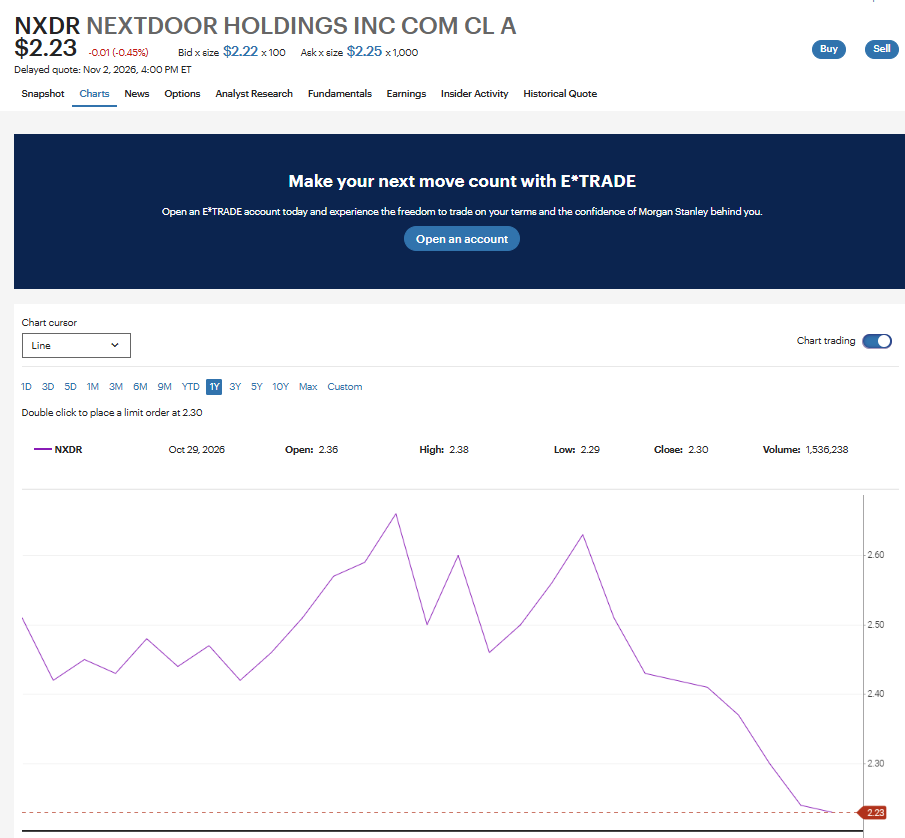
Yesterday, NXDR closed at $2.24. Today, it closed at $2.23, down about 0.45%.
One day, another step backward. Not a dramatic drop on its own, but it's part of a trend that's caught my attention.
I've been watching this movement since October 22, 2026, and I'm curious about what's behind it.
Another day in the wrong direction
I've noticed a pattern in previous earnings cycles. NXDR would bump up in the days leading up to an earnings report, only to give back some of those gains shortly afterward.
This time, something looks different.
Instead of the pre-earnings momentum I’ve seen before, the stock has continued to drift downward.
So what's changed?
Is this normal market activity? Are investors waiting for the next earnings announcement? Are there concerns about the company's financial performance, its growth strategy, advertising expansion, or its ability to turn its audience into sustainable revenue?
I don't know the answer, and I'm not going to pretend that I do.
But I would like to hear an explanation.
So I asked The Google: Why do investors think NXDR is sliding?
I asked The Google why investors believe Nextdoor Holdings (NXDR) is declining.
The AI Overview returned several explanations. Some are particularly interesting because they overlap with issues I've been discussing over the past year.
Here's a summary of what The Google identified:
1. Execution and scale concerns
Investors and analysts may be questioning whether Nextdoor has the cost structure and overhead of a much larger technology platform without generating the revenue to support it.
In other words, does the business have the scale to justify its operating structure?
2. Muted guidance and slower growth
The AI Overview pointed to analyst price-target reductions, with targets moving toward the $2.10–$2.20 range, along with expectations for modest revenue growth and adjusted EBITDA margins.
Revenue growth is important, but investors also want to understand how that growth translates into sustainable profitability.
3. Moderation and user friction
This one should sound familiar.
The overview identified concerns about automated moderation, including ordinary neighbor recommendation posts being classified as commercial content and comment threads being closed.
I've spent considerable time discussing moderation, inconsistent enforcement, and the frustration users experience when legitimate neighborhood conversations are restricted.
A platform depends on its users. Make it difficult for them to participate, and you risk damaging the very community that makes the business valuable.
4. Internal culture and leadership questions
The overview also mentioned concerns surrounding employee stock compensation, workplace culture discussions, and leadership changes.
These are areas that deserve careful examination rather than assumptions. However, questions about leadership stability and the ability to execute a strategy can influence investor confidence.
5. A large cash cushion and corporate urgency
Finally, the overview referenced Nextdoor's substantial cash reserves and argued that a significant cash cushion could reduce pressure to make difficult changes.
Having cash is a strength. But cash alone doesn't guarantee a successful business model, profitable growth, or shareholder returns.
These points come from Google's AI Overview, not independently established explanations for today's price movement. They represent potential investor concerns and should be evaluated against company filings, earnings results, analyst research, and other evidence.
Here's what caught my attention
I may not have used the same polished language as Google's AI Overview, but I've raised every one of these issues over the last year or so.
Execution. Revenue growth. Moderation. User experience. Leadership. Company culture. Cash reserves—shareholder value.
I've written about these subjects repeatedly.
I've questioned whether Nextdoor is building a sustainable business or simply adding more advertising opportunities to a platform that still has fundamental user-experience problems.
I've asked whether the company understands the consequences of moderation decisions and how those decisions affect participation and engagement.
I've questioned whether leadership is listening to users and whether the company is doing enough to communicate with investors.
And I've repeatedly asked for answers to specific questions, including the two detailed research reports that remain outstanding.
Apparently, these aren't just questions coming from one neighbor writing a blog.
They're also among the concerns being discussed in the broader investment conversation.
That doesn't mean my commentary caused the stock decline, nor does it prove that every concern in the AI Overview is accurate. But it does reinforce why these subjects deserve attention.
Will management address the decline?
Nextdoor has an earnings report coming up. That creates an opportunity for management to address more than just revenue, user growth, and adjusted EBITDA.
I'd like to hear how leadership views the market's reaction to the company's performance.
Some questions I'd like answered:
What does management believe is driving the recent decline in NXDR?
Is investor confidence changing?
How is Nextdoor measuring the success of its newer advertising and sponsored-search initiatives?
What is the path toward sustainable GAAP profitability?
What is the company doing to create long-term shareholder value?
How does Nextdoor plan to improve trust and engagement among the neighbors who make the platform valuable?
Revenue growth and user numbers are important. But they don't automatically translate into investor confidence or a stronger stock price.
My concern: Will we get any real answers?
Here's where my skepticism comes in.
I expect the earnings report to focus on the usual financial metrics and forward-looking statements. I wonder whether management will address the questions investors are actually asking about the stock's performance.
And that brings me back to a recurring concern throughout this case study: transparency.
I've spent 141 days raising questions about Nextdoor's communication, leadership, moderation, advertising strategy, and accountability.
I've also requested two detailed research reports and am still waiting for a meaningful response.
The company talks about community, connection, and creating value. But those promises need to extend beyond marketing language.
Investors deserve meaningful communication. Users deserve a platform that puts their experience first.
Day 141: The numbers are telling a story. Is anyone listening?
A 0.45% decline in one trading session isn't necessarily a warning sign on its own. I know stock prices move for many reasons, and I don't have enough information to attribute this decline to any one factor.
But the direction since October 22 deserves attention.
Nextdoor has celebrated 15 years, announced new revenue opportunities, and promoted its partnerships. That's great.
Now I'd like to see the company demonstrate how those milestones translate into investor confidence, sustainable growth, and a better experience for its neighbors.
Nirav Tolia and the Nextdoor leadership team: What is driving the slide, and will you address it?
I'll be watching the earnings report.
Day 141. The slide continues. The questions continue. And the wait for answers continues.

Day 137: NXDR Falls to $2.24. Is Nextdoor Losing the Trust It Needs to Grow?

Fifteen years in business. New advertising opportunities. Another earnings report approaching. So why is the stock still sliding?

Day 137 of my Nextdoor case study, and NXDR is now trading at $2.24.
Let's recap.
Nextdoor recently celebrated its fifteenth anniversary by ringing the Nasdaq closing bell. The company has announced an expansion of sponsored search advertising, with new categories expected to include health care, pet care, real estate, telecommunications and financial services beginning in January.
The next quarterly earnings report is approaching, and historically I've seen a pattern where NXDR rises shortly before the earnings presentation, holds some of those gains for a day or two, and then retreats.
That's my observation of historical price behavior, not a guarantee of what will happen next.
But this time, something looks different.
With all these announcements and potential new revenue opportunities, why is NXDR trending downward?
I don't know the specific reason. I don't have access to investor trading decisions, and I won't pretend that one LinkedIn post explains the stock price.
But perhaps we should look beyond the earnings calendar and the revenue announcements.
Perhaps we should look at the experience of the people who actually use Nextdoor.
The LinkedIn Post That Caught My Attention
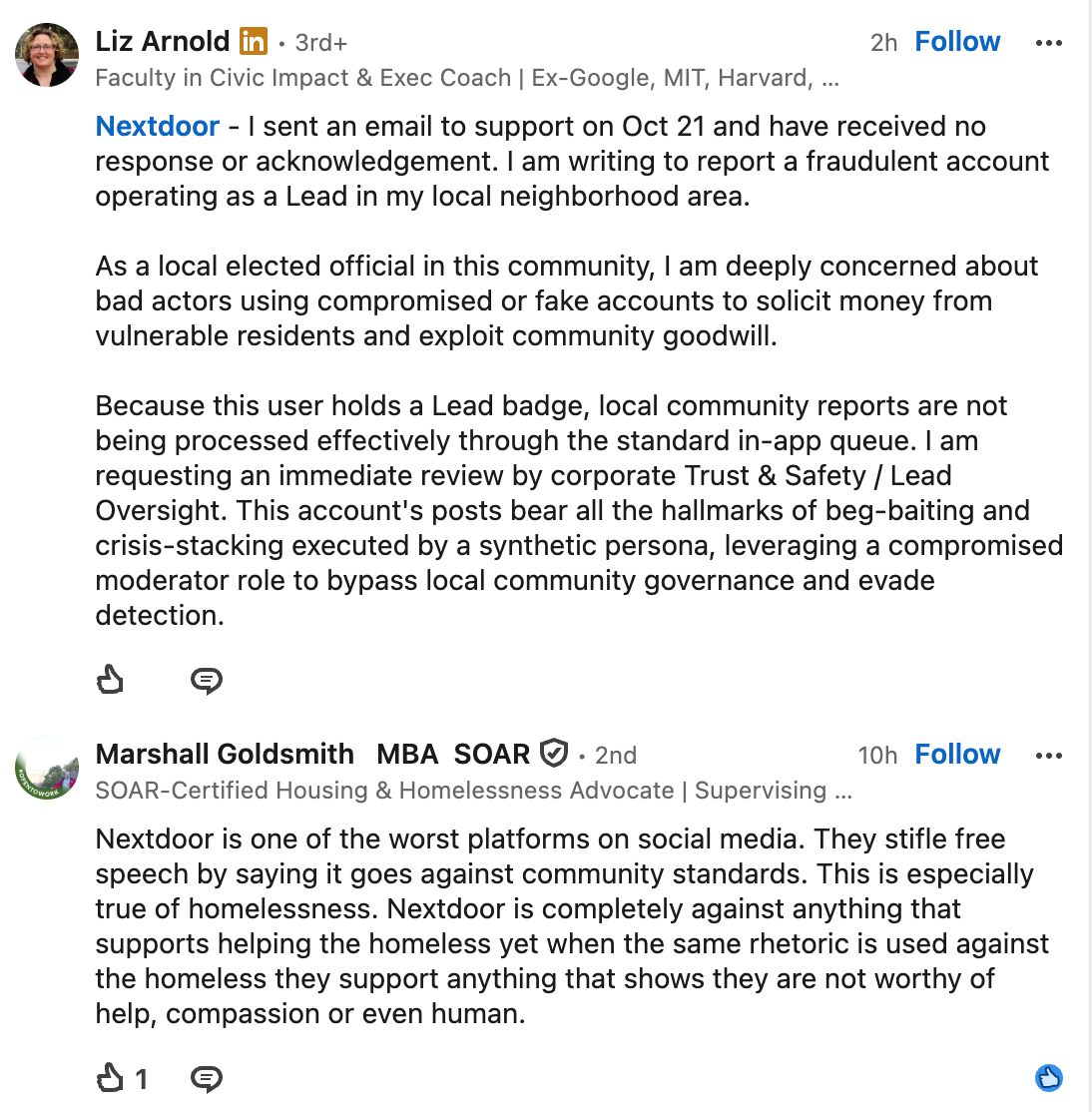
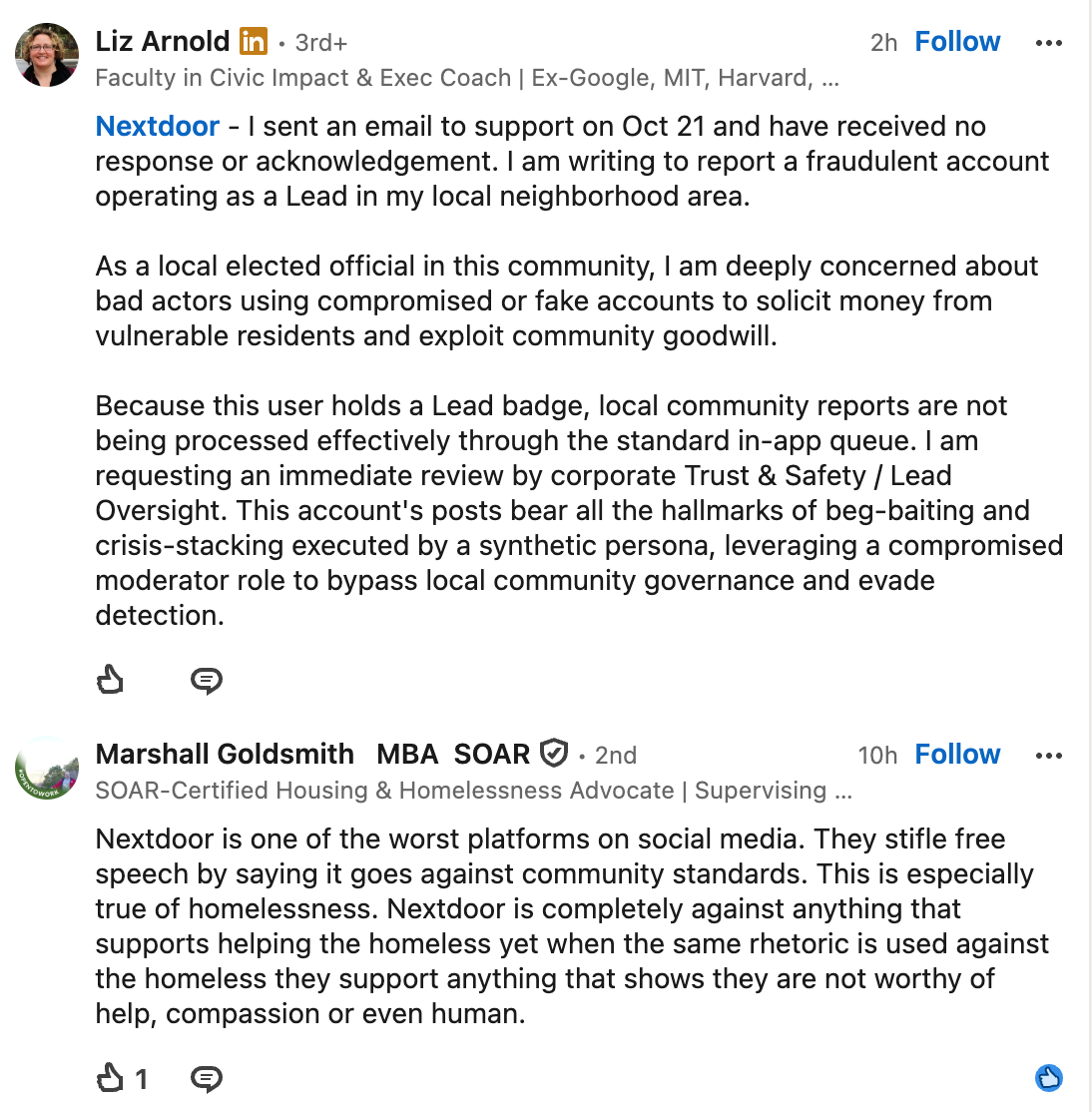
I came across a LinkedIn post by Liz Arnold that deserves attention.
She says she emailed Nextdoor Support on October 21 and received no response or acknowledgment.
Her concern involves an account allegedly operating fraudulently as a Lead in her local neighborhood. She identifies herself as a local elected official and expresses concern that compromised or fake accounts could be used to solicit money from vulnerable residents and exploit community goodwill.
She also raises a particularly important concern: because the account carries a Lead badge, she believes reports about it are not being processed effectively through the standard in-app reporting queue.
She is asking for an immediate review by Nextdoor's corporate Trust and Safety team and the people responsible for Lead oversight.
Let me be clear: these are allegations and concerns expressed in her LinkedIn post. I have not independently verified the account, the alleged fraud, or how her support request was handled.
But the issues she raises are significant.
If an account with a community leadership badge is compromised or being used deceptively, that creates a potential trust and safety problem. If the reporting process isn't working as intended, that creates another.
And if someone reports a potentially fraudulent account and receives no acknowledgment, that creates a customer-service problem.
Those are three issues a platform built around neighborhood trust should want to address.
A Lead Badge Should Come With Responsibility
Nextdoor's Lead program is intended to support community participation and neighborhood governance.
But what happens when a Lead account is compromised, misused, or otherwise becomes part of a dispute?
Is there a separate escalation process for concerns involving Leads?
Does Nextdoor regularly review whether Lead accounts are being used appropriately?
How quickly are reports involving potential fraud investigated?
Can users reach a corporate Trust and Safety team when the standard reporting process isn't working?
Does Nextdoor communicate when a report has been received and reviewed?
A badge creates an expectation.
It signals that the person has a recognized role in the community. If that role is misused, the company needs a reliable way to investigate and respond.
The trust associated with a badge should not make an account immune from scrutiny.
Another Comment Raises Questions About Moderation
The same screenshot includes a comment from Marshall Goldsmith, who describes his frustration with Nextdoor's moderation of discussions involving homelessness.
He alleges that the platform suppresses discussion supporting homeless people while allowing rhetoric directed against them.
That's his experience and interpretation, not something I can independently establish from the screenshot alone.
But it raises another recurring issue in my case study: consistency.
How does Nextdoor distinguish between a discussion that violates its Community Guidelines and one that expresses an unpopular or controversial opinion?
Are similar comments treated consistently?
Can users understand why content was removed?
And when someone believes moderation has been applied unfairly, is there a meaningful appeal process?
These are not new questions. I've been raising concerns about moderation, communication, and accountability for months.
The company needs more than a set of written rules. It needs consistent enforcement and a way to demonstrate that those rules apply fairly.

Nextdoor Wants More Advertising Revenue. What About the Existing Experience?
Let's return to the new sponsored-search opportunity.
Nextdoor wants to expand advertising into categories such as health care, pet care, real estate, telecommunications, and financial services.
That makes commercial sense. Someone searching for a veterinarian or financial service may have a specific need and be ready to consider a provider.
Advertisers want access to those high-intent moments.
But here's the problem I keep seeing:
Nextdoor is developing new ways to monetize the community while people still question the basic experience of using the platform.
More advertising opportunities don't automatically create more trust.
More revenue categories don't automatically produce better moderation.
And a larger advertising business doesn't automatically mean that users and small businesses are getting a fair value exchange.
The platform needs to get the fundamentals right.
The Gap Between Promise and Execution
Nextdoor's promise centers on connecting neighbors and building stronger communities.
That's a compelling idea.
But the experience has to support the promise.
Consider the issues that keep appearing in my case study:
For users:
Unclear or inconsistent moderation decisions.
Difficulty getting meaningful responses from Support.
Concerns about account security and impersonation.
Questions about how user-generated content is commercialized.
Limited visibility into how complaints are investigated.
For community leaders and moderators:
Questions about training and oversight.
Potential conflicts of interest.
Concerns about the misuse of moderation privileges.
Questions about the protection of nonpublic information.
For small businesses:
Questions about the return on advertising spending.
The growing commercialization of neighborhood recommendations.
Whether businesses of different sizes can access meaningful value.
For investors:
The need for sustainable revenue growth.
The path to consistent profitability.
The ability to retain users and advertisers.
Long-term shareholder value.
These are not all proven failures, and I recognize that Nextdoor has made progress in some areas. But they are recurring questions that deserve answers.

Why Is NXDR at $2.24?
That's the question investors may be asking as earnings approach.
Nextdoor has a new advertising opportunity. It has celebrated fifteen years in business. It has been promoting its neighborhood network and its commercial potential.
Yet the stock is at $2.24.
Multiple factors could explain the decline: broader market conditions, investor expectations, trading activity, company-specific concerns, or something else entirely.
I won't attribute the decline to the LinkedIn post, my case study, or any single issue without evidence.
But I do believe that a company's reputation, user experience, and ability to execute matter to its long-term prospects.
Investors aren't just buying a quarterly revenue number. They're evaluating the business they believe will exist several years from now.
And a business that depends on community trust should take reports of potential fraud, weak support, and inconsistent moderation seriously.
Day 137: Stop Adding New Features Until the Fundamentals Work
Nirav Tolia and the Nextdoor team have spent considerable time promoting new products, advertising opportunities and the company's fifteen-year history.
Those things have their place.
But I would like to see the same energy directed toward fixing the experience that users, community leaders, and small businesses encounter every day.
When someone reports a potentially fraudulent account, acknowledge the report.
When someone raises concerns about a Lead account, make sure the escalation process works.
When people question moderation decisions, provide a meaningful explanation.
When users raise concerns about privacy and nonpublic information, explain the safeguards.
And when people ask legitimate questions about the company, establish a process that brings those questions to resolution.
You cannot build a stronger commercial business on top of a community experience that people don't trust.
Perhaps the market is seeing something that isn't reflected in the anniversary photographs or the latest product announcements.
Perhaps investors want to see execution.
Perhaps users want to see accountability.
Perhaps small businesses want to see measurable value.
I don't know why NXDR is down to $2.24. But I do know that the questions about Nextdoor's underlying experience haven't disappeared.
Fifteen years is a significant milestone.
Now it's time to demonstrate that the company can deliver on the promise.
👉 Follow my continuing Nextdoor case study at NielFlamm.com/blog.