

Well, that didn't take long.
After Nextdoor released its quarterly earnings report, NXDR took a serious nose dive. The stock closed at $2.12 on November 5 and finished at $1.96 on November 6, falling below the $2 mark. That's another 7.55% decline on Friday alone.
So, what happened? Was it the earnings? Investor expectations? The company's long-term financial performance? Or perhaps investors are looking at the bigger picture and asking questions that Nextdoor still hasn't answered.
I have a few hypotheticals of my own.
Day 145: Still waiting for Jacob Chavis's research reports
Let's start with a recurring theme in this case study.
It's Day 145 of waiting for the research reports associated with Jacob Chavis, whom Nextdoor publicly identified as the contact for additional information.
I've sent emails. I've followed up. I've asked for the reports and the methodology behind the research.
Still waiting.
Perhaps investors are wondering how a company that promotes its research and insights can make it so difficult for someone to obtain the underlying information.
Perhaps they are wondering whether transparency is a priority when the questions become uncomfortable.
Perhaps they are wondering whether Nextdoor understands that responding to questions is part of building trust.
Just a thought.
Look at all the shiny new products!
Nextdoor published another product update:
What's New on Nextdoor: Product Updates
There's plenty to talk about.
The November 5 update highlights:
AI-powered Ask in search: Neighbors can ask questions in plain language and receive responses drawn from years of neighborhood conversations.
Local events in the feed: Events are being surfaced to nearby neighbors, with Nextdoor reporting 46% more views after the change.
Groups reaching beyond members: Group posts can now appear in feeds of neighbors who haven't joined.
A faster feed: Nextdoor reports improvements in loading speed on Android and the web.
Sponsored search expansion: More advertising categories are being added.
Neighborhood Intelligence: Advertisers can target and measure at the neighborhood level rather than just by ZIP code.
Nextdoor Blog
That's a lot of product activity.
And I'm not suggesting that these improvements have no value. Some sound useful. Others raise questions about advertising, privacy, moderation, and how neighborhood conversations are being used.
But here's my hypothetical:
Perhaps investors are wondering whether more features automatically translate into a profitable business.
Perhaps they're asking whether AI-powered search will generate enough additional advertising revenue to justify the investment.
Perhaps they're wondering whether expanding sponsored search will improve the experience for neighbors or simply put more advertisements into their feeds.
Perhaps they're asking how Nextdoor will demonstrate that neighborhood-level advertising produces better results for small businesses.
And perhaps they're wondering whether the company is measuring the success of these products by the value they create for users and advertisers—or simply by the number of new features it can announce.
A product announcement is not the same thing as a successful business model.
Fifteen years of building, but where's the profit?
Nextdoor was founded in 2011. We're now approaching 15 years of the company's existence.
And what are we still discussing?
Profitability.
The latest quarterly report showed:
Q3 2026 metric
Reported result
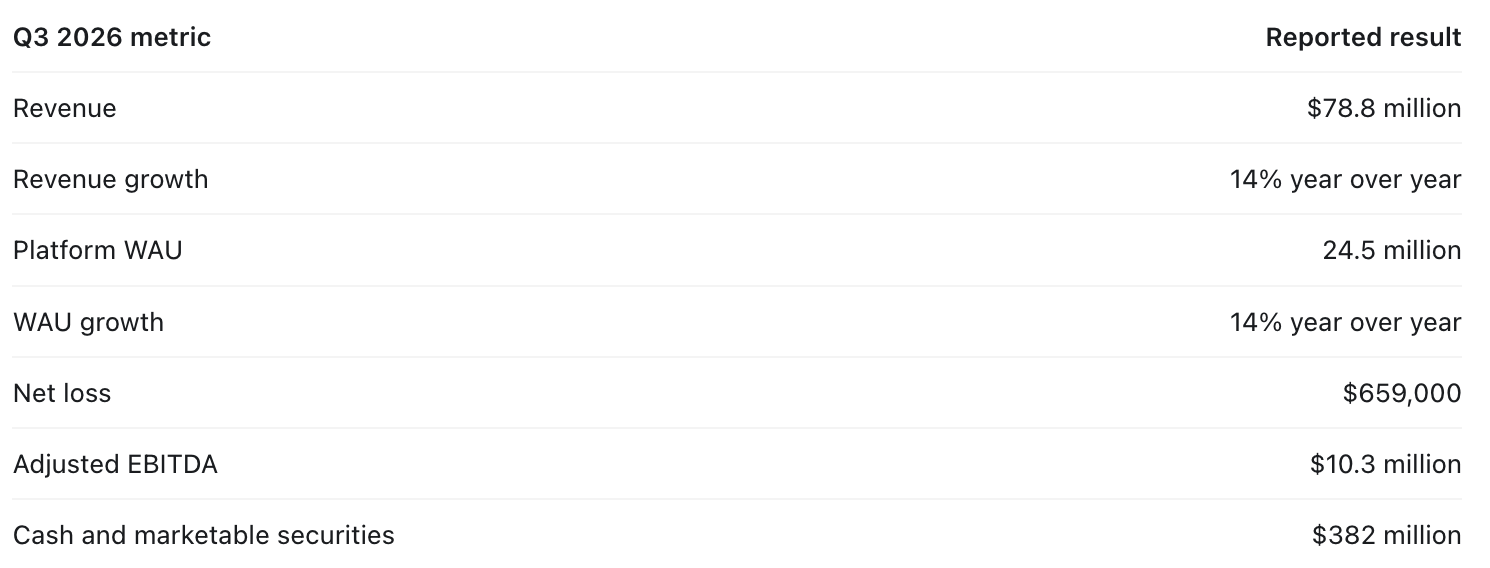
Nextdoor's net loss was considerably smaller than the $12.9 million loss reported in the same quarter last year. Adjusted EBITDA improved from $4.4 million to $10.3 million. Those are meaningful improvements.
But the company still reported a net loss.
And here's another hypothetical:
Perhaps investors are asking when all those years of building a neighborhood network will translate into consistent GAAP profitability.
Perhaps they're wondering how many more years of investment it will take before the business can stand on its own financially.
Perhaps they're asking whether the company has a clear path to sustainable profits or whether every earnings report will come with another explanation of why the next quarter will be better.
Growth is important. Revenue is important. Active users are important.
But eventually, a business needs to make money.
Will the executives get rewarded while shareholders wait?
Here's another question I've raised before.
If the company reports better numbers, does the executive team receive bonuses or other performance-tied compensation?
I don't know the details of the current bonus calculations or whether anyone received a bonus for this quarter. I'm not claiming that they did.
But it raises a worthwhile question.
If management is rewarded for increasing WAU, growing revenue, and reducing losses, how are shareholders rewarded for sticking with the company?
The earnings announcement also discussed the company's intention to continue investing while opportunistically returning capital to shareholders through its share buyback program. That's not the same as a dividend, and investors may reasonably want to understand how that approach benefits them.
Perhaps investors are asking whether executive compensation is sufficiently aligned with long-term shareholder returns.
Perhaps they're wondering whether management's performance measures should put more emphasis on profitability and the stock price.
Perhaps they're asking when the average investor gets to see a meaningful return beyond hoping the share price eventually goes up.
Just asking questions, Nirav.
Perhaps the problem isn't the products. Perhaps it's trust.
Let's put all of this together.
145 days waiting for research reports.
Questions about moderation and the treatment of local publishers.
Questions about advertising effectiveness and small-business support.
Questions about the value of verified addresses.
Questions about user-generated content and who benefits from it.
Questions about profitability and shareholder returns.
Questions about how management communicates with people who provide feedback.
Perhaps investors are looking beyond the quarterly financial statements.
Perhaps they're asking whether Nextdoor listens to its customers.
Perhaps they're wondering whether the company understands that trust is central to a neighborhood platform.
Perhaps they're asking whether the company can grow its advertising business without damaging the community experience that attracts people in the first place.
And perhaps they're wondering whether leadership is willing to address difficult questions instead of simply announcing the next product improvement.
I don't know whether any of these things contributed to the stock's decline. A stock price moves for many reasons, and I wouldn't pretend to know what every investor is thinking.
But these are questions that deserve answers.
Nirav, try something different
Nextdoor has a new product announcement. It has AI. It has Neighborhood Intelligence. It has 24.5 million Weekly Active Users. It has nearly $79 million in quarterly revenue.
Those are things worth discussing.
But the company also has a stock that closed below $2, a continuing net loss, and people asking questions about transparency, moderation, advertising, and accountability.
Perhaps it's time to spend less energy telling everyone what's new and more time explaining how it all creates sustainable value.
And while we're at it, perhaps someone could answer my email.
Jacob, I'm still waiting.
Nirav, I'm still providing feedback.
Day 145. NXDR is under $2. The questions are still worth more than a product announcement.
