
Day 107: NXDR Ends at $2.43 — What Is the Market Telling Us?

Day 107.
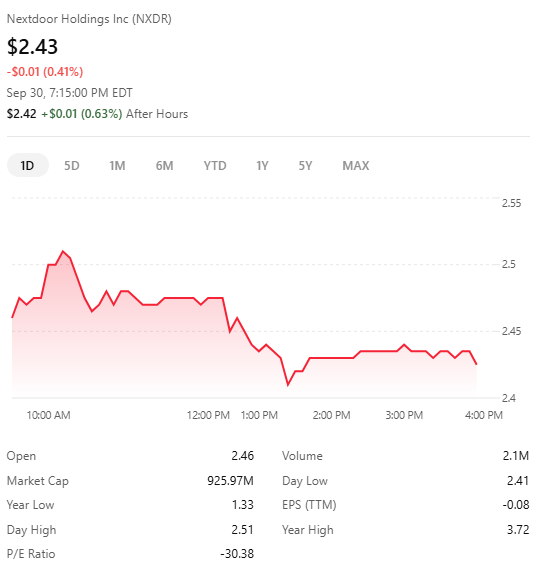
Today, Nextdoor Holdings (NXDR) finished at $2.43 per share, down slightly from Tuesday's $2.45 close. The stock traded between $2.41 and $2.52 during the session, with roughly 2.14 million shares changing hands.
One day doesn't tell the whole story.
The longer-term picture in the chart I've been watching is considerably more interesting.
A Year of Ups, Downs and Plenty in Between
Look at the one-year chart I included with this post.
NXDR has spent portions of the period down around the $2 range, while at other points it approached the upper $2.60s.
More recently, the movement has been just as interesting.
NXDR closed at $2.15 on September 9. By September 21, it had climbed to $2.64. It then fell to $2.38 on September 23, recovered to $2.51 on September 25, and finished September at $2.43.
That's quite a ride for a stock trading for less than $3.
And as a shareholder, it raises a question I've been asking throughout this Nextdoor case study:
What ultimately moves confidence in a company?
A Stock Price Isn't a Corporate Report Card
I want to be careful here.
A stock going up doesn't automatically mean management is doing everything right.
A stock going down doesn't automatically mean management is doing everything wrong.
And I'm certainly not going to look at today's two-cent decline and announce:
“The market has spoken about Nirav Tolia!”
😂
That's not how markets work.
Stock prices can move because of company financial results, expectations about future results, analyst opinions, broader market conditions, trading activity, liquidity, news, investor sentiment, and countless other factors.
NXDR itself demonstrates how quickly those expectations can change. In August, following its second-quarter results, analysts changed their views and price targets. More recently, NXDR has continued moving around considerably from session to session.
I can't attribute a specific Nextdoor decision to a particular movement on this chart.
No one else can either without evidence connecting the two.
But Confidence Still Matters
The chart still matters for my longer-term case study.
Markets ultimately involve people deciding what they believe something is worth.
And those decisions can include much more than yesterday's closing price.
Investors can consider:
Results. Strategy. Growth. Profitability. Execution. Leadership. Communication. Governance. Risk. And expectations about what happens next.
That's where confidence comes in.
A company can announce a brilliant strategy, but eventually investors can look for evidence that it worked.
A CEO can communicate a compelling vision, but eventually shareholders can compare that vision with results.
Management can make decisions that look strange today and brilliant two years from now.
Or the reverse.
Time has an interesting way of grading decisions.

That's Why I Keep Coming Back to Results
I've spent 107 days documenting my experience with Nextdoor.
I've asked about the detailed Insights data.
I've written about communication.
I've questioned transparency.
I've discussed moderation.
I've written about small businesses.
I've questioned how awards are judged.
I've discussed the economic value of neighbor-generated information.
I've praised Nextdoor when I thought it deserved praise.
I've provided feedback when I saw room for improvement.
That doesn’t mean today's $2.43 closing price validates my opinions.
It doesn't.
Likewise, if NXDR jumps to $3 tomorrow, that wouldn't suddenly invalidate the questions I've been asking.
What matters to me as a shareholder is what happens over time.
Decisions → Results → Confidence
Maybe that's the simplest way I can describe what I'm watching.
Leadership makes decisions.
Those decisions eventually produce results.
Those results can influence expectations.
And expectations can affect how investors value the company.
Not necessarily today.
Not necessarily tomorrow.
And certainly not because of one blog post, one executive interview, one Insights report, or one awkward email exchange.
But over time, execution has consequences.
That's why I'm interested in more than whether NXDR is green or red when I open the chart.
I'm interested in the decisions underneath it.
$2.43 Is Just Today's Number
Tomorrow it could be $2.35.
It could be $2.55.
Eventually it could be considerably higher—or considerably lower.
I don't know.
What I do know is that today's number becomes another point on that purple line.
$2.43.
Another trading day.
Another data point.
And another opportunity to remember that the market doesn't permanently value a company based on what leadership says it intends to accomplish.
Over the long run, investors also get to examine what actually happened.
That's the part of the chart I'll continue watching.
Day 107.
NXDR closes September at $2.43.
Let's see where the decisions, results, and confidence take it next.
👉 NielFlamm.com/blog

Day 82: Is Nextdoor Taking Another Four-Day Weekend?

It’s Day 82.
I’m still here.
Still reaching users.
Still talking to businesses.
Still raising questions for investors.
Still documenting my disappointment with Nextdoor.
And Nextdoor?
Well, from where I’m sitting, it looks like the company may be sticking to a familiar communications playbook:
It’s Friday before Labor Day weekend. Things have gotten very quiet.
No new post today that I’ve seen from Nextdoor’s corporate communications channels.
Nothing new from CEO Nirav Tolia.
And those two detailed Insights studies I’ve been requesting?
Still nothing.
But I do have some exciting news.
NXDR Is Up a Penny! 🎉
As I write this, NXDR is up approximately $0.01.
Hey, at least it isn’t down.
After 82 days, I’ve learned to appreciate the little things.
One penny at a time, people.
Of course, a penny on one trading day doesn't tell us much about the company's long-term value or investor confidence. What matters is sustained performance and whether management's decisions ultimately create shareholder value.
Will We Hear From Nextdoor on Labor Day?
My guess?
Probably not.
We'll see Monday.
But I have to wonder: how difficult is it for a corporate communications organization to schedule a Labor Day post in advance?
You don't exactly need someone sitting at a desk Monday morning typing:
“Happy Labor Day!”
Schedule it.
Go enjoy the barbecue.
Problem solved.
Then Tuesday arrives.
Maybe we'll get another beautifully polished message about verified neighbors, trusted recommendations, local businesses building brand recognition, and how Nextdoor is strengthening communities.
That's the messaging.
I'm interested in what happens underneath it.
Because the Bigger Questions Are Still Sitting There
How is Nextdoor's increasing monetization of small-business interactions going to affect the businesses that helped create the platform's local value?
Where are the two detailed Insights studies that Nextdoor's own previous blog posts invited readers to request?
How does executive compensation align with sustained shareholder value creation?
When does Nextdoor move from improving its losses to delivering the consistent profitability and value shareholders ultimately expect?
And when does somebody simply say:
“Niel, let's talk.”
That's the part that continues to amaze me.
This Could Have Been Very Different
I've said this before, but it becomes more relevant with every passing day.
If someone from Nextdoor had simply reached out to me almost a year ago, I doubt I would be this invested in documenting accountability today.
Not because they needed to agree with me.
Not because I expected special treatment.
Not because one phone call magically solves every disagreement.
Because somebody would have demonstrated something incredibly basic:
Accountability.
“We hear you.”
“We disagree.”
“Here's why.”
“Here's what we can do.”
“Here's what we can't do.”
That's communication.
Instead, I've spent months documenting what happens when questions linger, communication breaks down and a dissatisfied shareholder becomes increasingly interested in understanding why.
And here we are.
Day 82.
And No, I'm Not Interested in Being a Keyboard Warrior
Somebody reading all of these posts might think:
This guy just likes fighting with people online.
Actually, I'd much rather have a conversation.
In person.
By phone.
By web conference.
I'll even make it pleasant.
Let's Have a Virtual Coffee Date ☕
Anyone from Nextdoor who wants to discuss what I've been documenting is welcome to contact me.
I've provided this information before, and it's available on my website.
Email: niel@nielflamm.com
Phone: (843) 212-6824
Nirav, Communications, Investor Relations, Insights—or someone else at Nextdoor:
Pick up the phone. Send an email. Schedule a video call.
Coffee is on me.
Well, technically, my coffee is on me. Yours is on you.
Enjoy the Weekend
Maybe Nextdoor surprises me Monday.
Maybe there's a Labor Day post.
Maybe someone sends the studies.
Maybe my phone rings.
Maybe NXDR goes up another penny.
At this point, anything is possible.
Because almost a year ago, a conversation might have been enough.
Now we're on Day 82.
The invitation remains open.
Let's talk.

Day 66: The Kinder, Gentler Reset Continues

It's Day 66.
Yesterday, I tried something different.
A kinder, gentler reset.
No lengthy email. No dissertation about corporate culture. No recap of the previous 65 days.
I emailed Jacob Chavis and asked for two Nextdoor Insights reports:
The Home Insurance Insights study I've been requesting, and the newly published Financial Advising and Investing study.
Short. Polite. Direct.
Now I'm wondering something beyond my own experience:
Is anyone actually able to obtain the detailed studies referenced on the Nextdoor Blog or LinkedIn?
Nextdoor's latest Insights post directs readers who want the complete report and detailed data to contact Jacob.
So I'd like to hear from someone who has done it.
Did you request one? Did you receive it? How long did it take?
That comparison matters as I examine whether I'm experiencing terrible communication or being treated differently.
Meanwhile, Back at NXDR...
The broader market slid yesterday, and NXDR followed suit.
The stock had been making gains following Nextdoor's Q2 results and was approaching its two-year highs. That enthusiasm appears, at least for now, to have been short-lived.
As a shareholder, I want NXDR to succeed. That's what makes my feedback counterintuitive: financially, I'm rooting for the company I'm criticizing.
I've also noticed E*TRADE now provides additional visibility into options activity, giving investors another interesting data point to watch.
And Then There's the Legal Question
Finding an attorney interested in evaluating a potential discrimination claim isn't as simple as announcing, "Lawyer wanted!"
There's a process.
An attorney would need to determine whether the facts support a viable claim, which law applies, what damages are available, and whether others have experienced comparable treatment.
The same applies to a potential class action. There needs to be an identifiable class with common legal and factual issues.
I'm exploring those questions.
Nextdoor also has substantial cash on hand. Using the figures I've been reviewing—approximately $377.97 million in cash against $27.70 million in debt—that's roughly $350 million net of debt.
But that's not a pot of money automatically available to plaintiffs or attorneys. Any recovery would require an actual viable claim followed by a settlement or judgment.
So I'm not counting imaginary settlement checks or contingency fees.
First comes the simpler experiment.
I sent the polite email.
I asked for the studies Nextdoor tells people they can request.
Now let's see what happens.
And I'd particularly like to hear from anyone who has successfully requested and received a Nextdoor Insights report.
Day 66. Kinder. Gentler. Still documenting.
The complete timeline is at NielFlamm.com/blog.

Day 64: I’m Not Asking for the C-Suite. I’m Asking for Someone.
It's Day 64.

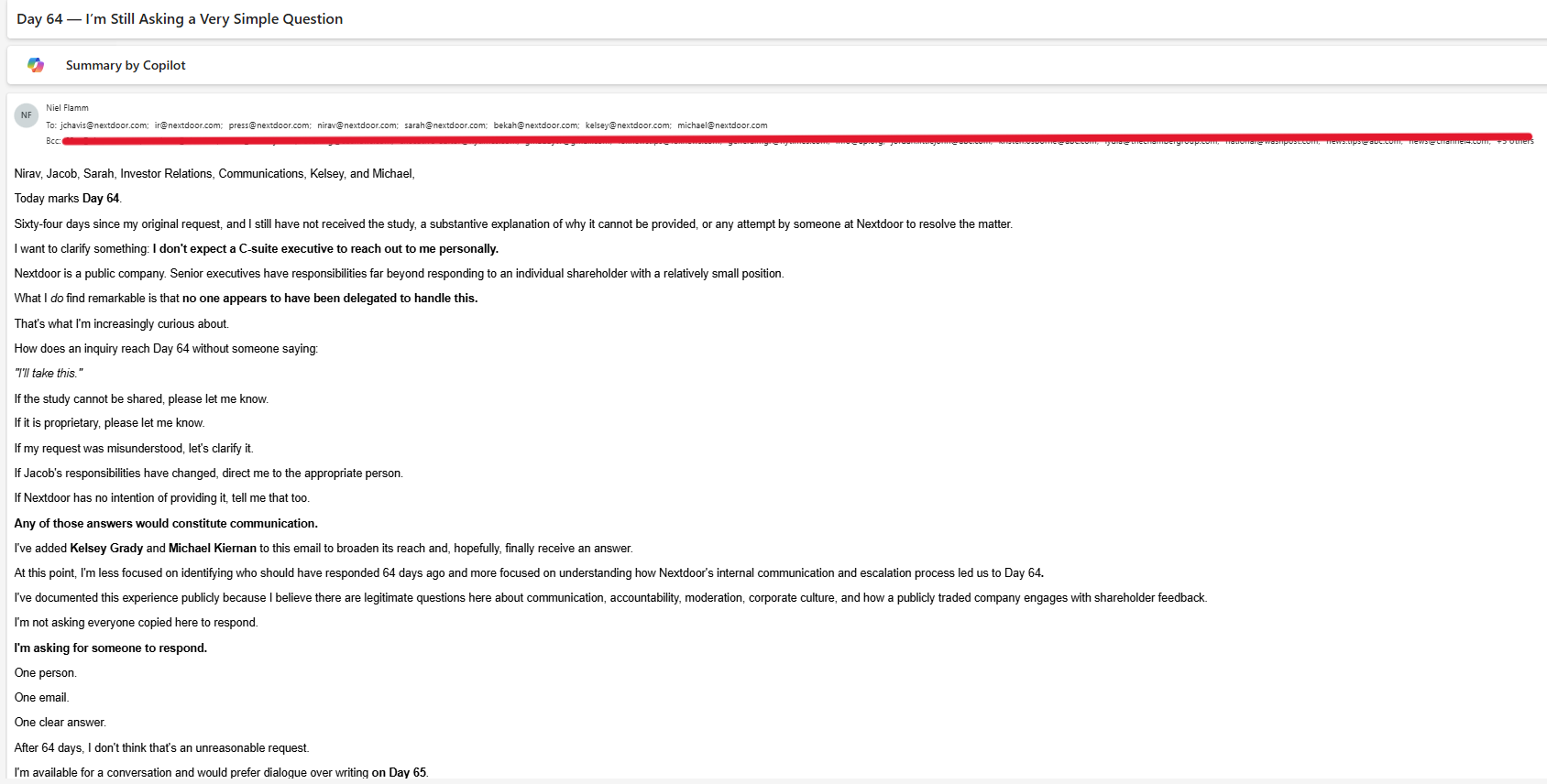
I sent another email today regarding the study I originally requested from Jacob Chavis.
This time, I want to make something clear:
I don't expect a C-Suite executive to contact me personally.
I'm a shareholder with a relatively small position. I understand that Nirav Tolia, Sarah Leary, and other senior leaders have responsibilities far beyond answering my emails.
But here's what I don't understand:
Why hasn't anyone been delegated to respond?
Sixty-four days.
No study.
No substantive explanation.
No, "We can't provide it."
No, "You've reached the wrong person."
No, "Let me connect you with someone who can help."
Not even, "Niel, the answer is no."
That's what makes this increasingly fascinating to me.
Today I expanded the email distribution list to include Kelsey Grady and Michael Kiernan, along with the people I've previously contacted.
Why?
Reach.
And hopefully, finally, an answer.
At this point, I'm no longer asking only:
Where is the study?
I'm asking:
How does a publicly traded company allow a relatively simple shareholder inquiry to reach Day 64 without assigning someone to handle it?
That's a process question.
That's a communication question.
And, increasingly, I believe it's a culture question.
Someone inside Nextdoor could end this particular chapter with one email.
The answer doesn't have to be what I want.
It doesn't have to come from Nirav.
It doesn't have to come from Sarah.
It doesn't even have to come from Jacob.
I'm asking for someone to respond.
One person.
One email.
One clear answer.
I've spent 64 days documenting what happens when communication doesn't happen.
I'd much rather spend Day 65 writing about what happened when someone finally decided to communicate.
The email has been sent.
Your move, Nextdoor.
Join the discussion at NielFlamm.com/blog. Leave some feedback—I'd genuinely love to hear your perspective.
When a Communication Strategy Becomes a Communication Problem
I've spent 61 days documenting what I see as a fundamental communication failure at Nextdoor.
At this point, it's no longer one unanswered request.
Look at the pattern I've experienced:
Nirav Tolia blocked me on LinkedIn.
Comments are routinely turned off on Nextdoor's LinkedIn posts.
I've sent direct emails to Jacob Chavis, Nirav Tolia, Sarah Leary, Communications, and Investor Relations, but have not received a substantive response to my request.
And now there's another example involving Sarah Leary.
I had been commenting on an older X post she reposted about a Massachusetts community—if I remember correctly, Beacon Hill—preparing for significant snowfall and other neighborhood happenings.
The post eventually accumulated approximately 180 comments.
I'd estimate at least 75% were mine, documenting my ongoing Nextdoor experience.
Then the post disappeared.
To be clear: I don't know why it was deleted or whether my comments had anything to do with the decision.
But it got me thinking.
Yes, there may have been steam coming from my ears. 💨
If Nextdoor had an effective communication strategy for handling critical feedback, would any of this be happening?
That's when I started thinking about Kelsey Grady, Executive Vice President of Communications at Nextdoor.
I looked at the typical responsibilities associated with an executive communications role. At that level, we're talking about responsibility for an organization's internal and external messaging, brand reputation, public relations, crisis response, and advising executive leadership on communication strategy.
Which raises some fascinating questions.
Is ignoring my emails an intentional communications strategy?
Was blocking me on LinkedIn part of a strategy?
Is routinely disabling comments part of it?
Did anyone advise Sarah to remove that X post?
Or are executives individually deciding how—or whether—to engage?
I don't know.
I'm deliberately asking rather than pretending I know what happens inside Nextdoor.
But that's precisely why communication matters.
A coordinated communications strategy shouldn't leave outsiders spending 61 days trying to determine whether there even is a strategy.
And ultimately, responsibility travels upward.
Kelsey Grady may oversee Communications, but Nirav Tolia is CEO.
The buck eventually stops there.
One of the most important responsibilities of executive communications is crisis management.
Now, I'm certainly not suggesting one small shareholder asking for a study constitutes a corporate crisis.
But something that could have been resolved with a simple email has now generated 61 consecutive days of public commentary about Nextdoor's leadership, moderation, culture, investor relations, verification, business strategy and communication.
That's the part I find remarkable.
My grade for handling this particular situation?
Crisis Management: F.
Not because Nextdoor hasn't given me the answer I want.
Because after 61 days, Nextdoor still hasn't given me an answer.
Perhaps the most useful question isn't "Why does this shareholder keep posting?"
Maybe it's:
"How did we allow a simple request to become a 61-day public case study in communication?"
I'd genuinely like to hear Kelsey Grady's perspective on that one.
Join the discussion at NielFlamm.com/blog. Leave some feedback—I'd love to hear your perspective.