

Day 126: Another Email to Nextdoor. The Request Hasn't Changed.

📧 Day 126. Another email sent. Another opportunity for Nextdoor to close the loop.
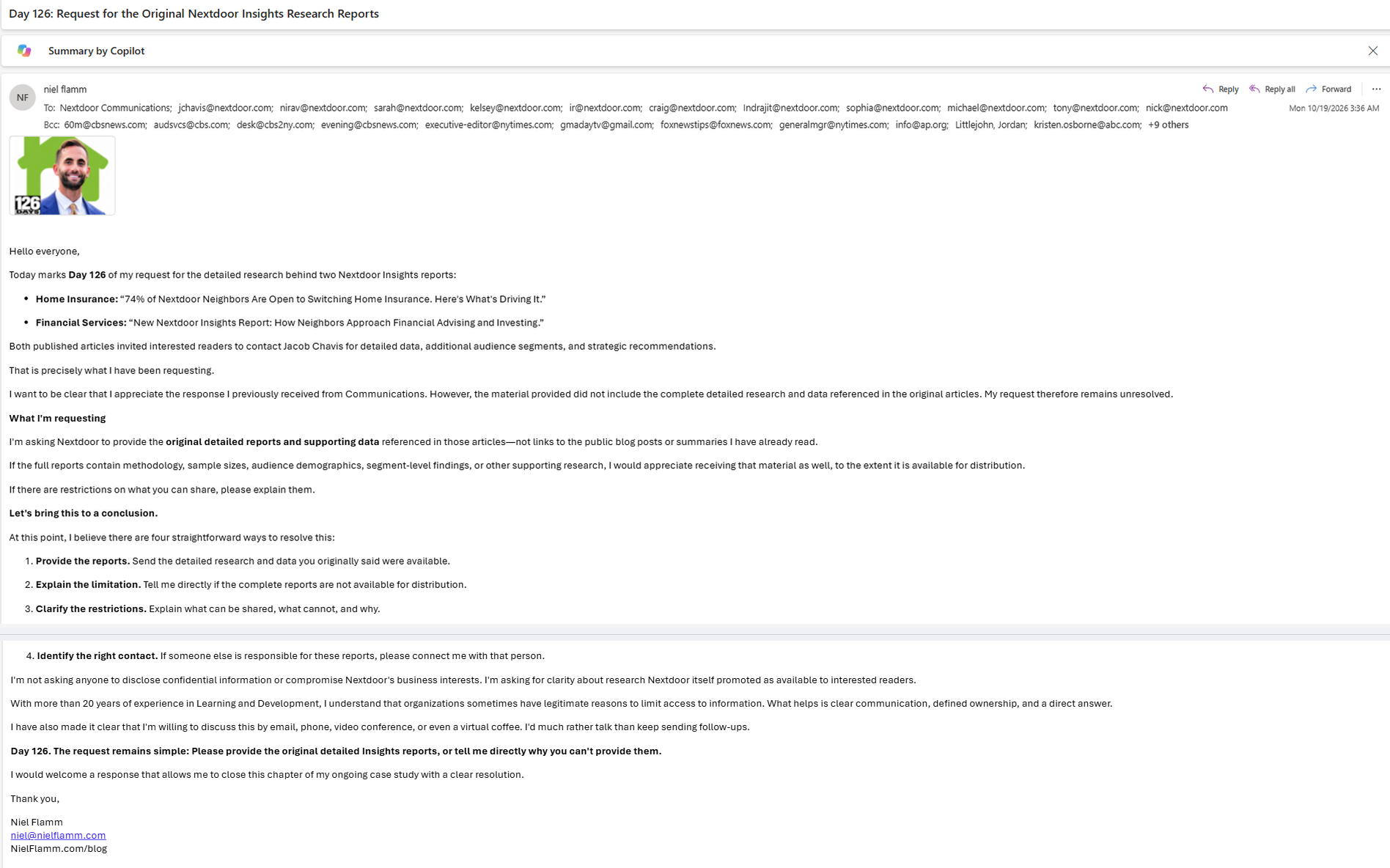
Today, I sent another email to the usual group of Nextdoor contacts, including Communications, Jacob Chavis, CEO Nirav Tolia, and members of the leadership team.
The subject line was straightforward:
Day 126: Request for the Original Nextdoor Insights Research Reports
No new accusations. No complicated demands. Just a request that has sat unresolved for 126 days.
What Am I Asking For?
Let's go back to the beginning.
Nextdoor published two Insights articles that invited interested readers to contact Jacob Chavis for detailed data, additional audience segments, and strategic recommendations.
The two reports were:
🏠 Home Insurance: “74% of Nextdoor Neighbors Are Open to Switching Home Insurance. Here's What's Driving It.”
💰 Financial Services: “New Nextdoor Insights Report: How Neighbors Approach Financial Advising and Investing.”
I didn't ask Nextdoor to create a new study for me. I didn't ask it to build a custom research project. I asked for the detailed research that the original articles said was available.
That distinction matters.
Communications Responded. But the Request Remains Unresolved.
I want to acknowledge that Nextdoor Communications previously responded. I'm not claiming the company has never communicated with me.
However, the material I received did not include the complete detailed reports and supporting data I originally requested.
Being sent links to public blog posts isn't the same as receiving the detailed research those posts reference.
I'm not asking for the same summary again. I'm asking for the underlying reports.
If those reports aren't available for distribution, please tell me. If there are restrictions, explain them. If someone else handles the request, connect me with that person.
Any of those responses would be more useful than leaving the central question unresolved.
Four Ways to Close This Case
In today's email, I laid out four straightforward options:
Provide the reports. Send the detailed research and data you originally said were available.
Explain the limitation. Please tell me directly if you can't distribute the complete reports.
Clarify the restrictions. Explain what can be shared, what cannot, and why.
Identify the right contact. Connect me with the person responsible for these reports.
That's it.
I'm not asking Nextdoor to disclose confidential information or compromise its business interests. I'm asking for clarity about research the company itself promoted as available to interested readers.
If some portions contain confidential information, perhaps you can share a version that excludes those portions. If that isn't possible, I'd like to understand why.
A Learning and Development Perspective
I've spent more than 20 years working in Learning and Development, including instructional design, facilitation, management, and organizational processes.
One lesson from that experience is that when a task gets stuck, it helps to identify the owner, define the expected outcome, and clarify what needs to happen next.
A request shouldn't require an endless chain of follow-ups simply because nobody has clearly communicated the answer or the next step.
Sometimes the answer is yes. Sometimes it's no. Sometimes there are conditions.
But clear communication and defined ownership help people move forward.
That's the perspective I'm bringing to this situation. I'm not claiming to know what's happening inside Nextdoor or why this request hasn't been resolved. I can only describe what I've requested, what I've received, and what remains outstanding.
I'd Rather Talk Than Keep Typing
I've made it clear that I'm willing to discuss this by email, phone, video conference, or even a virtual coffee.
I'd much rather talk than keep writing follow-up emails and documenting another day in this case study.
I don't expect a CEO to respond to every shareholder question personally. But I do believe someone within an organization should be able to take ownership of a straightforward request and provide a clear answer.
And if the reports cannot be shared, I can accept a direct explanation of that decision—even if it's not the answer I hoped to receive.
Day 126: The Clock Keeps Ticking
I'm still interested in understanding Nextdoor's research, its methodology, and how the company develops insights from its neighborhood community.
I also want Nextdoor to succeed. I've said that repeatedly, and I mean it.
But wanting a company to succeed doesn't mean ignoring every unanswered question. Asking questions and providing feedback help businesses identify gaps and improve their processes.
So, here's where things stand.
Day 126. The request remains simple: Please provide the original detailed Insights reports, or tell me directly why you can’t.
I would love for the next update in this case study to be about a resolution rather than another follow-up.
Nextdoor, the ball is in your court.
👉 Follow the continuing case study at NielFlamm.com/blog
The Hinge Experiment: Harry Potter, Market Research and a Very Profitable Weekend
Apparently, the universe has decided that The Hinge Experiment™ needs a travel budget.
I found out yesterday that I might be able to go to Columbia, South Carolina, this weekend for a two-day market research interview/discussion.
That sounds pretty good on its own.
Then I found out there was a small problem.
Airica was hoping we could go see the Harry Potter experience at COSM in Atlanta.
Well, that ain't happening.
Atlanta will have to wait.
But then I realized something.
Airica is in Columbia.
And suddenly, this market research weekend got a whole lot more interesting.
Wait... This Actually Works
The original plan was Harry Potter in Atlanta.
Instead, we're going to have:
Friday night: Dinner with Airica.
Saturday: I do my market research session, then we hang out afterward.
Sunday afternoon: More time together.
So instead of one Harry Potter adventure in Atlanta, I potentially get three opportunities to hang out with Airica in Columbia.
I'm calling that a win.
And there's another little detail that makes this weekend even better.

Somebody Is Paying Me to Go on This Trip
Let's review the economics here.
I'm getting:
A hotel for the weekend.
Food during the market research sessions.
Payment for participating.
And 72 cents per mile for the drive.
Seventy-two cents.
Per.
Mile.
When can I do another one of these?
Seriously.
Where do I sign up?
If somebody wants to pay me to drive to Columbia, put me in a hotel, feed me, pay me for my time, and give me an opportunity to see Airica...
I suddenly have a very strong interest in market research.
I may become the world's foremost expert on answering questions in exchange for hotel rooms.
"Would you recommend this product?"
Absolutely.
"Why?"
Because you're paying me to be here.
Next question.
The Harry Potter Detour
I do feel bad that the Harry Potter plans aren't going to happen.
Airica wanted to see the Harry Potter movie at COSM in Atlanta.
Unfortunately, the timing of this market research opportunity makes that a no-go.
But here's the thing I've learned about dating:
Plans change.
Things come up.
We adjust.
And instead of spending the weekend apart because the original plan didn't work, we're finding a way to spend time together anyway.
Friday night.
Saturday after my session.
Sunday afternoon.
I'm pretty sure that's significantly better than sitting in my hotel room eating whatever they give me and watching television.
Although I reserve the right to do that for at least part of Saturday night.
I'm 54.
I'm allowed to get tired.

Then Came This Morning
This morning, I beat Airica to the "Good morning" text.
This is apparently becoming a competition.
And I have to admit, I hesitated.
It was my usual dialysis morning.
The time when most normal human beings are asleep.
The time when I'm awake because I have an appointment with the vampire machine to clean my blood.
The dialysis facility was also short-staffed, so I ended up sitting in the waiting area.
And while I was sitting there, I thought:
Should I text her?
It's early.
Really early.
Most of the world isn't awake at the hour I willingly allow a machine to remove approximately every useful thing from my blood while someone sticks two needles into my arm.
Would "Good morning" at this hour be considered sweet?
Or would it be considered:
"Why the hell is this guy texting me at 5-something in the morning?"
There's a fine line between romantic and requiring a restraining order.
I decided to risk it.
I sent the message.
Apparently, I'm Learning
One thing I've noticed about this whole experience is how different it feels.
I'm not trying to manufacture conversation.
I'm not sitting there wondering if I'm going to get a response.
I'm not staring at a Hinge screen wondering why someone disappeared.
We're actually talking.
We're making plans.
And now we're figuring out how to make a weekend work when the original plan doesn't.
That's dating.
At least, I think that's dating.
Remember, I'm the guy whose recent dating résumé includes being asked for rent money and a phone bill.
My qualifications are limited.
Columbia, Here I Come
So now I get to drive to Columbia, get paid to participate in market research, get reimbursed for the mileage, stay in a hotel, eat someone else's food...
and see Airica three times.
Harry Potter may have lost.
But I think I came out pretty well in the rewrite.
And somewhere, Steve the Iguana is probably sitting on a beach wondering how the hell this happened.
A few weeks ago, I was seriously considering deleting Hinge.
Now I'm planning a weekend around a woman I met on it.
Maybe The Hinge Experiment isn't quite ready to end.
Maybe it's just getting interesting.
And if anyone knows where I can sign up for another two-day market research study in a city where Airica happens to live...
I'm available. 😂
Day #11: Three Requests, Still No Study
Day #11: Three Requests, Still No Study
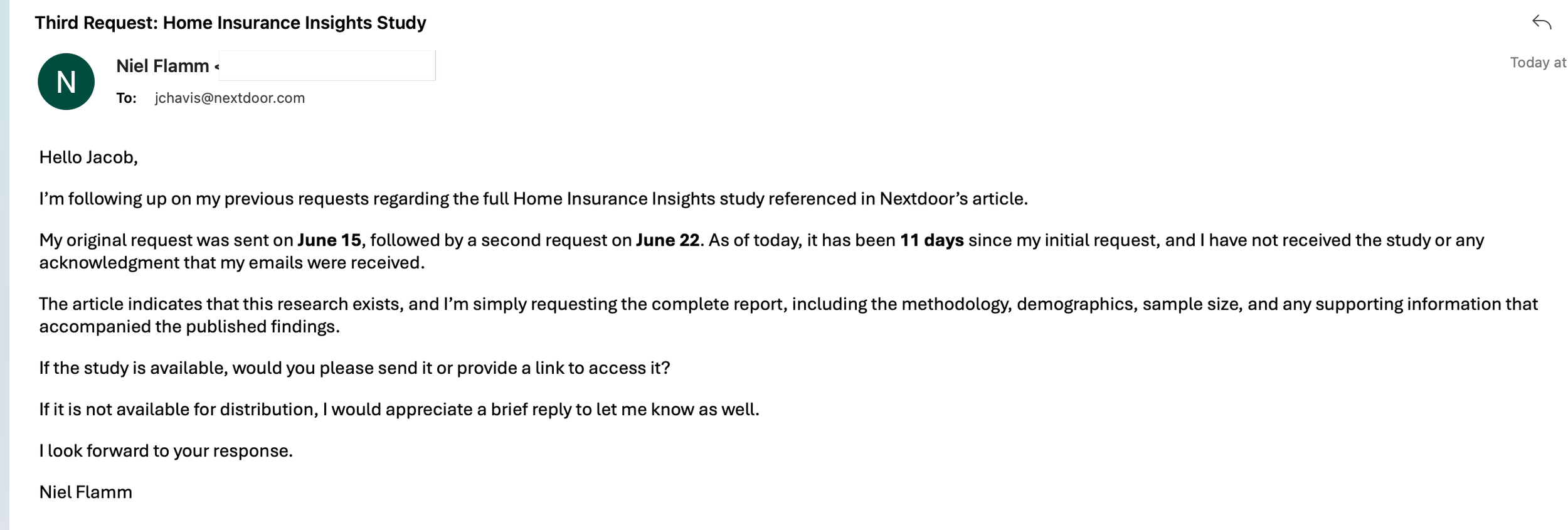
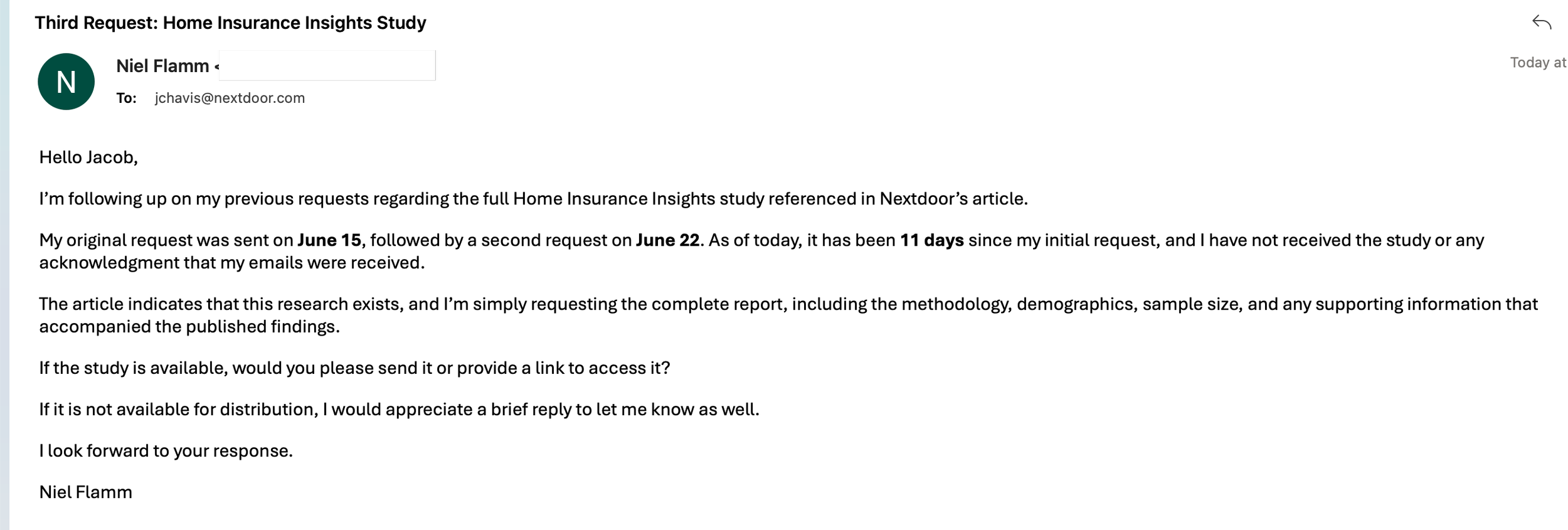
Today I sent my third request for the Home Insurance Insights study referenced by Nextdoor.
Here’s the timeline:
June 15: Initial request for the full study.
June 22: Follow-up request.
Today: Third request.
As of today, it’s been 11 days since my original email.
The result?
No acknowledgment.
No explanation.
This isn’t about whether I agree or disagree with the findings.
It’s about transparency.
If a company publicly references research, it seems reasonable to expect that someone requesting the underlying methodology, demographics, and supporting information would at least receive a response.
Instead, the silence has become the story.
It also raises a broader question.
If this is how an investor is treated when requesting information referenced in a public article, what should users, local businesses, advertisers, or other shareholders expect when they have a question that needs attention?
Leadership sets expectations.
Culture determines whether those expectations are met.
At some point, a simple reply becomes less about one email and more about how an organization values communication and accountability.
If the study arrives tomorrow, I’ll gladly share that update too.
Join the discussion on NielFlamm.com.
Day 2: The Study That May or May Not Exist
Nextdoor recently published another LinkedIn article, this time highlighting a survey about FIFA and Canadian neighbors' excitement about hosting part of the world's biggest sporting event.
https://dailyhive.com/vancouver/vancouverites-split-hosting-fifa-world-cup
As I read it, one question immediately came to mind:
Where is the link to request the full study?
I couldn't find one.
Does the complete research actually exist for public review? Or is this another example where the optics of looking neighborly stop at the marketing copy?
This is now Day #2 since I sent Jacob Chavis a direct request for the complete insurance study referenced in another Nextdoor publication.
So far, I've received:
No report.
No acknowledgment.
No "We're working on it."
No "You'll receive it shortly."
Not even a polite "No."
It almost makes me wonder whether there's an unofficial policy that says, "Don't engage with Niel Flamm."
Organizations often deny having unofficial practices while employees describe cultures that say otherwise. Years ago, officers in the NYPD alleged unofficial productivity expectations despite formal denials. Wells Fargo's incentive culture became infamous even though the company didn't have an official policy encouraging fraudulent accounts. Employees at major cellular carriers have also described "performance metrics" that felt a lot like quotas.
Which leads me to a fun challenge.
If anyone from Nextdoor would like to anonymously provide verifiable evidence that there is an unofficial policy directing employees not to engage with me, send it to:
The information must be verifiable and not AI-generated.
First one to provide credible documentation wins a gift card for dinner for two at your favorite neighborly restaurant.
Ready...
Set...
Go.
Nextdoor's Latest "Study" or Just Another Sales Pitch?
For months, I've been requesting transparency from Nextdoor leadership regarding the surveys and research they publish. I've asked for methodology, sample sizes, demographics, confidence intervals, moderation metrics, and the data behind the headlines.
The questions have largely gone unanswered.
Now we're presented with another report claiming that 74% of Nextdoor neighbors are open to switching home insurance providers. To me, this comes across more like a marketing vehicle designed to encourage insurance companies to advertise on the platform rather than independent research.
Suppose the data is legitimate; great. Show us the methodology. Show us the complete report. Let everyone evaluate the findings for themselves.
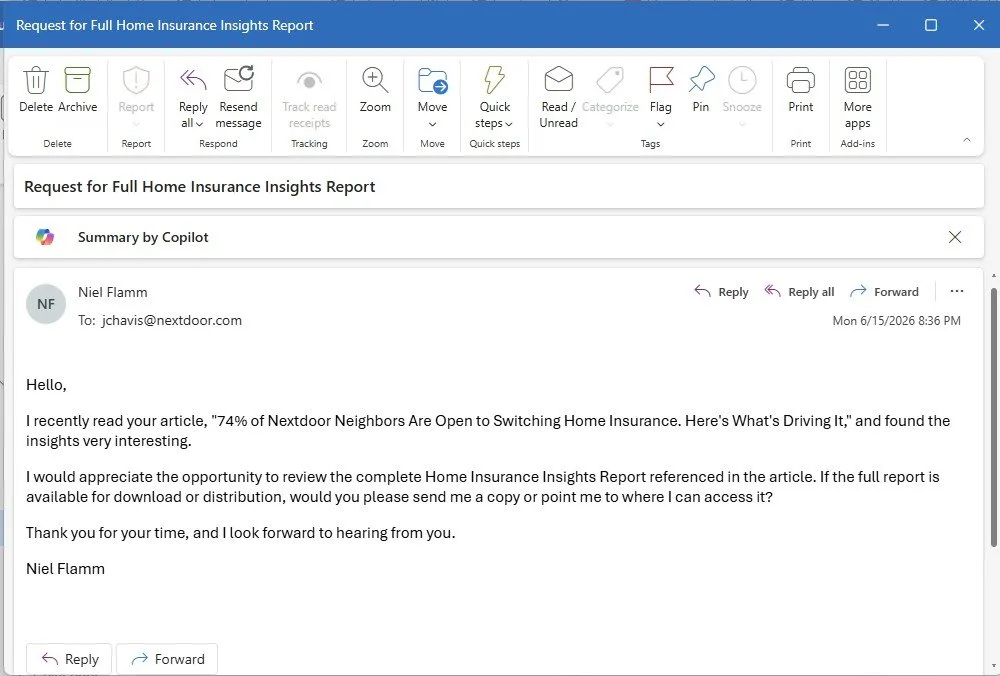
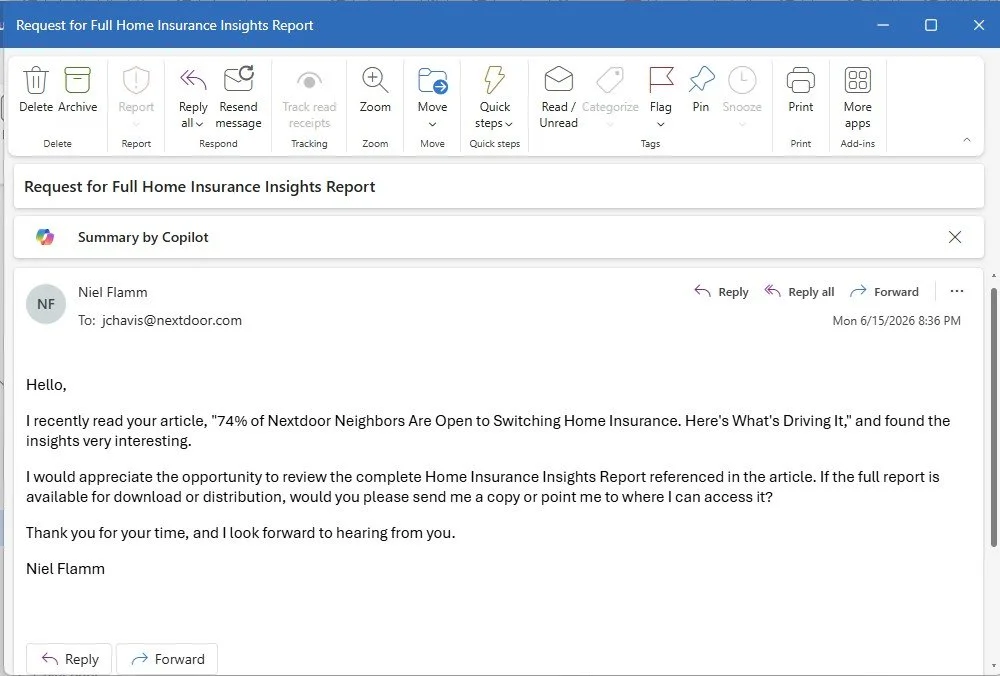
Today I sent an email to Jacob Chavis requesting the comprehensive research behind the study. We'll see what happens.
Based on my past interactions with the company, I don't have high expectations. Requests for information have historically gone unanswered or taken an unreasonable amount of time to respond.
Transparency builds trust. Marketing headlines without supporting data create more questions.
I'll happily update this post if and when the full report is provided.