Loyalty, Accountability, and the Difference Between the Two
On June 22, 2026, Nirav Tolia posted about his longtime professional relationship with Sarah Leary, noting that they’ve worked together for 27 years and that she’s someone he trusts completely. The comments were pulled from his appearance on Ollie Forsyth’s New Economies podcast.
Let me be clear:
I have nothing against Sarah Leary.
I don’t have anything personal against Nirav Tolia, either.
What I am doing is holding a public company CEO accountable for decisions that impact employees, users, advertisers, and shareholders.
There’s a difference.
While podcasts focus on connection, trust, and vision, investors have to evaluate outcomes.
Some questions I continue to ask:
Why should shareholders be excited about a stock trading around $2.16 per share, down on the day?
When will investors see meaningful value creation?
Why spend capital on a Dallas office when much of the work could be performed remotely, potentially reducing costs?
Why promote neighborhood connection while many users continue to report division, moderation concerns, and inconsistent experiences?
Why reference surveys publicly while requests for supporting studies go unanswered?
Speaking of unanswered questions, I’m still waiting for a response regarding a survey request sent to Jacob Chavis.
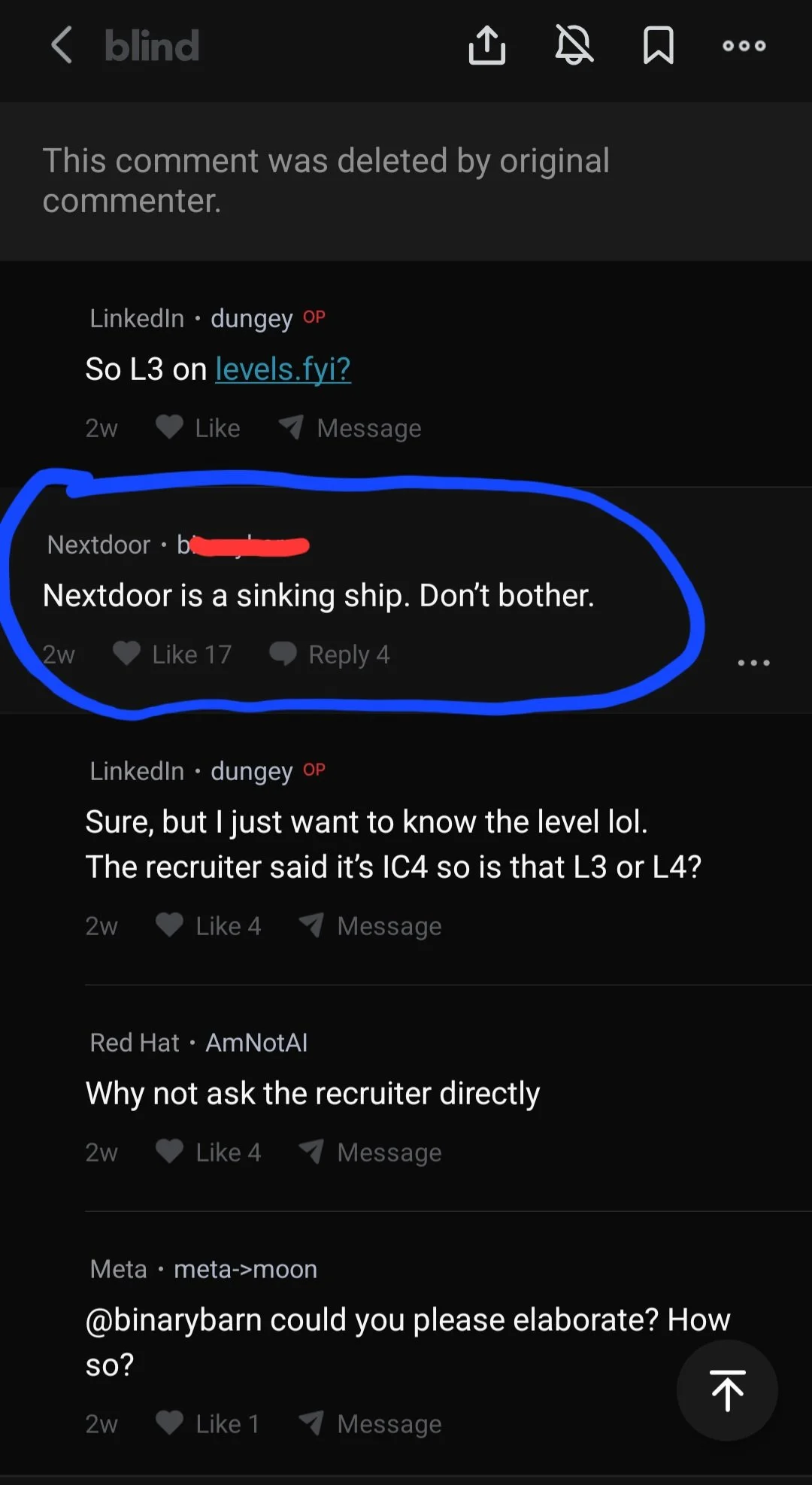
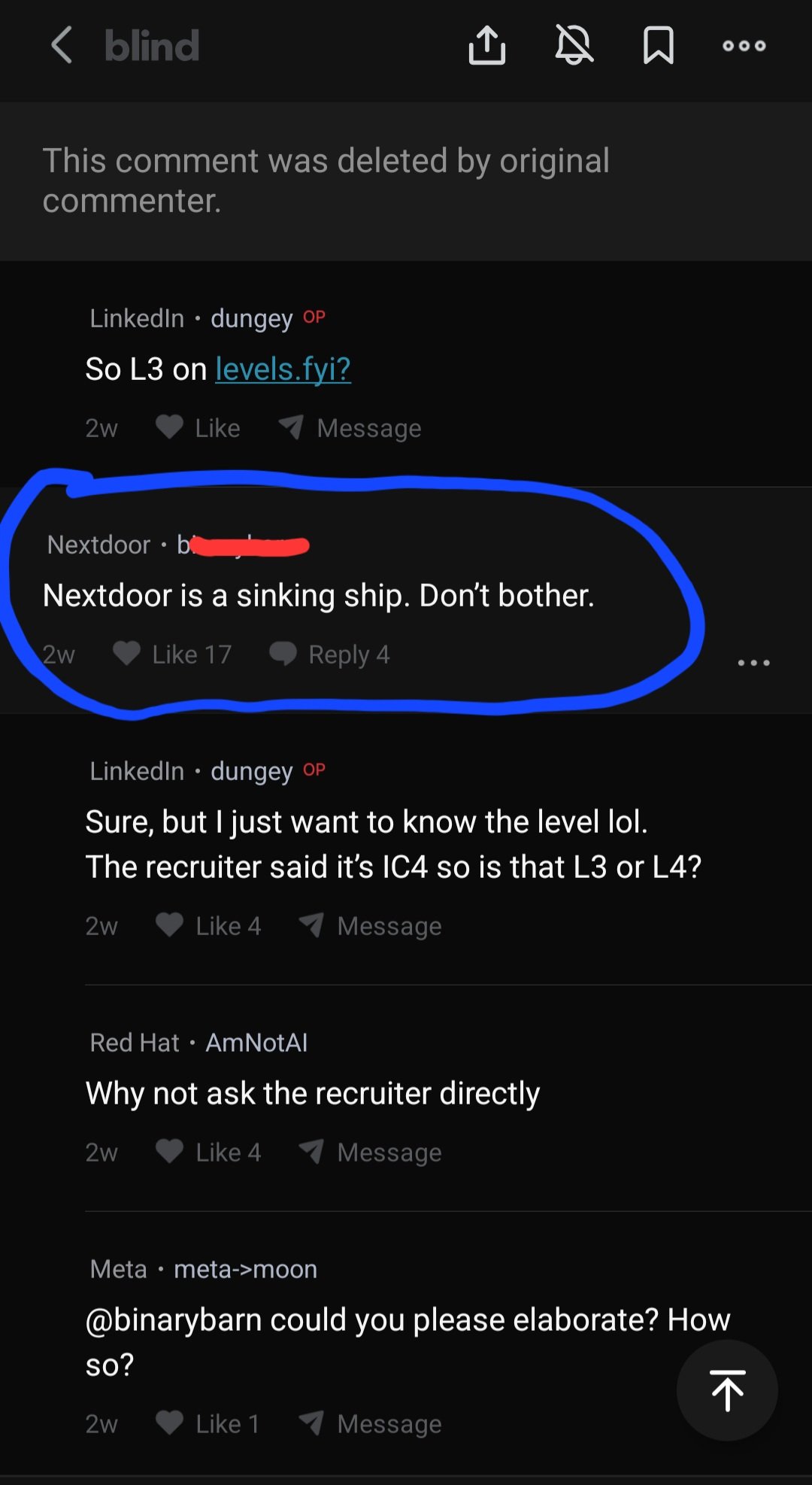
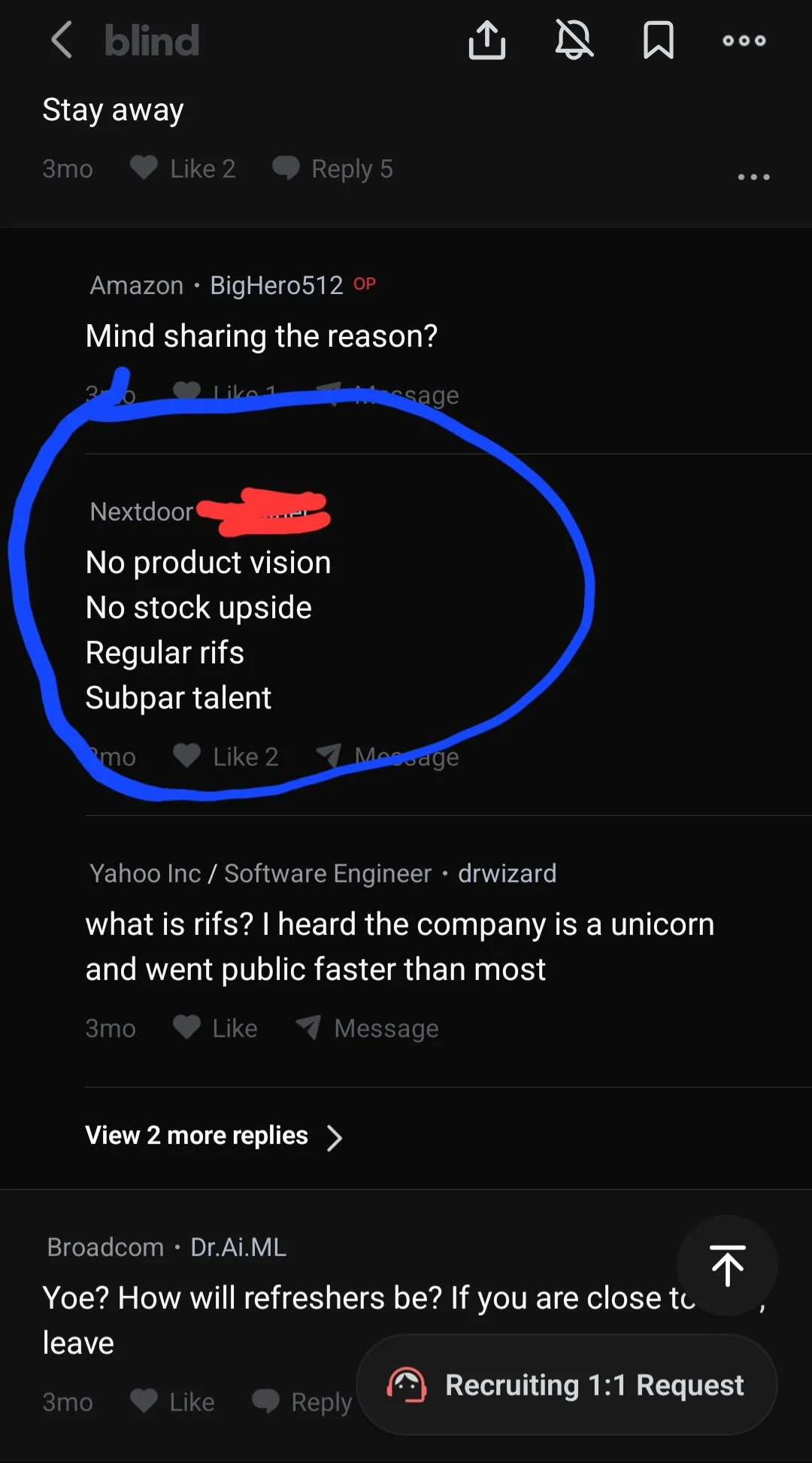
That experience made me think about Blind, the anonymous workplace app where employees discuss company culture, leadership, compensation, and strategy without attaching their real names. Like any anonymous platform, comments should be evaluated carefully, but it often provides insight that differs from the polished narratives presented in earnings calls, podcasts, and press releases.
What interests me is the gap between internal sentiment and external messaging.
Sometimes Nextdoor reminds me of The Stepford Wives—a place where conformity appears more valued than disagreement. If you fit the narrative, everything is fine. If you challenge it, you may find yourself ignored, blocked, or dismissed.
That’s why feedback matters.
Strong companies don’t improve because everyone agrees.
They improve because leaders are willing to hear perspectives they may not like.
Loyalty is important.
Accountability is more important.
Day #9: Silence Is Still a Response
Today marks Day #9 since I requested the full Home Insurance Insights study from Jacob Chavis.
No study.
No acknowledgment.
No “we’re working on it.”
No response at all.
At this point, I have to assume that if I were a business, user, or investor with an issue, I should expect a similar experience from the company.
And that’s concerning.
Leadership sets culture. Culture drives behavior.
Which brings me to CEO Nirav Tolia.
Nirav, you’re allowing a team you lead to simply not respond. I don’t understand why. According to the original post, the study exists and is available. This should be a simple interaction:
“Thanks for reaching out.”
Attach study.
Or:
“Here’s the link.”
Done.
The entire exchange could probably be completed in less time than it took to read this post.
In fact, if AI is truly the transformational force that Nextdoor leadership frequently discusses, perhaps an AI-powered chatbot could respond with the study automatically.
Instead, we’re on Day #9.
When companies don’t respond to questions, people start wondering whether the issue is process, priorities, or culture.
Either way, silence doesn’t build trust.
It erodes it.
As always, if the study arrives tomorrow, I’ll happily update everyone.
Leadership Isn’t About the Camera—It’s About Building Human Connection
I’ve spent a lot of time thinking about leadership, organizational culture, and why some companies unite people while others seem to profit from keeping them divided.
That led me to think about Nirav Tolia’s educational background in English.
An English degree can produce exceptional communicators and storytellers. By all appearances, Nirav has excelled at being in front of a camera, speaking with the media, appearing on podcasts, and presenting a compelling vision.
My concern isn’t the degree.
It’s whether the product consistently delivers on that vision.
I’ve heard many times throughout my career that success is a combination of hard work, who you know, and a lot of luck.
Looking at Nirav’s career, it’s difficult to argue those elements haven’t played a role. Joining Yahoo during the infancy of the web. Founding ePinions during the dot-com era and seeing it acquired. Launching Nextdoor when social media and local communities were colliding online.
Those opportunities required work and execution.
But they also required timing.
As I learned while living in Las Vegas, luck eventually runs out and markers eventually come due.
The challenge for every founder is proving that success wasn’t just the product of timing.
If AI and human connection are truly the future of Nextdoor, why not invest in initiatives grounded in behavioral psychology instead of simply driving engagement?
For less than the cost of many marketing campaigns, Nextdoor could sponsor five pilot neighborhoods at $50,000 each and scientifically measure outcomes.
Consider initiatives such as:
Neighborhood Mediation Labs: Professionally facilitated sessions where neighbors resolve recurring disputes over parking, pets, noise, fireworks, and HOA issues while AI identifies common themes and recommends solutions.
Community Service Challenges: Competing neighborhoods earn recognition by volunteering at food banks, cleaning parks, assisting seniors, or supporting veterans’ organizations, rewarding cooperation instead of conflict.
MBTI and DISC Community Workshops: MBTI (Myers-Briggs Type Indicator) and DISC are personality frameworks used worldwide to help people understand communication styles, motivations, and conflict behaviors. Imagine neighbors learning that the person they disagree with isn’t necessarily unreasonable—they simply process information differently. Understanding differences often reduces conflict and increases empathy.
Behavioral AI Nudges: Before posting an inflammatory comment, AI could ask, “Would you say this face-to-face to your neighbor?” while suggesting language that promotes constructive dialogue instead of escalation.
Track neighborhood sentiment. Track retention. Track advertiser engagement. Track participation.
If the pilots work, expand them nationwide.
That’s what investing in human connection looks like.
Instead, too often the platform appears optimized for complaints, arguments, outrage, missing packages, barking dogs, fireworks disputes, and HOA drama because conflict generates engagement.
The best leaders don’t simply talk about bringing people together.
They build systems that make it happen.
Because eventually every founder faces the same test:
Was it skill?
Was it timing?
Or was it luck?
And as every gambler eventually learns, even a broken clock is right twice a day.
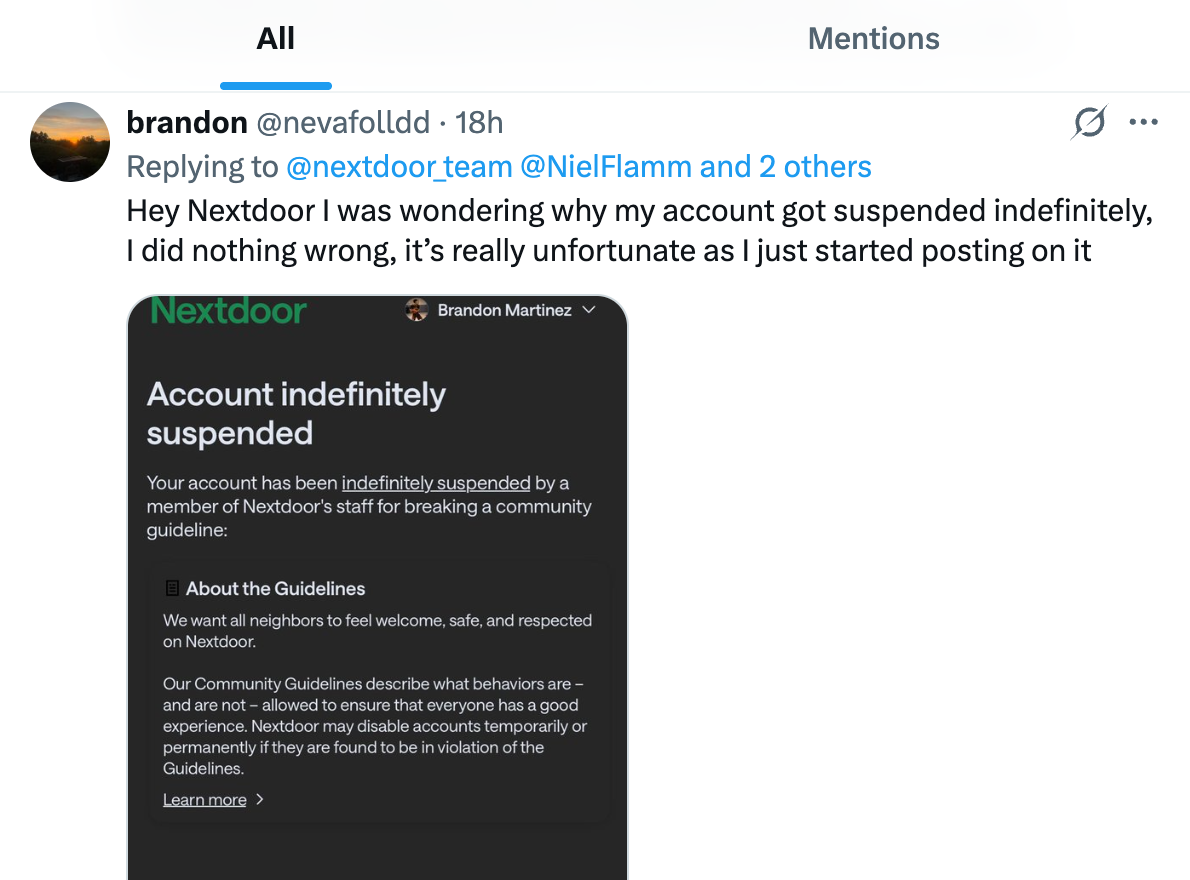
The Suspensions Nextdoor Doesn’t Study
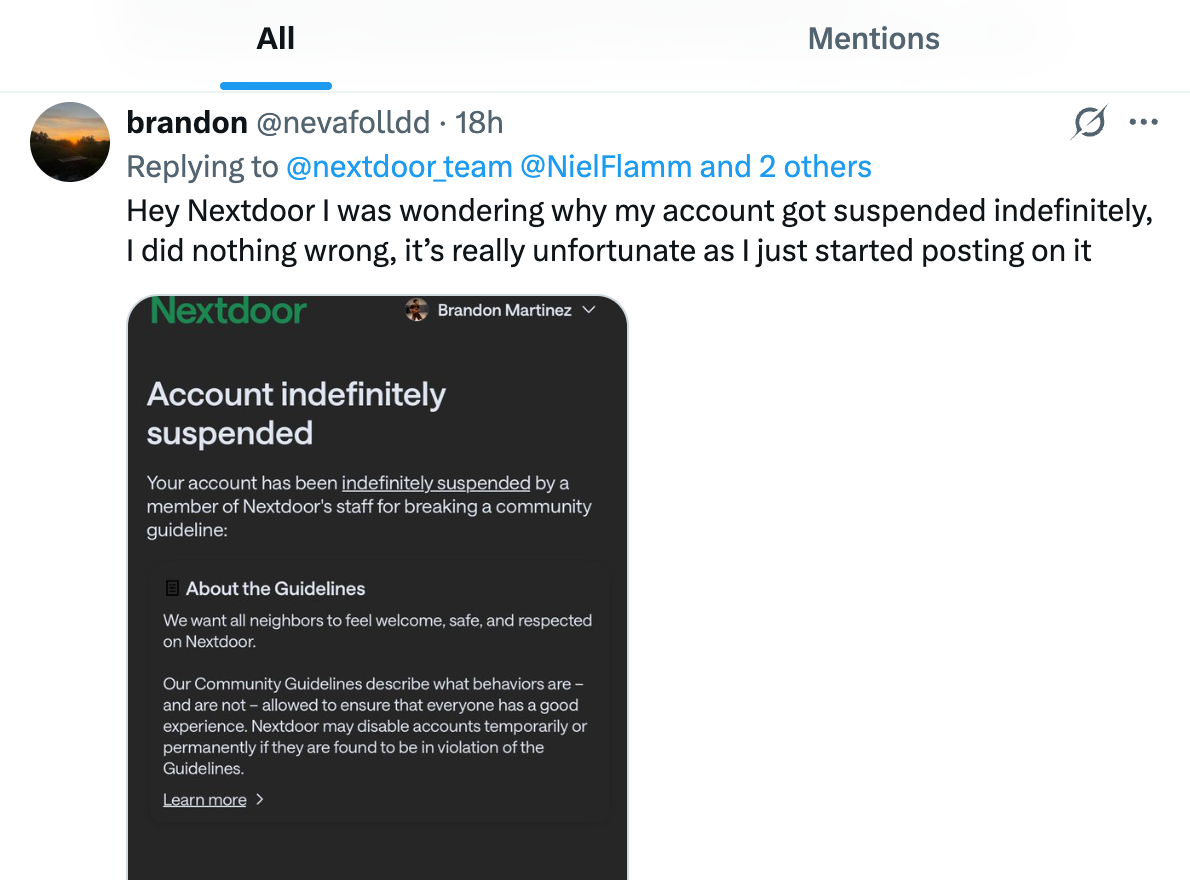
Late Saturday, Brandon shared that his Nextdoor account had been indefinitely suspended shortly after he started posting.
This is the part of Nextdoor that doesn’t show up in the surveys, research reports, or LinkedIn articles.
It’s also the part that raises questions about transparency.
When users are suspended, what exactly is the appeal process? How are decisions reviewed? What standards are being applied? Why are the Community Guidelines often written broadly enough that interpretation seems to favor the platform?
I’ve asked these questions before and have yet to receive meaningful answers.
What makes this even more interesting is that suspended users don’t necessarily disappear from the ecosystem immediately. Their accounts, data, and history remain part of the platform. Yet discussions about transparency surrounding suspensions, appeals, and user rights rarely seem to receive the same attention as discussions about Weekly Active Users, advertising opportunities, or engagement metrics.
For many users, it can feel as though simply asking difficult questions, disagreeing with the prevailing narrative, or refusing to become “another brick in the wall” creates risk.
Whether that’s perception or reality, it is a perception that leadership should take seriously.
This isn’t a study about FIFA.
This isn’t a study about home insurance.
This isn’t a study about pharmaceutical advertising.
This is about real users who believe they’ve been silenced and want to understand why.
And that’s a study I’d be interested in reading.
If You Can't Park It, Maybe Don't Drive It
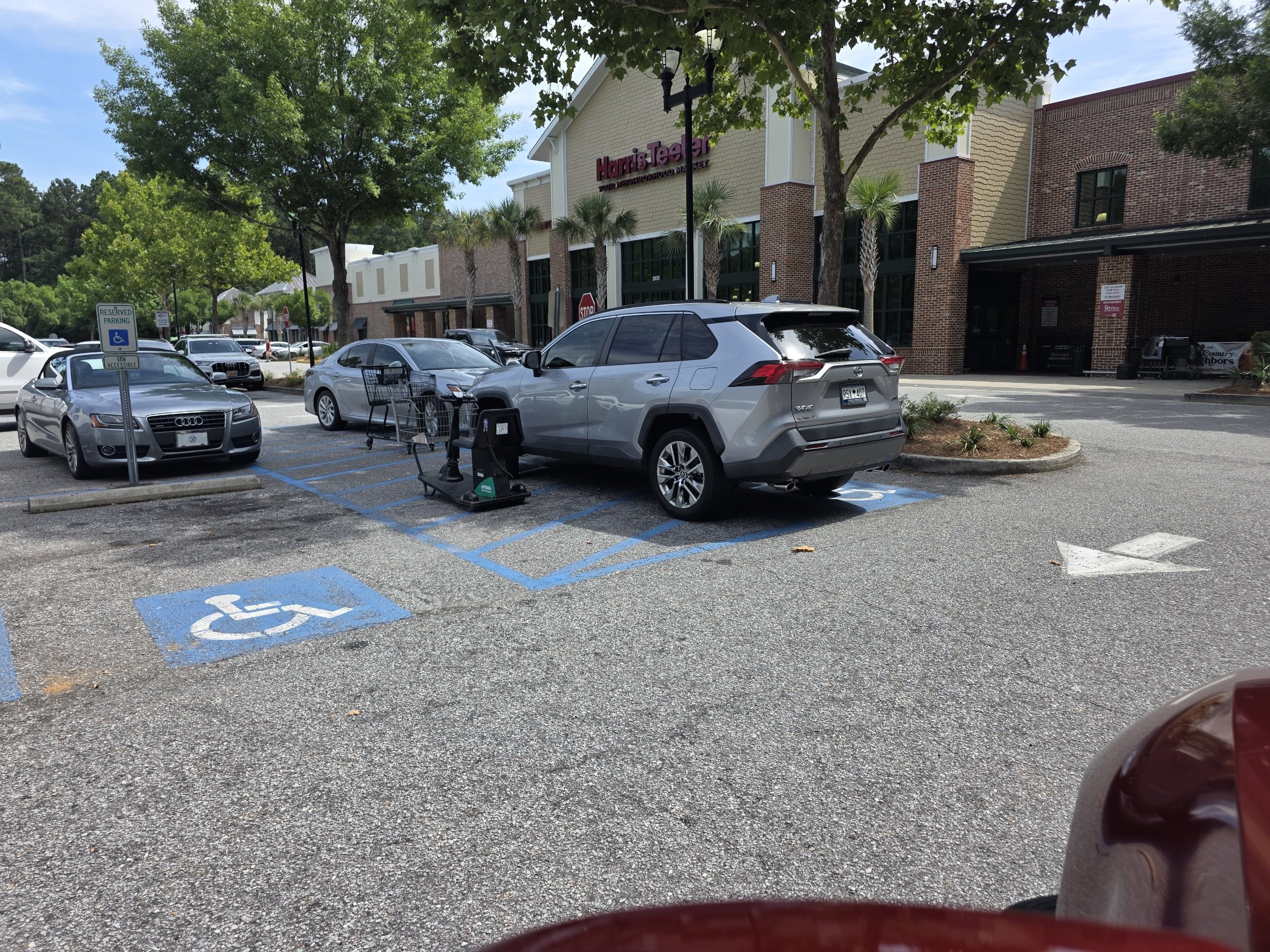
Today around 4:00 PM EDT at the Rivertowne Harris Teeter, I stumbled across another parking masterpiece.
I have a simple philosophy in life:
If I can't park a vehicle between two giant painted lines, I'm getting a smaller vehicle.
Apparently, not everyone shares this revolutionary concept.
This particular driver parked like they were fleeing a bank robbery, avoiding an asteroid strike, or both.
Look, nobody is perfect. We all have bad days.
But if your SUV needs parts of three parking spaces to feel emotionally supported, it might be time to reconsider your relationship with that vehicle.
Just a thought from a guy with one leg who somehow manages to stay between the lines.
Until the next installment of Internet Garbage...