
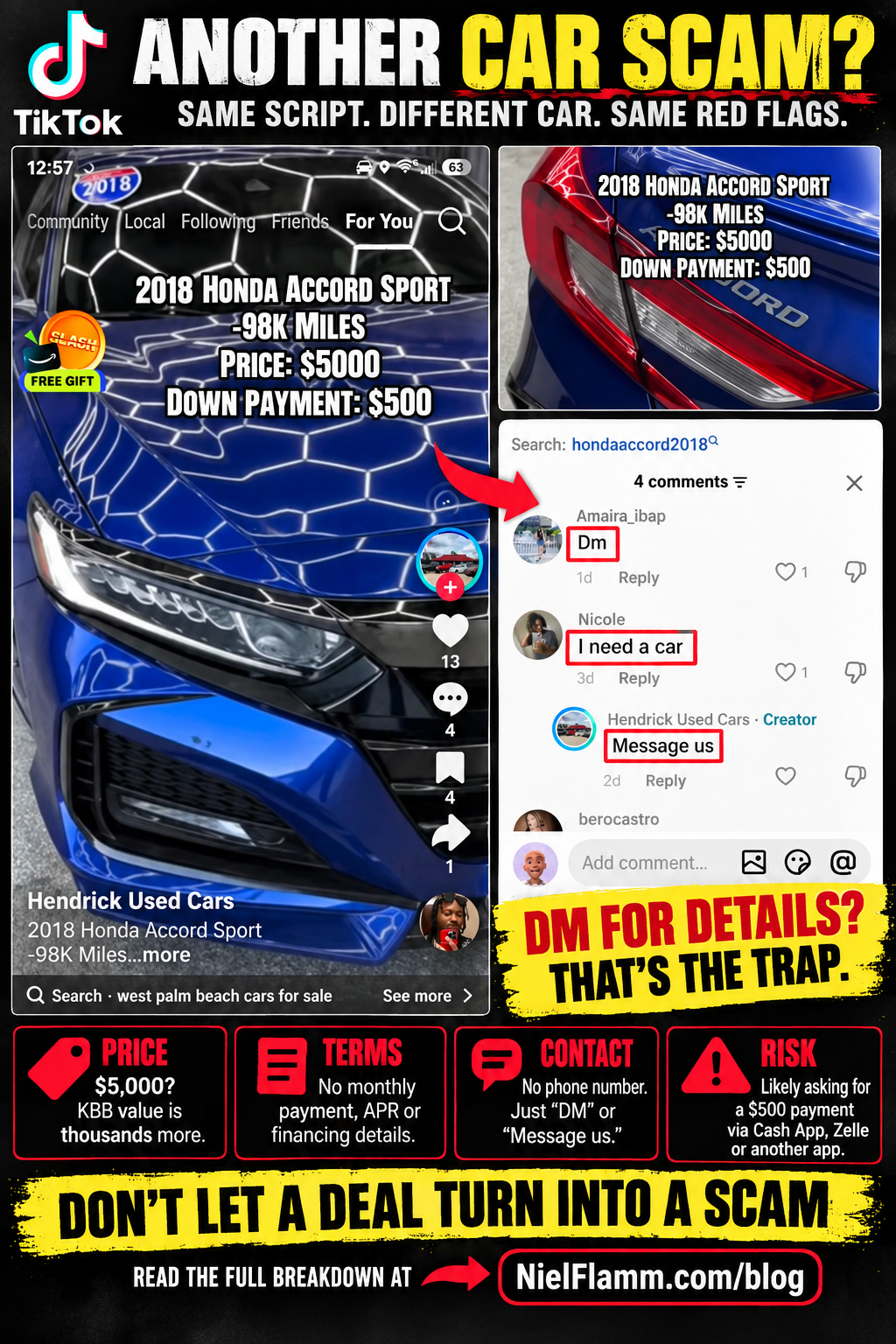
Another $500 Down TikTok Car? This Time It’s a $5,000 Honda Accord
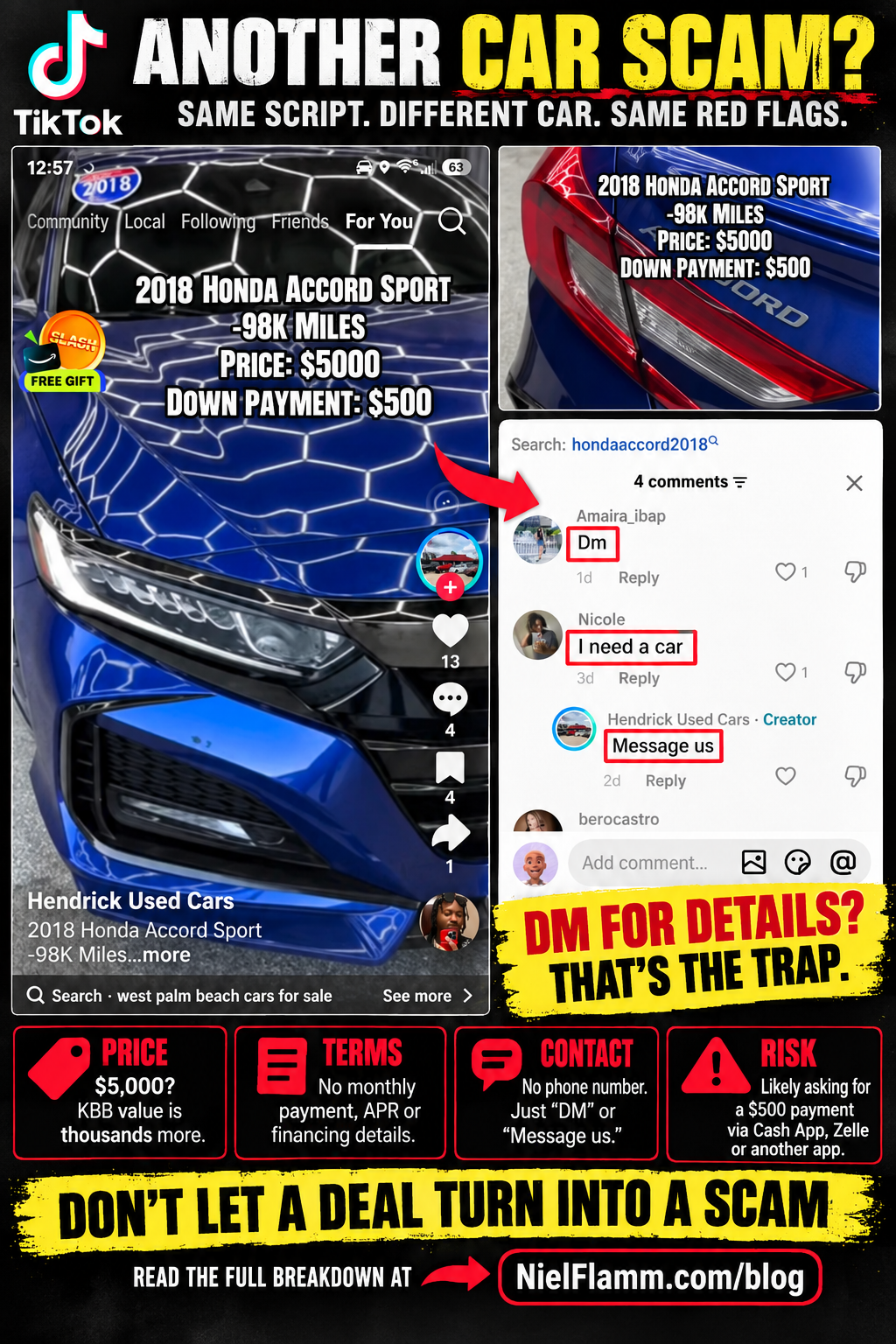
Apparently, TikTok has decided that since I stopped to investigate one suspicious used-car deal, I must want all of them.
And here we go again.
This time the video comes from an account calling itself “Hendrick Used Cars” and advertises:
2018 Honda Accord Sport
98,000 miles
Price: $5,000
Down payment: $500
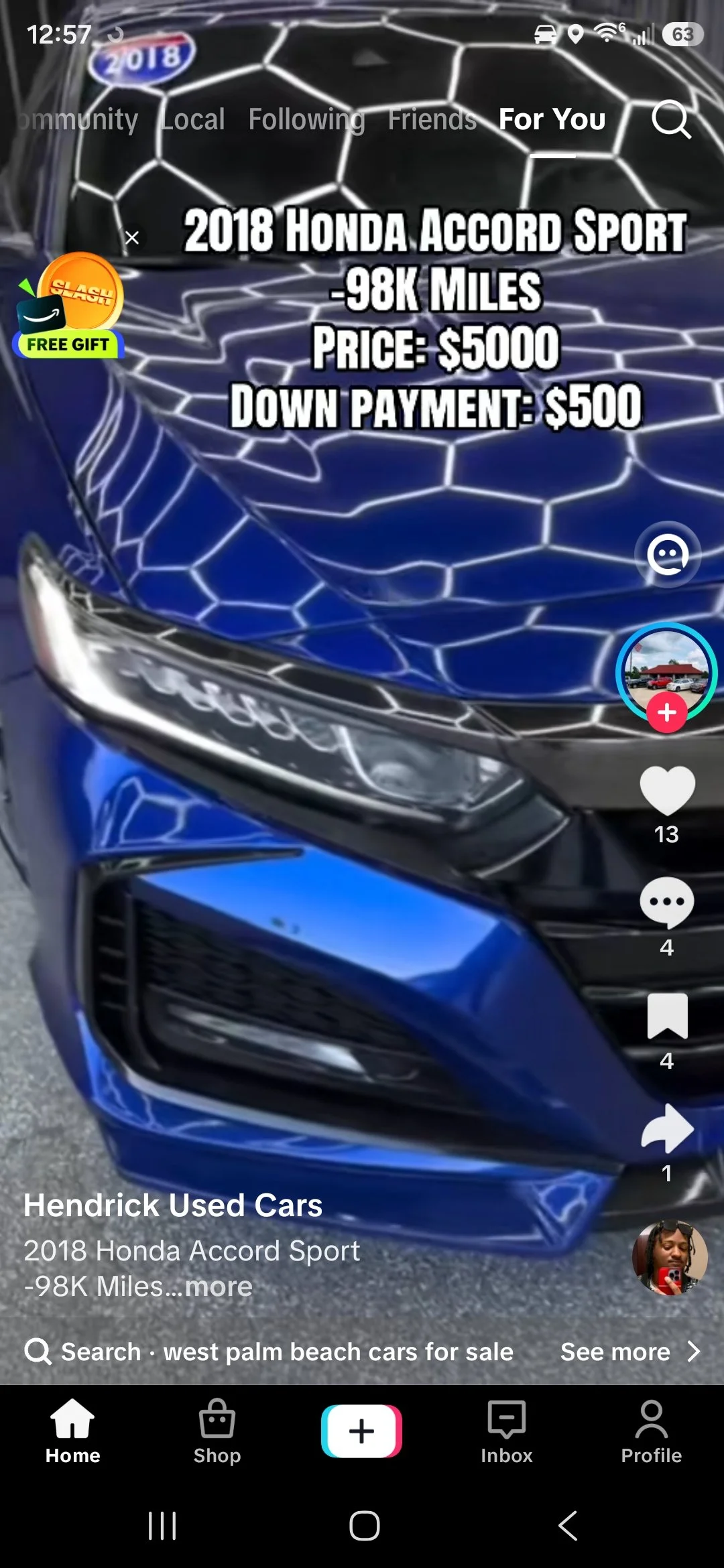
At first glance, this one might seem more believable than the $6,800 Camry I recently wrote about. After all, this Honda has almost 100,000 miles.
Maybe $5,000 really is possible.
So, once again, rather than simply yelling SCAM! at my phone, let's look at some actual numbers.
🚩 First Stop: Kelley Blue Book
Kelley Blue Book currently puts a 2018 Honda Accord Sport Sedan at roughly a $16,860 Fair Purchase Price. Depending on condition, KBB shows trade-in values of approximately $11,240 to $13,440 and private-party values of about $13,900 to $16,600. Kelley Blue Book
Those aren't a precise appraisal of the car in this TikTok. Mileage, condition, location, equipment, accident history and title status matter.
But we're talking about an advertised price of:
$5,000.
That's not merely a great deal compared with KBB.
That's a vehicle supposedly being offered for thousands less than its estimated trade-in value.
Why?
If this is a normal, clean-title, running 2018 Accord Sport, why wouldn't the seller simply sell it wholesale or trade it for substantially more than $5,000?
That's where this gets even more interesting.
🚩 What About the Auction Value?
Maybe this seller somehow acquired the car ridiculously cheap at auction.
Okay. Let's look there too.
Auction data does show 2018 Accords selling around the $5,000 range—but there's a gigantic catch.
An auction archive covering more than 13,000 recorded 2018 Accord sales at Copart and IAAI shows a median final bid of about $5,100. But these aren't necessarily clean, retail-ready cars. Front-end damage alone accounts for 47% of the recorded vehicles, and many examples have salvage titles or significant damage. FinalBid
Here's an especially interesting comparison.
A 2018 Honda Accord Sport with 98,151 miles—almost exactly the mileage advertised in this TikTok—sold at auction in March 2026 for:
$6,600.
It had front-end damage and a California salvage title. Its listed actual cash value was $18,006. DreamBid
Read that again.
A damaged, salvage-title 2018 Accord Sport with almost precisely 98,000 miles sold at auction for $6,600.
And TikTok wants me to believe this one is available for:
$5,000.
Interesting.
Another 2018 Accord with 87,408 miles sold at Copart in February for $6,200. CarFast
So even the wholesale/salvage-auction world doesn't automatically make this $5,000 advertisement make sense.
Could a 2018 Accord legitimately sell for $5,000? Of course. A vehicle can have severe damage, mechanical problems, a branded title, or any number of other issues.
But if that's why this particular Accord is $5,000, where's the disclosure?
🚩 And There’s Our Favorite Number Again: $500
Now we get to the part that really caught my attention.
The previous suspicious TikTok car I wrote about advertised:
$500 down.
This one?
$500 down.
What a coincidence.
But unlike the previous advertisement, this one doesn't even bother giving us a monthly payment.
Price: $5,000.
Down payment: $500.
And then...nothing.
What's the APR?
How long is the loan?
Who is financing it?
What are the payments?
What credit qualifications apply?
What's the total amount financed?
Nothing.
But don't worry.
Apparently, there's a solution.
🚩 “DM”
I opened the comments.
One person writes:
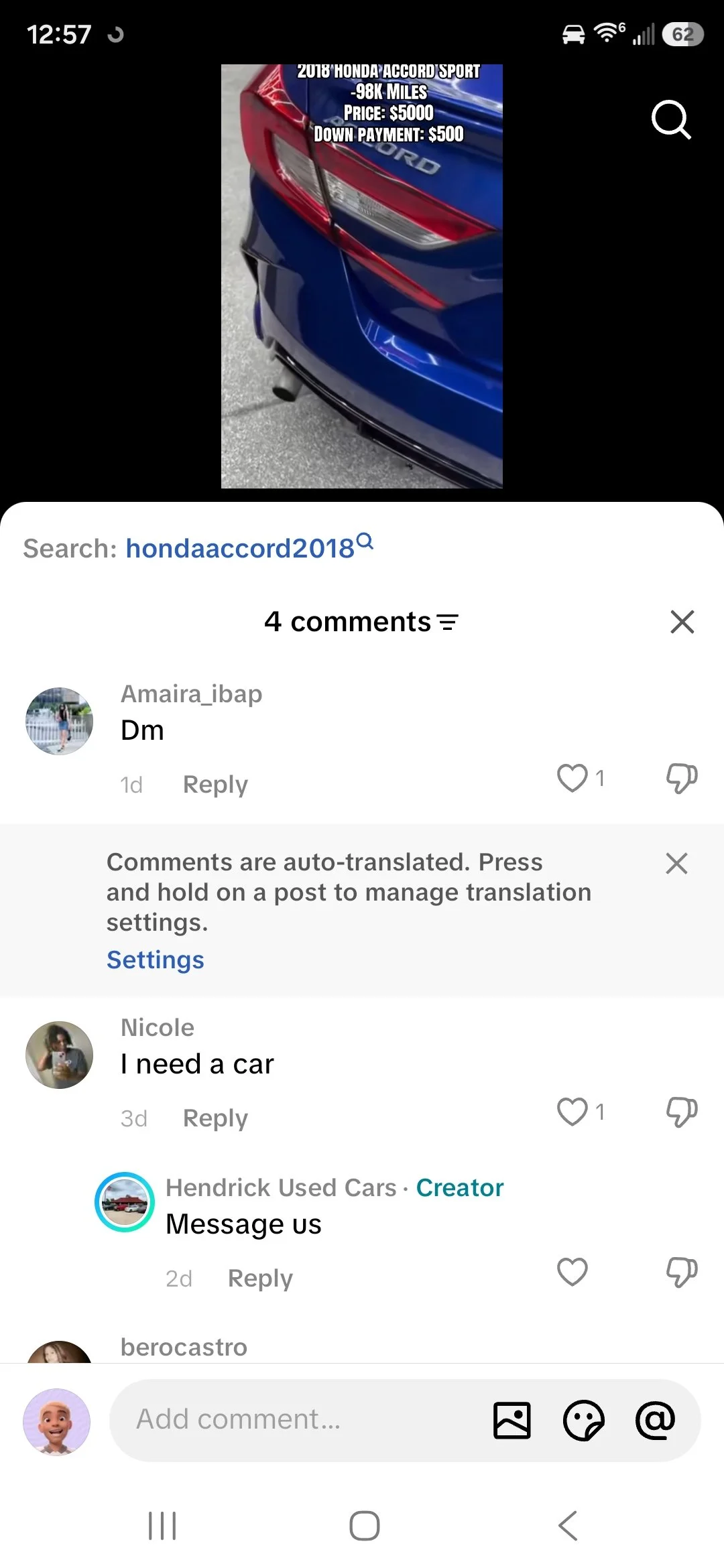
“Dm”
Another writes:
“I need a car”
And the account responds:
“Message us”
There it is.
The public advertisement gets your attention.
The suspiciously cheap car creates urgency.
The conveniently affordable $500 down payment establishes a number in your mind.
Then the actual transaction moves somewhere private.
DM us.
Or, as the kids say, slide into the DMs.
That's the point where I'd become extremely cautious.
🚩 What Happens After the DM?
I haven't messaged this account, so I'm not going to claim I know what they say privately.
But if I were investigating this further, I'd watch for a very specific progression.
The car is still available.
Lots of people are supposedly interested.
They can hold it for you.
All they need is...
$500.
Maybe through Cash App.
Maybe Zelle.
Maybe another peer-to-peer payment method.
And suddenly that harmless-looking “DOWN PAYMENT: $500” at the beginning of the video makes a lot more sense.
Again, I'm not saying that's what this account does. I haven't seen the private conversation.
But I absolutely would not send anyone $500 based on this TikTok.
🚩 There's Another Detail: “Hendrick Used Cars”
That name is interesting because Hendrick Automotive Group is a real, major automotive retailer.
That does not mean this TikTok account is affiliated with Hendrick Automotive Group.
And that's another thing consumers should verify.
Don't assume an account belongs to a legitimate company because its username, logo or description resembles a familiar business.
Go to the company's official website independently. Find its actual phone number. Call the dealership directly and ask whether the vehicle, social-media account, and offer are theirs.
Don't use the phone number or link somebody sends you in a DM to “verify” themselves.
That's not verification.
The Math Is the Best Scam Detector
This is now the second suspiciously cheap vehicle TikTok has served me.
And the pattern is remarkably similar.
An attractive used car.
A price far below conventional retail value.
A conveniently small $500 down payment.
Very little information.
And an invitation to take the conversation private.
Could there be a legitimate explanation?
Absolutely.
But that's exactly why you ask questions before sending money.
For this Accord, KBB's numbers put a normal example far above $5,000. Kelley Blue Book: Even a nearly identical-mileage damaged salvage example sold at auction for $6,600. DreamBid
And this one is supposedly yours for $5,000?
Maybe.
Show me the VIN.
Show me the title.
Show me the Carfax or AutoCheck.
Show me the dealership.
Let me independently call the business.
Let me inspect the car.
Let me verify that you actually own it.
Then we can talk about money.
Until then, my $500 is staying exactly where it is.
Because sometimes the most expensive $5,000 car you'll ever buy is the one that never existed.
Follow along at NielFlamm.com/blog for more questionable social-media deals, scams, recruiting adventures, and other things the algorithm apparently thinks I need in my life.
“Don’t You Meet Single Women at Recovery Meetings?”
As I've continued documenting The Hinge Experiment™, I've had a thought that I'm sure some people reading along have had too:
“Niel, don't you meet single women at recovery meetings?”
Well...
Yes.
There are women at recovery meetings.
Some very smart, incredibly funny, interesting, and great-looking women are at the meetings I attend.
But there's a pretty significant difference between noticing that someone is attractive and treating a recovery meeting like Hinge with folding chairs and bad coffee.
And I'm very intentional about that.
There's This Thing Called the “13th Step”
If you're unfamiliar with recovery culture, you may have heard of the 12 Steps.
There is no official Step 13.
The “13th Step” is a slang term commonly used when someone—particularly someone with more time in recovery—pursues a romantic or sexual relationship with someone who may be new or vulnerable in recovery.
That's something I have zero interest in doing.
I'm not going to a meeting looking for dates.
I'm not scanning the room thinking:
Single? Married? Divorced? Hinge? Tinder? Is it complicated?
That's not why I'm there.
People walk into recovery meetings dealing with all kinds of things. Some are having fantastic days. Others may be having one of the worst days of their lives.
The last thing I want is for a woman to wonder whether I'm being friendly because I'm genuinely welcoming her or because I'm trying to get her phone number.
I don't want to be that guy.
I Don't Even Know Who's Single
There's also one tiny problem with the theory that I should simply meet someone at a meeting:
I have absolutely no idea who is available.
I don't ask.
Someone could be married.
Dating.
Engaged.
Recently divorced.
Separated.
Happily single.
Not interested in men.
Not interested in dating.
Or perhaps interested in dating, just very specifically not interested in me.
All perfectly legitimate possibilities.
Unlike Hinge, nobody arrives at a meeting with a little sign above her head saying:
“Single. Looking for long-term relationship. Likes dogs, tacos and communication.”
And I'm certainly not walking around afterward conducting a relationship census.
“Hi, great share tonight. By the way, are you seeing anybody?”
No.
Absolutely not.
I'd like to continue being welcomed back.
But Yes, I Notice
Now, I'm also not going to pretend I've suddenly lost the ability to see.
There are women I've met through recovery who are smart, funny, attractive, interesting and genuinely enjoyable to talk to.
Of course I notice.
I'm sober.
I'm not dead.
Sometimes you meet someone and think:
Wow, she's really funny.
Or:
She's incredibly smart.
Or, yes:
She's really attractive.
And then I do something truly revolutionary:
I go to the meeting.
Because there's a time and place for everything.
Then There's One Other Minor Problem
I'm shy.
Yes.
Me.
The guy who writes about his dating life on the internet.
The guy who publicly chronicles getting ghosted.
The guy who invented an imaginary iguana named Steve as an alternative dating strategy.
Shy.
Put me behind a keyboard, and apparently I'll tell the internet everything.
Put an attractive woman six feet away from me and suddenly my brain starts buffering.
Loading...
Loading...
Still loading...
Eventually:
“Hey.”
Outstanding work, Niel.
Absolutely crushed it.
Maybe that's part of why dating apps appealed to me in the first place. There's an obvious context.
We're both on Hinge.
We matched.
Presumably, there is at least some mutual interest.
At a recovery meeting, none of that information exists.
And I don't want to make assumptions.
Could I Ever Date Someone I Met in Recovery?
Sure.
I'm not saying I have some absolute rule that I could never date anyone I've met through recovery.
Life isn't that black and white.
If two people have established recovery, get to know each other naturally, discover they're both available, and there's genuine mutual interest, that's entirely different from going to meetings hunting for dates.
Intention matters to me.
I want women to feel comfortable around me at meetings.
I want someone to be able to talk to me without wondering whether I'm interpreting basic friendliness as romantic interest.
And I especially never want someone who's vulnerable or early in recovery to feel like I'm circling.
That's a boundary I'm comfortable having.
So Back to Hinge We Go...
Which brings us back to my current dating situation.
Hinge isn't exactly setting the world on fire.
Gina has gone silent.
The new matches have dried up.
The dates remain theoretical.
But at least on Hinge, there's one thing everyone has presumably agreed upon:
We're there to meet somebody.
At recovery meetings, I'm there for recovery.
And if someday I naturally connect with someone through that community and something develops outside the rooms?
Wonderful.
Until then, I'm not turning a meeting into singles night.
Besides, my shyness would probably ruin the entire plan anyway.
And if Hinge continues at its current pace...
There's always Steve.
The iguana has no problem approaching strangers. 🦎
The Hinge Experiment: Gina Is Silent, the Matches Have Stopped, and Steve Is Getting Nervous
It's time for another update from The Hinge Experiment™.
Unfortunately, this update won't take very long because...
NOTHING HAS HAPPENED.
Remember Gina?
I made what I considered another bold move in the world of modern dating.
I asked her:
“What's your number?”
Four words.
Direct.
Simple.
No ambiguity.
No 900-word explanation.
No discussion of cryptocurrency.
No request to move to WhatsApp.
No smoke signals.
Just:
What's. Your. Number?
And the response?
Absolutely Nothing
No number.
No message.
No “I'd rather keep talking here.”
No “I'm not comfortable giving you my number yet.”
No “Thanks, but I'm not interested.”
Not even one of those increasingly familiar:
“Good morning.”
Nothing.
The Hinge communication department is apparently closed for renovations.
Now, to be fair, it hasn't been an eternity. People have lives. People work. People get busy. People don't necessarily check dating apps every 13 minutes.
I understand all of that.
But this is becoming a familiar pattern in The Hinge Experiment.
Match.
Say hello.
Attempt conversation.
Ask questions.
Try to move things toward an actual meeting.
And then...
WELCOME TO THE VOID.
And There Aren't Any New Contestants
Here's the other exciting development:
I haven't gotten any new matches either.
None.
Zero.
Nada.
The Hinge bullpen is empty.
Apparently, the greater Charleston-area female population collectively looked at my profile and decided:
“We're good.”
Fair enough.
I can't force the algorithm to love me.
But it's funny when you consider how this experiment started.
I joined Hinge after ending my Tinder experiment. Almost immediately, I got a match.
I thought:
OH! HINGE IS DIFFERENT!
Look at this!
People actually match here!
Maybe the whole “designed to be deleted” thing is real!
Well...
Technically, an app can be designed to be deleted for multiple reasons.
Let's Review the Starting Lineup
We've had quite the roster.
Kelli.
A promising beginning that evolved into a fascinating study of how many different ways two people can say “Good morning” without actually having a conversation.
Unmatched.
Then there was Missing Me.
She asked questions!
We communicated!
I asked her out!
She said Sunday could work!
For approximately 36 glorious hours, I thought The Hinge Experiment was about to produce its first actual date.
Then Sunday arrived.
Missing Me lived up to her name.
Missing.
Unmatched.
And then...
Gina.
Gina and I matched before Missing Me, so she's practically a veteran of the program.
We've exchanged messages.
I've asked about getting together.
I've tried moving the conversation forward.
Finally, I threw the pitch right down the middle:
“What's your number?”
And now I'm standing at home plate wondering whether the catcher, umpire, and entire opposing team quietly went home.
Am I Doing This Wrong?
I keep coming back to the same question:
How do people actually meet?
Because I'm beginning to suspect dating apps may not be the answer.
At least not for me.
I'm not expecting someone to fall madly in love after three messages.
I'm not asking anyone to update her Facebook relationship status before appetizers.
I don't have a U-Haul sitting in the driveway.
I'd simply like to get from:
MATCH
to
CONVERSATION
to
PHONE CALL
to
“Hey, want to grab something to eat?”
That progression doesn't seem completely unreasonable.
Instead, I'm discovering an entirely different dating funnel:
MATCH → GOOD MORNING → GOOD MORNING → QUESTION → SILENCE → UNMATCH
I should put that on a PowerPoint.
Meanwhile, Steve Is Watching
For newer readers, Steve is my imaginary iguana.
Steve was created as my contingency plan.
If dating apps don't work, I'm getting a reptile and becoming that guy walking around the beach with an iguana on his shoulder.
Everybody talks to that guy.
Nobody knows his name.
Nobody understands his life choices.
But everyone wants to meet the lizard.
At first, Steve was a joke.
Then he became a recurring character.
Now?
I'm starting to think I should research iguana ownership.
Because here's the uncomfortable truth:
Steve would probably generate more conversations in one afternoon on the beach than I've generated through weeks of Hinge.
And Steve doesn't even have a profile.
So Where Does The Hinge Experiment Go From Here?
For now, I'm still on it.
Gina is still there.
She can respond.
Maybe she will.
Maybe another match will suddenly appear.
Maybe someone will shock me by asking a question, answering one of mine, having an actual conversation, and agreeing to meet.
I'm open to being surprised.
But as of today's official standings:
New matches: 0
Response from Gina: 0
Upcoming dates: 0
Iguanas currently owned: 0
That final statistic is the most likely to change.
The Hinge Experiment continues.
For now.
Steve...
start stretching.
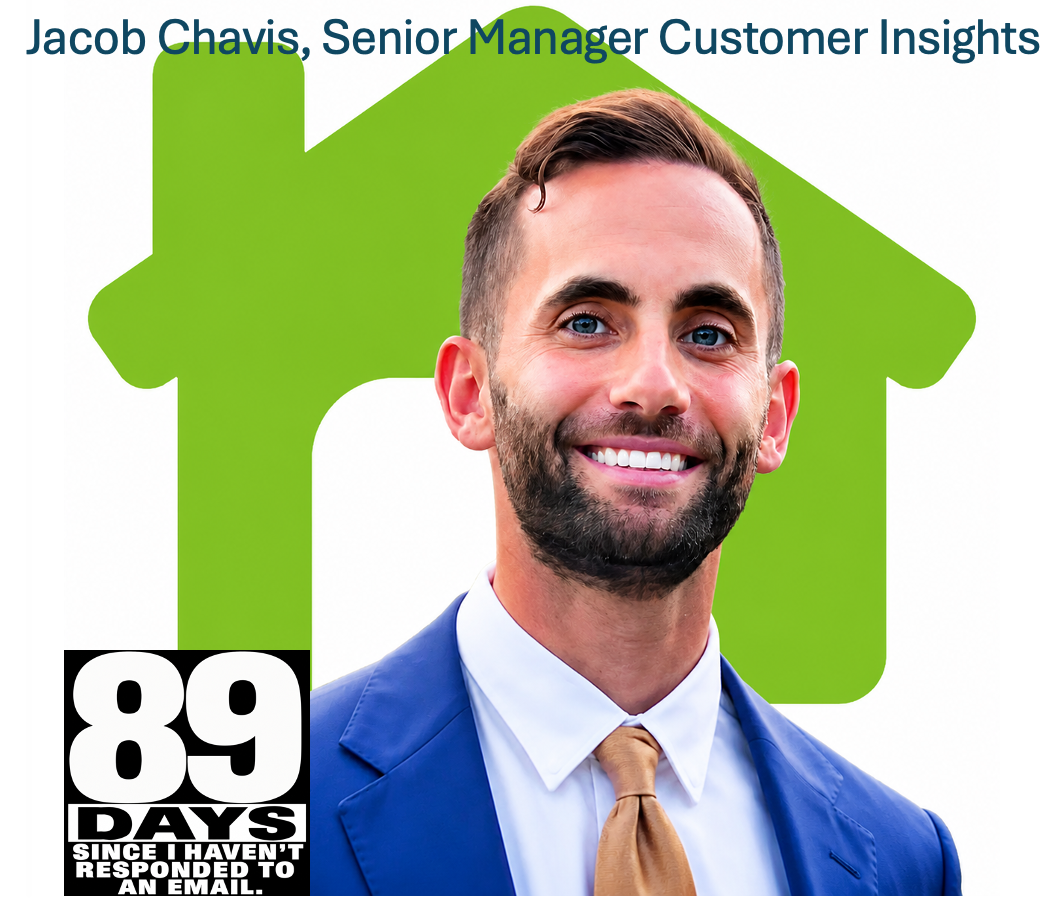
Day 89: What If Nextdoor’s Biggest Competitor Isn’t Another App?
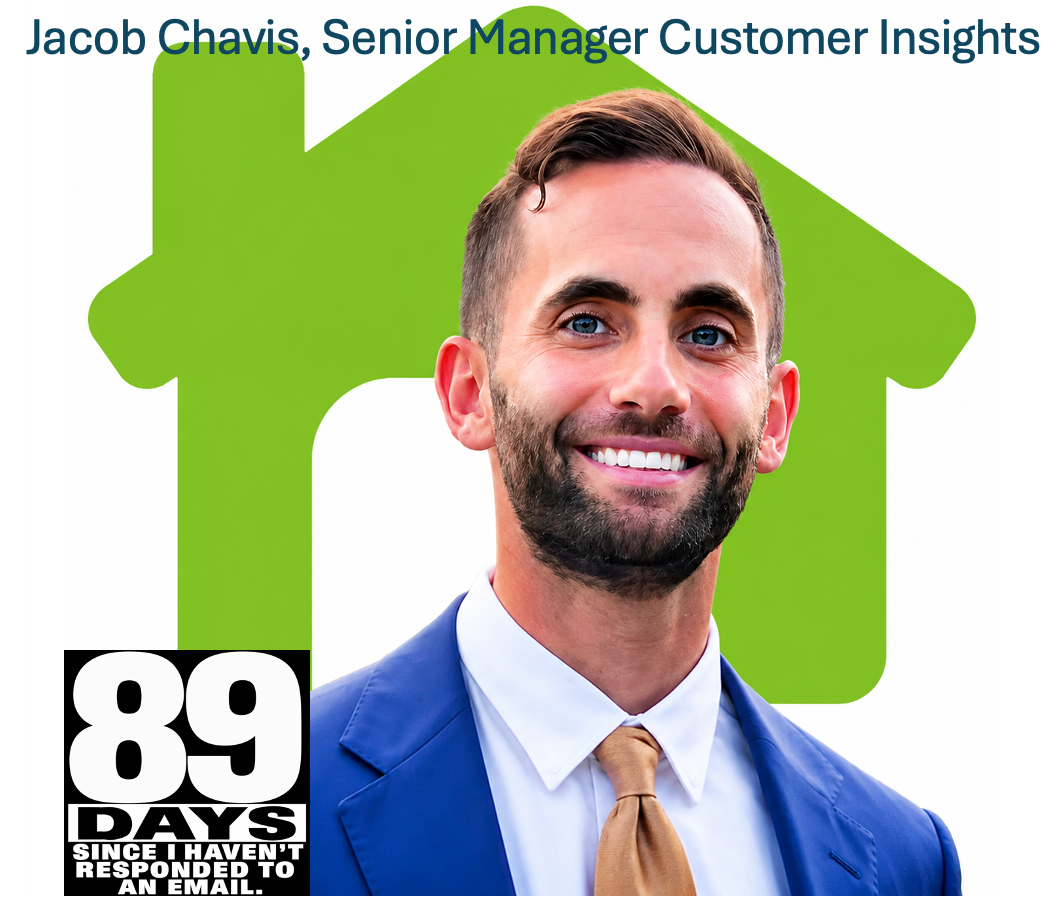
For 88 days, I’ve written about Nextdoor from almost every angle imaginable.
Leadership. Communication. Surveys. Detailed data that I’m still waiting for. Moderation. Small businesses. Advertising. Stock price. Executive decisions. AI. Trust. Blocking shareholders. Even the question of whether anybody is actually driving the bus.
So for Day 89, let's go somewhere completely different.
What if Nextdoor's biggest competitive threat isn't Citizen, Facebook, Ring, Reddit, or some new neighborhood app?
What if Nextdoor's biggest competitor is simply…not opening Nextdoor?
Think about that.
The Most Dangerous Competitor Has No Logo
Every technology company watches its competitors.
What features did they launch?
How many users do they have?
What are they charging?
What are people saying about them?
But there's another competitor that doesn't appear on a PowerPoint competitive-analysis slide.
Indifference.
The person who gets a Nextdoor notification and swipes it away.
The business owner who decides it isn't worth figuring out how Nextdoor works.
The neighbor who hasn't deleted the app but hasn't opened it in six months.
The person who once checked Nextdoor every morning and gradually stopped.
They're technically still a potential user.
But Nextdoor has lost something arguably more important than an account:
Nextdoor has lost their attention.
Deleting an App Is Actually a Dramatic Event
Someone deleting Nextdoor can be measured.
Someone quitting publicly can be noticed.
Someone posting:
“I'M DONE WITH NEXTDOOR!”
is actually giving the company valuable information.
They're angry enough to explain why they're leaving.
But what happens when someone doesn't leave?
They just stop caring.
No complaint.
No angry email.
No support ticket.
No dramatic goodbye post.
Nextdoor remains buried somewhere between Candy Crush and an app they downloaded three phones ago.
That's much harder to fix.
Think About Your Own Neighborhood
If something happens on your street, what's your first instinct?
Do you open Nextdoor?
Text a neighbor?
Check Facebook?
Look at Ring?
Search Google?
Check Citizen?
Look out the window?
Walk outside?
Or do you simply wait until somebody tells you what happened?
That's the real competitive battle.
Nextdoor doesn't merely need to convince people that it's better than another social platform.
It needs to become the answer to:
“Where do I go when I want to know what's happening around me?”
That's a much bigger challenge.
This Is Where “Essential” Gets Interesting
Nextdoor has described itself as an essential neighborhood network.
That's a powerful word.
Essential.
Water is essential.
Electricity is essential.
My morning caffeine can occasionally feel essential.
But an essential product isn't something people have to remind themselves to use.
It becomes habitual because it repeatedly provides value.
That's why I think Nextdoor's most important metric may not simply be how many people can use it.
It's whether people feel they need to use it.
And This Isn't Just About Users
The same question applies to businesses.
Imagine you're a plumber.
A landscaper.
A restaurant.
A dog groomer.
A handyman.
With limited time and limited marketing dollars.
They can be spent on Google.
Facebook.
Instagram.
Direct mail.
Local sponsorships.
Search advertising.
Or Nextdoor.
Nextdoor doesn't just compete against those platforms.
It competes against the business owner saying:
“Nah. I'm good.”
That's the competitor without a logo again.
Indifference.
Maybe This Is the Question Nextdoor Should Obsess Over
Instead of:
How do we get another click?
Try:
What would make somebody miss Nextdoor if it disappeared tomorrow?
That's a fascinating question for any company.
If Nextdoor vanished tonight, what would neighbors genuinely lose?
Local recommendations?
Emergency information?
Community discussion?
Business discovery?
Lost-dog alerts?
Someone asking what that helicopter is doing?
The annual neighborhood debate about whether fireworks are legal?
And, of course, the timeless classic:
“WHOSE DOG POOPED ON MY LAWN?”
There is genuine value buried inside all of that.
The challenge is making the valuable parts important enough that people tolerate—or better yet, don't encounter—the parts that drive them away.
Day 89: Forget the Competition for a Minute
I've spent a lot of time examining what Nextdoor says.
Today I'm more interested in what users do.
Nextdoor can advertise trust.
Nextdoor can announce AI.
Nextdoor can redesign Business Pages.
Nextdoor can create new advertising products.
Nextdoor can publish Insights reports.
Nextdoor can make podcast appearances.
But none of it matters if the customer eventually responds with the most dangerous sentence in business:
“I don't really use it anymore.”
Anger can be addressed.
Complaints can be investigated.
Products can be improved.
Even a shareholder writing about you for 89 consecutive days is demonstrating engagement.
But indifference?
Indifference doesn't complain.
It just leaves the app sitting unopened.
And maybe that's the Nextdoor problem worth talking about on Day 89.
Not who's criticizing the company.
Not who's blocking whom.
Not even where NXDR closed yesterday.
Who still cares enough to open the door?
Follow my continuing Nextdoor case study at NielFlamm.com/blog.
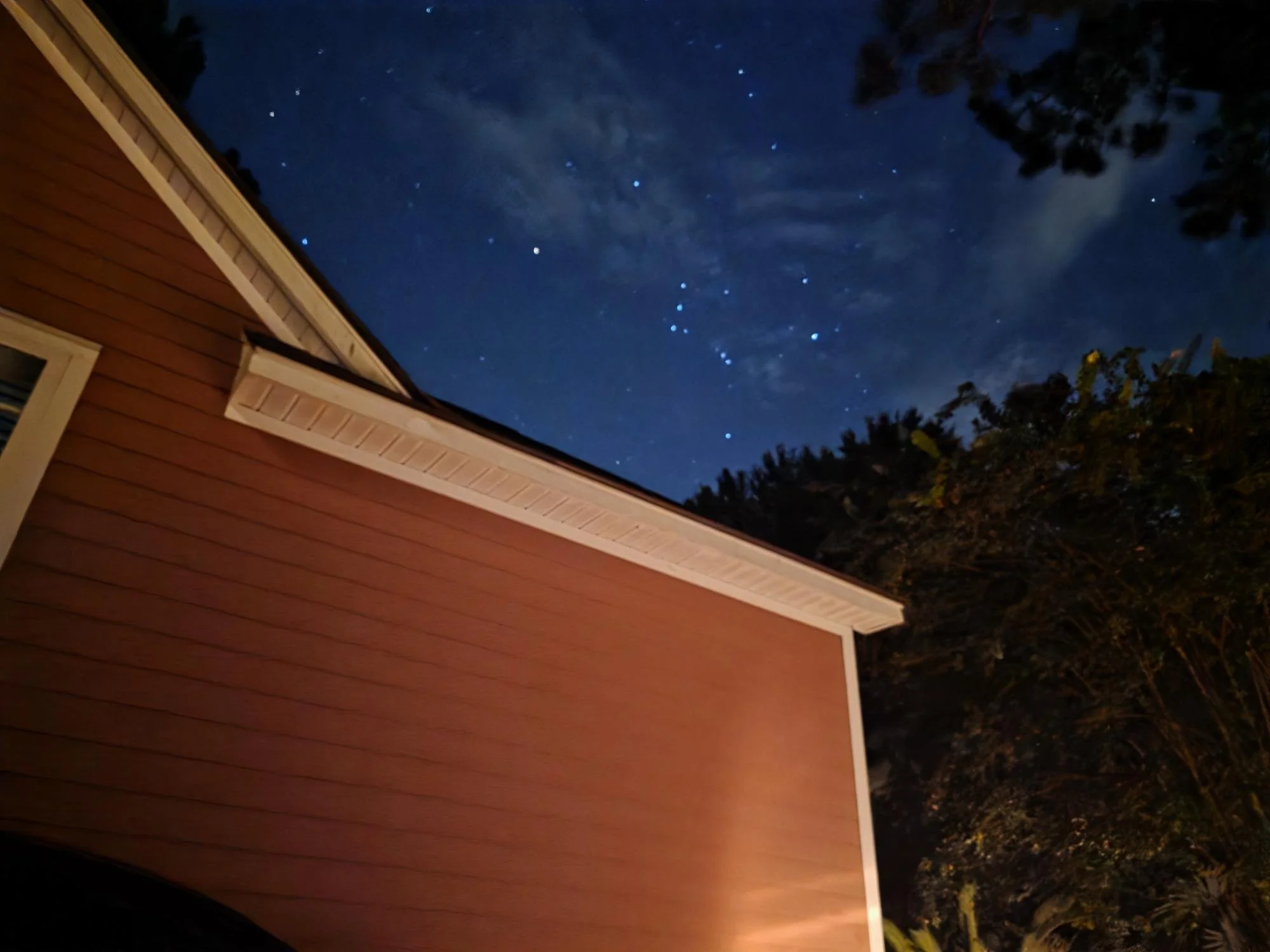
A Moment Under the Stars at 5:15 AM
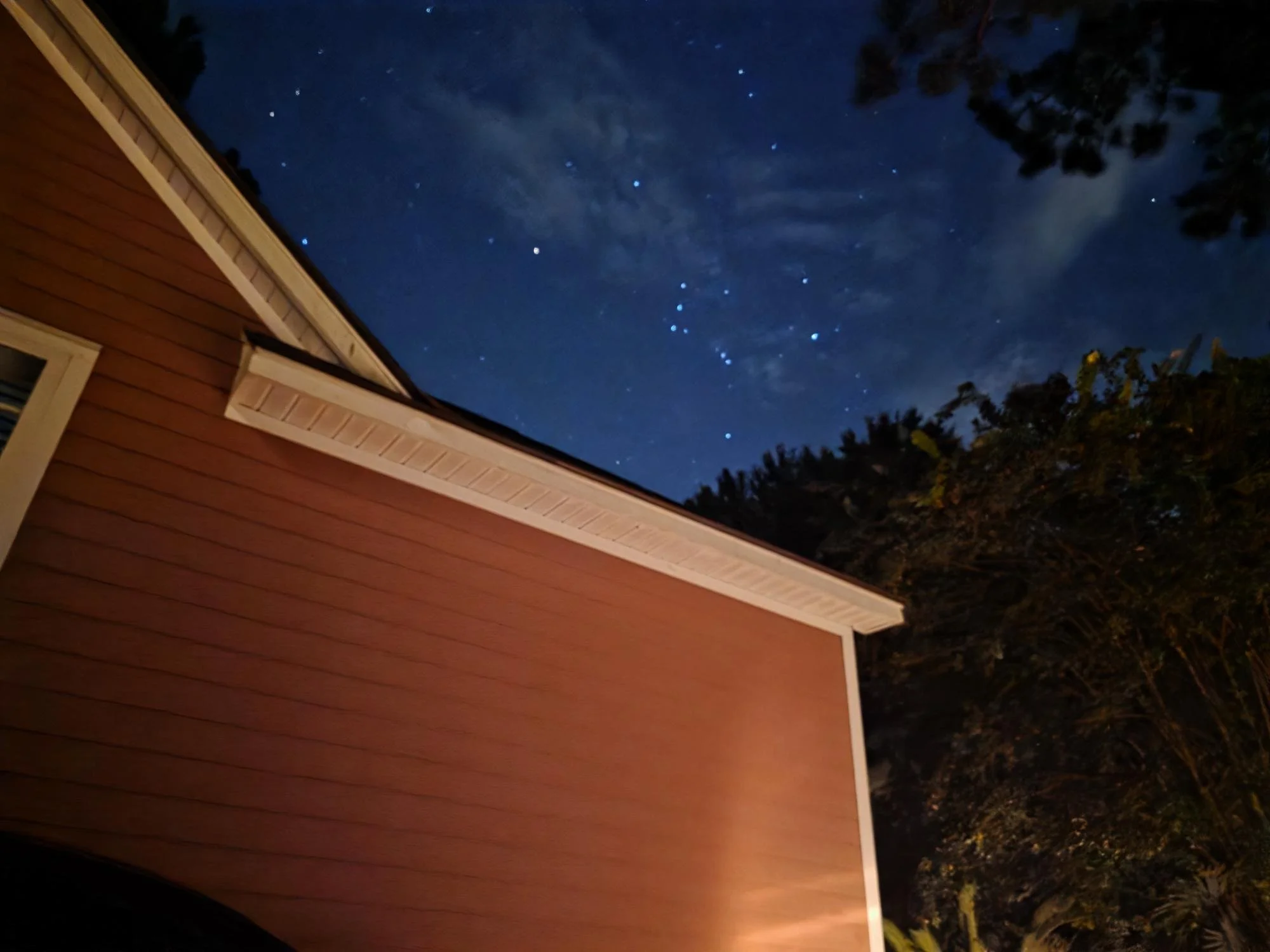
At 5:15 this morning, I stepped outside to leave for dialysis and looked up.
Above the roof of the house, a constellation shone through the early morning darkness. Stars dotted the deep blue sky, framed by clouds and tree silhouettes. Before getting on my way, I paused to take in the view.
Leaving for dialysis before sunrise is part of my routine. There is a schedule to keep and a long morning ahead. But today, there was also this small moment outside my own front door—a chance to breathe and notice something beautiful.
I took this picture to carry a little of that moment with me. The appointment still waited, but the stars gave me something else to think about as I headed out.
Sometimes, a quiet moment looking up is a good way to begin the day.