
Three Months, One Leadership Role, and No Update: What Does Hiring Silence Say?
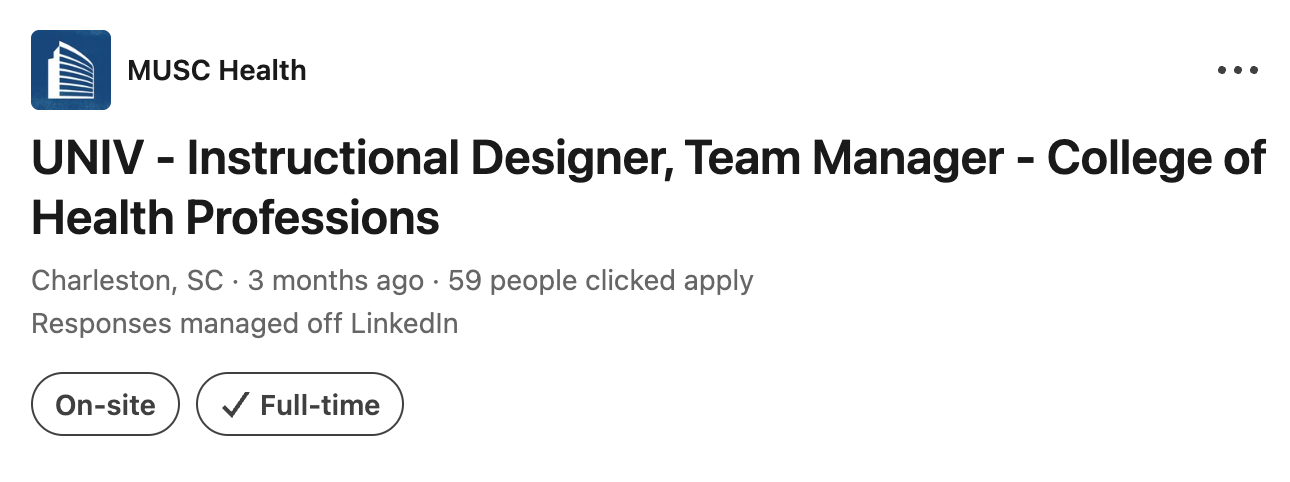
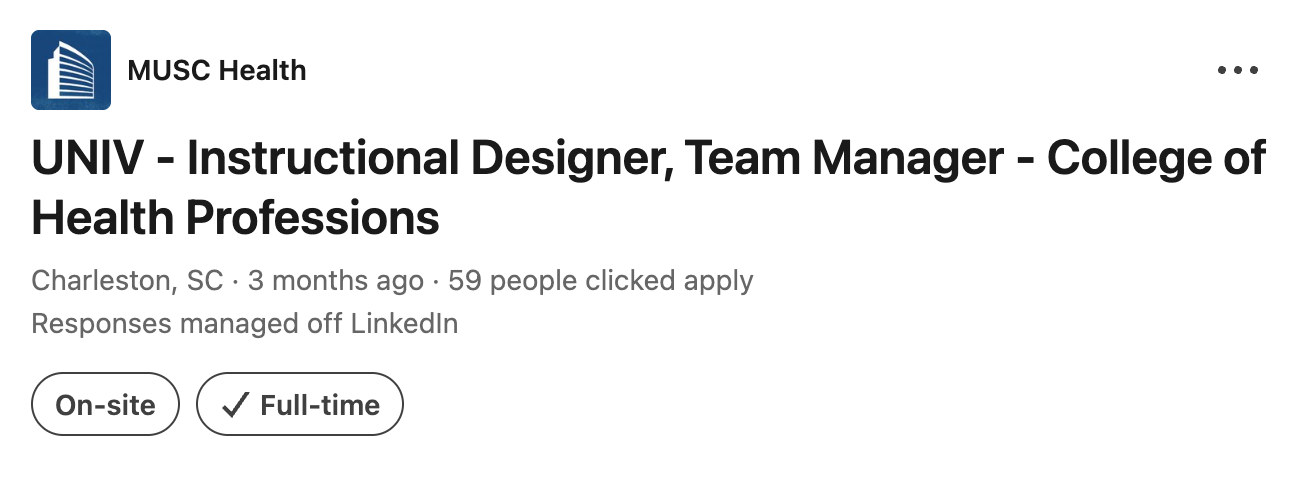
Three months after a leadership position is posted, what should applicants—and the team waiting for that leader—expect? I applied for MUSC Health’s Instructional Designer, Team Manager position in the College of Health Professions and have not received an update, a rejection letter, or any indication of where my application stands. T
he attached listing shows that the position was posted three months ago. That does not establish whether the search remains active, an offer is pending, or the posting simply has not been updated. Still, the absence of communication leaves me wondering: Has this role been filled, and if not, what is delaying the decision?
If the position remains unfilled, has no candidate met the requirements in three months? Are the expectations aligned with the compensation, on-site requirements, and available talent? Could budget approval be delaying a hire while the posting remains visible? Perhaps the responsibilities are being revised, a search committee is navigating competing priorities, or a finalist declined an offer. An internal candidate could be under consideration, or an organizational change could have paused the process.
These are hypothetical explanations, not claims about MUSC Health. Without an update, applicants cannot know whether a search is progressing, paused, or already complete.
The team’s experience also matters. If this leadership seat has been vacant for three months, how is the team being supported? An interim leader may be providing excellent coverage, but is that person carrying another full-time workload? Who is setting priorities, supporting professional development, resolving competing requests, and making decisions about instructional quality?
A vacant position does not necessarily mean an absence of leadership, but prolonged coverage arrangements raise reasonable questions about workload, continuity, and whether employees have the support they need.
I recognize that hiring takes time, particularly in complex institutions, and submitting an application does not guarantee an interview or an offer. Still, timely communication is a reasonable professional expectation. A brief update that a search is ongoing, delayed, closed, or being reconsidered would demonstrate respect for candidates’ time. How can organizations make their hiring communication reflect the professionalism they expect from applicants?
I welcome perspectives from candidates, hiring managers, and teams navigating extended searches. For more of my thoughts on leadership, hiring, and the workplace, follow along at https://NielFlamm.com/blog.
Recovery Update: The Scabs Are Leaving, the Scar Is Staying
Healing apparently has stages.
First, everything looks terrible.
Then it somehow looks even worse.
Then one day I look at it and realize, “Wait… that actually looks a lot better.”
That’s where I seem to be today.
👁️ The Eye: Boring Is Still Beautiful
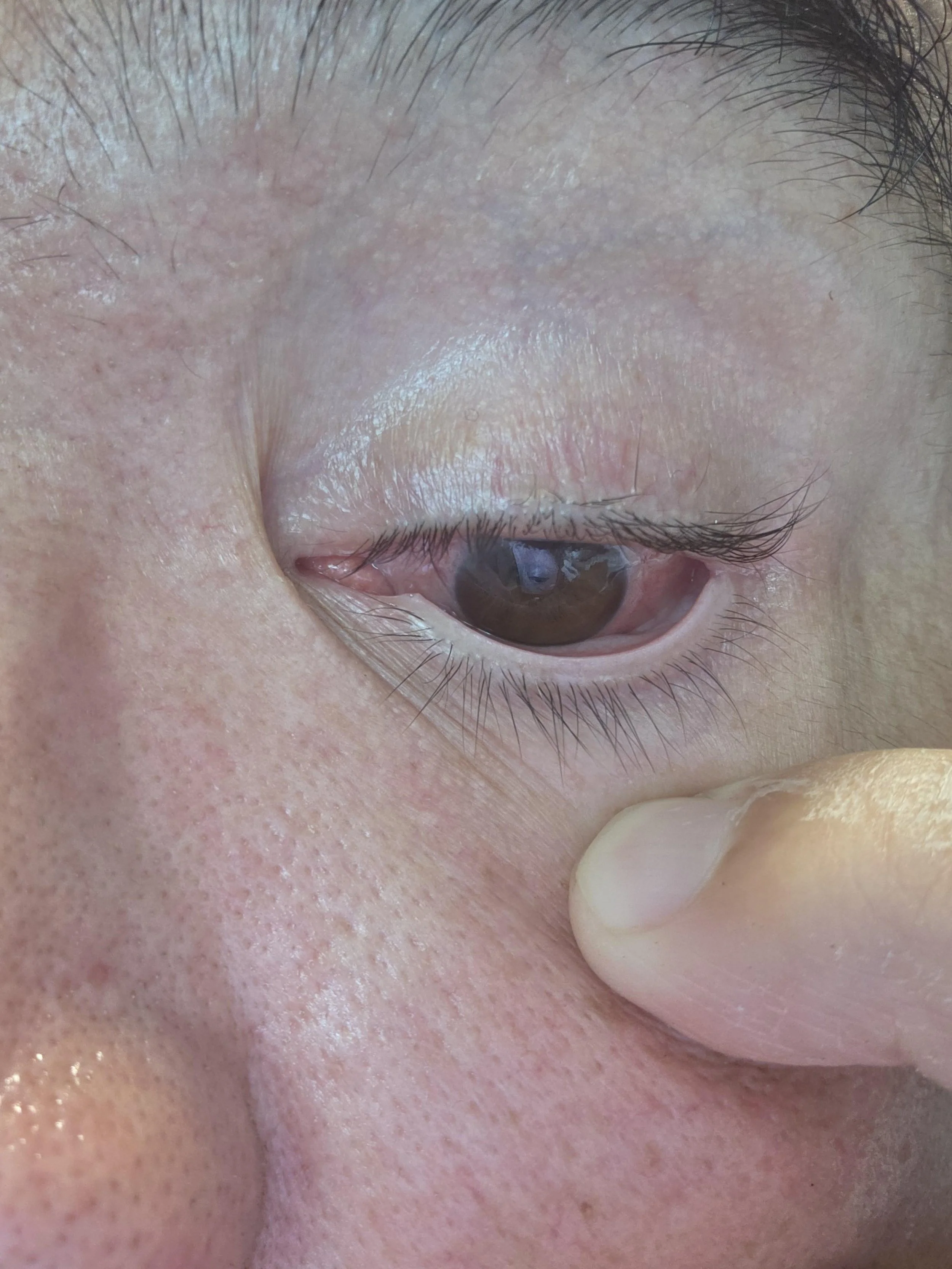
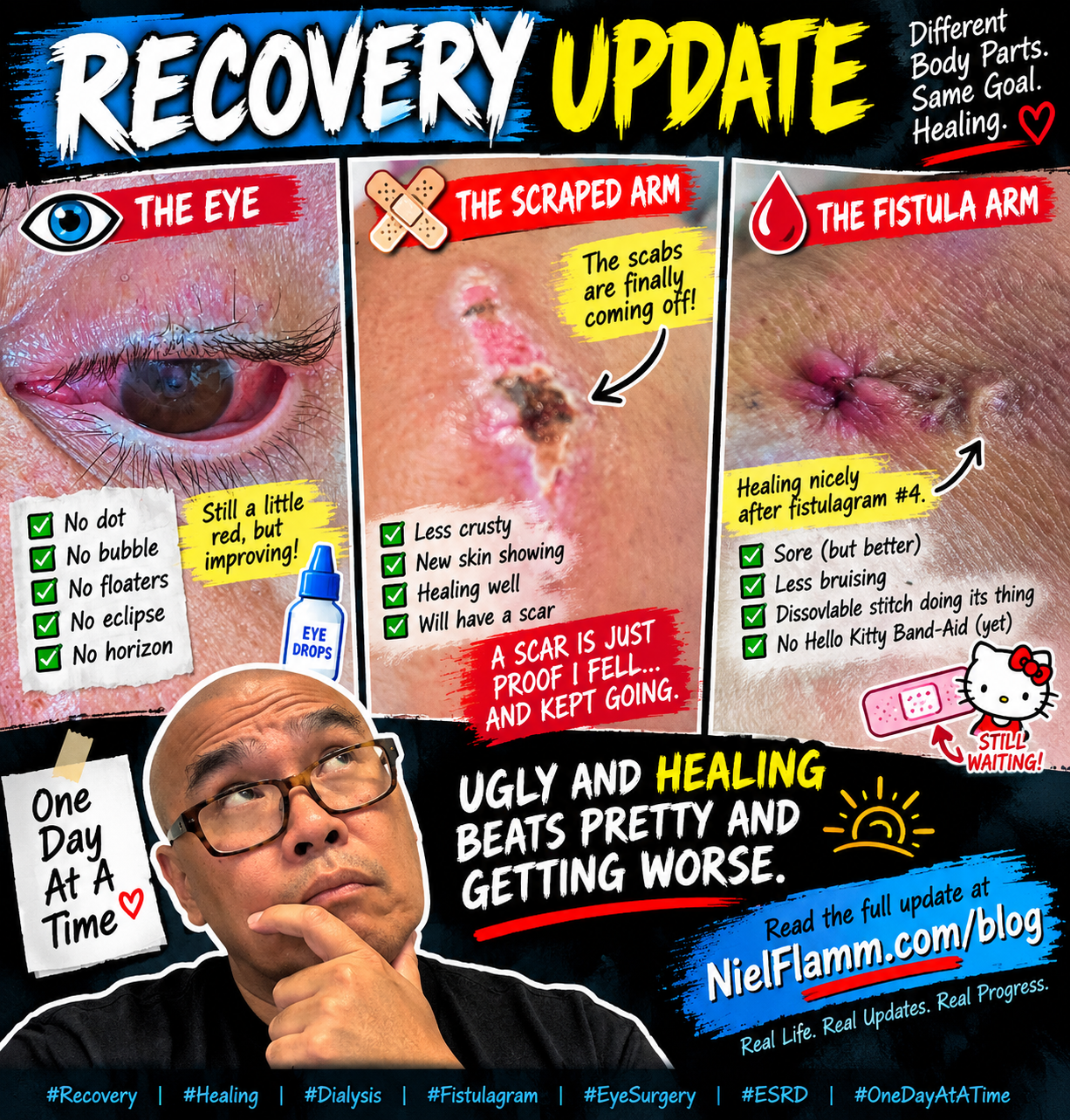
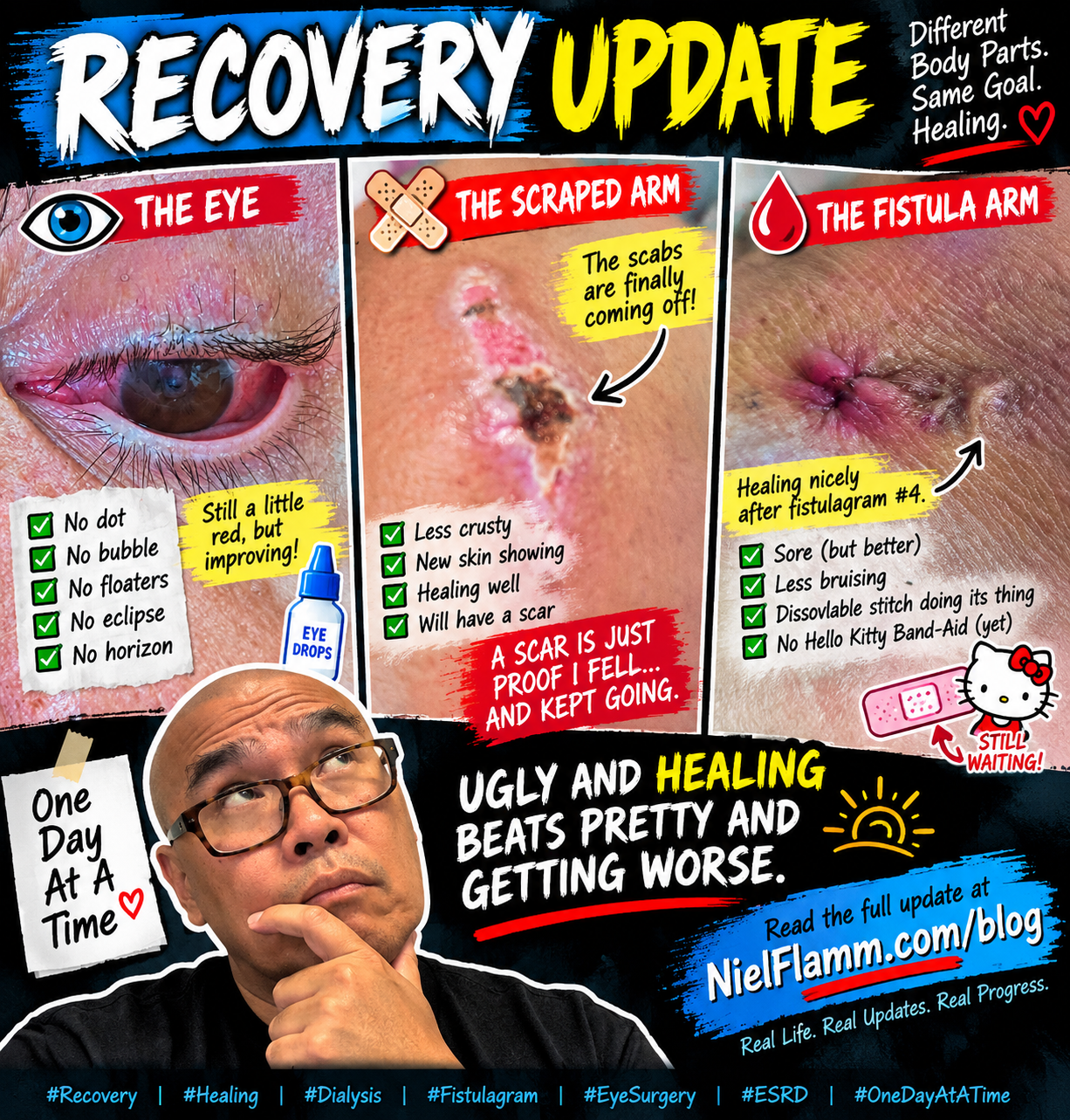
My eye continues to look better. There’s still some redness, but compared with where this adventure started after the silicone oil removal, I'll take it.
More importantly, the visual effects are still gone.
No dot. No bubble. No floaters. No horizon. No eclipse.
I never thought I’d be this excited about seeing absolutely nothing unusual.
I'm continuing the drops and watching the eye, but boredom remains my favorite development.
💪 The Scraped Arm: Crust City Is Being Demolished
Now for the arm.
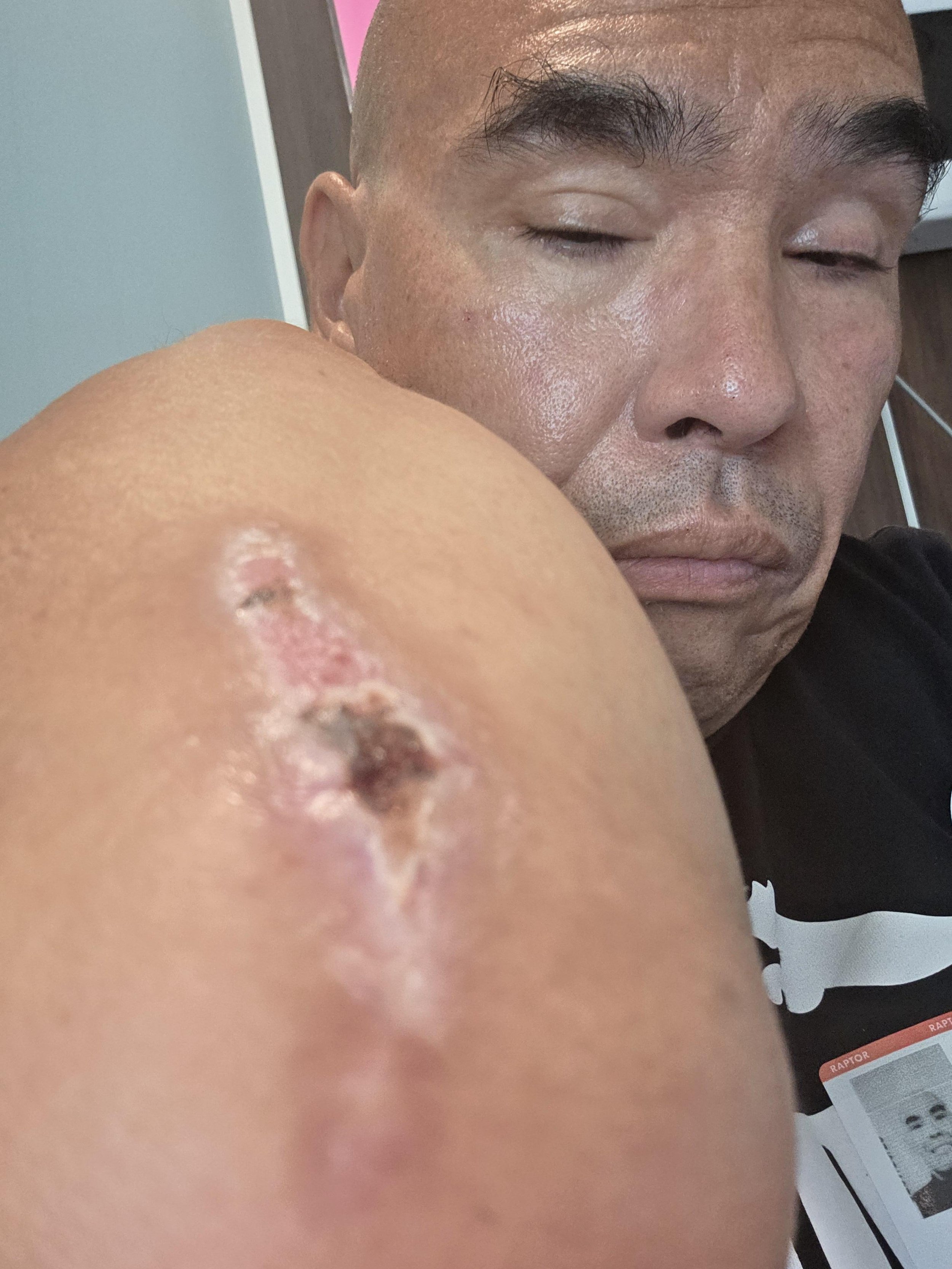
Look at the difference.
Most of that giant, nasty scab that has been starring in these updates is finally gone. What’s underneath is pink, fresh-looking skin with one stubborn darker area hanging around.
And I think we can officially call this one:
I'm going to have a scar.
Considering what this thing looked like immediately after the fall—and then during its glorious Crust City phase—a scar seems like a pretty reasonable souvenir.
I suppose I could make up an impressive story about how I got it.
Shark attack?
Bar fight in Singapore?
Saving a family from a burning building?
Nope.
I fell.
Sometimes reality just doesn't cooperate with the legend.
🩸 The Fistula Arm: Where Did the Stitch Go?
Meanwhile, the fistulagram site keeps healing, too.
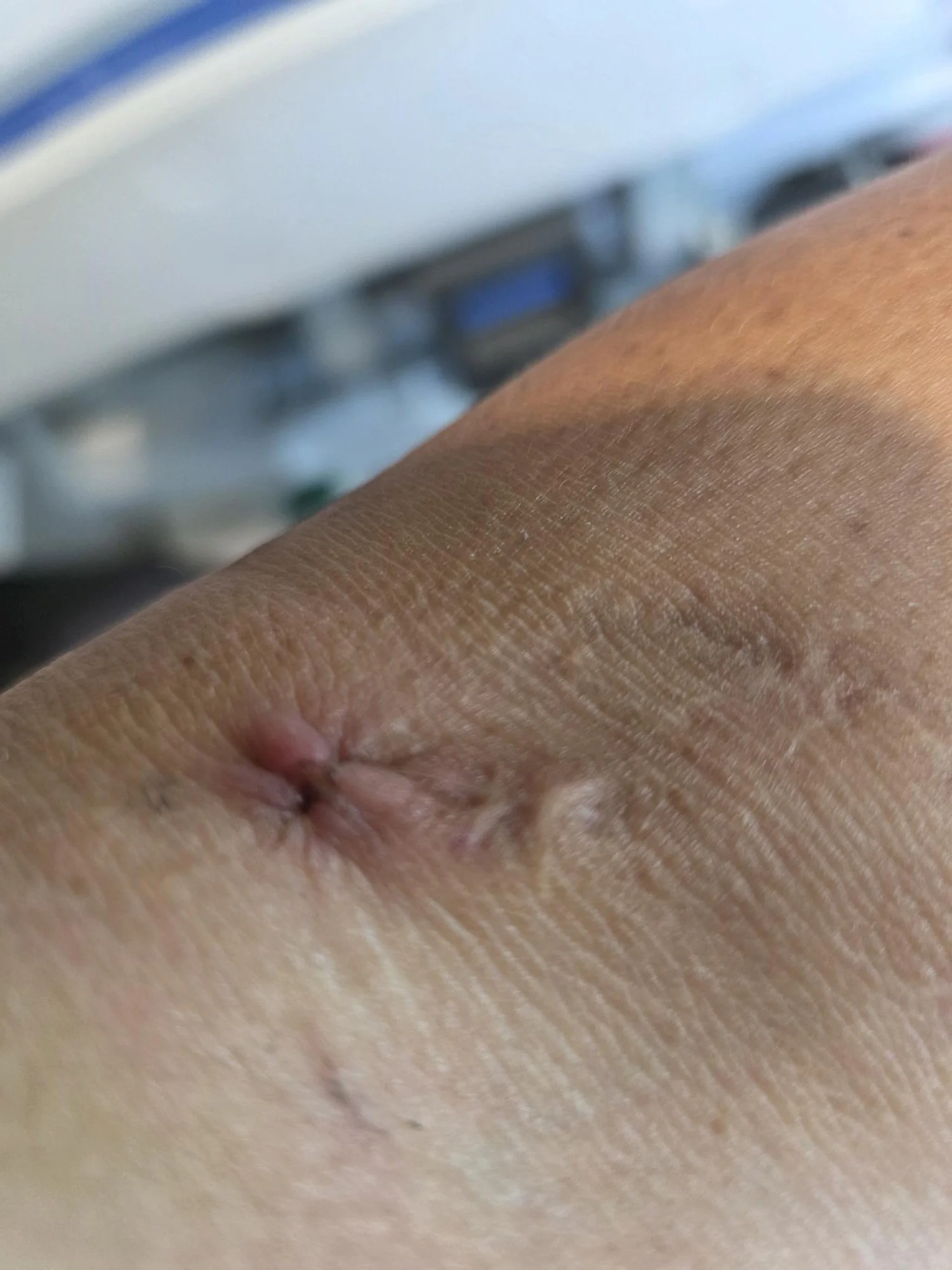
The dissolvable stitch appears to be doing exactly what the name advertised. The area is still visible and there’s some discoloration, but it looks considerably less dramatic.
Still waiting on that Hello Kitty Band-Aid upgrade. 🎀
I haven't forgotten.
Three Different Parts. Same Direction.
So today's recovery report is considerably less disgusting than some of the previous editions:
Eye: less red, no dots or floaters.
Scraped arm: most of the scab is gone, new skin is showing—and yes, there will be a scar.
Fistula arm: healing nicely after fistulagram #4.
The scar on my arm will probably stick around long after I've stopped writing these daily updates.
That's okay.
Scars are just receipts proving my body paid the bill and kept going.
And this particular receipt comes with a very simple description:
Fell down. Got back up.
Apparently, the Scammers Have Stopped Writing Emails
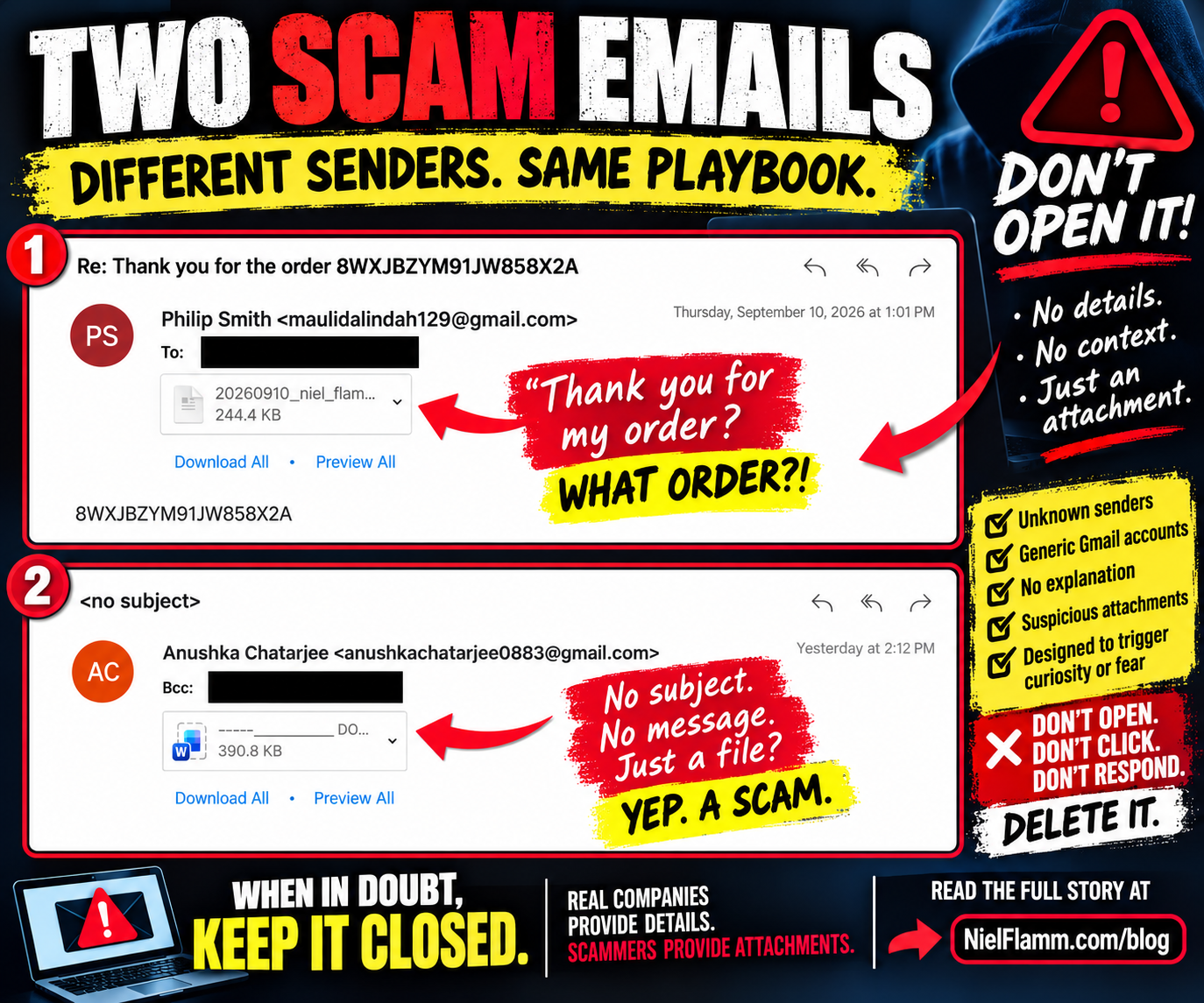
I've written quite a bit lately about scam emails, suspicious recruiters, mystery attachments, and people desperately trying to convince me to click something.
Apparently, we've now reached the minimalist phase of scamming.
Why bother writing an elaborate fake invoice when you can simply send me an attachment and hope I do the rest?
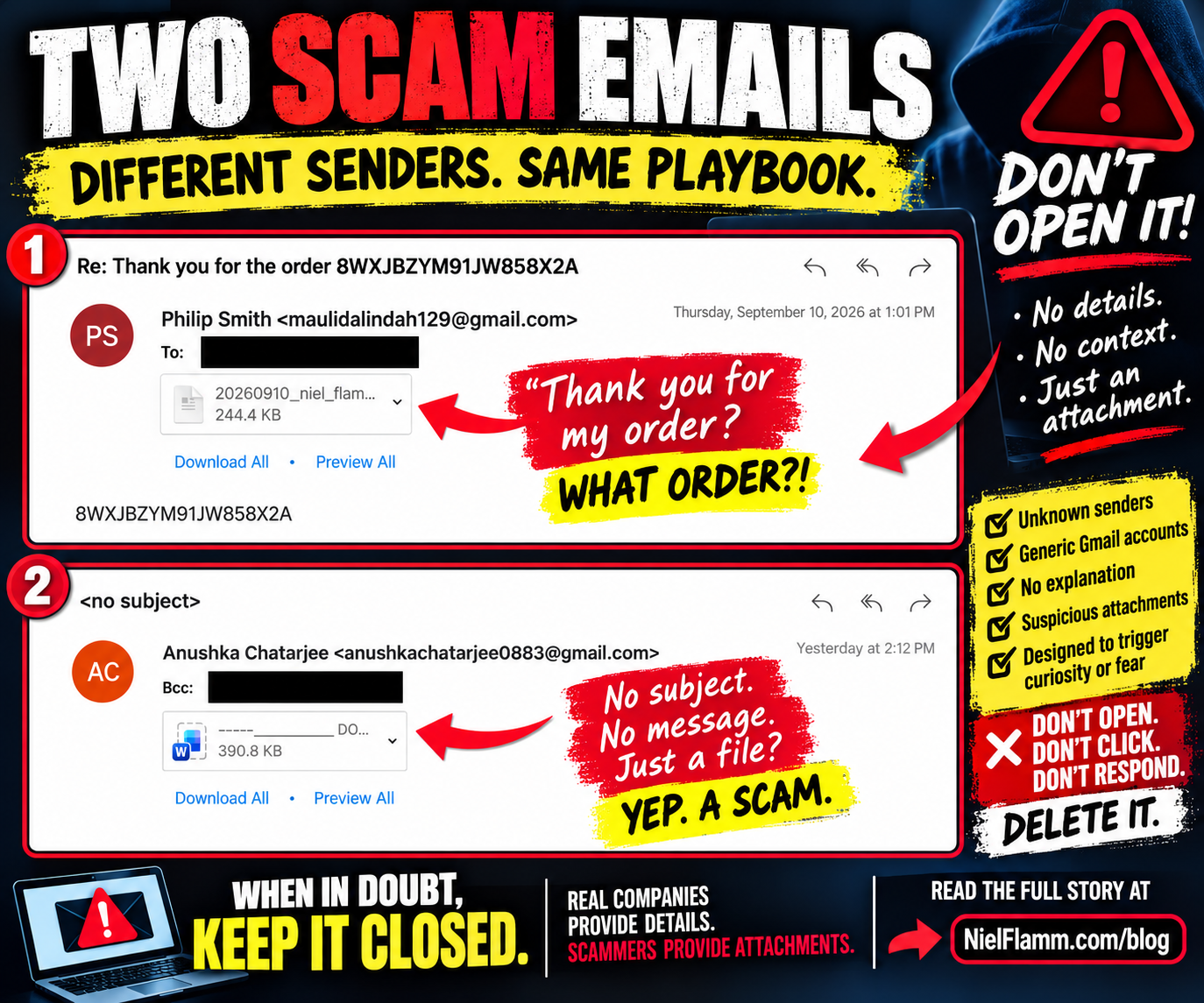
Over the past few days, I received two more emails that follow essentially the same strategy: almost no information, a mystery attachment, and curiosity as the bait.
🚩 Scam Email #1: Thank You for the Order!
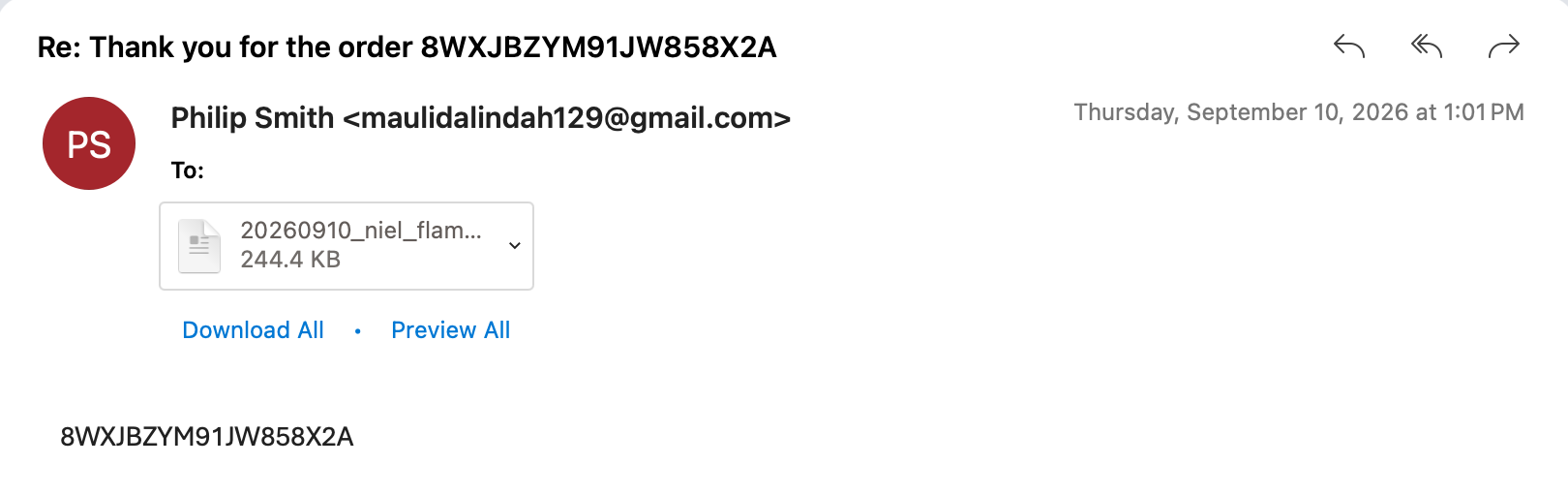
The first one came from someone identifying himself as Philip Smith, using a Gmail address.
The subject:
“Re: Thank you for the order 8WXJBZYM91JW858X2A”
Oh!
Thank you for my order!
There's just one tiny problem.
What order?
There's no company name.
No product.
No price.
No shipping information.
No recognizable merchant.
The body of the email contains essentially nothing except the same mysterious string:
8WXJBZYM91JW858X2A
And then there's an attachment.
A 244.4 KB file with a filename beginning with a date and my name.
That's a nice touch.
Putting someone's name in a filename can make the attachment feel personalized and legitimate.
But I'm supposed to believe I placed an order somewhere, received no explanation of what I purchased, and now need to open an unexplained attachment to discover what happened?
No thanks.
🚩 Scam Email #2: They Didn't Even Bother With a Subject
Then another masterpiece arrived.
Sender:
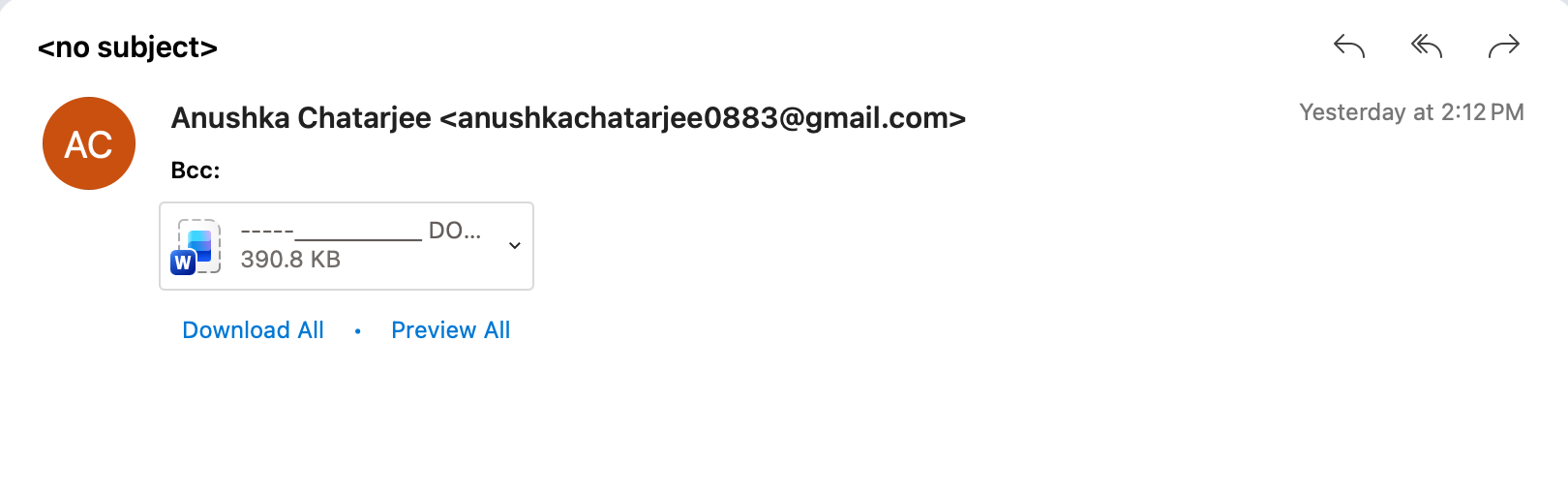
Anushka Chatarjee
Another Gmail account.
Subject:
<no subject>
The message was sent using BCC, suggesting I may simply be one of multiple recipients who received the same message.
And what's in the email?
Nothing useful.
But, naturally, there's a 390.8 KB Microsoft Word attachment.
So now the pitch has been reduced to:
Hi.
Actually, they didn't even say hi.
It's basically:
Here's a Word document. Open it.
That's the entire sales presentation.
The Attachment IS the Email
This is what people need to understand about messages like these.
The lack of information isn't necessarily a failure.
Curiosity can be the social-engineering technique.
The first email wants me wondering:
Did I accidentally order something?
Was my credit card compromised?
How much did they charge me?
What did I supposedly buy?
And where should I look for the answer?
Inside the attachment.
The second email is even more direct.
There's no story at all. Just a mysterious Word document.
The scammer doesn't necessarily need me to believe anything yet.
They just need me to open the file.
Why I Don't Open Them
I don't know what's inside either attachment because I didn't open them.
That's important.
I'm not going to claim these particular files contain malware, malicious links or credential-stealing software when I haven't analyzed them.
I also don't need to.
An unexpected attachment from an unknown Gmail account with no legitimate explanation for why I'm receiving it has already failed my trust test.
The safest question isn't:
“I wonder what's inside?”
It's:
“Why would I open this?”
And in both cases, I can't come up with a good answer.
The Fake Order Trick Is Particularly Clever
The fake-order approach adds another psychological ingredient:
Fear.
Imagine someone receives the first email and thinks:
I didn't order anything!
That's exactly when rational thinking can get replaced by urgency.
They want to find out whether someone used their credit card.
They want to know how much money was charged.
They want to cancel the transaction.
So they open the attachment.
That's why, if you receive a suspicious purchase confirmation, don't use the mystery attachment to investigate it.
Check your credit card or bank account independently.
Log into Amazon, Walmart, PayPal or whatever company supposedly processed the purchase by going directly to the service yourself—not through links or attachments supplied in the suspicious message.
If there's no transaction, there's nothing to cancel.
From “Pharmacy Office” to This
Just days ago, I received another email with the subject “Pharmacy Office.”
That one also contained mystery attachments with practically no explanation.
Now I've received a mysterious order confirmation and a completely blank email carrying a Word document.
There seems to be a theme developing:
The scammers want me to supply the curiosity.
Sorry.
I'm fresh out.
My New Attachment Policy Is Pretty Simple
Unknown sender?
Unexpected attachment?
No explanation?
Generic Gmail account?
Fake urgency?
Mystery purchase?
I'm not opening it.
If someone legitimately needs me to review a document, they can identify themselves, explain what they're sending, and give me a reason to expect it.
Until then, your mysterious 390.8 KB Word document can remain a mystery forever.
Sometimes the safest click is the one you never make.
Follow along at NielFlamm.com/blog for more scams, suspicious emails, questionable recruiters and the increasingly creative ways strangers on the internet try to get me to click things.
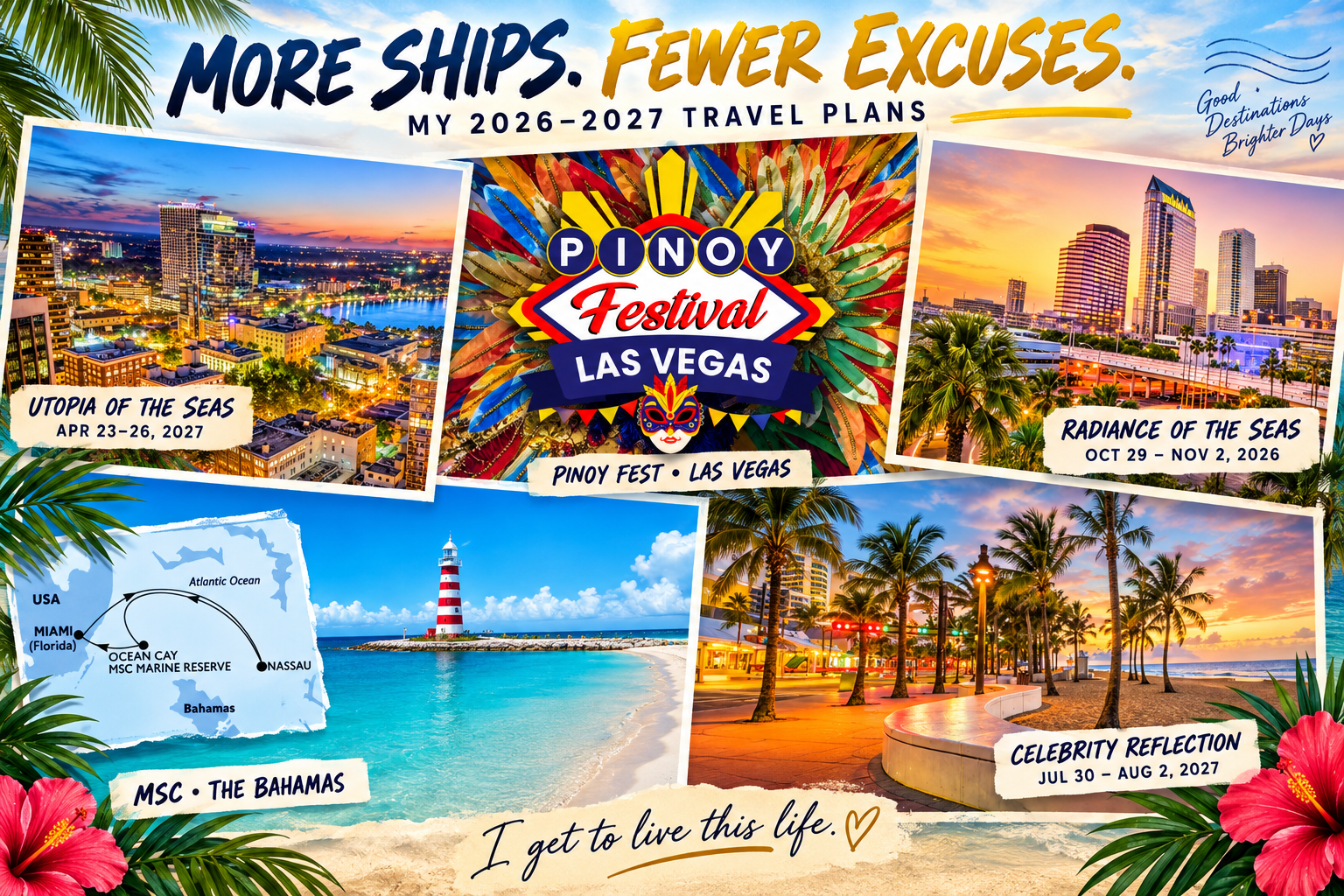
More Ships, Fewer Excuses: My Travel Plans for Late 2026 and 2027
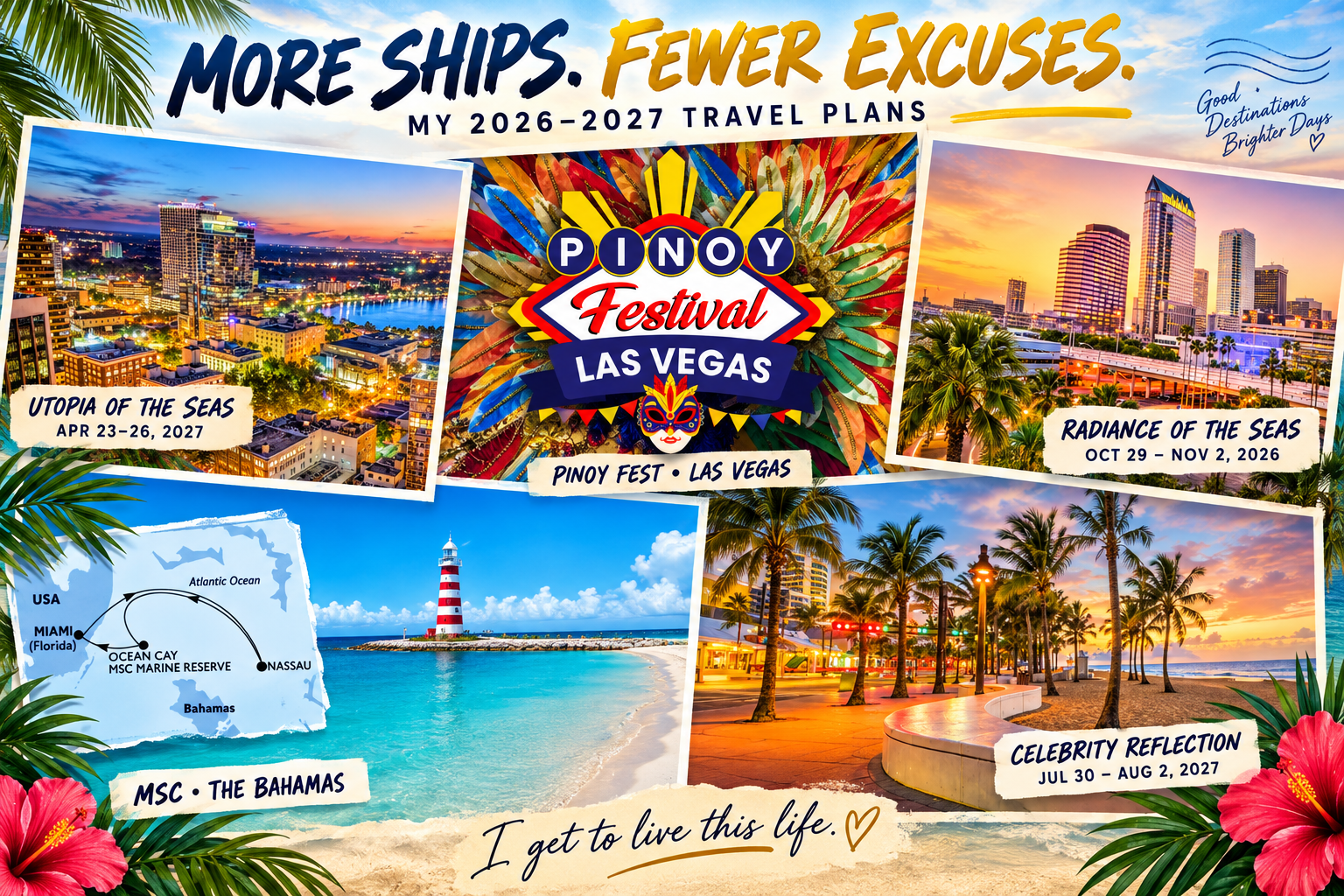
My calendar is starting to look like I’m avoiding being home. I kinda am.
There’s Las Vegas. There’s Cozumel on Halloween. There’s a fraternity alumni holiday gathering with a name that covers several celebrations at once. And there are cruises, because apparently my preferred way to unpack once is to have the entire hotel move.
I get to live this life—the only one I have—and I’m putting a few more things on the calendar worth looking forward to.
First up: Las Vegas, with a Filipino accent

In early October, I have a Saturday ticket to Pinoy Fest in Las Vegas. I love the Filipino culture, the food, and the people, so this was an easy decision.
Just Saturday. I’m trying to show some restraint in this travel schedule.
Halloween in Cozumel
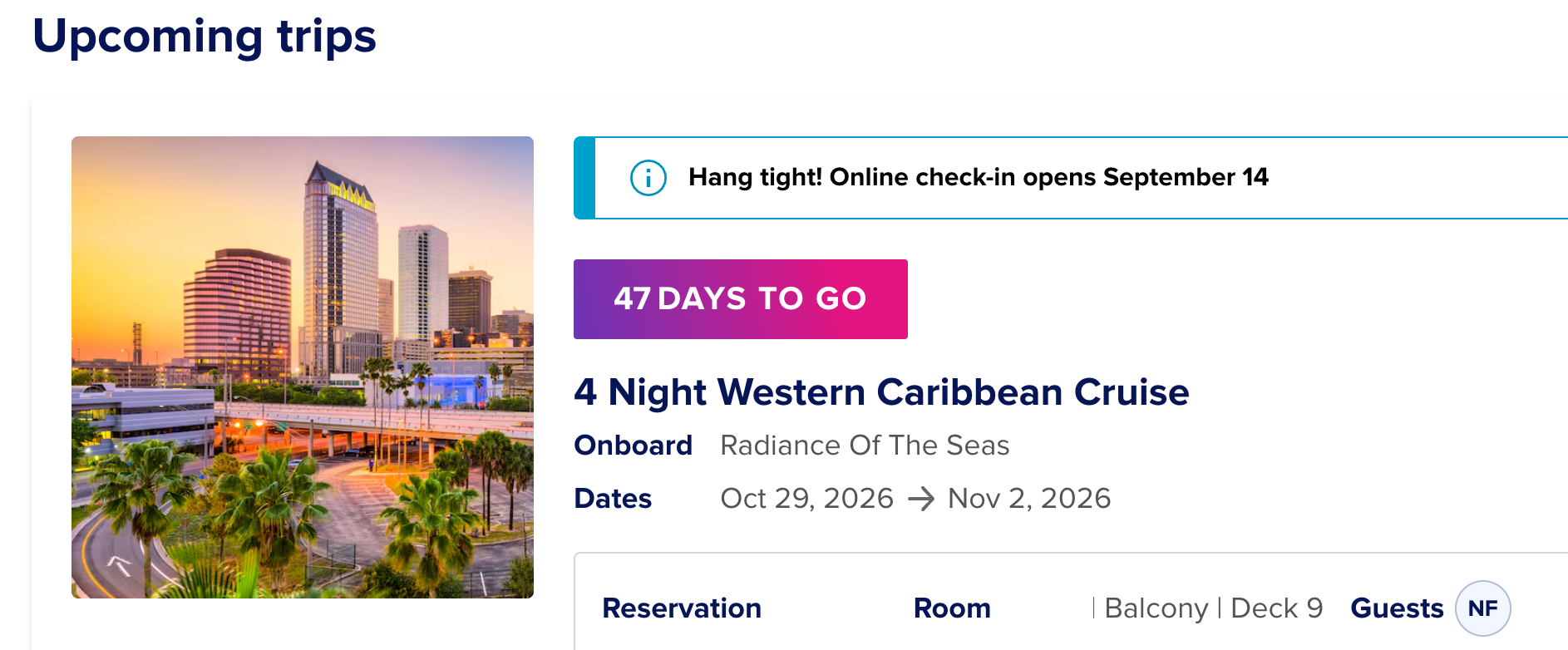
At the end of October, I’m sailing on Royal Caribbean’s Radiance of the Seas: leave Tampa, spend a day at sea, stop in Cozumel on Halloween, enjoy another day at sea, and return to Tampa.
I’ve taken a Halloween cruise before. It was interesting. On a cruise, you already spend some time wondering about people’s wardrobe decisions. Halloween adds the question, “Is that a costume, or just his vacation shirt?”
Radiance is a smaller, more classic ship, without all the newer attractions—the water slides, ice-skating rink, Johnny Rockets, and so on. That suits me. I don’t need every vacation to include an amusement park and a waiver.
A ship, the ocean, and time to enjoy both will do nicely.
ChrisKwanukah and the $30 pancake
December 13, 2026, is the Tau Epsilon Phi, Phi Chi Alumni Club ChrisKwanukah event.
I went last year, flying into HPN, where a bit of snow wreaked havoc. Somewhere in that experience, I ended up with a $30 pancake and Diet Pepsi.
For that price, I felt the pancake should at least have helped with my luggage.
Still, I’m planning to return. Seeing people matters. Shared history matters. Apparently, I’m also willing to give winter air travel another opportunity to test my personality.
Trying MSC in January 2027
In early January, I’m taking an MSC cruise from Miami to the Bahamas. MSC will be new to me.
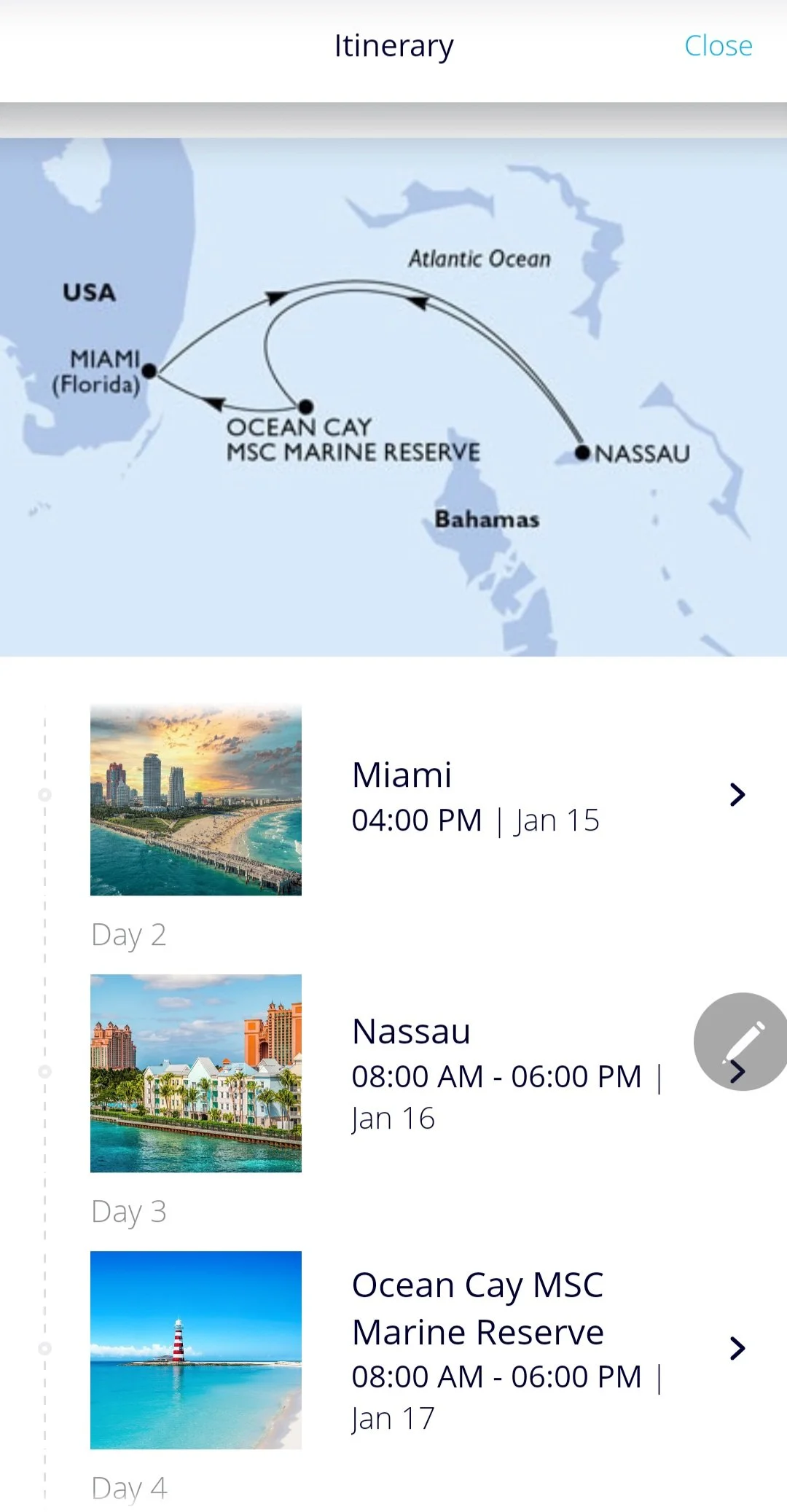
I’ve read the good reviews and the bad ones. The ships are supposed to be beautiful, while the food and service can apparently be hit or miss. I’m going with an open mind and will form my own opinion.
Reading cruise reviews is its own voyage. Two people can get off the same ship convinced they visited entirely different planets.
Utopia, with a road trip attached
There’s also the three-day Royal Caribbean trip on Utopia of the Seas from Port Canaveral that I’ve written about before.
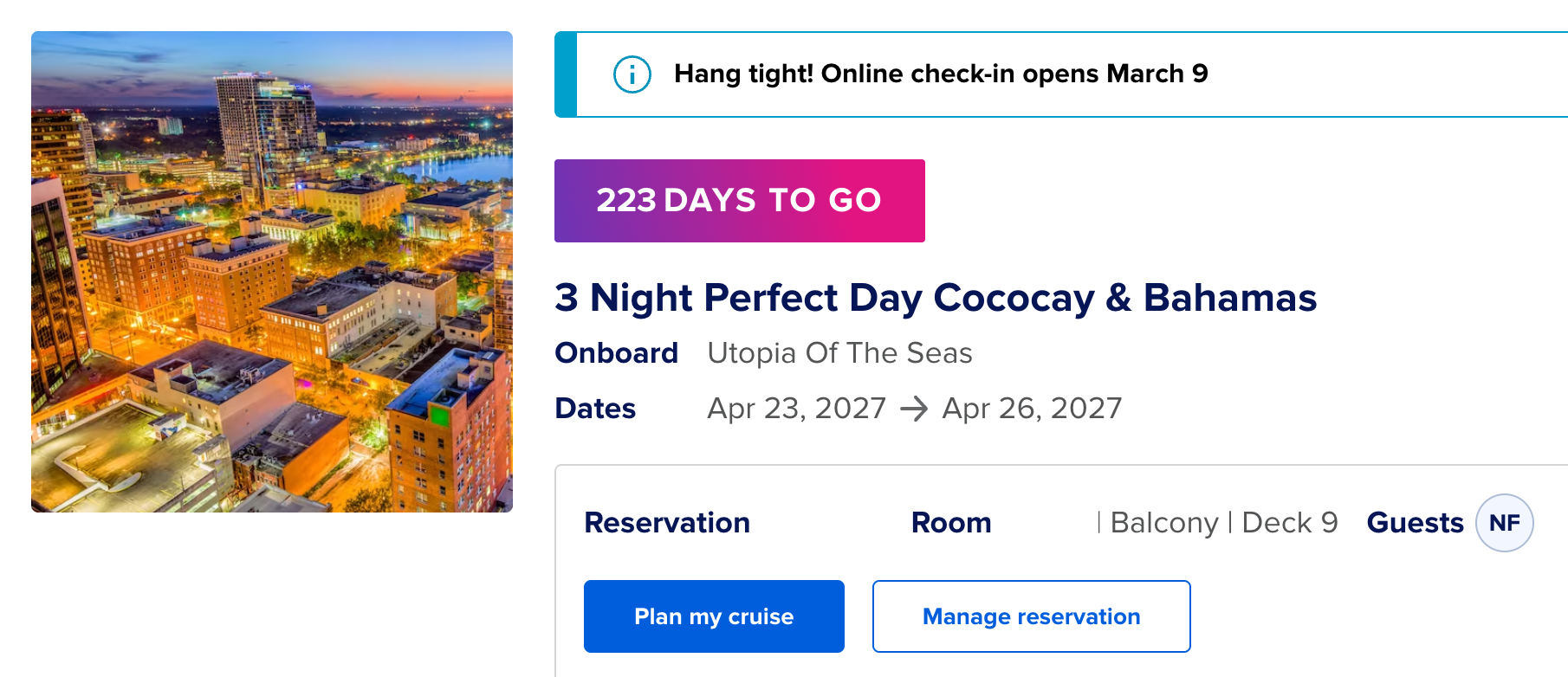
I plan to drive to that port. Put the bags in the car, get myself there, and board the ship. That’s a travel day I can appreciate.
My car hasn't charged me extra for a suitcase yet.
Yesterday’s booking: back to Celebrity Reflection
Yesterday, I booked Celebrity Reflection for July 30 through August 2, 2027—a three-night Key West and Bahamas cruise, with a balcony on Deck 10.
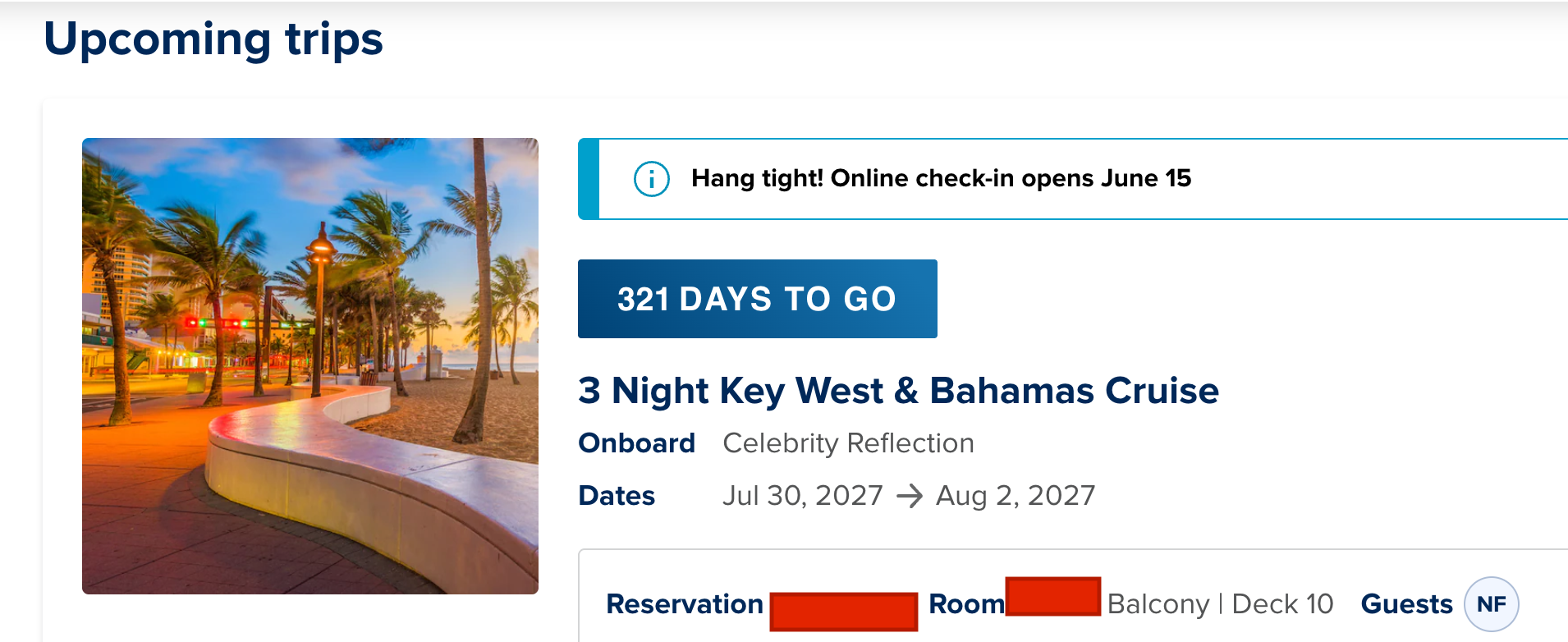
I’ve been on this ship twice, stopping in Key West both times. I’d also visited Key West twice before those sailings, so we’re reasonably well acquainted.
This trip includes Grand Bahama, and I have absolutely no intention of getting off the ship.
I like the ship. I liked the staff on my last two voyages. I liked the experience. That’s enough reason to go back.
I'm not required to turn every port stop into a field trip. Sometimes the destination is the balcony I already paid for.
If anyone needs me, I’ll be conducting a thorough inspection of the ocean from a seated position.
Yes, there’s room for a future ex-wife
There is a spot for a future ex-wife. A sense of humor would be helpful, along with an appreciation for cruising and my occasional decision to visit a country without actually stepping onto it.
Passport not required for eligible U.S. citizens on qualifying round-trip U.S. cruises; a certified birth certificate and valid government-issued photo ID can do the job. We’ll check the specific sailing’s requirements before packing. Romance is one thing; being denied boarding is another. Celebrity’s travel-document requirements
Let’s start with a cruise and see whether we can agree on dinner before involving attorneys.
Why I’m doing all this
I was told that a lot of amputees and dialysis patients end up sitting around and disengaging from life. I know what withdrawing feels like because I did it myself.
Everyone’s circumstances are different. I can only speak for mine: I decided I wanted to take some risks and enjoy more of the little part of the universe I get to occupy.
Being an amputee and being on dialysis are parts of my life. Travel takes planning. Some things require more effort. But I still want experiences, people to meet, familiar faces to see, and stories to bring home.
Even if one of those stories involves a financially ambitious pancake.
I get to live this life. I want to be present for it—with a few boarding passes, some Filipino food, Halloween in Cozumel, and a balcony waiting somewhere ahead.

Day 90: What If Nextdoor Is Trying to Serve Too Many Customers at Once?

Day 90.
Ninety consecutive days of looking at Nextdoor from different angles.
Yesterday, NXDR closed at $2.27. That's up from the $2.23 close I discussed on Day 88, but I'm not going to spend Day 90 dissecting four cents.
Instead, I want to ask a completely different question:
Who exactly is Nextdoor's customer?
Sounds simple.
I'm not sure it is.
Meet the Nextdoor Family
Think about all the different people Nextdoor is trying to satisfy.
There's the neighbor who wants to know why three police cars just went down the street.
There's the small-business owner who wants customers.
There's the advertiser who wants access to those neighbors.
There's the moderator trying to keep everyone from digitally strangling each other over political signs and dog poop.
There's the researcher or marketer interested in Nextdoor's Insights.
There's the shareholder—hello!—who wants the company to create sustainable value.
And then there's Nextdoor itself, which has to somehow turn this entire neighborhood block party into a profitable business.
That's a lot of people sitting at one table.
And they don't necessarily want the same meal.
The Neighbor Doesn't Wake Up Thinking About Monetization
I doubt many people roll out of bed thinking:
“I hope Nextdoor improves its advertising yield today.”
Neighbors want utility.
What's happening?
Who can fix my air conditioner?
Did somebody find my dog?
Why is the power out?
Is that restaurant any good?
What's being built down the street?
And, naturally:
“Did anyone else hear that boom?”
That's the product from the neighbor's perspective.
But there's a problem.
The neighbor may be the person using the product...
without being the person primarily paying for it.
That's where things get interesting.
The Advertiser Wants Something Completely Different
The advertiser doesn't necessarily care whether Karen and Steve finally resolve their six-day dispute over Steve's garbage cans.
The advertiser wants:
Attention.
Preferably local attention.
And preferably attention from people likely to buy something.
That creates a balancing act.
Nextdoor needs enough people using the platform to make the audience valuable to advertisers.
But if monetizing that audience makes the experience less useful, those people may use Nextdoor less.
And then the audience becomes less valuable.
Welcome to the social-media hamster wheel.
Then Along Comes the Small Business
This is where Nextdoor has another interesting relationship.
The local business can simultaneously be:
Content creator.
Advertiser.
Community participant.
Recommended business.
Potential paying customer.
That's a lot of hats.
Nextdoor wants neighbors to recommend local businesses organically because those recommendations build trust and create useful content.
But Nextdoor also needs to make money from businesses.
That's not inherently wrong.
Nextdoor is a public company, not a neighborhood charity.
The interesting question is where the line sits between:
Helping local businesses participate
and
Monetizing their need to reach neighbors.
That's a strategic question worth watching.
And Then There Are Shareholders
This is the group I belong to.
I don't need Nextdoor to be free of advertising.
I want revenue growth.
I want profitability.
I want innovation.
I want management making intelligent investments.
And yes...
I want NXDR worth more than $2.27.
But here's the catch.
If Nextdoor squeezes too much money out of the platform and damages the neighbor experience, that isn't necessarily good for shareholders long-term.
If Nextdoor focuses exclusively on making neighbors happy but can't build a profitable business around them, that's not particularly helpful either.
The interests are connected.
Maybe Nextdoor Isn't One Product
This is the thought that really interests me on Day 90.
Maybe we're evaluating Nextdoor incorrectly by thinking of it as one product.
It may actually be several products sharing the same neighborhood.
To the neighbor, Nextdoor sells connection and information.
To the local business, it sells visibility and potential customers.
To the advertiser, it sells access and attention.
To researchers and marketers, it offers neighborhood insights.
And to shareholders, management is ultimately selling something else:
The promise that all of those pieces can become a valuable business.
That's a difficult puzzle.
Imagine Trying to Run This Restaurant
Imagine opening a restaurant where one customer wants steak.
Another wants vegan.
Another wants breakfast.
Another wants cocktails.
Another wants everything free.
And there's a shareholder standing near the kitchen asking why the margins aren't better.
Hi. I'm the guy near the kitchen.
Meanwhile, the chef is doing podcasts explaining the future of restaurants.
At some point somebody has to decide:
What's our signature dish?
That's what I'm asking about Nextdoor.
What Is the One Thing Nextdoor Must Be Exceptional At?
Not 17 things.
One.
Is Nextdoor primarily:
The place to discover what's happening nearby?
The place to connect with neighbors?
The place to discover trusted local businesses?
A hyperlocal advertising platform?
A neighborhood recommendation engine?
A source of uniquely valuable local data?
Maybe it can eventually be all of those things.
But companies usually become indispensable because they're exceptionally good at something.
Then they expand.
And That Brings Me Back to $2.27
NXDR closed yesterday at $2.27.
Four cents higher than the $2.23 close I discussed earlier this week.
Good.
As a shareholder, I'll happily take the four cents.
But Day 90 isn't about whether the stock moved four cents.
It's about what eventually moves it forty cents, a dollar, or several dollars—and keeps it there.
That requires more than announcements.
It requires a business people understand.
A product neighbors value.
An ecosystem businesses value.
An audience advertisers value.
And a strategy shareholders believe will eventually create sustainable returns.
That's a lot of customers to keep happy.
Day 90: Who Gets the Best Seat at the Table?
So after 90 days, here's today's question:
When the interests of neighbors, businesses, advertisers, and shareholders collide, who comes first?
Because saying everyone comes first sounds wonderful.
Until two of them want completely different things.
That's when corporate strategy stops being a mission statement and becomes a decision.
And those decisions may ultimately tell us far more about Nextdoor's future than whether NXDR closed yesterday at $2.27 or $2.23.
Ninety days down.
And somehow, I still haven't run out of doors to open.
Follow my continuing Nextdoor case study at NielFlamm.com/blog.