
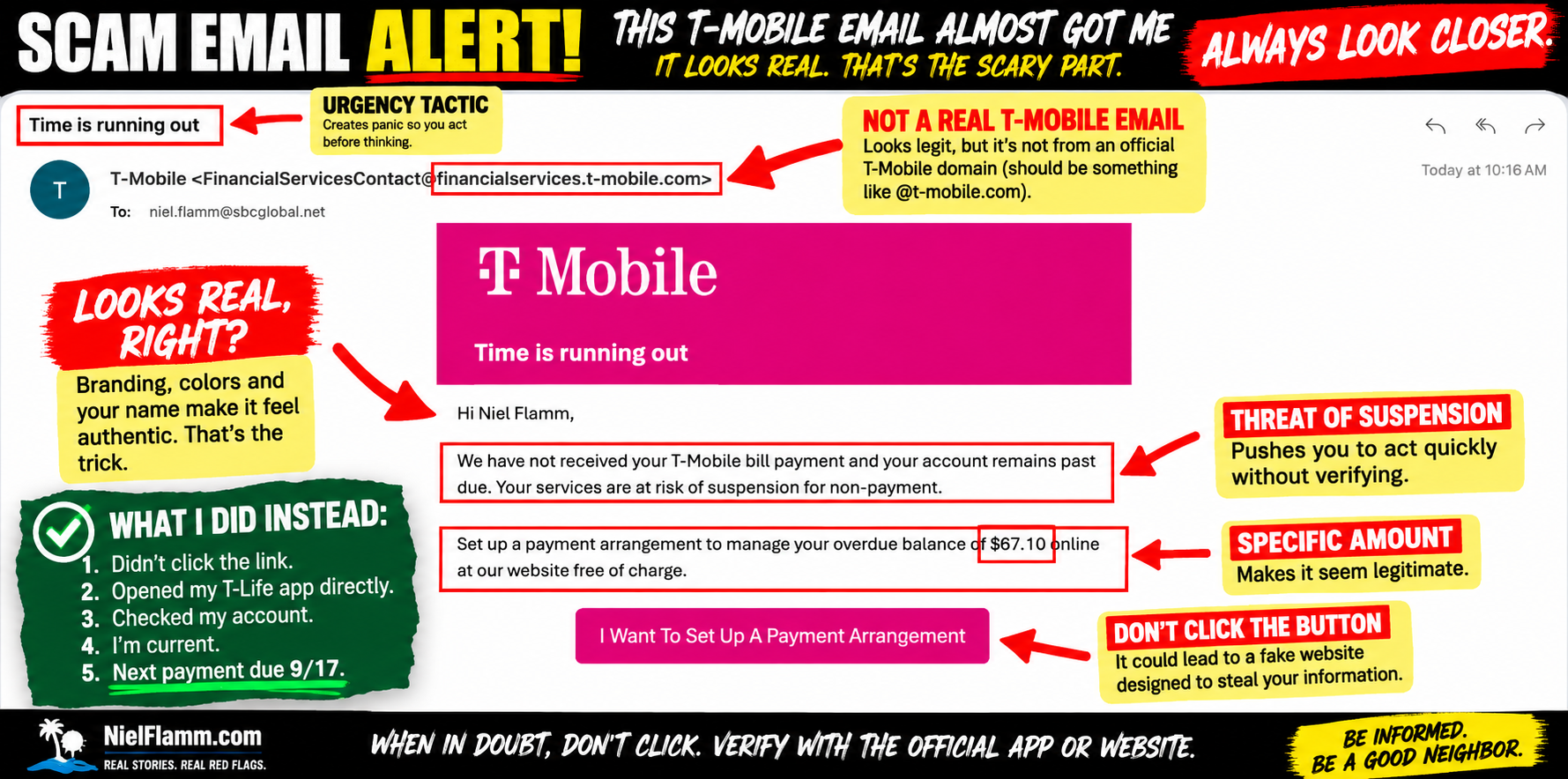
This T-Mobile Email Almost Got Me — And That’s What Makes It Good
I get enough scam emails that most of them don't survive more than a few seconds before getting mentally tossed into the garbage.
Bad grammar.
Random Gmail address.
Mystery attachment.
A $700 charge for something I never bought.
Somebody telling me I won a prize I never entered to win.
Easy.
This one was different.
This one almost got me.
And that is exactly why I'm writing about it.
📱 It Looked Like T-Mobile
The subject line was:
“Time is running out”
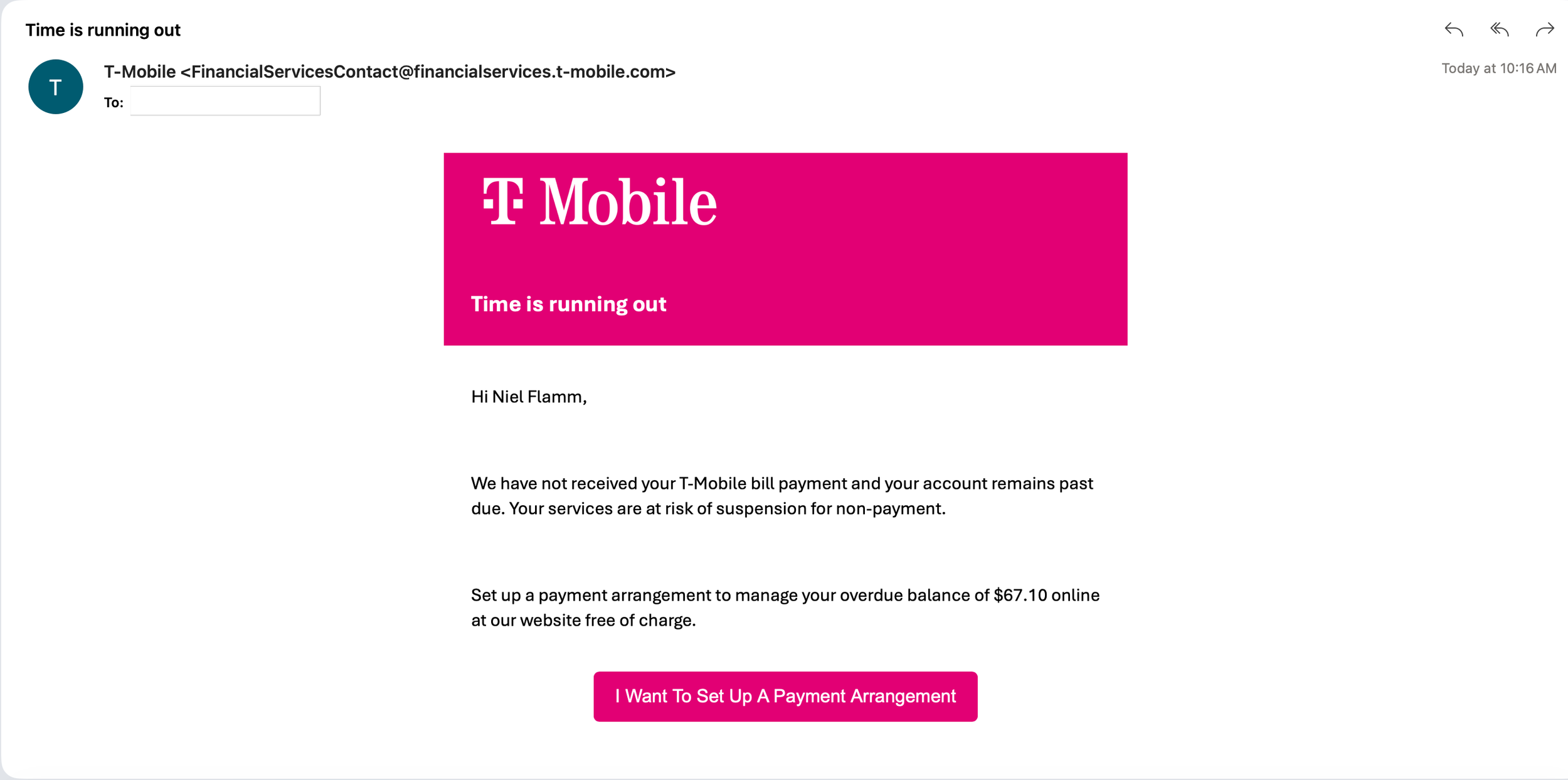
The email had the familiar magenta T-Mobile branding, addressed me by name, and told me:
“We have not received your T-Mobile bill payment and your account remains past due.”
It even gave me a specific overdue balance:
$67.10
Then came the threat:
My service was at risk of suspension for non-payment.
And conveniently, right underneath was a big magenta button:
“I Want To Set Up A Payment Arrangement”
That's a pretty effective combination.
Recognizable company.
My name.
Specific dollar amount.
Urgency.
Threat of losing service.
And an immediate solution.
For a moment I thought:
Wait... did I miss my T-Mobile payment?
🚩 Then I Looked Closer
The email looked fairly legitimate.
Fairly.
Then I looked at the sender:
FinancialServicesContact@financialservices.t-mobile.com
At first glance, that's pretty convincing.
There's “T-Mobile” right there in the address.
But an email address that looks legitimate isn't enough for me anymore.
And more importantly, I realized I was about to make the mistake these emails are designed to encourage:
I was using the email to determine whether the email was legitimate.
So I stopped.
I didn't use the button.
I didn't follow its instructions.
I went somewhere I already trusted.
📲 I Opened the T-Life App
This was the easiest test of all.
Instead of clicking the payment-arrangement button, I opened my T-Life app independently and checked my actual account.
Guess what?
I'm current.
My account isn't showing the overdue situation described in the email.
My next payment isn't due until September 17.
Well, that's awkward.
Apparently, my T-Mobile account forgot to tell T-Mobile that my T-Mobile account is fine.
😂
🚨 This Is the Kind of Message That Concerns Me
The ridiculous scams aren't necessarily the ones I'm most worried about.
It's these.
The ones that are close enough.
The branding looks right.
The formatting looks professional.
The amount is believable.
The situation is plausible.
And the sender information looks convincing enough that you might not examine it carefully.
Then they add urgency:
TIME IS RUNNING OUT
Your service might be suspended.
You owe money.
Fix it now.
And here's a convenient button.
That urgency matters because it pushes you to act before you independently verify the claim.
🔍 The Best Scam Detector Wasn't the Email
Here's the lesson I'll take from this one.
I didn't need to determine whether every graphic was authentic.
I didn't need to inspect HTML.
I didn't need to click the button to see where it went.
And I didn't need to contact whoever sent the message.
I went straight to the account the email was supposedly about.
My actual T-Mobile account told the story.
That's an incredibly simple habit:
If your bank emails you about a problem, open your banking app yourself.
If Amazon says there's an order, open Amazon yourself.
If PayPal says somebody charged you, open PayPal yourself.
If your wireless carrier says you're past due, open your carrier's app yourself.
Don't use the suspicious message to get there.
🧠 And Yes, This One Almost Worked
I think that's worth admitting.
People sometimes talk about scams as though only gullible or technologically inexperienced people fall for them.
That's dangerous thinking.
I spend a ridiculous amount of time looking at these things.
I've written about scam emails.
Recruiting scams.
Mystery attachments.
Fake subscription charges.
Questionable car advertisements.
And this email still made me stop and think:
“Wait... am I past due?”
That's what good social engineering does.
It doesn't necessarily make you believe something ridiculous.
It gives you something believable enough that you react before you think.
Fortunately, this time I thought.
Then I checked.
🏡 Be a Good Neighbor
If you have a parent, friend, coworker, or neighbor who might receive something like this, show them this simple trick:
Don't click the button.
Open the company's app or type the company's known website yourself.
Check the account independently.
A 30-second verification could prevent a much bigger headache.
And if you're ever tempted to think:
“I'd never fall for something like that.”
Neither did I.
But this one got close.
Very close.
That's why I'm sharing it.
Follow along at NielFlamm.com/blog for more scam investigations, suspicious emails and the occasional message that makes even me look twice.

Day 99: A Stock Ticker Measures More Than Numbers

Day 99.
Tomorrow, this Nextdoor journey officially enters triple digits.
Another email requesting the detailed Insights studies is coming, but today I want to look at something completely different: leadership reputation and shareholder confidence.
I recently saw a reel discussing how a stock isn't influenced only by revenue, earnings, and a balance sheet. Investors also evaluate management, governance, credibility and the risks surrounding the people running a company.
That reminded me of Dan Bilzerian and Ignite International Brands.
Former Ignite executive Curtis Heffernan sued after his 2020 termination, alleging he was fired after refusing to approve substantial expenses he believed were personal expenses being charged to the company. Bilzerian disputed that account and said Heffernan was terminated for negligence and incompetence. The dispute eventually reached the California Court of Appeal. Bloomberg
And the story didn't end there.
Later litigation involving Ignite became even more complicated. In 2024, federal prosecutors charged Dan's father, Paul Bilzerian, and others in a case involving Ignite. Prosecutors alleged Paul secretly exercised significant control over the company while concealing that role. Those are government allegations, not something I'm presenting as independently proven here. Paul had previously been convicted of securities fraud in 1989. Department of Justice
Court records also show that Dan was removed as Ignite's CEO in 2023 after internal disputes, including concerns about his impact on the brand. Justia Law
Why Am I Talking About This on Day 99?
Not because Nextdoor is Ignite.
It isn't.
And I'm certainly not suggesting Nirav Tolia has done anything resembling what was alleged in the Ignite cases.
My takeaway is much simpler:
Leadership becomes part of a company's asset—or liability—whether the balance sheet lists it or not.
A CEO's reputation matters.
How leadership communicates matters.
How criticism is handled matters.
How shareholders are treated matters.
Whether questions receive answers matters.
And when leadership becomes closely identified with the company itself, the distinction between corporate reputation and executive reputation can become increasingly difficult for investors, customers, and the public to separate.
That's something I think about as a Nextdoor shareholder.
I've spent 99 days asking for studies that Nextdoor publicly said readers could request.
Tomorrow we hit 100.
At that point, the unanswered question isn't only about the studies anymore.
It's also about what 100 days of an unresolved request says about communication, ownership, and leadership.
See you in the triple digits.
👉 NielFlamm.com/blog
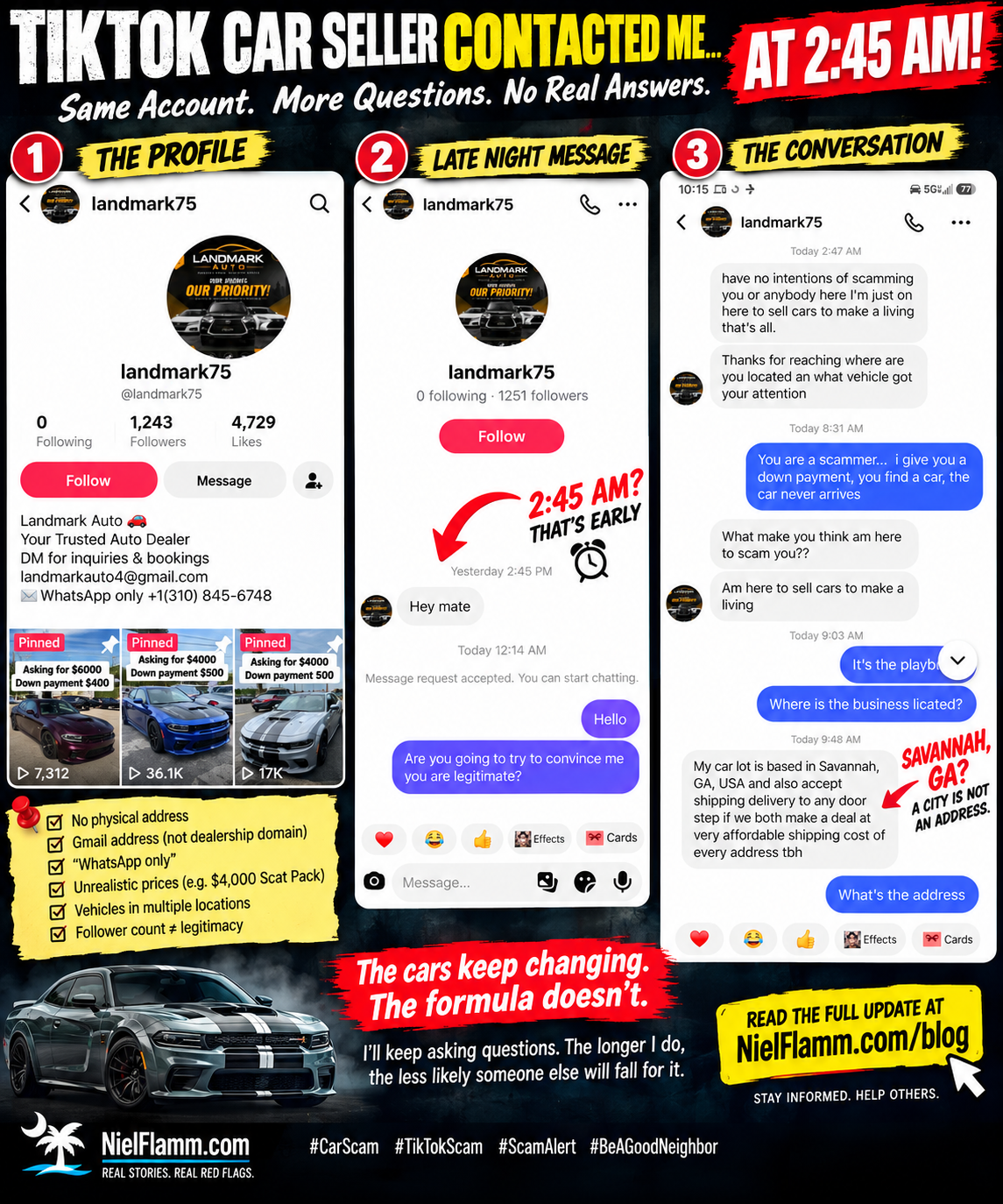
Update: The $4,000 Scat Pack Seller Messaged Me—At 2:45 in the Morning
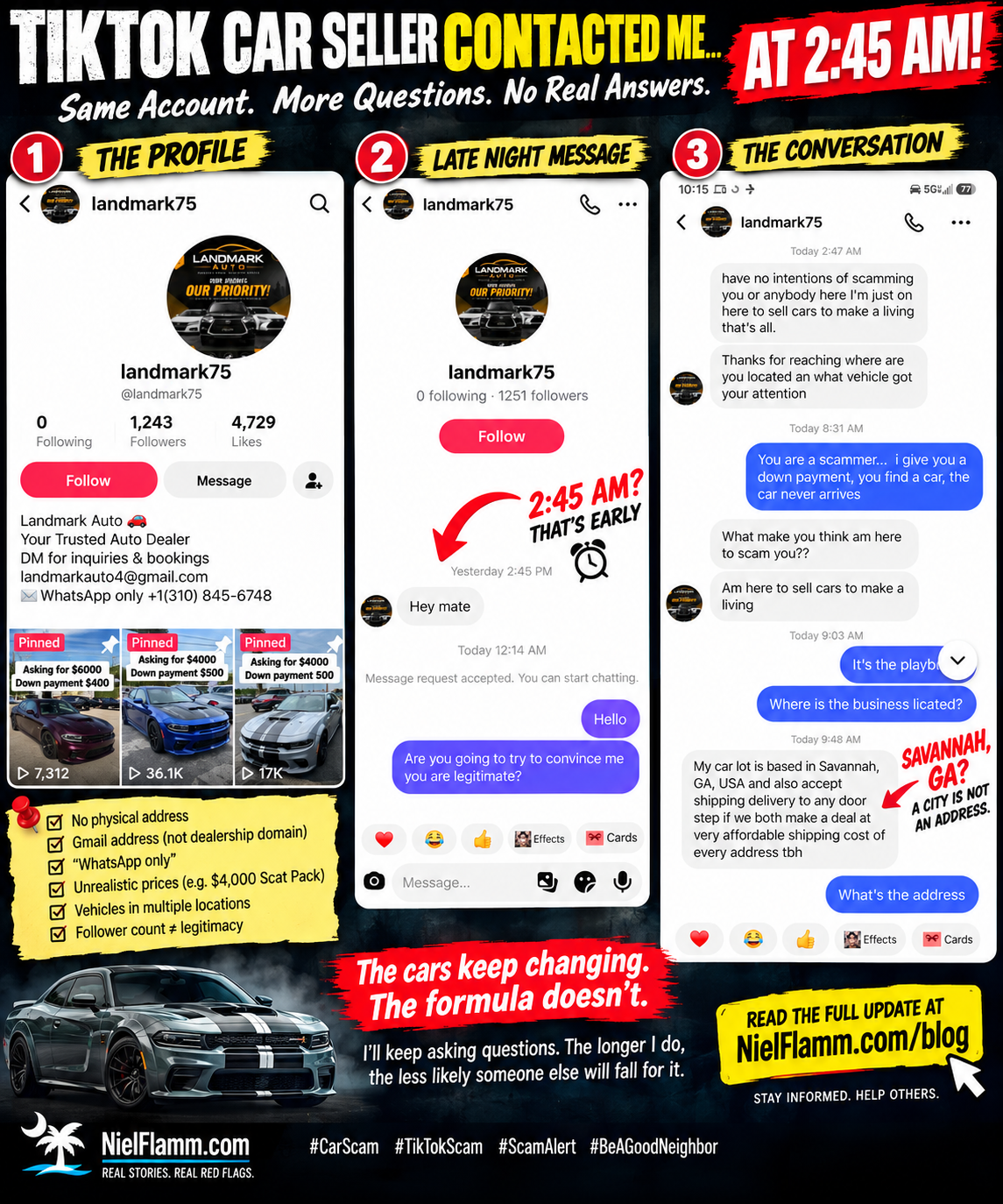
Well, this story just became interactive.
In my last post, I looked at the TikTok account landmark75, which describes itself as “Landmark Auto” and advertises vehicles at prices and down payments that immediately raised questions—including a purported 2021 Dodge Scat Pack with 45,000 miles for $4,000 and $500 down.
Now the account has contacted me directly.
And apparently, dealership hours start at 2:45 AM.
🌙 “Hey mate”
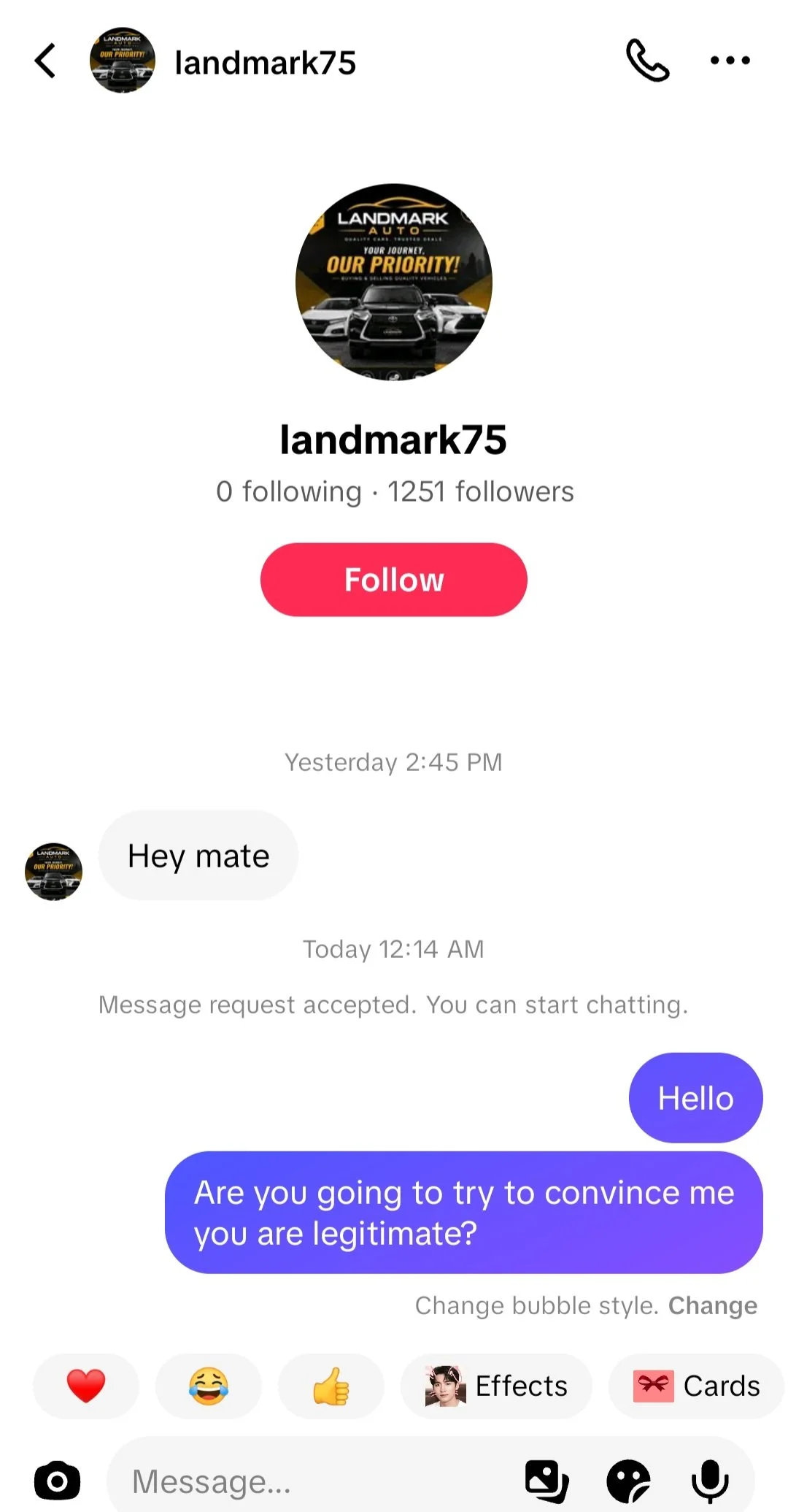
The first message arrived at 2:45 AM:
“Hey mate”
I eventually accepted the message request and didn't exactly hide my skepticism.
I asked:
“Are you going to try to convince me you are legitimate?”
The response came at 2:47 AM:
“have no intentions of scamming you or anybody here I'm just on here to sell cars to make a living that's all.”
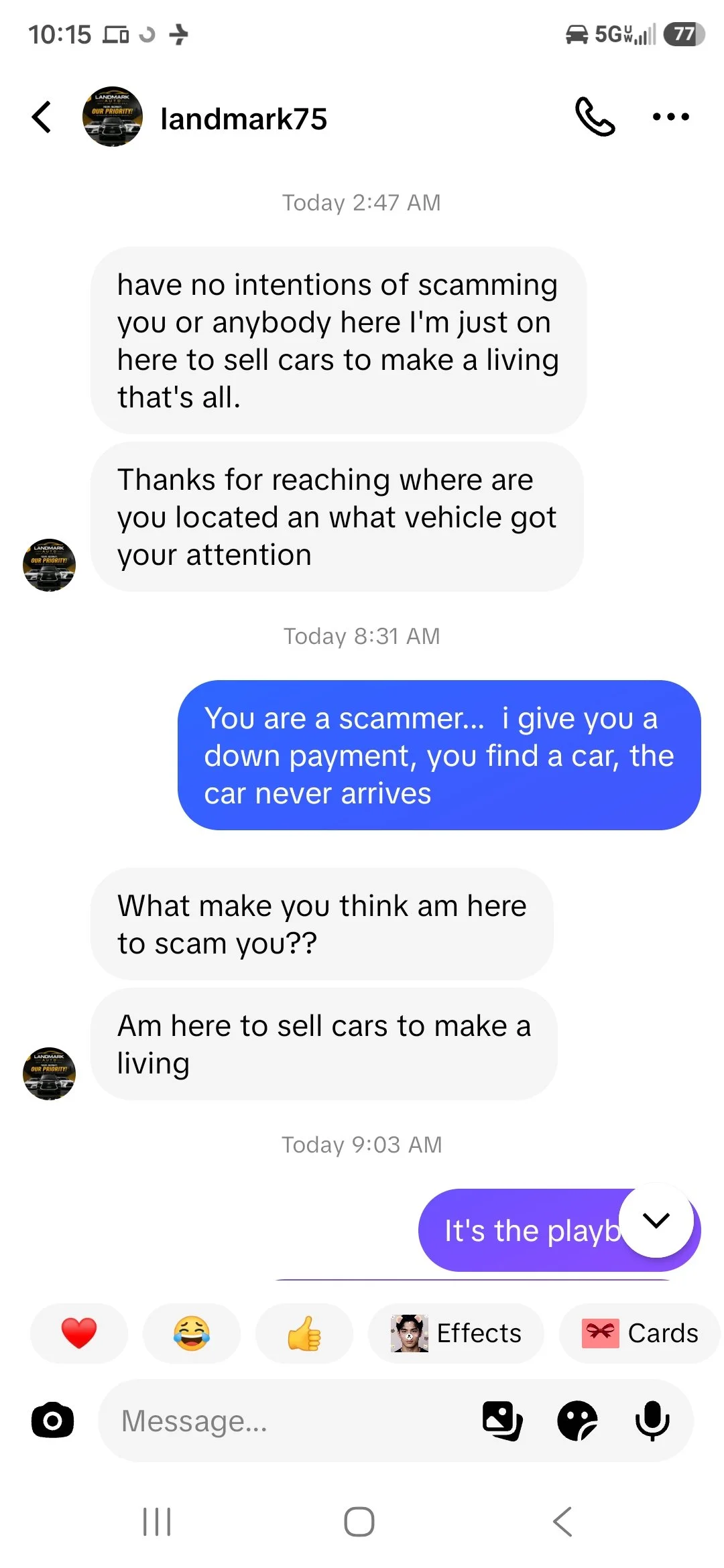
They then asked where I was located and which vehicle caught my attention.
Fair enough.
Except I wasn't shopping.
I was investigating.
🚩 I Asked Direct Questions. I Wanted Direct Answers.
I told the account why I was skeptical.
Their response was essentially: What makes you think I'm here to scam you? I'm here to sell cars and make a living.
But that's not really the question I need answered.
I don't need someone to tell me they're legitimate.
I need information that allows me to independently verify they're legitimate.
There's a big difference.
So I asked one of the simplest questions imaginable:
Where is the business located?
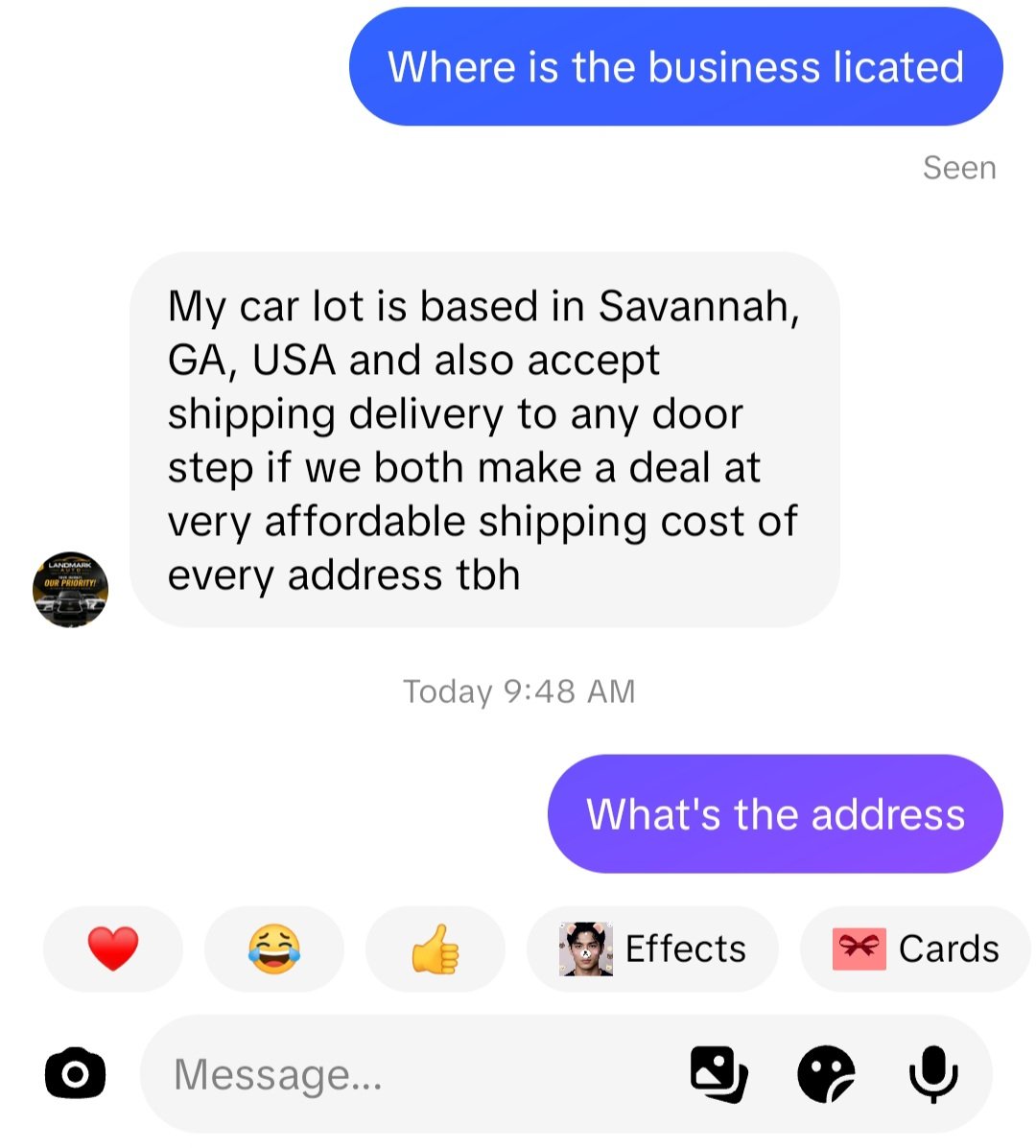
The answer:
“My car lot is based in Savannah, GA, USA and also accept shipping delivery to any door step if we both make a deal at very affordable shipping cost…”
Okay.
Savannah, Georgia.
That's a city.
It's not an address.
So I followed up with an even simpler question:
“What's the address?”
That's where the screenshots currently end.
🔎 I Tried Independently Verifying It
I also searched publicly available sources for the business information displayed on the TikTok profile.
The profile previously showed a Gmail address and a 310-area-code WhatsApp number, while the person messaging me now says the car lot is based in Savannah, Georgia.
My searches did turn up several legitimate businesses around the country using variations of the name “Landmark Auto,” but I did not find a Savannah used-car dealership in the local-business results that clearly matched this TikTok account, its displayed contact information, and the Savannah claim. Instead, search results surfaced unrelated Landmark businesses and other established Savannah used-car dealers with publicly listed street addresses. Landmark Auto Sales
That doesn't by itself prove the TikTok account is fraudulent.
But it certainly doesn't answer my question either.
One public phone-directory result also associates the 310-845 number block containing the number displayed on the TikTok profile with Culver City, California—not Savannah. Phone numbers can be retained, ported, and used remotely, so that isn't proof of anything by itself. It's simply another detail I'd want explained before sending money. Stan at Work
🚩 This Is Why “What's the Address?” Matters
If you're operating a physical car lot, an exact street address shouldn't be hard to provide.
In fact, a legitimate dealership normally wants customers to know where it is.
I should be able to independently look up that address and determine:
Does the dealership exist?
Is the business registered there?
Is it licensed to sell vehicles?
Does the business name match?
Does the phone number match?
Do the vehicles shown online actually belong to that dealership?
Can I physically inspect the car?
Can I call a publicly listed number instead of communicating only through TikTok or WhatsApp?
Those are ordinary due-diligence questions.
I'm not asking for the Coca-Cola recipe.
I'm asking where the car lot is.
🚩 The Conversation Is More Interesting Than the Sales Pitch
Something else stands out.
The account initiated this conversation with me.
They've continued responding even after I openly told them I believe the operation follows a familiar scam playbook.
That's useful.
Because every additional answer gives me something else I can potentially check independently.
If I get an address, I'll check it.
If I get a dealership name, I'll check it.
If I get a dealer-license number, I'll check it.
If I get a VIN for that $4,000 Scat Pack, I'll check it.
And if I get asked to send a deposit before I'm allowed to independently verify those things?
Well...
That'll be interesting too.
🧠 “Trust Me” Isn't Verification
This is one of the bigger lessons from this entire series.
Someone saying:
“I have no intention of scamming you.”
doesn't establish legitimacy.
Neither does:
“I'm just here to sell cars to make a living.”
Those statements might be completely sincere.
But legitimate businesses don't need customers to rely exclusively on sincerity.
They can provide independently verifiable information.
Business name.
Street address.
Dealer license.
VIN.
Title information.
Written purchase agreement.
Financing disclosures.
Independently verifiable telephone number.
That's evidence.
⏰ I'll Keep the Conversation Going
I'll keep engaging with this account as long as the conversation remains useful and safe.
Not because I plan to buy a car.
And definitely not because I'm sending a down payment.
I'm interested in seeing where the conversation goes and documenting the process.
There's another reason.
Time spent answering my questions is time not spent moving someone else quickly toward a deposit.
I can't know whether my conversation actually prevents someone else from being targeted, so I won't pretend it does.
But if keeping the conversation going gives me more information to verify—and gives readers a better look at how these interactions develop—I'm willing to keep asking questions.
And my next one is already sitting there:
What's the address?
A city isn't an address.
Let's see what comes next.
Follow the continuing story at NielFlamm.com/blog.
Lost in Translation—in the Best Possible Way
After uploading my vlog about Resident Evil 2026—which you should definitely check out—I decided to peek at the translation metrics for my website.
Honestly, I hadn’t checked the translation API in quite some time. Apparently, while I wasn’t paying attention, the internet was busy translating.
The numbers impressed me:
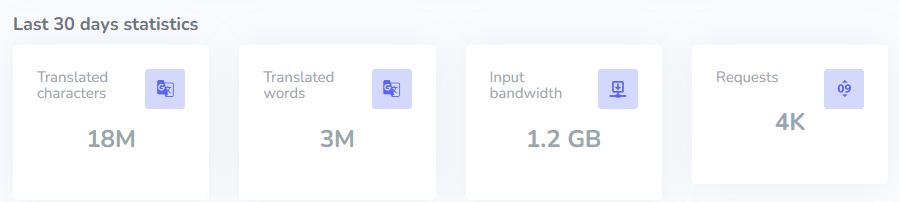
18 million characters translated
3 million words translated
4,000 translation requests
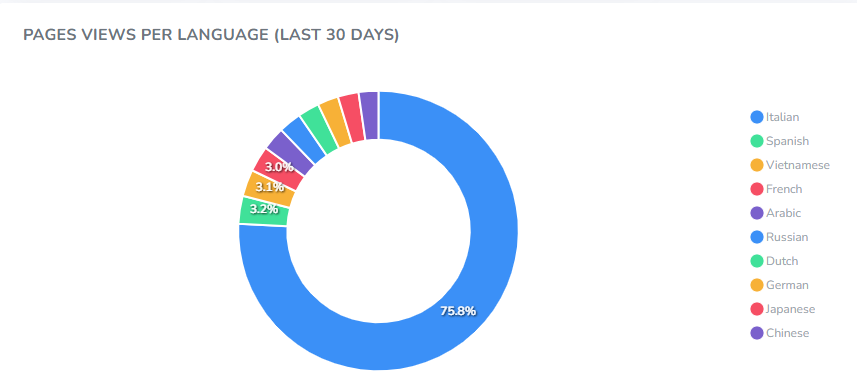
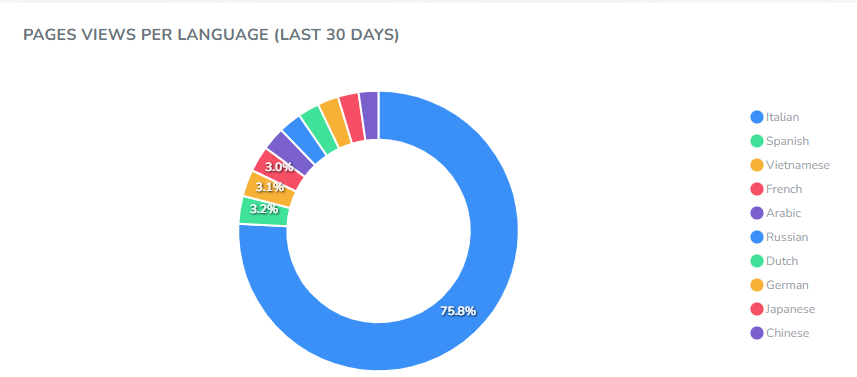
Italian generated the most page views by language, followed by Spanish and Vietnamese. Chinese came in last, which surprised me because China has previously been one of the top sources of traffic to my website.
Today, I added two more languages: Thai and Czech.
I added Thai because I hope to spend part of my remaining years living in Thailand. If I’m going to enjoy the beaches, food, culture, and hopefully a beachfront view, it seems only fair that Thai readers can enjoy my adventures—and occasional misadventures—in their own language.
Czech was also added because the more people who can read and watch my content, the better. My website is slowly becoming more multilingual than I am. I’m still working on English some days.
To everyone who has visited, read a blog post, watched a video, or translated my content: thank you.
These numbers may not break the internet, but they mean a great deal to me. I truly enjoy bringing this content to you and sharing the strange, funny, serious, and unexpected moments of my life.
Thank you for reading, watching, and joining me on the journey—wherever in the world you may be.

Resident Evil (2026): Bryan, Get a Clue!

I went into Resident Evil (2026) knowing almost nothing.
I had seen a few creepy trailers—including those arms coming out of the house and grabbing the door frame—and that was enough to get me into the theater.
Then my friend asked:
“Is this a remake of the movies based on the video game?”
My highly researched answer?
“I don't know.”
Afterward, I asked THE GOOGLE and learned this isn't simply a remake of the Milla Jovovich movies. There are familiar elements, including Raccoon City and the Umbrella Corporation, but this movie does its own thing.
And then there's BRYAN.
He's a medical courier. He's our hero. He's funny.
He also makes some decisions that had me wanting to yell:
“BRYAN! GET A CLUE!”
Throw in a snowstorm, a desolate city, a wandering woman, some seriously gross horror, and the consequences of people creating something they probably shouldn't have created...
And I had a pretty good time.
Did I need to know all the Resident Evil games and movies to enjoy it?
Nope.
I needed Bryan to make more thoughtful decisions.
🎬 Watch my full Resident Evil (2026) review: