

From Tau Epsilon Phi to Ska: My Fraternity Brother Goon Is Still Making Noise

I’ve forgotten some things from college.
Classes. Professors. What I was supposed to be studying. And probably more than a few nights that are better left in the 1980s.
But I haven’t forgotten my fraternity brothers.
Back at The City College of New York, I was a member of Tau Epsilon Phi, Phi Chi Chapter. Like any respectable fraternity, we had pledge names—and some were considerably more memorable than others.
One of my fraternity brothers received the distinguished, dignified, and undoubtedly well-deserved pledge name:
Alice the Goon.
I’ve always just called him Goon.
All these years later, Goon is still making noise—except now people actually want to hear it.
He’s part of The Phensic, a ska band.
And somehow, that seems completely appropriate.
If you had asked me back during my CCNY days what someone named Alice the Goon would be doing decades later, playing in a ska band probably would have made my Top 10.
Maybe even the Top 5.
If you’re into ska, check out The Phensic. And if you’re not familiar with ska, this might be a good excuse to discover something different.
You can listen to their music here:
One thing I appreciate more as I get older is looking back at the people I knew during those college years and seeing where life took us all.
We’re older.
Hopefully, we’re wiser.
The hair situation has definitely changed for some of us. In my case, I decided hair was apparently an unnecessary luxury.
But those fraternity memories and connections are still there.
So, from one Tau Epsilon Phi, Chi Chapter brother to another:
Keep making noise, Goon.
And if you like ska—or want to hear what one of my fraternity brothers has been up to—check out The Phensic!
The Power of Attorney Is Signed: Welcome to My Real-Life Version of The Traitors
Well, we have an update.
If you read my previous post about caring for my mother, money, control, and family boundaries, you know we’ve had some difficult conversations about what happens next.
My mother has made her wishes known. I’ve been working on making sure those wishes are heard and respected.
Now, there’s a new development:
I have a signed South Carolina Power of Attorney.
Yep.
The paperwork is signed.
The next step?
I need to give my father a copy.
And then we see what happens.
Previously, on NielFlamm.com...
In the last episode, my father and I had some very different views about my mother's money and how it should be used for her care.
When I asked about accessing information concerning money she had earned and saved, I heard:
“I’ll think about it.”
Later, I heard:
“Prove it.”
Well, I didn't exactly set out to turn this into a cliffhanger, but here we are.
The Power of Attorney is signed.
Now comes the part where I hand him a copy.
Cue dramatic music.
This Isn't 90 Day Fiancé
I've been trying to figure out exactly what kind of reality show my life has become.
It's definitely not 90 Day Fiancé.
Nobody is getting a rose, so The Bachelor is out.
I'm thinking we're getting closer to a real-life version of The Traitors.
We've got family.
We've got money.
We've got disagreements.
We've got questions about who controls what.
We've got people wondering what someone else will do next.
And we've got me standing in the middle of it thinking:
How did I get cast in this show?
Unfortunately, unlike reality television, nobody yells “CUT!” and sends everyone back to their trailers.
This is real life.
What Happens Next?
That's the interesting part.
I don't know.
I'm going to give my father Power of Attorney and see what happens next.
Maybe the document changes the conversation.
Maybe it doesn't.
Let’s move forward with figuring out my mother's finances and how her resources can support the care she wants.
Maybe we're headed for another episode.
Whatever happens, my objective remains the same: listen to my mother and advocate for what she wants.
The Power of Attorney isn't the finish line. It's another step in a much bigger process.
Stay Tuned
So that's today's update.
South Carolina Power of Attorney: signed.
Copy for Dad: next.
Dad's reaction: TBD.
And apparently, that's my teaser for the next episode.
Keep coming back to NielFlamm.com/blog because I have a feeling this story isn't finished.
Forget 90 Day Fiancé.
Forget The Bachelor.
Welcome to my real-life version of The Traitors.
Except there's no cash prize at the end.
Just family, paperwork, boundaries, and hopefully doing what's best for Mom.
Stay tuned.

They’re Back! Apparently I Paid $450 for Another Mystery Subscription
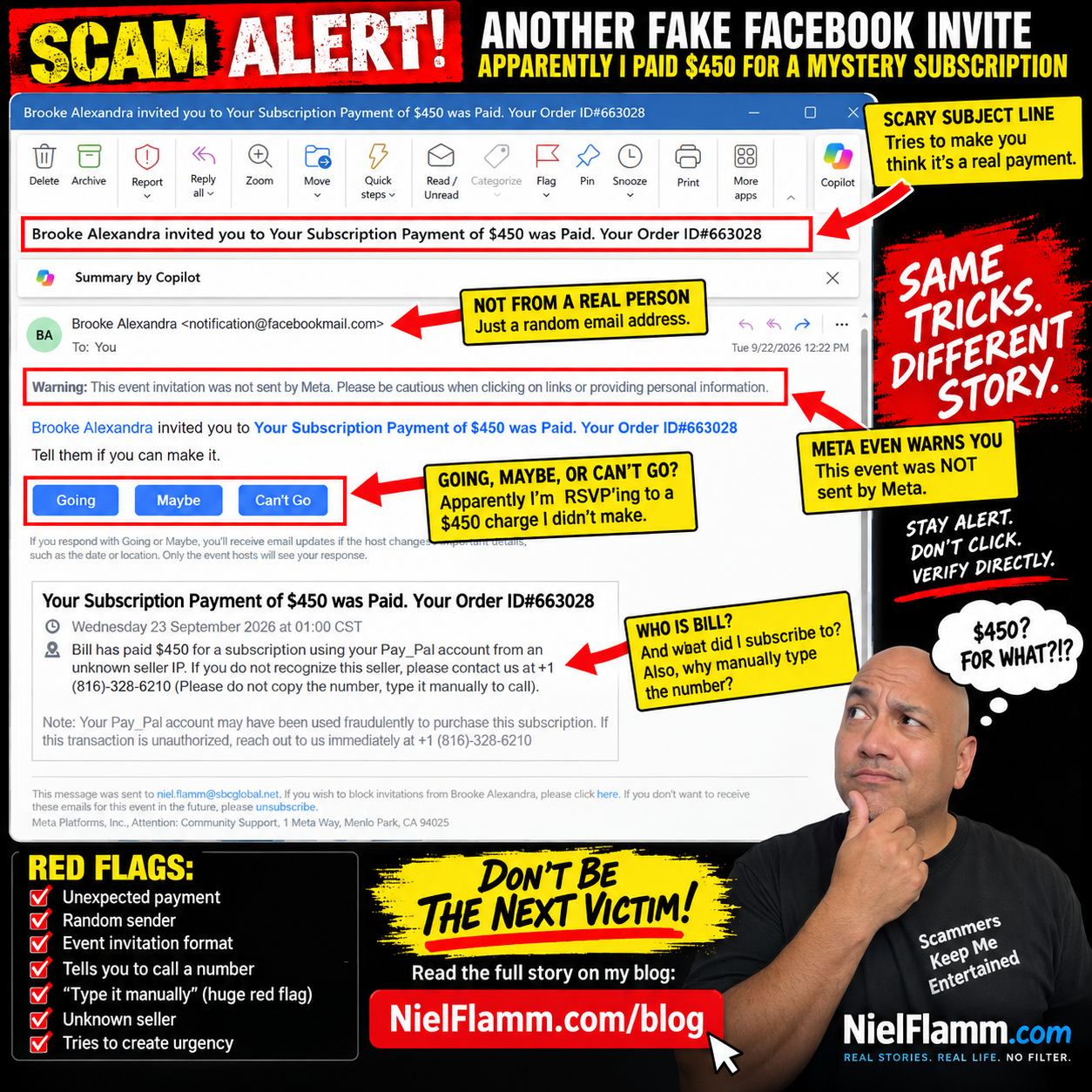
It’s been a little while, but apparently my scam social calendar is back in action.
For those who haven’t been following along, I’ve received some interesting emails over the past few months. According to my inbox, I’ve bought Bitcoin, renewed Geek Squad protection—more than once—and even had a watch repaired that I never sent anywhere.
Today, we return to an old favorite:
The Facebook Event Invitation Scam.
This time, “Brooke Alexandra” has invited me to an exciting event called:
“Your Subscription Payment of $450 was Paid. Your Order ID#663028”
Well, Brooke, thank you for the invitation.
Unfortunately, I have absolutely no idea what I supposedly subscribed to.
Going, Maybe, or Can’t Go?
My favorite part of these scams is still Facebook’s event format.
I’ve supposedly just discovered an unauthorized $450 PayPal transaction, and immediately underneath this alarming news, I’m asked:
Tell them if you can make it.
My choices?
Going.
Maybe.
Can’t Go.
Decisions, decisions.
I’m going with Can’t Go.
Not because I have another commitment. I try not to attend celebrations for fraudulent purchases.
Meet Bill, My Apparently Very Generous Alter Ego
The description gets even better.
It says:
“Bill has paid $450 for a subscription using your Pay_Pal account from an unknown seller IP.”
Who is Bill?
I have no idea.
Bill, please stop spending my imaginary money.
The message then provides a phone number and tells me to call if I don’t recognize the seller.
And then comes my favorite instruction:
“Please do not copy the number, type it manually to call.”
Oh, absolutely.
I'm not comfortable trusting a financial alert that asks me to type a phone number manually.
That’s practically the international symbol for:
“Nothing suspicious happening here!”
Meta Is Literally Warning Me
As with the previous versions, there’s an important message sitting prominently near the top:
“Warning: This event invitation was not sent by Meta. Please be cautious when clicking on links or providing personal information.”
That deserves more attention than the scary $450 headline.
The formula hasn’t changed much:
Create an alarming transaction.
Use a recognizable brand name like PayPal.
Please let me know if my account may have been compromised.
Give me a telephone number.
Please create urgency so I call before I stop to think.
And package everything inside a Facebook event invitation so the resulting notification looks more familiar.
The Scam Has One Big Problem
If my PayPal account really has a mysterious $450 transaction, I don’t need Brooke Alexandra—or Bill—to help me investigate it.
I can go directly to PayPal through its official app or website and check my account.
The same rule applies to suspicious emails claiming to come from a bank, credit card company, retailer, Geek Squad, or practically anyone else.
Don’t let the suspicious message tell you how to verify the suspicious message.
Verify it independently.
And don’t call a mystery number just because someone put “PayPal” next to it.
My Imaginary Spending Spree Continues
So let’s add another purchase to the growing list.
Bitcoin? ✔️
Mystery subscriptions? ✔️
Geek Squad? ✔️
Watch repair? ✔️
Another mystery $450 subscription? ✔️
At this point, the person living inside my spam folder has a considerably more exciting financial life than I do.
I’m just disappointed that after all this imaginary spending, nobody has emailed me to say I’ve purchased a beachfront condo in Thailand.
Scammers, if you’re reading this, at least make the next fake purchase interesting.
Have a Scam Story? Send It My Way
Now I want to hear what’s landing in your inbox.
If you’ve received a scam email, suspicious text, social media message, fake invoice, questionable refund notice, or something that made you think, “There is no way this is legitimate,” send it to me.
Please send me your screenshots and let me know what happened. I may feature some of them in future posts as we look at the creative—and sometimes hilariously bad—ways scammers try to separate people from their money.
Please remove or cover passwords, account numbers, addresses, phone numbers, or other sensitive personal information before sending screenshots.
Maybe it’s time to turn my scam collection into our scam collection.
And until then, Brooke...
Can’t Go.

My Nextdoor Petition Has One Signature. Mine. So…What Am I Missing?
Time for a little open-book transparency.
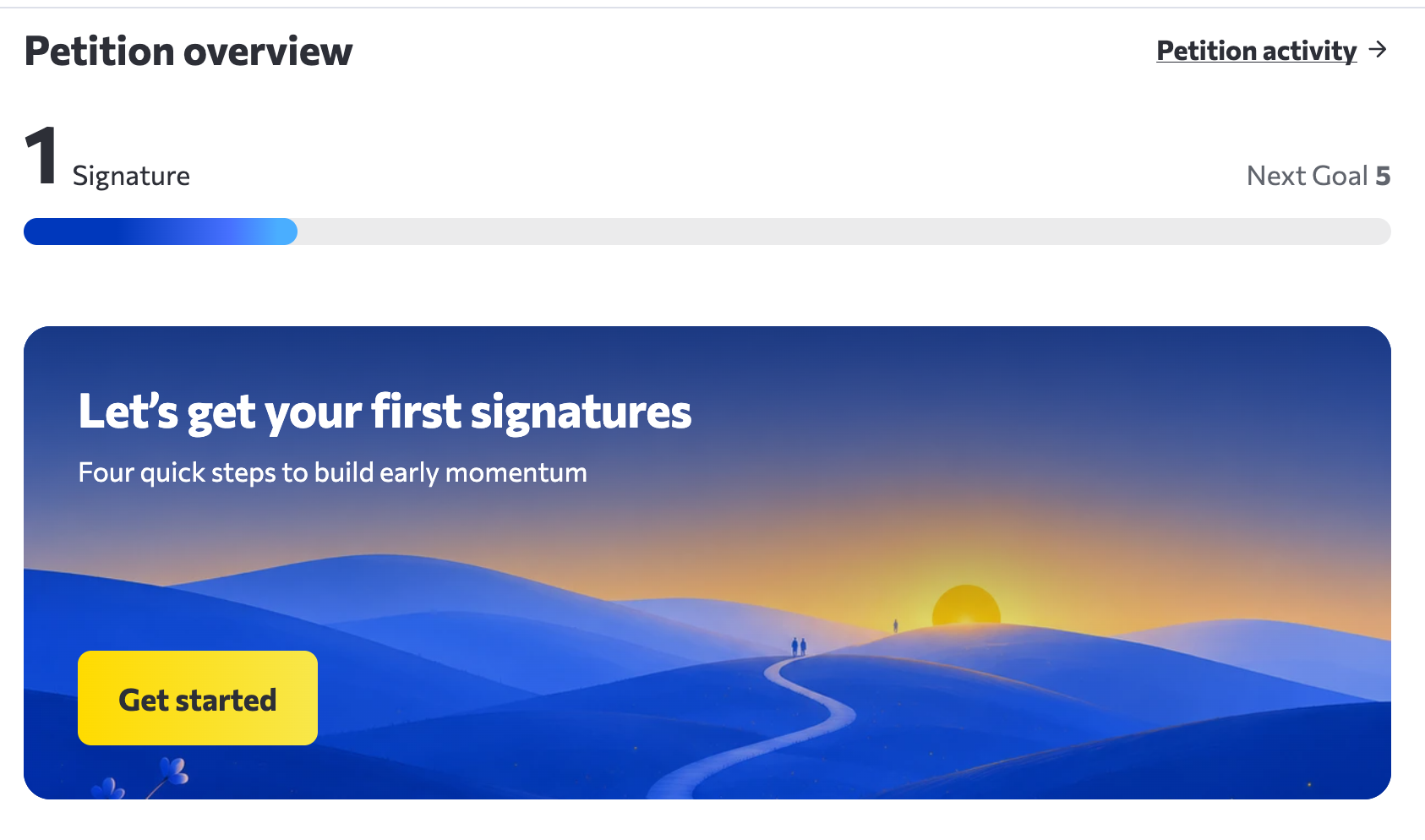
I launched my petition asking Nextdoor to create a meaningful value-sharing model for the neighbors whose reviews, recommendations, advice and local knowledge help make the platform valuable.
How's it going?
One signature.
Mine. 😂
So clearly, I'm not exactly storming the gates with an angry mob.
But instead of pretending it's gaining traction when it isn't, I'd rather ask why.
Maybe I Got the Petition Wrong
The basic idea still makes sense to me.
Nextdoor provides the platform. Neighbors provide enormous amounts of information and local knowledge. If that information can ultimately be organized, analyzed, used by AI, and turned into commercial value, why shouldn't the people helping create that value participate in some of the upside?
I mean some form of profit or value sharing tied to what users contribute and what the platform ultimately earns from it.
Nextdoor should make money.
I'm a shareholder. I want Nextdoor to make money.
But why does it have to be either platform profits or users’ benefit?
Why not both?
Now I Need Your Feedback
Maybe the petition is too complicated.
Maybe the ask isn't clear enough.
Maybe people like the concept but don't want to sign a petition.
Maybe asking users to pause business reviews and recommendations is the wrong approach.
Or maybe people simply disagree with me.
Tell me.
I spend plenty of time asking Nextdoor to listen to feedback, so I'd better be willing to do the same.
Read the petition and tell me what you'd change. What would make you sign it? What part doesn't work? Is there a better model for sharing the value neighbors create?
And if you do agree with the idea, I need two things:
First, sign it. Then share it.
Right now, the petition has exactly one supporter—and I already know what that guy thinks. 😂
Read and sign the Nextdoor Neighbor Value-Sharing Petition
Our information. Our time. Our value. Why not share?
Caring for My Mother: Money, Control, and Family Boundaries
There is another side to the story I shared about visiting my mother. If I’m going to be transparent about the coffee, the conversations, and the importance of showing up, I need to be honest about the harder part, too.
My mother is in a skilled nursing facility after two strokes in three months. She wants to move into assisted living. Eventually, when she’s mobile enough, the plan is to get her to Thailand.
She has also made something else clear: she does not want to return to Rivertowne to live with her husband, my father.
That is a difficult sentence to write. It is also necessary to understand what’s happening.
The Cost of Care
Assisted living is expensive. The places I’m looking at start around $6,000 a month for somewhere “nice.” We are not talking about the Four Seasons. At that price, though, I wouldn’t mind a mint on the pillow.
When my mother was in the hospital and expressed that she didn’t want to return home, my father’s first response was:
“Who is going to pay for it?”
I understand that hearing your spouse doesn’t want to live with you can hurt. I’m divorced. I received my own invitation to leave the home, and I left. I didn’t return. I understand that conversation carries feelings.
But my mother still needs care. Her wishes still deserve to be heard.
During a trip to Costco, before all of this, my mother told me she had a 401(k) through her employer. She gave me a rough idea of the balance during a conversation about things involving my father that were upsetting her.
Apparently, a Costco trip can include bulk groceries and information that becomes very important later.
When my father balked at assisted living, I remembered that account. My mother had worked and saved money over time. I wanted to explore using those savings for her care.
I asked him for the information to start that process.
His response was:
“I’ll think about it.”
Money and Control
I’ve heard stories about families coming apart over money. About a parent needing care and the conversations turning into arguments over accounts, expenses, and who gets to decide.
Now I’m experiencing that family strife myself.
From where I stand, this is all about money and control.
My mother has expressed where she wants to live and what she wants her next chapter to look like. Yet my conversations with my father keep coming back to whether money will be made available and who gets the final say.
When I hear “I’ll think about it” in response to a request for information about her savings, I hear him positioning himself as the person who decides whether her wishes can move forward.
That is why this feels like more than a disagreement about an expensive facility. Access to money affects my mother’s choices. Whoever controls that access has enormous influence over where she can go and how she can live.
I understand that $6,000 a month requires planning. I’m willing to work through the costs, the account details, and the practical questions.
What I’m struggling with is having to argue for taking my mother’s wishes seriously in the first place.
Taking Responsibility for Her Wishes
As of today, I am officially my mother’s power of attorney. I am also her designated proxy.
I let my younger brothers know my intentions because I wanted them informed. They know the plan: assisted living, then Thailand when Mom is mobile enough.
I want my mother’s wishes to guide the decisions about her care. There are details to work through, but I don’t want her voice getting lost in arguments about money or what someone else prefers.
Yesterday, my father began what I experienced as a negotiation over her care.
I told him I didn’t see this as a negotiation. I was talking about money my mother had earned and saved, and using it to care for her.
His response was:
“Prove it.”
Those two words changed how I saw him.
I was trying to move a conversation about my mother’s care forward. Instead, I felt pulled into a contest over authority and control.
My mother is recovering from two strokes. She has enough work ahead of her without her wishes becoming another thing she has to fight for.
What This Has Brought Up for Me
In that moment, I lost respect for my father.
I can acknowledge that he helped give me life, taught me things, and supported me at different points. Those parts of our history exist.
So does the pain I carry from childhood into adulthood. This crisis has brought some of that pain back to the surface. His responses now are affecting a relationship that already has a complicated history.
Hearing “I’ll think about it,” followed by “prove it,” while trying to help my mother get the care she wants has left me angry, hurt, and deeply disappointed.
I have been passionate in these conversations. My mother’s care and happiness matter to me, and I haven’t had many quiet feelings about either.
I also still live in the house my parents co-own. I go back there after visiting my mother, attending recovery meetings, going to dialysis, watching a movie, and doing the other things that make up my life.
My routine hasn’t changed much.
My connection with my father has.
Since hearing “I’ll think about it,” I’ve had less to say. I’ve been less engaged. I’m trying to live in that space while being honest about what I feel and what I can give.
I Still Believe in Showing Up
I meant what I wrote in my earlier post.
I believe in visiting people in hospitals and skilled nursing facilities. I believe in calling, listening, and making time for people, especially older people who may have fewer opportunities for connection.
I believe God created us to be in community with one another. We need people. We need conversation, care, and the experience of knowing someone remembered us.
I also have limits.
I cannot do all the work of maintaining a relationship. I cannot create mutual care by myself. And I have to be able to sleep at night with the choices I make about who receives my time and energy.
Right now, I am showing up for my mother, listening to what she wants, and working toward her next step. I’m also continuing my recovery, taking care of my health, and figuring out what boundaries I need with my father.
None of that feels particularly tidy.
But it is open and transparent.
I’ve heard how money can divide a family. Experiencing it myself has made me painfully aware of how closely money and control can become connected—and how much damage that can do when someone needs care.
Time is the one resource I know I will never get back. I want to spend mine helping my mother live the life she is asking for, while taking care of the life I’m responsible for, too.
Today, I want my mother to know that I hear her—and that I’m taking her wishes seriously.