

Bill Is Back—Twice: Apparently My Fake PayPal Account Had a Busy Morning
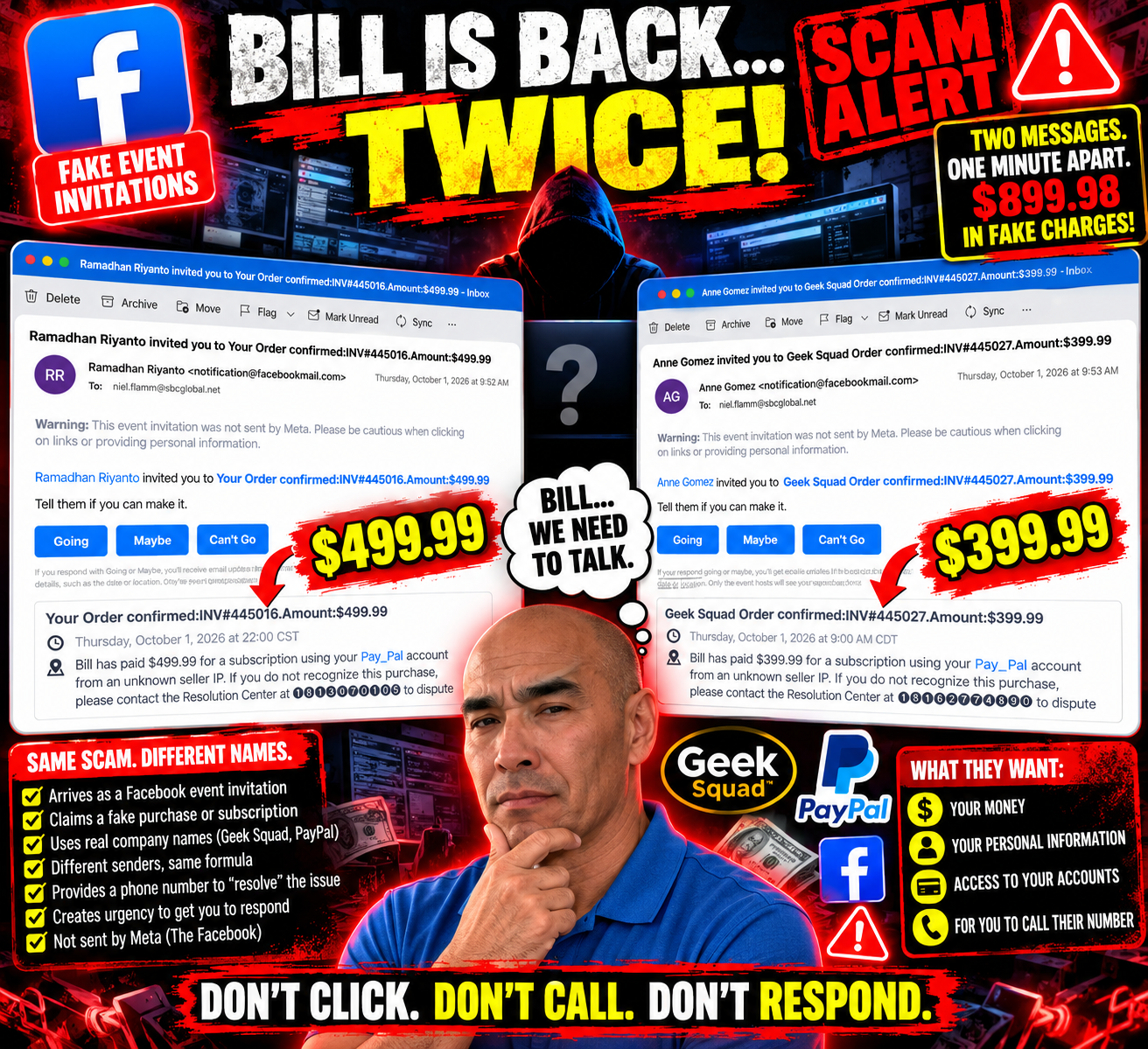
At this point, I think Bill needs an intervention.
If you've been following my continuing adventures with scam emails, you may remember Bill. Bill is the mysterious person who keeps appearing in these fake invoices and event invitations, supposedly using my PayPal account to buy things I never ordered.
Well, Bill is back.
And this time, he brought friends.
On October 1, I received two more suspicious event invitations. They arrived just one minute apart.
The first came from Ramadhan Riyanto at 9:52 a.m.
The second came from Anne Gomez at 9:53 a.m.
Apparently, scammers believe in efficiency.
First Invitation: $499.99
Ramadhan invited me to:
“Your Order confirmed: INV#445016. Amount:$499.99”
How thoughtful.
According to the invitation, Bill supposedly paid $499.99 for a subscription using my “Pay_Pal” account.
Yes, Pay_Pal.
Maybe PayPal's lesser-known cousin.
And, naturally, if I didn't recognize the purchase, there was a convenient telephone number for the “Resolution Center.”
Convenient for whom is another question.
The invitation even gave me the familiar choices:
Going. Maybe. Can't Go.
I'm going with Can't Go.
I have a scheduling conflict.
I'm busy not losing $499.99.
One Minute Later: Another Party!
Apparently, declining one imaginary purchase wasn't enough.
At 9:53 a.m.—just one minute later—Anne Gomez invited me to another event:
“Geek Squad Order confirmed: INV#445027. Amount:$399.99”
And guess who made the purchase?
BILL!
Bill allegedly spent another $399.99 using my imaginary Pay_Pal account.
So within one minute, Bill supposedly racked up $899.98 in fake charges.
Bill, buddy...
We need to talk about your spending habits.
The Similarities Are Almost Comical
Put these two messages side by side, and the pattern is hard to miss.
Different sender.
Different invoice number.
Different dollar amount.
Different supposed Resolution Center phone number.
But almost everything else follows the same formula.
Both arrived as event invitations.
Both claim Bill used my PayPal account.
Both mention an “unknown seller IP.”
Both provide a telephone number to dispute the transaction.
Both create a sense of urgency around a purchase I supposedly didn't make.
And both contain a warning right there in the email:
“This event invitation was not sent by Meta. Please be cautious when clicking on links or providing personal information.”
At this point, the warning may as well be flashing in neon.
Yesterday It Was Geek Squad. Today It's a Doubleheader.
What makes this even funnier is that these arrived right after another fake Geek Squad invitation I recently wrote about.
That one claimed Bill spent $399.99.
Now Bill supposedly spent another $499.99 and $399.99.
My fictional friend is having quite a shopping spree.
If this keeps up, I'll need to stage a fictional financial intervention.
Why Send Two So Close Together?
I obviously can't know who is behind these messages from the emails alone, and I can't say whether the two invitations were generated by the same person or operation.
But the nearly identical wording and timing are worth noticing.
That's part of why I keep documenting these messages.
One strange email might make someone stop and wonder whether there's really a problem with an account.
When several nearly identical versions appear, the formula becomes much easier to see.
The company name can change.
The amount can change.
The sender can change.
The telephone number can change.
But the basic objective appears to remain the same:
Get me worried enough to respond before I stop and think.
I'm Still Not Calling
If I received a legitimate-looking notice about a PayPal, Geek Squad, bank or credit-card transaction I didn't recognize, I wouldn't use the telephone number supplied in a suspicious email.
I'd go directly to the company's official app or website and check my account independently.
The email doesn't tell me how to verify it.
That's an important distinction.
And I'm definitely not calling a mystery “Resolution Center” because Bill supposedly went shopping again.
Going? Maybe? Can't Go?
I still love that these arrive as event invitations.
Imagine putting these on my calendar:
9:00 a.m. — Lose $399.99
10:00 p.m. — Lose another $499.99
Dress code: Business casual.
Refreshments: None.
Financial regret: Complimentary.
RSVP?
Can't Go.
Keep Sending Me Your Scam Stories
I'll keep documenting these because the more examples we see, the easier it becomes to recognize the patterns.
If you've received a suspicious invoice, fake purchase notification, Facebook event scam, PayPal impersonation, Geek Squad message, or another creative attempt to separate you from your money, send me your story and screenshots at:
Just remove or cover any sensitive personal or financial information before sending it.
As for Bill?
If anyone sees him, please tell him his Pay_Pal privileges have officially been revoked.

Godspeed, Brooke Eby: A Spirit ALS Couldn’t Take
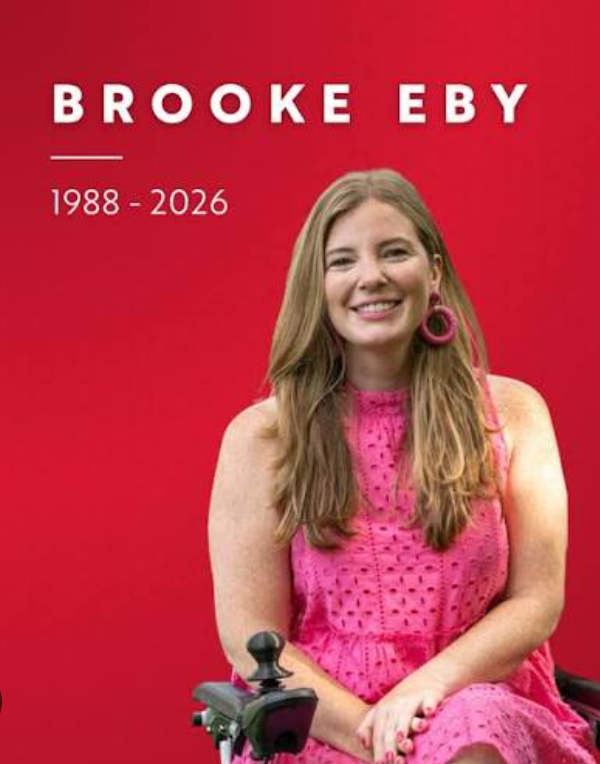
Today I learned that Brooke Eby died after her long journey with ALS, amyotrophic lateral sclerosis, commonly known as Lou Gehrig’s disease. She was only 37 years old. Brooke was diagnosed in 2022 after experiencing symptoms for years, and she eventually became an extraordinary advocate for people living with ALS. People.com
I didn't know Brooke personally.
But I felt like I knew a small piece of her because she was willing to let people like me into her life.
I came across Brooke through her social media posts under the name @LimpBroozkit. By the time I started following her, she was already using a wheelchair. I started watching her short videos, then went back, catching up on the journey that brought her there.
And I kept watching.
What ALS Takes Away
ALS is a progressive neurodegenerative disease that attacks the motor neurons in the brain and spinal cord—the nerve cells that control voluntary muscles.
As those motor neurons deteriorate and die, the brain gradually loses its ability to communicate with the muscles.
The muscles weaken. They atrophy. Movement becomes increasingly difficult.
Over time, ALS can take away a person's ability to walk, use their arms and hands, speak, swallow, eat, and eventually breathe independently. There is currently no cure that stops its progression. ALS Association
One of the things that makes ALS particularly cruel is that the beginning may not look like what most of us imagine a devastating neurological disease would look like. Early symptoms can include tripping, difficulty walking, dropping things, muscle cramps or twitching, weakness in an arm or leg, or changes in speech. ALS Association
Brooke's story made that real to me.
She talked openly about the symptoms that eventually led to her diagnosis—things that, had they happened to me, I don't know that I would immediately have connected with something as serious as ALS.
Then I watched what happened afterward.
The Wedding Story I Never Forgot
One of Brooke's stories especially resonated with me.
She talked about going to a wedding while struggling with everything that was happening to her body. She had to wear sneakers. She felt self-conscious. She wanted to leave the reception early.
A friend followed her.
Instead of letting Brooke disappear from the celebration, her friend encouraged her to stay.
Eventually, Brooke's walker became part of the party. People incorporated it into a makeshift limbo line.
Something that could have represented everything she was losing became, at least for that moment, part of the fun.
I understood that story in a way I wish I didn't.
After my amputation, I became incredibly self-conscious. There was depression. There was grief. There was sadness. I realized the body I had lived in for decades had permanently changed.
And I had to figure out how I was going to live in that changed body.
That's one reason Brooke's approach stayed with me.
She wasn't pretending ALS wasn't horrible.
She wasn't pretending she wasn't losing things.
She found a way to talk about those losses with humor, vulnerability, and transparency.
Then I Watched ALS Take More
During the last month or so, I noticed the changes becoming much more apparent.
Brooke needed a lift to transfer in and out of her wheelchair.
She was beginning to set up an eye-gaze communication system.
When she told stories, the animated movements of her arms and hands that had once accompanied her words were no longer there.
ALS kept taking.
Mobility.
Independence.
Movement.
Eventually, even speaking and swallowing became increasingly difficult. TMZ
But there was something ALS never seemed able to take.
Brooke.
Her personality was still there.
Her humor was still there.
Her willingness to tell the truth was still there.
Her desire to educate people was still there.
She didn't allow ALS to define her spirit.
A Quarter as Hard
I live with my own health challenges.
They aren't ALS, and I won't pretend they're comparable.
But watching Brooke changed how I think about living inside a body that doesn't always cooperate with the plans I have for it.
I've written openly about dialysis, kidney disease, losing my leg, prosthetics, surgeries, recovery, and all the strange little indignities that come along for the ride.
Sometimes I make jokes about them.
Sometimes I'm angry.
Sometimes I'm scared.
Sometimes I'm simply tired of dealing with it all.
And that's why Brooke's example meant something to me.
She showed that humor doesn't mean something isn't serious.
Being vulnerable doesn't mean being weak.
And acknowledging what a disease has taken doesn't require surrendering everything it hasn't.
I hope that whatever comes next in my own journey, I continue to fight even a quarter as hard to keep my spirit up as Brooke did throughout hers.
She deserved more time.
She deserved a different ending.
But in the time she had, Brooke made people laugh. She educated hundreds of thousands of people about a disease many of us knew little about. She created a community for people living with ALS and helped others feel less alone. The MoCo Show
And she made people like me stop scrolling long enough to think differently about our own lives.
I never met Brooke Eby.
I'm grateful she chose to share herself with the rest of us.
Godspeed, Brooke.
ALS took your body piece by piece. It never took your spirit.

The Free Data Buffet Is Over: If Our Content Creates Value, We Should Share in It
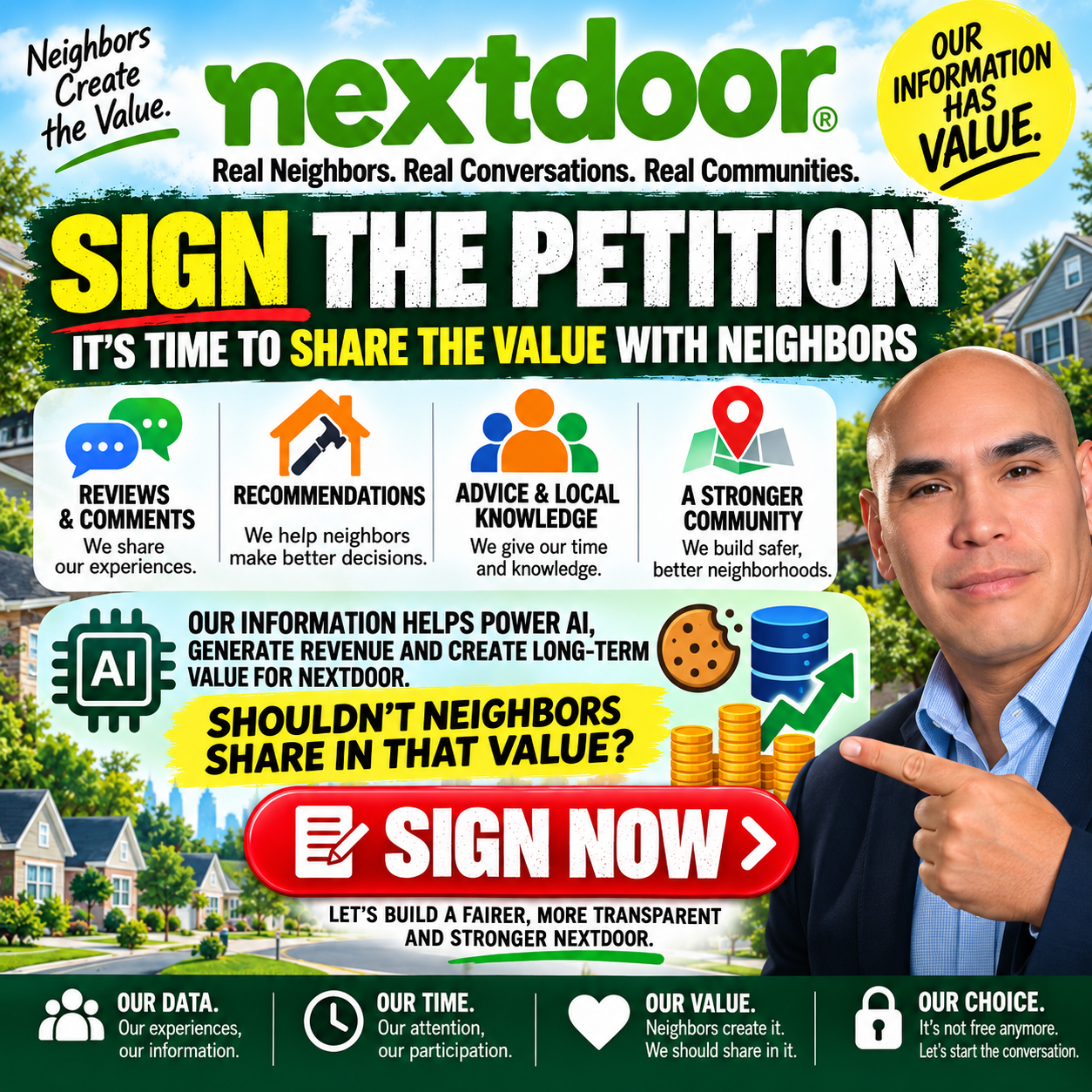
A while ago, I started a petition asking a fairly simple question:
If Nextdoor can create economic value from information neighbors provide, why shouldn't the neighbors who provide it participate in that value?
Today, I'm expanding the question.
This isn't only about Nextdoor anymore.
It's about social media platforms, websites, apps, advertising networks, and other digital businesses that collect information about what we read, click, search, recommend, review, discuss, and buy.
My message is becoming simpler:
Our information isn't free anymore.
At least, I don't think it should be.
We Keep Supplying the Raw Material
Think about what people give digital platforms every day.
We write reviews. We recommend restaurants. We tell neighbors which plumber showed up on time. We answer questions. We upload photographs. We comment. We click. We search. We like things. We tell platforms what interests us.
Then there's the less obvious information: cookies, device identifiers, IP addresses, browsing activity, clicks and other event data.
These aren't all legally or technically the same thing, and different privacy laws and platform agreements govern how different types of information may be collected and used. I'm not claiming that placing a cookie on my browser magically means somebody owes me a royalty check.
I'm making an argument about economic value.
Because individually, one click may be almost meaningless.
Multiply those clicks, posts, recommendations, and behavioral signals across millions of people, however, and suddenly we're talking about an extremely valuable resource.
Nextdoor Makes the Point Particularly Well
Nextdoor increasingly describes itself in terms of neighbor-generated knowledge. Its 2025 Transparency Report described the platform as containing “neighbor-generated content and locally relevant information,” while Nextdoor's newer AI-powered Ask product draws upon nearly 15 years of conversations among verified neighbors. Nextdoor
That's valuable.
And who created those conversations?
Neighbors did.
Nextdoor built the platform.
Nextdoor paid engineers.
Nextdoor created the infrastructure.
Nextdoor developed the advertising business.
Nextdoor has every right to try to build a profitable company from those investments.
But neighbors supplied an enormous amount of the raw material that makes the platform useful.
Nextdoor itself says almost 30% of its content consists of organic recommendations and has talked about tens of millions of “Faves” associated with millions of businesses. Nextdoor Blog
That's nothing.
Cookies Are Part of the Bigger Conversation
The same principle makes me think differently about tracking.
Nextdoor's own data-processing documentation identifies things such as cookie IDs or similar identifiers, IP addresses, user-agent information, and event data such as clicks or installs among categories of personal data involved in certain advertising-related processing. Nextdoor Legal
Again, this isn't uniquely a Nextdoor issue.
It's an internet issue.
We've spent years becoming accustomed to clicking:
ACCEPT ALL COOKIES
Maybe we should start thinking more carefully about what we're accepting and what companies receive in return.
If information about my behavior helps improve targeting, train recommendation systems, develop products, measure advertising, build audiences or otherwise contribute to commercial value, I think it's reasonable to have a larger conversation about what the person generating that information receives in return.
Welcome Back to My Very Lonely Petition 😂
My petition hasn't exactly become the Boston Tea Party of user-generated data.
Last time I checked, it had one signature.
Mine.
😂
I already know what that guy thinks.
But perhaps my original message was too focused on Nextdoor.
Because this question is much bigger.
My updated message isn't:
Destroy social media.
It isn't:
Stop using the internet.
And it certainly isn't:
Companies shouldn't make money.
It's this:
If our participation creates commercial value, let's start talking about sharing that value.
That could take many forms.
Direct compensation for opt-in research. Contribution credits. Subscription benefits. Revenue-sharing pools. Advertising credits. Payments for particularly valuable content. Rewards for reviews or recommendations that generate measurable commercial activity. Stronger controls over commercial reuse. Clear choices about whether content can be used to develop AI products.
I don't pretend to have the perfect economic model.
That's what the conversation is for.
Until Then, We Can Stop Supplying Some of the Commodity
That's the other part of my petition.
Participation is voluntary.
If I don't like the economic arrangement, I can reconsider what I voluntarily contribute.
That doesn't mean withholding information about a missing child, dangerous weather, a lost pet, a fire, an emergency, or something that could protect another person.
Human safety comes before my argument about data economics.
I'm talking about the routine commercial material platforms benefit from:
Which roofer should I hire?
What's the best restaurant nearby?
Who installed your HVAC system?
Would you recommend this dealership?
Which insurance company do you use?
Every answer adds another tiny piece to a valuable database.
Maybe we should stop automatically assuming that contribution costs $0.00.
The Internet Made Us the Product, the Customer and the Workforce
That's what fascinates me.
We can simultaneously be the audience viewing advertisements, the customer purchasing products, the creator producing content, and the source generating behavioral data.
That's an extraordinary business model.
For the companies.
Maybe it's time users become more conscious participants in the economics too.
And I'm not suggesting that users automatically have a legal right to payment for everything they post or every cookie generated. Platform terms, privacy laws, and individual choices matter.
I'm saying something much simpler:
We can ask for a different deal.
Nextdoor, You're Still My Test Case
Nextdoor remains particularly interesting to me because its product depends so heavily on what neighbors know.
Without neighbors, there are no neighbor recommendations.
Without neighbors, AI has no years of neighborhood conversations to search.
Without neighbors, there are no local experiences to organize.
Without neighbors, advertisers have far less reason to want access to those neighborhoods.
Nextdoor says it wants every voice to have value. Nextdoor Business
Great.
Let's talk about the economic value too.
Nextdoor built the container.
Neighbors keep filling it.
So I'm Updating the Invitation
To Nextdoor.
To social-media companies.
To websites.
To apps.
To companies collecting behavioral information.
And, most importantly, to the people creating all of it:
Stop thinking of your digital activity as automatically worthless simply because nobody has historically written you a check for it.
Ask what you're providing.
Ask how it's being used.
Read the privacy controls.
Decline unnecessary tracking when you prefer not to.
Think before voluntarily providing another commercially useful recommendation, review, or piece of content.
And if enough people decide the current exchange isn't good enough?
Companies will have an incentive to offer a better one.
My petition may still have only one signature.
That's okay.
Every movement has a first person willing to look slightly ridiculous standing there alone.
I'm already bald. I've survived worse. 😂
Our information has value.
Our content has value.
Our recommendations have value.
Our attention has value.
Our time has value.
The question isn't whether digital companies should be allowed to create value.
The question is whether the people supplying so much of the raw material should be part of it.
I think that's a conversation worth having.
👉 Sign the petition: https://c.org/GkNWmffgg9
👉 Follow the continuing case study: NielFlamm.com/blog

🌎 Aisha on Grounding: Sometimes We Need to Reconnect With the Earth

Today’s post at A Godd3ss3s Cr3ation is about grounding—taking off your shoes, feeling the Earth beneath your feet, slowing down, and reconnecting with the present moment. 🌎💚
If you need something spiritual today, give it a read:
A Godd3ss3s Cr3ation Blog
https://www.agodd3ss3scr3ation.com/blog
Thirty Years of Talking Crap—and Showing Up
Most Tuesdays and Fridays, a core group of us guys gets together on Zoom. If you’re picturing thoughtful discussions, mature reflection, and dignified conversation… you’ve got the wrong Zoom.
Most nights, we talk crap about each other.
For some of us, this started more than 30 years ago. And apparently, we still have material.
Sure, there are moments when we get serious. We talk about life, the hard stuff, and whatever somebody is going through. But most of the time, these calls are a chance to escape life's pressures and just have fun. For a little while, we get to laugh with people who knew us long before our current responsibilities did.
Last night, though, something happened that made me appreciate these friendships a little differently.
A few of the guys go to New York Comic Con every year. It’s an event. It’s expensive. It’s crowded. I’ve never been, but I’ve seen the pictures, and the costumes are clearly part of the experience. That’s cosplay, for anyone unfamiliar: dressing up as a character from a comic, movie, game, or whatever world you want to step into.
One of our guys is going this year with his 15-year-old son. Their first time.
Naturally, we asked if he was going to cosplay.
He was against the idea.
Naturally, that did not end the discussion.
With AI being what it is, I used his likeness and his son’s to put together some costume suggestions. Real possibilities, presented in a PowerPoint. Because apparently, this is what decades of friendship have prepared me for.
He looked through it with his son.
Then his son wanted to join our Zoom.
His dad told him to go away.
Now, before anyone gets caught up in that last part, let’s appreciate what happened: a 15-year-old wanted to hang out with us.
Us.
I took two things away from that.
First, we’re still cool enough for a teenager to want in. Or we act like 15-year-olds often enough that he recognized his people.
Some of the time, anyway.
Okay. Most of the time.
But the second thing stayed with me.
He got a glimpse of what a lasting friendship can look like. A group of guys who, across time, distance, race, and all the ways life can pull people apart, still make room for each other.
We weren’t trying to teach him anything. We were doing what we always do: making fun of one another, laughing, and showing up. Yet somewhere in that, he saw something he wanted to be part of.
That means a lot.
Friendships like these don’t sustain themselves. People get busy. Priorities change. Life gets complicated. Keeping a connection takes effort, even when that effort looks like logging onto Zoom to hear the same guy tell the same ridiculous story again.
It isn’t always easy. And I know what we have is rare.
I hope his son finds his own version of it. People he can grow up with and grow older with. People who will listen when life gets heavy—and give him a hard time when he needs a laugh.
And to everyone reading this, I hope you already have friends like that. If you don’t, I hope you find them.
Thirty years from now, may you still be showing up for each other.
And still have plenty of crap to talk.