
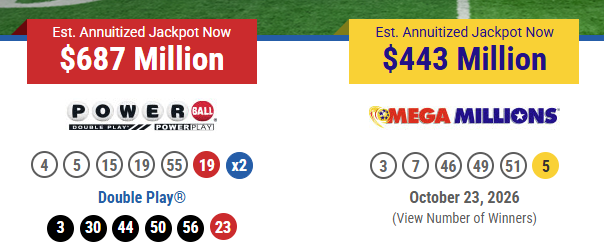
The West Side of Harlem Is Back in the Lottery Game
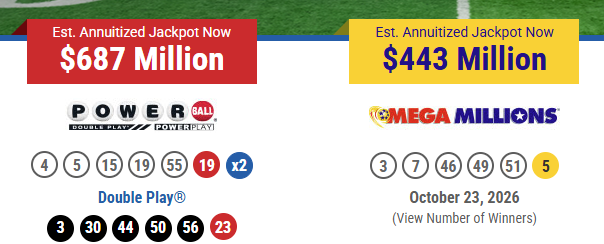
Last round, ten of us put in $20 each, giving the pool $200. We spent $100 on each game and came away with $11 in winnings—that’s $1.10 per person.
A modest return, sure. But we’ve made it through 50 years, decades of brotherhood, and enough City College stories to fill the whole Apollo. Eleven dollars? That’s practically a victory lap.
Now we’re back with nine participants and $180 in the pool. We’re putting $90 into each game: 18 Mega Millions tickets and 45 Powerball tickets. The jackpots are looking mighty tempting, and the brothers are feeling lucky.
We’re City College brothers who lived on the West Side of Harlem: seasoned, sharp, and just reckless enough to believe the next ticket could change everything. First order of business: buy back the old fraternity house. Then we’ll add something completely unexpected inside—perhaps a secret bowling alley, a speakeasy behind the bookcase, or a tiny indoor lagoon for absolutely no practical reason. The historic exterior stays true to its roots; all the madness happens indoors.
Either way, the pool is in, the numbers are picked, and the brotherhood is dreaming big.
West Side of Harlem, hold on to your hats. We’re at it again.

Day 133: Nextdoor Has Time for AI. What About Protecting Neighbor Data?

Monday. Just before noon.
It's been a slow day on Nextdoor. I missed Day 132 because there wasn't much to report. Now, four days have passed without a public response to the questions I've been raising about moderator accountability, neighbor privacy, and protecting nonpublic information.
Nirav Tolia hasn't responded to those questions either.
At this point, the silence feels routine.
Meanwhile, I checked NXDR this morning. The stock is trading around $2.37, down from $2.63 on Friday. That's a notable move, although I have no evidence connecting it to anything I've been discussing.
But the stock price isn't today's story.
Today's story is what Nextdoor chooses to talk about—and what it doesn't.
Day 133: The Questions Are Still There
My question is straightforward.
What safeguards does Nextdoor have to protect neighbors if a volunteer moderator misuses their position or accesses nonpublic information for purposes unrelated to moderation?
I'm not accusing a specific moderator of misconduct. I'm asking about the controls that should exist before something goes wrong.
Nextdoor's U.S. Member Agreement says that volunteers who have access to nonpublic information through account features must use it only in connection with their volunteer role. That's an important rule.
But a rule is only one part of a safeguard.
What limits access in the first place? How does Nextdoor monitor potential misuse? What happens when a neighbor reports that a moderator has abused their privileges? How does Nextdoor investigate complaints when the person being reported is part of the moderation system?
And what training must moderators complete to understand their responsibilities around confidentiality, conflicts of interest, and personal retaliation?
I want Nextdoor to publicly explain these protections in plain English.
Not because I know a breach has happened. I don't.
Not because I know a moderator has misused nonpublic information. I don't.
I want the company to explain how it prevents these things from happening and how it responds if they do.
AI Days: An Interesting Initiative, but Is It the Priority Neighbors Need?
Last week, Tony Castellanos, Nextdoor's head of People, highlighted the company's monthly AI Days—time set aside for employees to experiment with AI tools and explore ways to improve their work. HR Brew also covered the initiative.
Experimentation can be useful. Companies should explore tools that help employees work more effectively.
My concern isn't that Nextdoor is exploring AI.
My concern is the difference between the topics the company promotes and the practical questions users still need answered.
We hear about AI experimentation, neighborhood-level advertising intelligence and product initiatives. Those subjects may be relevant to Nextdoor's business strategy.
But where is the equally clear public explanation of how the company protects the people who make its platform valuable?
Where is the straightforward discussion of moderator access, confidentiality, accountability and safeguards against retaliation?
AI can help a company move faster. It cannot replace sound policies, effective oversight or accountability.
Nirav Tolia, What Are the Safeguards?
Nirav, I'm not asking you to respond personally to every post I publish. I'm asking Nextdoor, as a company built around verified neighbors and local relationships, to explain how it protects the information and trust those relationships depend on.
Here are the questions I'd like answered:
Access: What nonpublic information can volunteer moderators access, and how is that access restricted?
Monitoring: What controls detect or investigate potential misuse of moderator privileges?
Training: Is annual refresher or compliance training mandatory for volunteer moderators? What does it cover?
Complaints: How can neighbors report suspected moderator abuse without fear of retaliation?
Accountability: Who reviews serious complaints when the moderator is the subject of the report?
Transparency: Where can users read a clear explanation of these safeguards and how they're enforced?
Nextdoor's public policies provide some information about expected conduct. What I want to understand is how the company puts those expectations into practice.
Publishing the rules is important. Explaining the protections behind them is important, too.

Four Days of Silence, Another Day of Questions
I started this case study to examine the gap between Nextdoor's promise and its execution.
I'm still doing that.
I don't expect a response to every question, and I recognize that the company can't disclose every detail of its security procedures. There are legitimate reasons not to publish information that could help someone circumvent a security control.
But there's a difference between revealing sensitive technical details and explaining the principles, training, oversight, and accountability measures used to protect people.
A company can be transparent about its approach without giving bad actors a roadmap.
That's what I'm asking for.
As I write this on Monday, October 26, NXDR is down from Friday's close, and, from my perspective, my questions about moderator safeguards remain unanswered. The stock movement is one data point. The unanswered questions are a separate issue.
Nextdoor has announced that its next earnings report will come on November 5. Investors will hear about business performance, and I'm sure there will be plenty to discuss.
But I hope Nextdoor also remembers that its long-term future depends on more than revenue, engagement, and new technology.
It depends on whether neighbors can trust the platform—and whether the company can demonstrate that it takes their privacy and safety seriously.
Stop making AI the headline for a moment. Tell neighbors how you're protecting them.
That's the update I'm waiting for.
👉 Follow my continuing Nextdoor case study at NielFlamm.com/blog.
Good Times at the Dialysis Clinic
Today started like a typical Monday: up at 4:15 a.m., showered, and headed out for dialysis, which starts at 5:45.
I got hooked up to the machine, took a nap, woke up when the physician assistant came by to discuss medication, and then went back to napping. A pretty ordinary morning—until it was time to remove the needles and put on the bandages.
That’s when the clinic got lively.
First, one patient started yelling and cursing at a dialysis tech, then a nurse, and finally the clinic manager. The exchange got heated, including a few F-bombs. I don’t know what started it, but it went on for a while.
Then, about 15 minutes later, a male patient from the second shift started swearing on the phone. He isn’t usually the kindest caller. I understand he’s been bedbound for as long as I’ve been at the clinic, and I imagine that’s incredibly frustrating. Still, he has a habit of taking that frustration out on callers whose numbers he doesn’t recognize. He always answers—and this time, he definitely threw a few F-bombs.
The clinic staff looked at each other, wondering what was going on. I looked at the technician taking care of me and asked, “Is there something in the water? I can confirm it was a full moon.”
She replied, “Correct!”
Good times at the dialysis clinic.

Other Mommy: Something Is Very Wrong in This House… 👀

Some horror movies make you jump.
Others leave you wondering what you just watched.
And then there's Other Mommy.
Starring Jessica Chastain, this movie introduces a family, a child, and a presence that seems to want something more than just a little attention.
But what happens when that connection goes too far?
I caught this one after dialysis, and I had a few thoughts. The trailer certainly got my attention, but did the movie deliver what I was expecting?
Let's say a few things I wanted to see didn't quite make the cut.
And there's one particular scene from the trailer that left me asking, "Wait… why wasn't THAT in the movie?" 😳
Was this a nightmare worth experiencing on the big screen? Could Hollywood be setting us up for more? And what exactly was missing from the story?
I'm keeping the details under wraps for now. You'll have to watch my review to hear what I thought!
🎬 Ready to find out what I thought of Other Mommy?
👉 Watch my movie reviews here: https://NielFlamm.com/videos/moviereviews
Come for the creepy mystery. Stay for the good, the bad, and the stupid.
Or don't. 😉
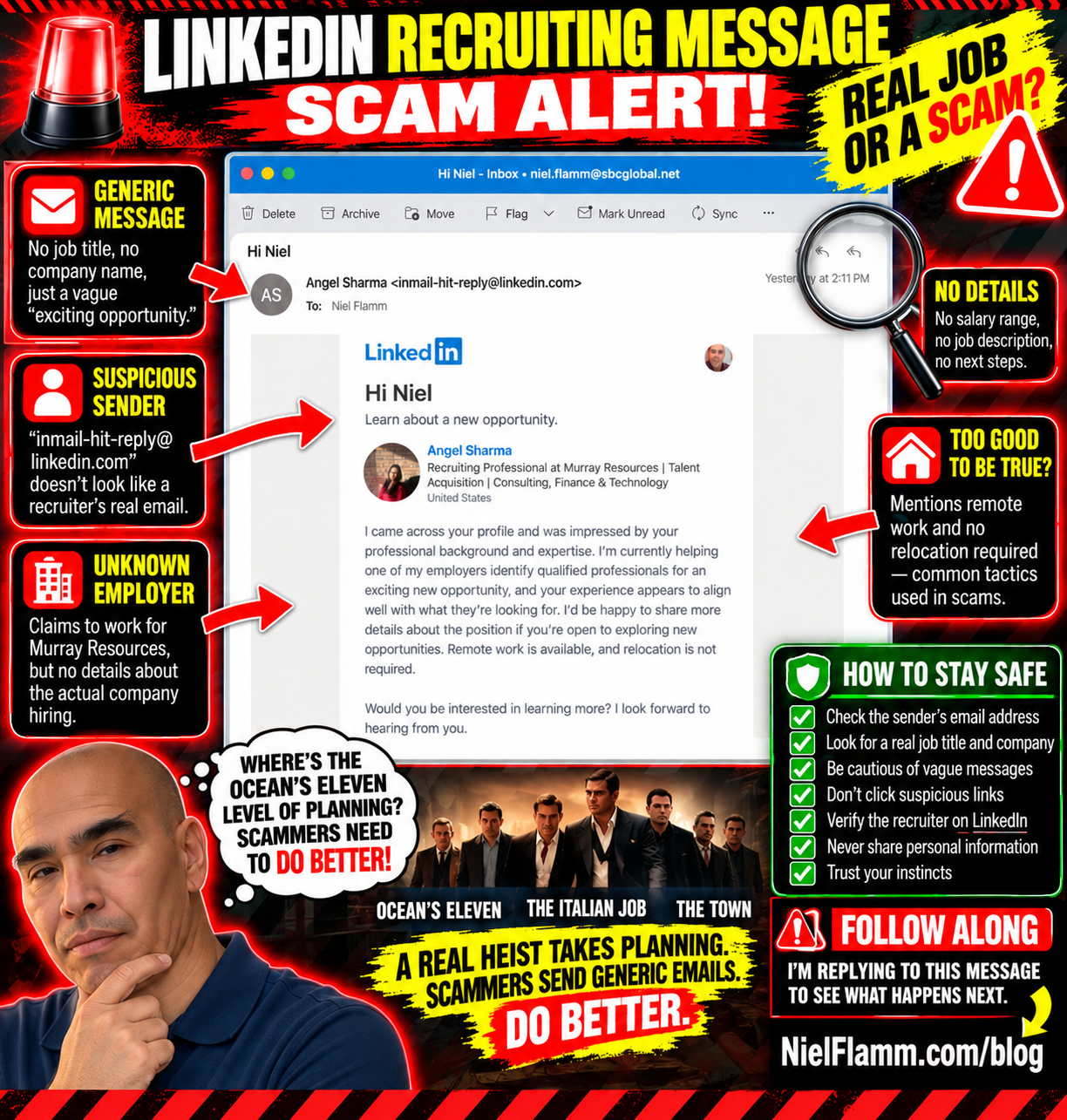
The LinkedIn Caper: Apparently Scammers Have Never Watched Ocean's Eleven
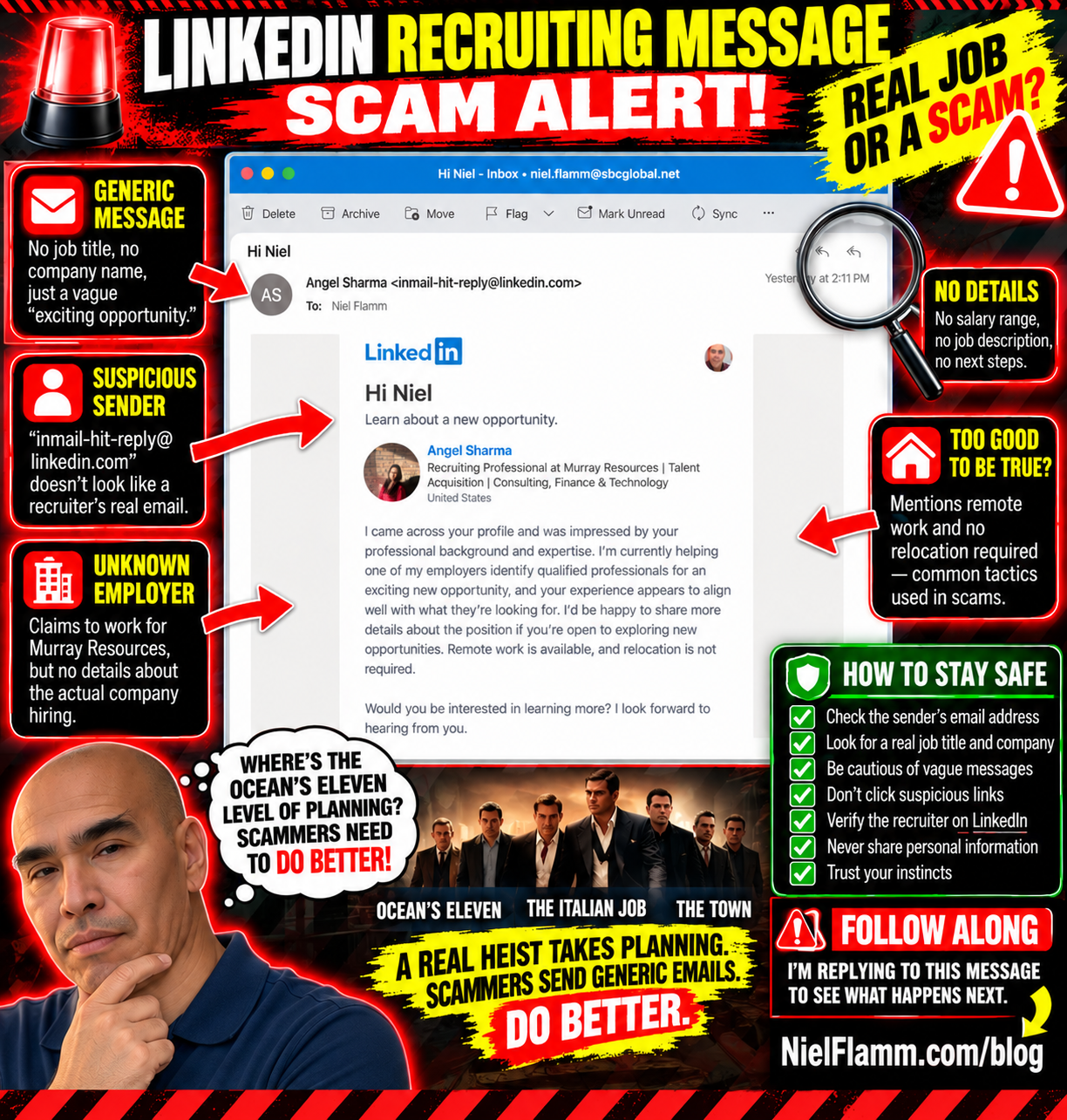
Another day, another unsolicited message that lands in my inbox promising a mysterious job opportunity.
This time, it's supposedly from Angel Sharma, a recruiter at Murray Resources, reaching out via what looks like a LinkedIn notification email.
The message says she came across my profile, was impressed by my professional background, and is helping one of her employers identify qualified professionals for an exciting opportunity.
Remote work is available. No relocation required.
Sounds wonderful, doesn't it?
There's just one small detail missing: What is the actual job?
No job title. No company name for the supposed employer. No salary range. No specific details about the opportunity.
Just a friendly introduction and an invitation to express interest.
Now, I don't know yet whether this particular message is a scam, a questionable recruiting approach, or a legitimate recruiter using a very generic opening. I'm not going to pretend I know more than the screenshot tells me.
But it got me thinking about the state of the scamming business.
Have Today's Scammers Lost Their Imagination?
I was thinking about this today: Some of these scammers don't seem to know how to run a proper grift anymore.
They want the money immediately.
Click this link. Send this payment. Pay this fee. Give me your information.
It's all very rushed.
Where's the creativity? Where's the planning? Where's the commitment to the craft?
Think about movies like Ocean's Eleven, The Italian Job, and The Town.
These movies didn't revolve around someone walking into a casino or a bank and yelling, “Hey, give me all your money!”
Well, that would have made for a very short movie.
Instead, the caper involved planning, reconnaissance, learning how the target operated, understanding security, identifying weaknesses, coordinating people, and executing a carefully developed plan.
The characters invested time before attempting the big score.
When successful, these fictional heists could bring in millions of dollars.
Meanwhile, some of today's suspicious emails can't even tell me what job they're supposedly recruiting me for.
Come on, people. At least give me a plot.

It's a Marathon, Not a 40-Yard Dash
Now, before anyone gets the wrong idea, I'm not offering scammers a consulting service. I'm making a point about how transparent and poorly constructed some of these approaches can be.
A message that promises an exciting opportunity but offers no meaningful details isn't exactly persuasive.
If you're trying to convince someone to trust you, a generic message that could have been sent to 10,000 people isn't a particularly compelling start.
And when the next step involves clicking an unexplained link, sharing personal information, or moving to another messaging platform, the warning signs become even more important.
The problem isn't that I need scammers to become more sophisticated. The problem is that I want people to recognize these tactics before they get hurt.
Still, looking at this email, I can't help but think of Hollywood's master thieves.
Danny Ocean would probably hold a team meeting, make a detailed plan, and prepare several contingencies before he ever approached the target.
This email? It barely makes it through the opening credits.
So, What Am I Going to Do?
I'm going to reply.
Yes, you read that correctly.
I'm going to respond to this message and see what happens next.
That doesn't mean I'll send money, disclose sensitive information, open suspicious attachments, or blindly follow instructions. I'll be cautious about links and requests, and I'll be paying attention to what the sender says next.
I'm curious to see whether this turns into a specific job opportunity, a request to move the conversation elsewhere, a pitch for personal information, or something completely different.
I don't know where this will lead, and that's precisely why I'm documenting the experiment.
I'll share the next installment once there's something to report.
Follow Along for the Next Chapter
Will this be a legitimate recruiting conversation? Will the opportunity become clearer? Will the plot take an unexpected turn?
I don't know yet.
But I'll find out what I can without risking my money or personal information.
If you've received similar recruiting messages, I'd love to hear about your experiences.
And to the people sending these generic messages: if you're going to approach someone with an “exciting opportunity,” at least bring a little substance to the opening scene.
Do better.
Because even a good caper takes planning—and this inbox production needs a rewrite.
Follow along here at NielFlamm.com/blog to see what happens next.