
Another day, another unsolicited message that lands in my inbox promising a mysterious job opportunity.
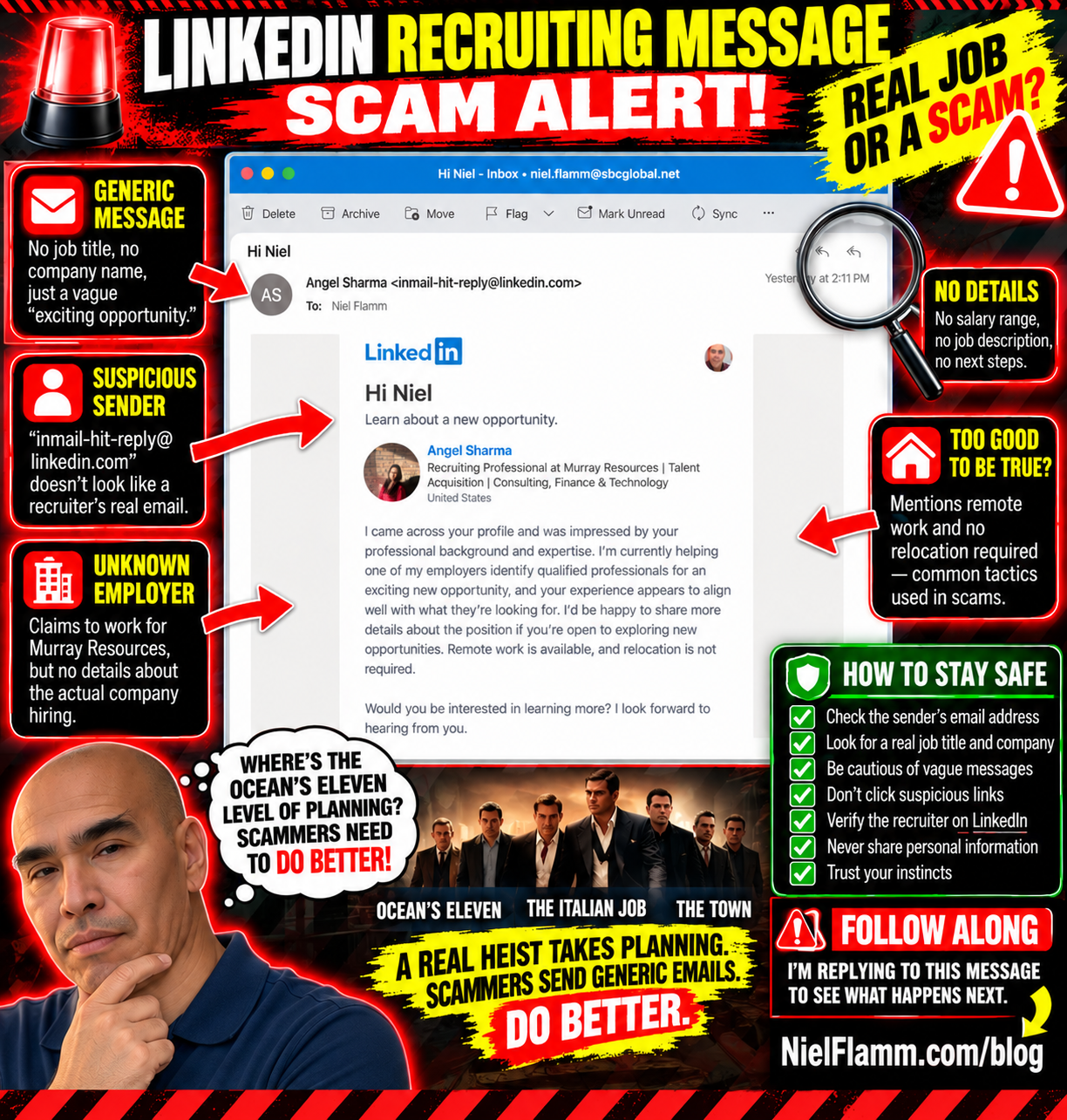
This time, it's supposedly from Angel Sharma, a recruiter at Murray Resources, reaching out via what looks like a LinkedIn notification email.
The message says she came across my profile, was impressed by my professional background, and is helping one of her employers identify qualified professionals for an exciting opportunity.
Remote work is available. No relocation required.
Sounds wonderful, doesn't it?
There's just one small detail missing: What is the actual job?
No job title. No company name for the supposed employer. No salary range. No specific details about the opportunity.
Just a friendly introduction and an invitation to express interest.
Now, I don't know yet whether this particular message is a scam, a questionable recruiting approach, or a legitimate recruiter using a very generic opening. I'm not going to pretend I know more than the screenshot tells me.
But it got me thinking about the state of the scamming business.
Have Today's Scammers Lost Their Imagination?
I was thinking about this today: Some of these scammers don't seem to know how to run a proper grift anymore.
They want the money immediately.
Click this link. Send this payment. Pay this fee. Give me your information.
It's all very rushed.
Where's the creativity? Where's the planning? Where's the commitment to the craft?
Think about movies like Ocean's Eleven, The Italian Job, and The Town.
These movies didn't revolve around someone walking into a casino or a bank and yelling, “Hey, give me all your money!”
Well, that would have made for a very short movie.
Instead, the caper involved planning, reconnaissance, learning how the target operated, understanding security, identifying weaknesses, coordinating people, and executing a carefully developed plan.
The characters invested time before attempting the big score.
When successful, these fictional heists could bring in millions of dollars.
Meanwhile, some of today's suspicious emails can't even tell me what job they're supposedly recruiting me for.
Come on, people. At least give me a plot.

It's a Marathon, Not a 40-Yard Dash
Now, before anyone gets the wrong idea, I'm not offering scammers a consulting service. I'm making a point about how transparent and poorly constructed some of these approaches can be.
A message that promises an exciting opportunity but offers no meaningful details isn't exactly persuasive.
If you're trying to convince someone to trust you, a generic message that could have been sent to 10,000 people isn't a particularly compelling start.
And when the next step involves clicking an unexplained link, sharing personal information, or moving to another messaging platform, the warning signs become even more important.
The problem isn't that I need scammers to become more sophisticated. The problem is that I want people to recognize these tactics before they get hurt.
Still, looking at this email, I can't help but think of Hollywood's master thieves.
Danny Ocean would probably hold a team meeting, make a detailed plan, and prepare several contingencies before he ever approached the target.
This email? It barely makes it through the opening credits.
So, What Am I Going to Do?
I'm going to reply.
Yes, you read that correctly.
I'm going to respond to this message and see what happens next.
That doesn't mean I'll send money, disclose sensitive information, open suspicious attachments, or blindly follow instructions. I'll be cautious about links and requests, and I'll be paying attention to what the sender says next.
I'm curious to see whether this turns into a specific job opportunity, a request to move the conversation elsewhere, a pitch for personal information, or something completely different.
I don't know where this will lead, and that's precisely why I'm documenting the experiment.
I'll share the next installment once there's something to report.
Follow Along for the Next Chapter
Will this be a legitimate recruiting conversation? Will the opportunity become clearer? Will the plot take an unexpected turn?
I don't know yet.
But I'll find out what I can without risking my money or personal information.
If you've received similar recruiting messages, I'd love to hear about your experiences.
And to the people sending these generic messages: if you're going to approach someone with an “exciting opportunity,” at least bring a little substance to the opening scene.
Do better.
Because even a good caper takes planning—and this inbox production needs a rewrite.
Follow along here at NielFlamm.com/blog to see what happens next.
