
Day 141: Nextdoor's Winter Travel Study — Where Are the Methodology and the Advertising Results?
Another day, another Nextdoor LinkedIn post promoting research, insights, and the platform’s value. This time, the subject is winter travel, household planning, and how businesses can use Nextdoor to advertise more effectively.
I read the article several times. I came away with more questions than answers.
The article is titled When Do People Plan Winter Travel? What Nextdoor Research Says About the Household Planner.
There's nothing wrong with conducting research or sharing findings. In fact, I encourage it. But when a company promotes research as evidence of consumer behavior and uses it to support its advertising platform, I want to understand what's behind the numbers.
And that's where the questions begin.
Where is the research methodology?
The article discusses findings about winter travel planning, but where is the supporting methodology?
Some basic questions deserve answers:
How many people participated in the survey?
Who was surveyed?
How were participants selected?
When was the research conducted?
What questions were asked?
What was the margin of error, if applicable?
Were the results representative of Nextdoor users or a broader population?
These aren't unreasonable requests. They're the basic details that help readers understand what research actually tells us.
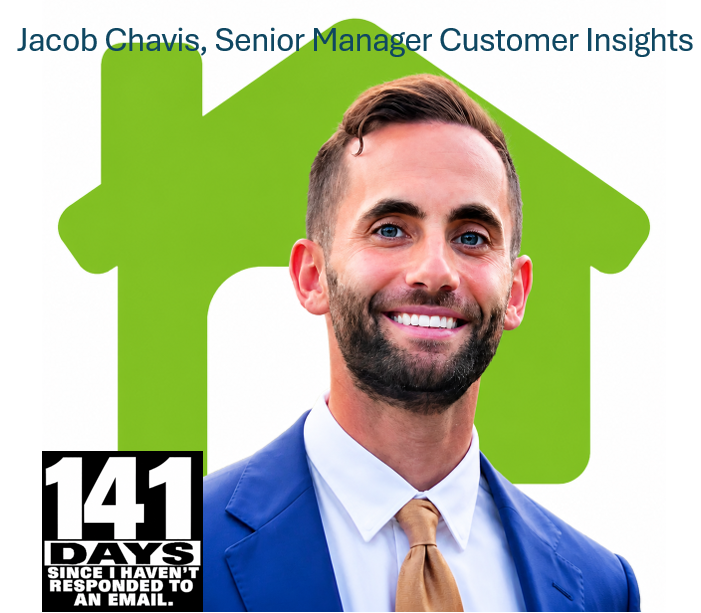
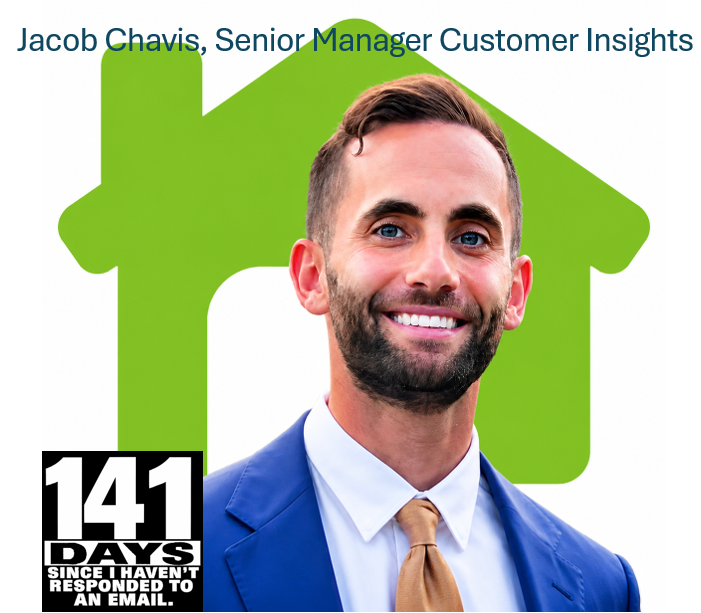
I previously contacted Jacob Chavis about Nextdoor Insights research after public references suggested I could get additional information by reaching out to him. I'm still interested in reviewing the underlying research and methodology.
If the full study is available, why not make it easier to access? If it isn't available, say so.
AI and travel planning: What's really new?
The article also discusses how people use AI and software to plan travel.
Technology-assisted travel planning isn't exactly new.
I remember using MapQuest when it was software installed on a computer. Before that, people used paper maps, guidebooks, travel agents, and all sorts of tools to organize trips.
MapQuest wasn't generative AI, and I'm not suggesting it was. It's simply an example of how people have been using technology to make travel planning easier for decades.
The technology has evolved. The tools are more sophisticated, and generative AI adds new capabilities. But the underlying desire to plan a trip, compare options, and make decisions with technology’s help is hardly revolutionary.
What makes Nextdoor advertising effective?
Here's where I really want to understand the message.
I also saw a Nextdoor post on X discussing the research in the context of effective advertising.
I went back and read the article several times. I couldn't find a clear explanation of what makes advertising effective, how Nextdoor measures that effectiveness, or what specific guidance a small business receives.
Are we talking about impressions? Click-through rates? Engagement? Leads? Store visits? Actual purchases?
Those are very different measurements.
And if a small business is spending money on Nextdoor advertising, shouldn't it clearly understand what it is trying to accomplish and how it will measure success?
My customer experience perspective
I've spent more than 20 years working in learning and development, customer experience, and contact center operations. Measurement has always been part of the work.
I've worked with metrics such as:
Average Handle Time (AHT)
Average Wait Time
First Call Resolution (FCR)
Customer Satisfaction (CSAT)
Calls per hour
Abandoned calls
Quality Assurance (QA) scores
Voice of the Customer (VoC) feedback
And those measurements aren't limited to day-to-day operations. They're used throughout the employee and customer lifecycle.
When you introduce a new hire class, change a procedure, roll out software, or implement a process improvement, you establish a baseline. You identify the business objectives and determine what should change.
Then comes the implementation.
You plan the rollout, prepare employees, provide training, conduct a soft launch when appropriate, move into full implementation, and measure the results.
You monitor the numbers, gather feedback from employees and customers, and determine whether the change actually accomplished what it was supposed to accomplish.
You don't simply announce that a new system will make everything better and walk away.
You measure it.
And you combine quantitative results with qualitative feedback. Surveys, focus groups, employee input, customer comments, and even word of mouth can help explain what the numbers are telling you.
A suggestion for Nextdoor: Hire Karen Romero
Here's a suggestion for Nextdoor: You really need to hire my former colleague and friend, Karen Romero.
She has the kind of QA experience and analytical perspective that could help Nextdoor evaluate whether its advertising campaigns are actually effective.
Think about it. Advertising effectiveness shouldn't be determined solely by how many people saw an advertisement or clicked on it. A proper QA analysis could examine the campaign's objectives, messaging, audience experience, customer interactions, and results to help determine what worked, what didn't, and what needs improvement.
Karen could help craft a meaningful approach to evaluating those campaigns, using QA analysis to go beyond surface-level numbers and identify opportunities to improve the customer and advertiser experience.
She's on LinkedIn, and Nextdoor can reach out to her there.
I'm making this recommendation because I know the value of having the right people involved in measuring performance and improving processes. Sometimes the answer isn't another marketing slogan or another research announcement. It's bringing in people who know how to evaluate the work and turn findings into actionable improvements.
Karen, consider this a public endorsement!

What happens after a small business buys an advertisement?
This is the part I think deserves more attention.
Does Nextdoor give a small business survey percentages and advertising tools, then leave it to figure out the marketing strategy?
Or does Nextdoor offer consultation to help that business determine:
Which audience it should target?
What type of advertising message is most appropriate?
How should the campaign be structured?
What does success look like?
Which metrics should be monitored?
How should the business interpret the results?
What adjustments should be made along the way?
If these services are available, Nextdoor could communicate that value much better.
Small businesses don't necessarily have dedicated marketing departments, analytics teams, or advertising specialists. They may be spending money they can't afford to waste.
An advertising platform should explain not only how to place an ad, but also how it helps businesses understand and evaluate the results.
And no, I'm not suggesting that Nextdoor can guarantee increased revenue. No advertising platform can reasonably promise that every campaign will produce a particular financial result.
But it should explain what it measures, what support it provides, and how businesses can evaluate whether their advertising investment is working.
The bigger picture: Research, transparency, and trust
This is becoming a recurring theme in my Nextdoor case study.
Nextdoor promotes research, insights, advertising opportunities, partnerships, and the value of its platform. Yet I continue to have questions about the details behind those claims.
Research should be supported by accessible methodology. Advertising effectiveness should be measured and explained. Small businesses should understand what they're buying and what resources are available to help them evaluate their investment.
These aren't complicated concepts. They're fundamentals of customer experience and business accountability.
And when a publicly traded company promotes its ability to help businesses grow, investors and customers alike should understand how it delivers that value.
Nirav, add this to the list of questions about why NXDR is struggling to build investor confidence. I wouldn't be surprised if some of these same concerns show up in a Google AI discussion about Nextdoor a year from now.
Day 141. The questions continue. The door is still open.
Day 140: NXDR Slides to $2.23 — What Is Driving Nextdoor's Decline?
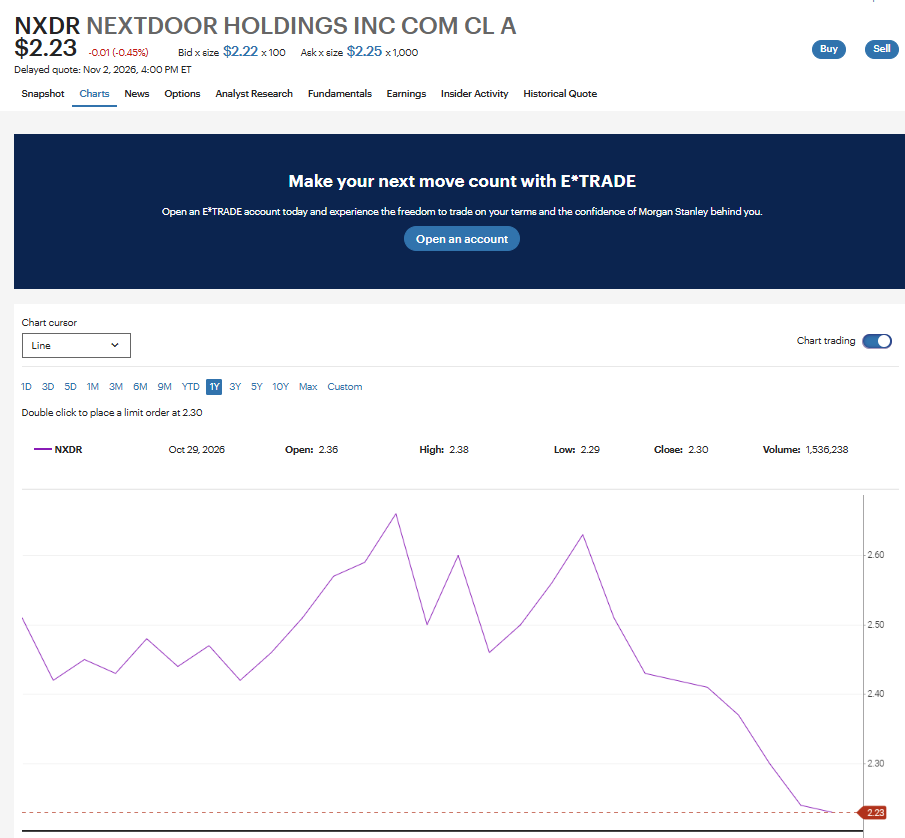
The slide continues.
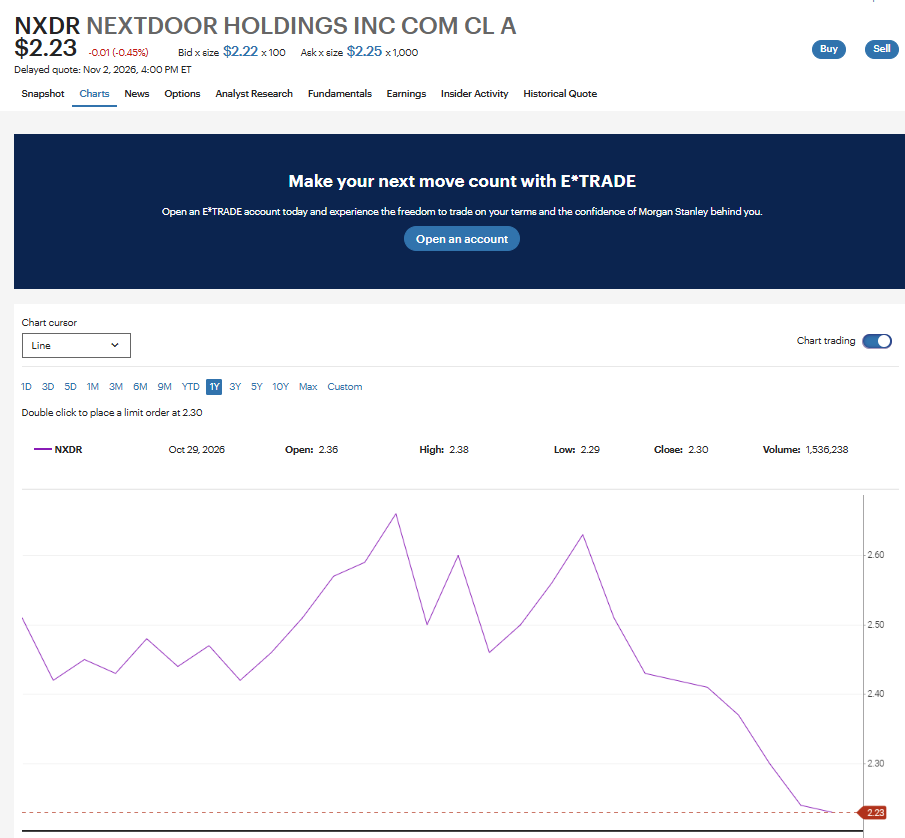
Yesterday, NXDR closed at $2.24. Today, it closed at $2.23, down about 0.45%.
One day, another step backward. Not a dramatic drop on its own, but it's part of a trend that's caught my attention.
I've been watching this movement since October 22, 2026, and I'm curious about what's behind it.
Another day in the wrong direction
I've noticed a pattern in previous earnings cycles. NXDR would bump up in the days leading up to an earnings report, only to give back some of those gains shortly afterward.
This time, something looks different.
Instead of the pre-earnings momentum I’ve seen before, the stock has continued to drift downward.
So what's changed?
Is this normal market activity? Are investors waiting for the next earnings announcement? Are there concerns about the company's financial performance, its growth strategy, advertising expansion, or its ability to turn its audience into sustainable revenue?
I don't know the answer, and I'm not going to pretend that I do.
But I would like to hear an explanation.
So I asked The Google: Why do investors think NXDR is sliding?
I asked The Google why investors believe Nextdoor Holdings (NXDR) is declining.
The AI Overview returned several explanations. Some are particularly interesting because they overlap with issues I've been discussing over the past year.
Here's a summary of what The Google identified:
1. Execution and scale concerns
Investors and analysts may be questioning whether Nextdoor has the cost structure and overhead of a much larger technology platform without generating the revenue to support it.
In other words, does the business have the scale to justify its operating structure?
2. Muted guidance and slower growth
The AI Overview pointed to analyst price-target reductions, with targets moving toward the $2.10–$2.20 range, along with expectations for modest revenue growth and adjusted EBITDA margins.
Revenue growth is important, but investors also want to understand how that growth translates into sustainable profitability.
3. Moderation and user friction
This one should sound familiar.
The overview identified concerns about automated moderation, including ordinary neighbor recommendation posts being classified as commercial content and comment threads being closed.
I've spent considerable time discussing moderation, inconsistent enforcement, and the frustration users experience when legitimate neighborhood conversations are restricted.
A platform depends on its users. Make it difficult for them to participate, and you risk damaging the very community that makes the business valuable.
4. Internal culture and leadership questions
The overview also mentioned concerns surrounding employee stock compensation, workplace culture discussions, and leadership changes.
These are areas that deserve careful examination rather than assumptions. However, questions about leadership stability and the ability to execute a strategy can influence investor confidence.
5. A large cash cushion and corporate urgency
Finally, the overview referenced Nextdoor's substantial cash reserves and argued that a significant cash cushion could reduce pressure to make difficult changes.
Having cash is a strength. But cash alone doesn't guarantee a successful business model, profitable growth, or shareholder returns.
These points come from Google's AI Overview, not independently established explanations for today's price movement. They represent potential investor concerns and should be evaluated against company filings, earnings results, analyst research, and other evidence.
Here's what caught my attention
I may not have used the same polished language as Google's AI Overview, but I've raised every one of these issues over the last year or so.
Execution. Revenue growth. Moderation. User experience. Leadership. Company culture. Cash reserves—shareholder value.
I've written about these subjects repeatedly.
I've questioned whether Nextdoor is building a sustainable business or simply adding more advertising opportunities to a platform that still has fundamental user-experience problems.
I've asked whether the company understands the consequences of moderation decisions and how those decisions affect participation and engagement.
I've questioned whether leadership is listening to users and whether the company is doing enough to communicate with investors.
And I've repeatedly asked for answers to specific questions, including the two detailed research reports that remain outstanding.
Apparently, these aren't just questions coming from one neighbor writing a blog.
They're also among the concerns being discussed in the broader investment conversation.
That doesn't mean my commentary caused the stock decline, nor does it prove that every concern in the AI Overview is accurate. But it does reinforce why these subjects deserve attention.
Will management address the decline?
Nextdoor has an earnings report coming up. That creates an opportunity for management to address more than just revenue, user growth, and adjusted EBITDA.
I'd like to hear how leadership views the market's reaction to the company's performance.
Some questions I'd like answered:
What does management believe is driving the recent decline in NXDR?
Is investor confidence changing?
How is Nextdoor measuring the success of its newer advertising and sponsored-search initiatives?
What is the path toward sustainable GAAP profitability?
What is the company doing to create long-term shareholder value?
How does Nextdoor plan to improve trust and engagement among the neighbors who make the platform valuable?
Revenue growth and user numbers are important. But they don't automatically translate into investor confidence or a stronger stock price.
My concern: Will we get any real answers?
Here's where my skepticism comes in.
I expect the earnings report to focus on the usual financial metrics and forward-looking statements. I wonder whether management will address the questions investors are actually asking about the stock's performance.
And that brings me back to a recurring concern throughout this case study: transparency.
I've spent 141 days raising questions about Nextdoor's communication, leadership, moderation, advertising strategy, and accountability.
I've also requested two detailed research reports and am still waiting for a meaningful response.
The company talks about community, connection, and creating value. But those promises need to extend beyond marketing language.
Investors deserve meaningful communication. Users deserve a platform that puts their experience first.
Day 141: The numbers are telling a story. Is anyone listening?
A 0.45% decline in one trading session isn't necessarily a warning sign on its own. I know stock prices move for many reasons, and I don't have enough information to attribute this decline to any one factor.
But the direction since October 22 deserves attention.
Nextdoor has celebrated 15 years, announced new revenue opportunities, and promoted its partnerships. That's great.
Now I'd like to see the company demonstrate how those milestones translate into investor confidence, sustainable growth, and a better experience for its neighbors.
Nirav Tolia and the Nextdoor leadership team: What is driving the slide, and will you address it?
I'll be watching the earnings report.
Day 141. The slide continues. The questions continue. And the wait for answers continues.
It's Over, It's Really Over! From Radiance of the Seas to Reality
It's over. It's really over.
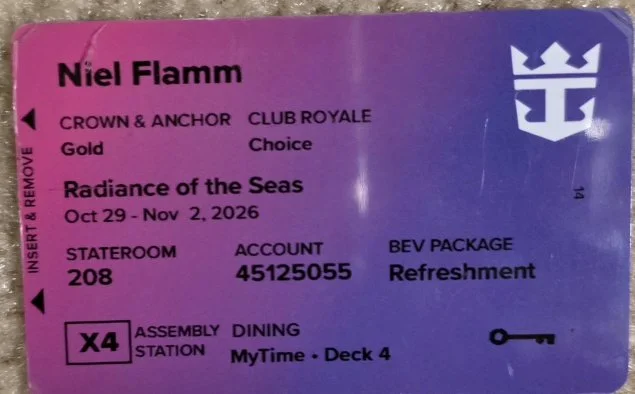
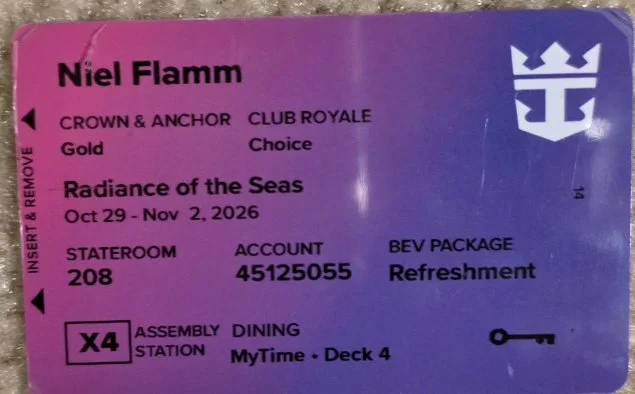
After several days aboard Royal Caribbean's Radiance of the Seas, the vacation has officially ended. The suitcase is back on dry land, the SeaPass card is retired, and it's time to return to reality. Well, almost.
The trip home actually went pretty smoothly. My American Airlines flight was super efficient, and I arrived in Charlotte earlier than scheduled. That's always a nice surprise!
Once I landed, I requested wheelchair assistance. I was handed off to this tiny young woman who was responsible for getting me from the wheelchair staging area to valet parking. Of course, there was one little complication: we had to retrieve my suitcase first.
And let me remind you, this suitcase was overweight. Heavy is probably an understatement.
I managed to get it off the baggage carousel, and she had to roll that beast along with us. We even got a little lost trying to find the valet. Eventually, we made it, and then we had to wait a bit for my car to be retrieved.
No big deal. I had time to reorganize my backpack and tackle the overweight luggage situation.
I pulled out a few things for Airica and a few others, which made the suitcase a little more manageable. It also gave me a chance to get everything sorted before continuing my journey.
A 1.5-hour detour for someone special
Rather than heading straight home, I made the approximately 1.5-hour drive from Charlotte to see Airica.
I delivered her stash of goodies. What did I get her? Well, you'll have to follow her on the social medias and see if she decides to post it. I'm not giving away the surprise here!
We went out to eat, talked about life, caught up, and enjoyed spending time together.
And really, isn't that what it's all about? Spending time with people who matter, sharing a meal, laughing, talking, and enjoying each other's company.
After all the travel, the cruise activities, the food, and the adventures, it was a pretty nice way to wrap things up.
The SeaPass card is officially retired
I took a look at my SeaPass card, and I'm sharing the picture here.
So, you mofos, don't even think about charging anything to my account. It's closed! 😂
There's something a little bittersweet about looking at that card. It's a reminder of the trip, the places I visited, the food I ate, the people I met, and all the little experiences that made the cruise memorable.
I should now have reached Royal Caribbean's Platinum loyalty status. The only problem is that Royal Caribbean's loyalty information seems to take forever to update.
For comparison, I think American Airlines had already updated my flight information by the time I checked, and I had only landed about eight hours earlier. Come on, Royal Caribbean! Surely we can do a little better with the technology.
A little technology appreciation
One thing I forgot to photograph during the cruise was the QR code in the stateroom that let us request commonly needed items from our cabin steward.
Need an extra bar of soap? An extension cord for your CPAP machine? Extra towels or blankets? Scan the code, make the request, and let the crew take care of it.
I think that's awesome.
It's a simple way to make the experience easier for guests and probably cuts down on the back-and-forth communication for the crew.
Now, if Royal Caribbean could take that same idea and apply it to room service, we'd really be getting somewhere!
What's next?
I'll be putting together a more detailed review of Radiance of the Seas, including the ship itself, the service, and the itinerary. There are plenty of things worth discussing, both good and not-so-good, and I want to give those topics the attention they deserve.
And if you think this is the end of my cruise adventures, think again.
There's already another cruise planned for January 2027.
You know the drill, peeps!
Stay tuned. There's more coming!

The Last Day of the Cruise: My Inner Cow Had to Sit This One Out

Today was the last day of the cruise, and if you've ever cruised, you know there's something about that final day that makes you believe your stomach has unlimited storage capacity.
Normally, by this point, I've eaten enough to feed a small village. But somehow, I always manage to find room for just a little more.
I turn into my inner cow. You know, the one with four stomachs. Somehow, I locate the other three that apparently weren't there the day before.
But this morning, I had a moment of reflection. Or maybe it was panic.
I looked in the mirror and saw someone who looked at least six months into gestation. Possibly seven. I'm not sure what the official measurement is, but my stomach was making a convincing argument.
So, I decided to behave myself.
Breakfast was going to be light. I went with a strawberry parfait, a fruit plate, decaf coffee, and tap water.
Of course, the ship wasn't going to make this easy.
I was offered pastries, bacon, toast, pancakes, and plenty of other temptations. All the things that normally make me say, "Well, it's vacation!"
But not today.
I stuck with the options that were a little better for me. No bacon mountain, no pancake tower, and no pastry collection. Just fruit, yogurt, coffee, and water.
Look at me, exercising restraint on the final day of a cruise!
I'm not sure how long this new behavior will last once I'm back home, but for today, I'm calling it a victory.
My inner cow can take the day off. Those other three stomachs will have to wait until the next cruise.
And speaking of the next cruise... January 2027 isn't that far away, is it?

Day 140: Nextdoor Public Safety Alerts and Advertising — Is Anyone Thinking About the User Experience?

Day 140 of my Nextdoor case study.
Nextdoor posted two times on LinkedIn today, apparently making up for last week's lack of activity. One discussed winter travel, which I'll save for tomorrow. Today's post caught my attention because it focused on public agencies and Nextdoor's partnerships with them.
The post discusses how to write a better public safety alert, using guidance from the Behavioral Comms Lab.
Here's the LinkedIn post:
I'm sure the tool and guidance can be helpful. When public agencies communicate with residents during emergencies, the wording, timing, and clarity of an alert can make a real difference.
But, as usual, I noticed a couple of things that made me stop and ask questions.
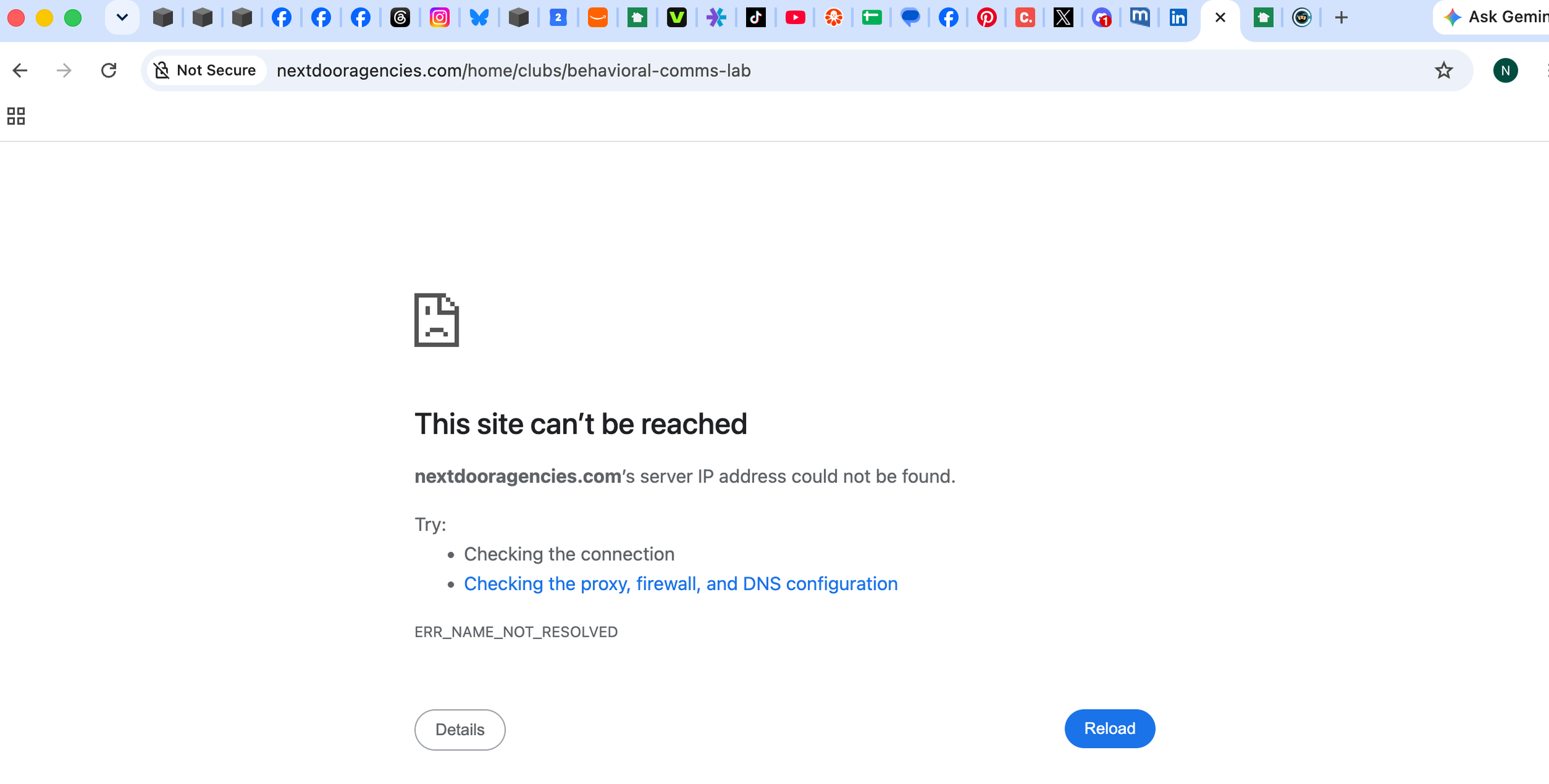
First problem: The link doesn't work
Nextdoor provided a link for readers who wanted to learn more about the Behavioral Comms Lab:
https://nextdooragencies.com/home/clubs/behavioral-comms-lab
I tried accessing it while sitting at Tampa International Airport, connected to public Wi-Fi. I initially had my VPN enabled. I turned it off and tried again.
I still couldn't access the resource.
So, let me get this straight. Nextdoor is promoting a tool intended to help public agencies communicate more effectively, but the link provided to learn more doesn't work for me.
Am I supposed to wait until I get home and use my private internet connection before I can access a guide on writing a better public safety alert?
Perhaps I've left danger behind and am now in a safer place because I'm using public airport Wi-Fi. Maybe that's the secret!
Of course, I'm being sarcastic. The point is that a link promoted publicly should work across ordinary internet connections. If access is restricted, the page should explain why. If the link is broken, someone should fix it.
Someone at Nextdoor should have tested this before publishing.
A simple quality-assurance check could have caught the problem.
Second problem: Where does the important alert appear?
This is where I have a bigger concern.
One of the ongoing complaints about Nextdoor is the amount of advertising appearing throughout the platform.
I understand advertising. It's a business, and advertising revenue helps keep the lights on. Nextdoor needs to generate revenue, attract advertisers, and build a sustainable business.
I'm not suggesting that advertising should disappear.
But let's talk about priorities.
If a public agency uses Nextdoor to publish an important alert about severe weather, a road closure, an evacuation, a public safety threat, or another urgent community issue, where does that alert appear in the neighbor's feed?
Will it be prominently displayed?
Or will a neighbor have to scroll past five, ten, or more ads before finding information that could matter to their safety?
That's not a trivial user-experience question.
An emergency alert should not have to compete with an advertisement for a product, service, or business.
The algorithm needs to understand the difference
Nextdoor should have a clear way to prioritize verified public agency alerts.
If the platform already has a system that prioritizes these messages, lead with that information. Explain how it works.
For example:
Are alerts from verified public agencies automatically prioritized?
Do they appear differently from ordinary neighborhood posts?
Are they protected from being buried by sponsored content?
Does the platform adjust their visibility based on urgency and geographic relevance?
Can an agency determine whether residents actually saw the alert?
These questions matter because publishing an alert and successfully communicating it are two very different things.
A public agency may do everything right: write a clear message, provide useful instructions, and publish it through an established partnership.
But if the platform doesn't deliver that message prominently to the people who need it, what has actually been accomplished?
The quality of the alert matters. So does the quality of the distribution.
Public agency partnerships come with responsibility
Nextdoor has an opportunity to be genuinely useful to communities through its relationships with public agencies.
That opportunity also comes with responsibility.
When residents rely on a neighborhood platform for local information, they need to know that important messages won't be treated like just another piece of content competing for attention.
I would like to see Nextdoor explain how it prioritizes public agency alerts, how it measures reach, and what safeguards prevent important information from being buried beneath advertising.
And while we're at it, please test the links included in your own promotional posts.
That's not asking for anything extraordinary. It's basic quality assurance.
Day 140: Nirav Tolia and the Nextdoor team, you're welcome.
Here we are at Day 140 of my case study. Another day of identifying things that deserve a closer look.
I keep providing feedback because I believe Nextdoor has tremendous potential. Public agency partnerships could be one of the platform's most valuable services.
But potential doesn't automatically translate into a good user experience.
Fix the broken links. Explain how public safety alerts are prioritized. Make sure critical community information gets visibility ahead of ordinary advertising.
Nirav Tolia and the Nextdoor team, you're welcome for the feedback. I'm trying to help you improve what I believe is severely broken.
And tomorrow, I'll turn my attention to that other LinkedIn post about winter travel.
One day, one Nextdoor post at a time.