
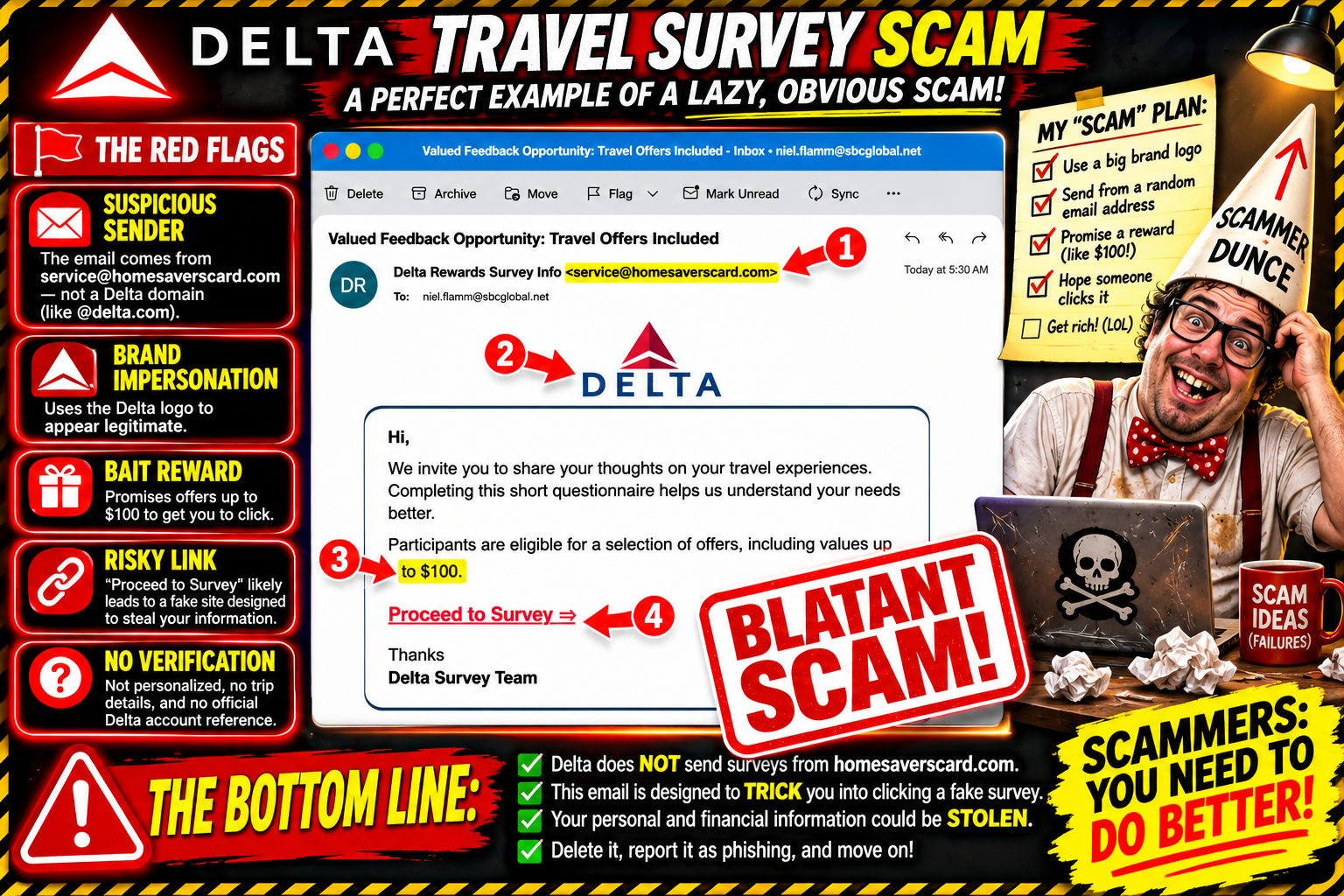
My inbox has another opportunity for me today.
This time, I'm apparently being invited to share my travel experiences with Delta Airlines in exchange for a chance to receive offers worth up to $100.
Well, isn't that generous?
The email arrived with the subject line:
“Valued Feedback Opportunity: Travel Offers Included”
The sender identifies itself as Delta Rewards Survey Info, but the actual email address is:
Wait a minute.
Delta Airlines... and Home Savers Card?
Something doesn't quite add up.
The Offer: Tell Us About Your Travel and Get Up to $100
The email features the Delta logo and a message inviting me to share my thoughts about my travel experiences.
It says completing a short questionnaire will help the company better understand my needs.
And here's the reward:
Participants are eligible for a selection of offers, including values up to $100.
There's a big red link encouraging me to:
Proceed to Survey
The message is short, polished enough to look like a promotion, and uses a familiar airline brand.
But the sender's actual email domain doesn't appear to have any connection to Delta.
That's my first red flag.
Delta? Home Savers Card? Who Is Actually Sending This?
Here's what we have.
Display name: Delta Rewards Survey Info
Actual sender: service@homesaverscard.com
Subject: Valued Feedback Opportunity: Travel Offers Included
Offer: A survey about travel experiences
Potential reward: Offers valued up to $100
Call to action: Proceed to Survey
The email uses Delta's branding, but the sender address raises a very reasonable question: who is actually behind this message?
I can't identify the sender or the survey link's destination from the screenshot alone. I also can't confirm whether the advertised reward exists.
But I certainly wouldn't click the link to find out.
If Delta wants my feedback, I'll go directly to Delta's official website or app and check for a legitimate survey or promotion.
I don't need an unrelated-looking email domain as a middleman.

Scammers, You Need to Do Better!
Here's something I've been thinking about as I keep documenting these messages.
Some of these scammers are making it far too easy to recognize that something is wrong.
If the goal is to convince people that a message is legitimate, why are there so many obvious inconsistencies?
Delta Airlines using a Home Savers Card email address?
A free Medicare Kit from a random Gmail account?
A USPS Cart offered through an unrelated survey domain?
A recruiter promising a six-figure opportunity without identifying the actual job?
Come on!
At some point, the lack of effort becomes the biggest warning sign.
I'm not suggesting criminals need coaching or that I want to help them succeed. Quite the opposite. I'm pointing out how frequently these messages fall apart under even a little scrutiny.
Think About the Movies: The Criminals Who Actually Planned
I recently mentioned movies like Ocean's Eleven, The Italian Job, and The Town when discussing a suspicious recruiting message.
Those fictional capers involved planning, preparation, coordination, and attention to detail.
The characters didn't just show up, announce what they were doing, and expect everything to work out.
And that brings me to a broader observation.
Criminals who attempt bank robberies, pass counterfeit checks, or use stolen identities to purchase expensive items can get caught because they make mistakes, overlook details, underestimate the people investigating them, or leave evidence behind.
Being involved in a crime doesn't make someone clever. And getting away with something temporarily doesn't mean someone has a good plan.
The same general principle applies to these suspicious emails: the more obvious the inconsistencies, the easier it is for recipients to recognize the warning signs.
The real objective here isn’t to help scammers improve. It's to help potential victims recognize the nonsense before they lose money or personal information.
The Problem With These Messages
A familiar brand name can make people let their guard down.
When someone sees Delta, MyChart, USPS, PayPal, or another recognizable organization, they assume the message deserves attention.
Then comes the offer:
Complete a survey.
Claim a reward.
Receive a free gift.
Confirm an account.
Resolve an unexpected charge.
The next step often involves clicking a link or providing information.
That's where I want people to slow down.
A logo is not proof of legitimacy. A familiar company name is not proof of legitimacy. A professional-looking email is not proof of legitimacy.
And an offer worth up to $100 doesn't mean you're actually receiving $100.
What I'm Doing With This One
I'm not clicking the survey link.
I'm not providing personal information.
I'm not giving the sender access to my travel preferences, accounts, or payment information.
If I want to participate in a Delta survey, I'll verify it through Delta's official channels.
And if the offer can't be independently verified, it can stay right where it belongs: in my suspicious-email collection.
The Bottom Line: Don't Make It Easy for Them to Fool You
I know these emails can be convincing to people unfamiliar with phishing tactics. That's why I keep sharing examples.
Not everyone has the time or experience to examine an email address, inspect a link, or recognize when a familiar brand is being used in a questionable message.
That's also why these messages deserve attention.
I don't want people to lose money because they thought they were claiming a travel reward, receiving a medical benefit, or responding to a legitimate company.
As for the supposed Delta offer, I'll pass.
My travel feedback isn't worth handing over my personal information to an unverified sender.
Have you received a similar survey or reward offer using a familiar company logo? Send me a screenshot at niel@nielflamm.com. Please remove personal and financial information first.
I'll keep collecting these examples and sharing the warning signs.
And to the people sending these messages: if your email falls apart the moment someone looks at the sender address, perhaps it's time to rethink your business model.
Actually, no. Better yet, find something legitimate to do.
I'll keep watching. And I'll keep sharing.
