
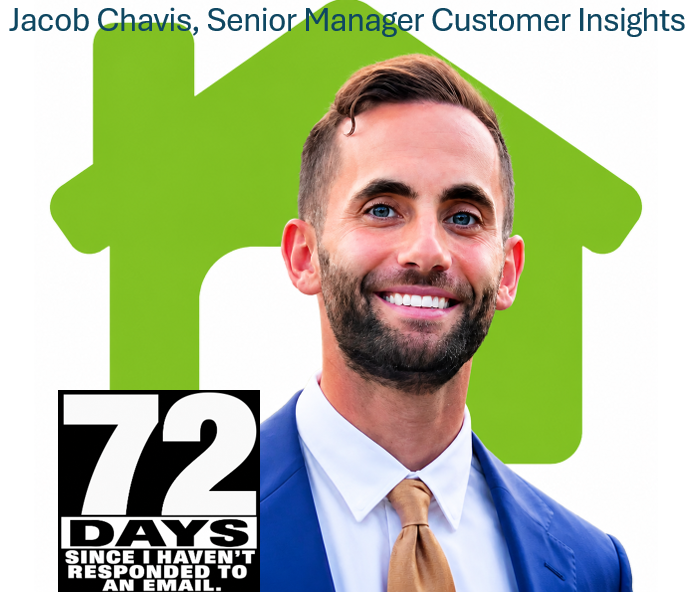
Day 72: “We Cannot Lose Our Humanness.” Are You Kidding, Nextdoor?
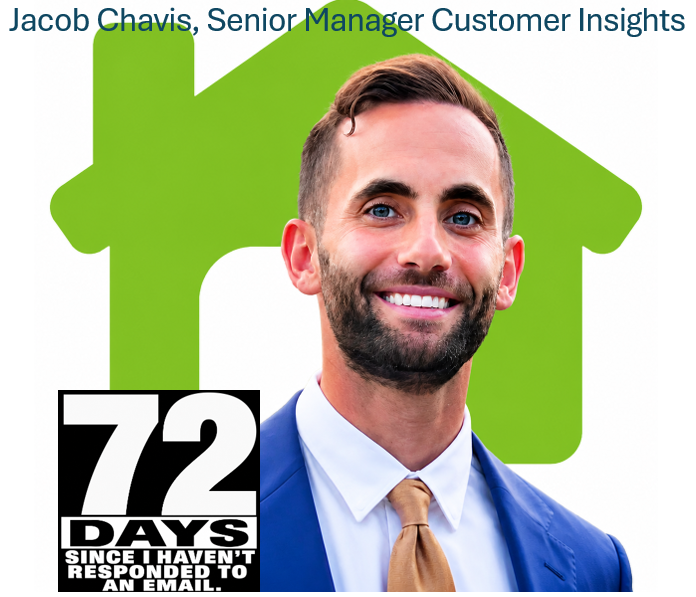
I saw Nirav Tolia is back on the podcast circuit, this time with Scott D. Clary on Success Story.
The title certainly got my attention:
“The Man Who Connected 100 Million Neighbors Says AI Is About to Make Us All Lonelier.”
Podcast:
https://lnkd.in/d6ncXhpj
Video:
https://lnkd.in/dY9AazUx
One of the first statements from Nirav highlighted in the LinkedIn post was:
“We cannot lose our humanness.”
I read that and thought:
He's kidding, right?
Not because I disagree with the statement.
Actually, I completely agree with it.
My issue is the disconnect between the rhetoric and what I've been observing and experiencing with Nextdoor.
What Does “Humanness” Actually Require?
Being human isn't simply having conversations about the dangers of AI.
To me, humanness includes:
Listening.
Empathy.
Accountability.
Acknowledging someone even when the conversation is uncomfortable.
And that's where Nirav's statement becomes fascinating when compared with what's happening at the company he leads.
It's Day 72 since I requested the detailed Home Insurance Insights research.
Enough said about that.
But this isn't only about me.
What About Nextdoor's Small Businesses?
I've been watching the reaction to Nextdoor's new pay-to-play approach, where businesses may have to pay to comment as businesses when a neighbor posts looking for a service.
And I've seen small-business owners who are not happy.
These aren't giant corporations with unlimited marketing budgets.
They're plumbers.
Landscapers.
Contractors.
Cleaners.
Handymen.
Local service providers.
Many operate on razor-thin margins.
They're also part of the small-business economy that helps keep communities—and the United States—running.
So while Nirav is discussing preserving our humanness in an AI-driven world, I'd like to know:
Who's listening to them?
Was someone sitting with Nirav when this monetization strategy was discussed asking:
“What does this mean for the small businesses that helped build engagement on our platform?”
Was there a focus group?
A beta?
Did anyone calculate the impact beyond Nextdoor's potential revenue?
Was there an effort to create buy-in?
Did anyone practice the very human behavior of listening before acting?
Maybe there was.
If so, please tell us about it.
Another Chapter in the White Paper on Rhetoric
That's increasingly what I find fascinating about studying Nextdoor.
The external messaging sounds terrific.
Community.
Connection.
Neighbors.
Humanness.
Then I compare those words with what I'm observing.
A shareholder waiting 72 days for detailed research he's repeatedly requested.
Small businesses questioning a new monetization model.
Corporate LinkedIn posts where comments are frequently unavailable.
Communication that, from my perspective, too often feels one-directional.
That's not an AI problem.
That's a human communication problem.
Nirav is right about one thing:
We cannot lose our humanness.
But perhaps the first place to demonstrate that philosophy isn't another podcast.
Maybe it's inside Nextdoor.
Listen.
Respond.
Show empathy.
Explain difficult decisions.
Engage with people who disagree.
Be accountable.
Otherwise, this becomes another fascinating chapter in my growing white paper on the difference between corporate rhetoric and corporate behavior.
And AI didn't create that problem.
Humans did.
Day 72.
Follow the continuing Nextdoor study at NielFlamm.com/blog.
Please subscribe at NielFlamm.com so you don't miss a post if the platform where you're reading this decides not to show you the next one.
Where Are Nextdoor's Moderators?
The Nextdoor experiment continues, and once again I find myself asking the same question:
Where are the moderators?
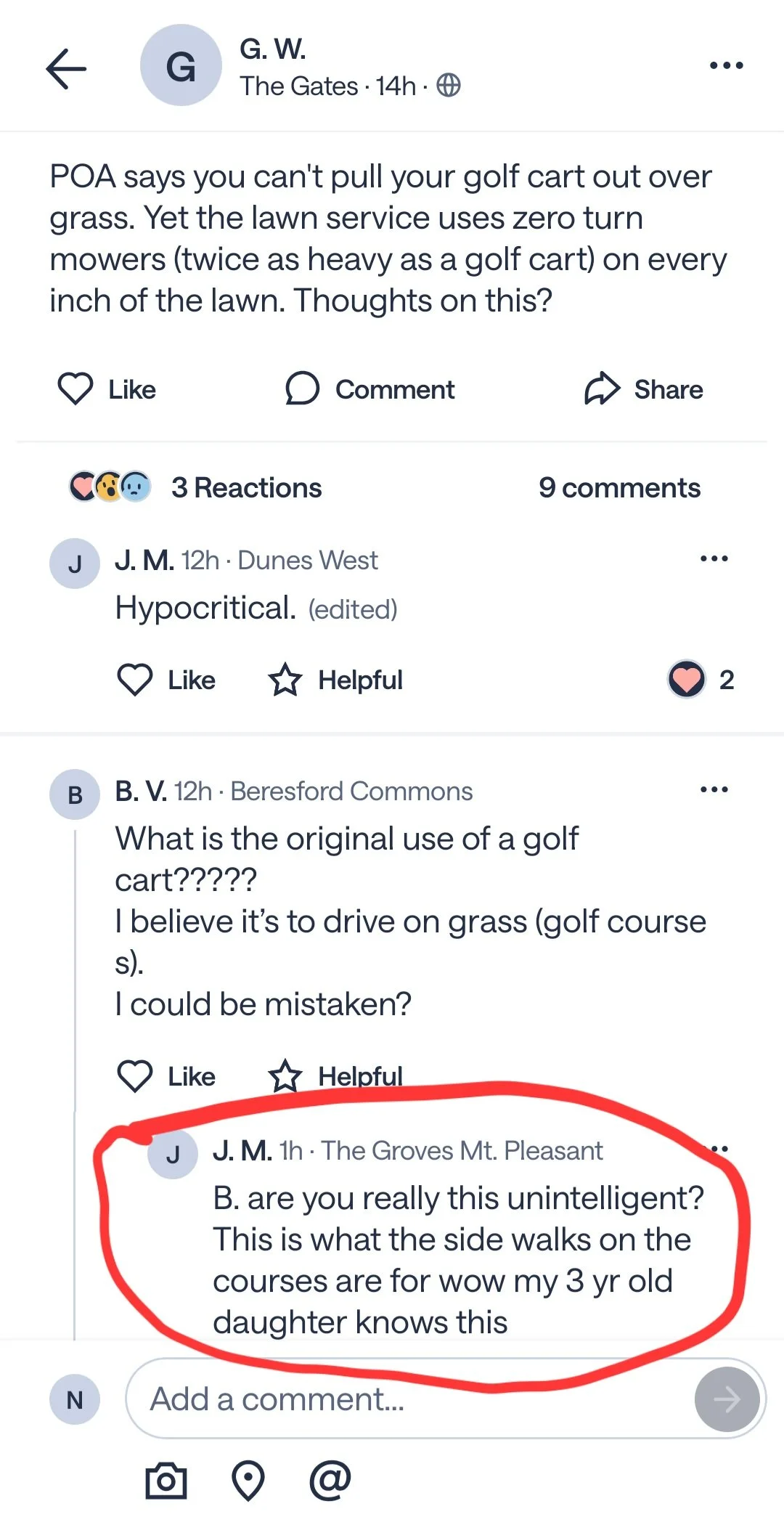
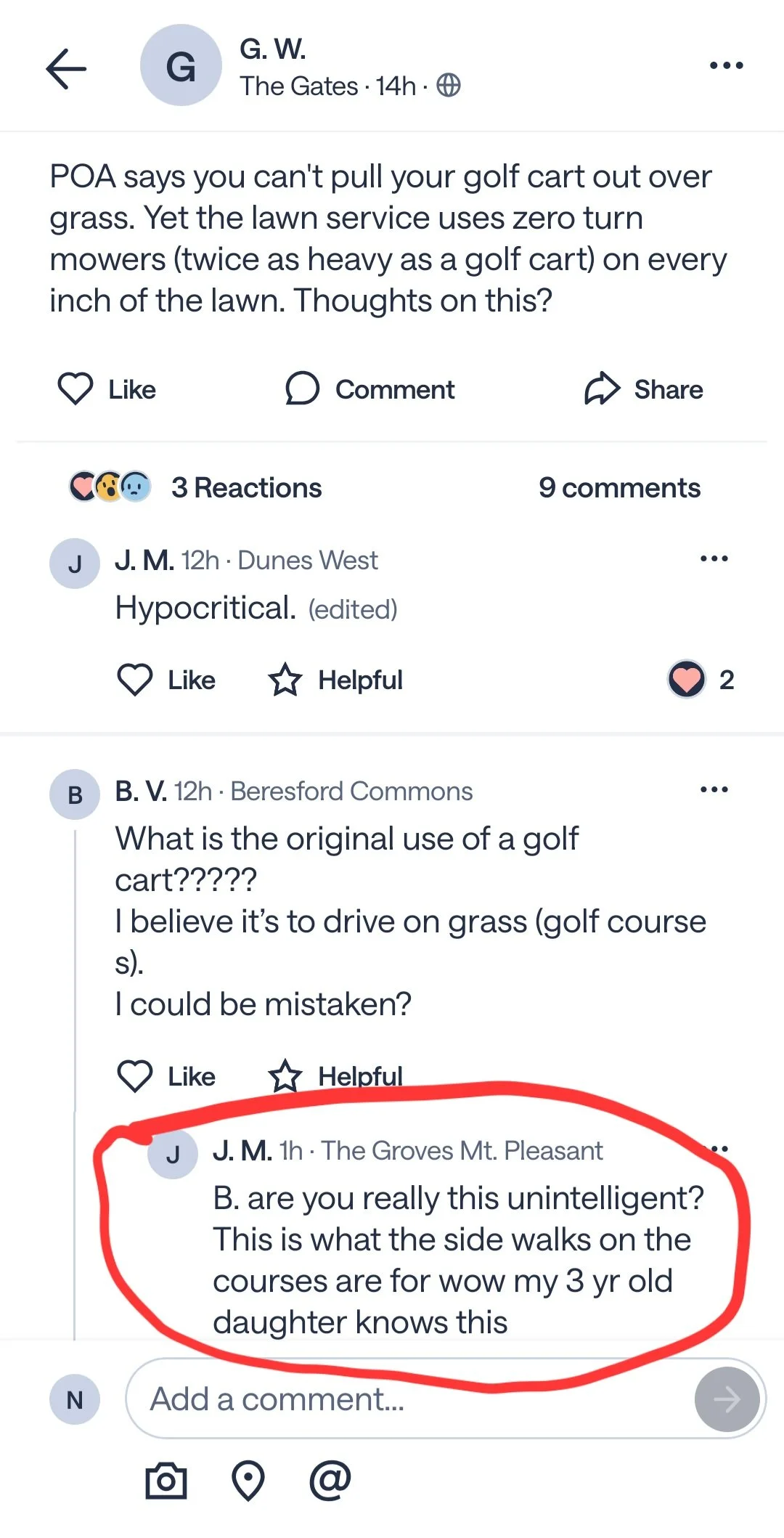
I came across a post from a neighbor that asked what I thought about whether golf carts should be driven across grassy common areas. The neighbor even compared it to commercial landscaping crews using zero-turn lawn mowers.
Whether you agree with the comparison or not, it was a discussion.
Then came the comments.
One neighbor called another "unintelligent."
According to the timestamp, the comment remained on the platform.
That leaves me asking the same questions I've been asking for weeks:
Where are the unpaid moderators?
Who reviews their decisions?
Is there any quality assurance process?
How is this type of personal attack allowed to remain while other users are suspended for much less?
For those who can't see the screenshot, I've included it in today's post on NielFlamm.com/blog.
As a shareholder, I'm also scratching my head.
The stock closed around $2.54 today.
What value is the market seeing if the platform continues to struggle with consistent moderation and identity verification? That's a question I'm trying to understand as I continue following the company.
On a different note, I've started using Citizen, and my initial experience has been positive.
Within minutes, I learned about a fatal crash approximately 3.9 miles from me, could see how many active users were nearby, and viewed other developing stories, including reports of a gastrointestinal outbreak affecting multiple states.
It's still early, but I'm looking forward to comparing the two platforms as I continue using Citizen.
Competition has a way of making every company better.
And that's good for users, advertisers, and shareholders alike.
Join the discussion on NielFlamm.com.
Day #11: Three Requests, Still No Study
Day #11: Three Requests, Still No Study
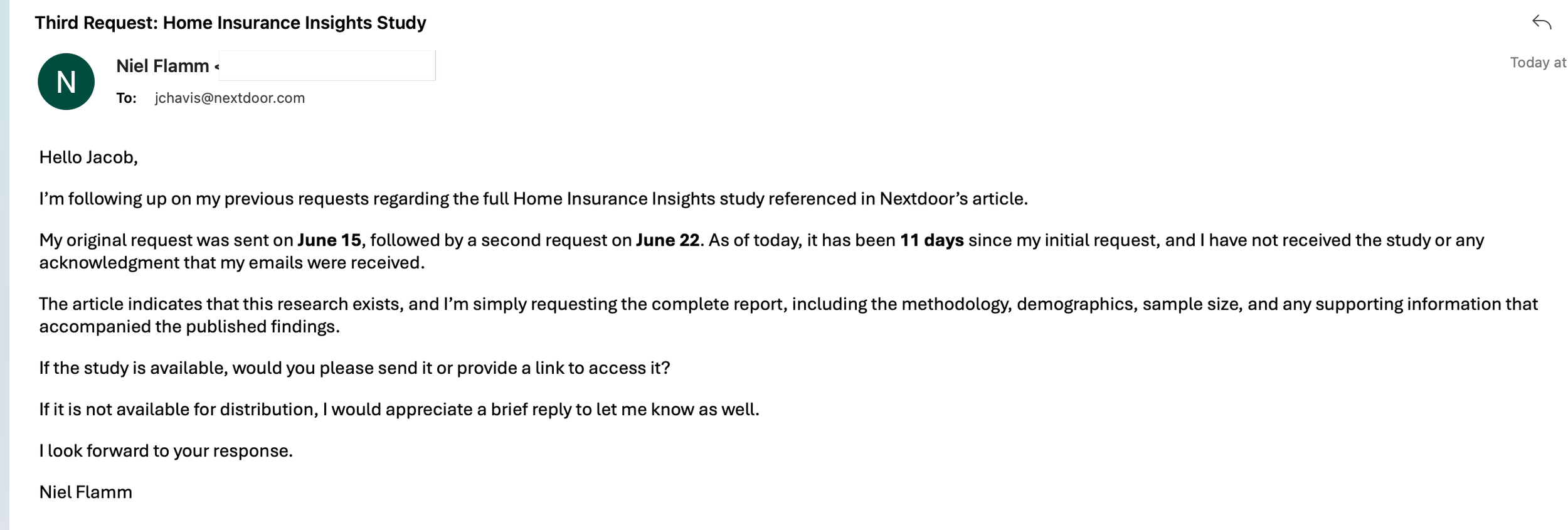
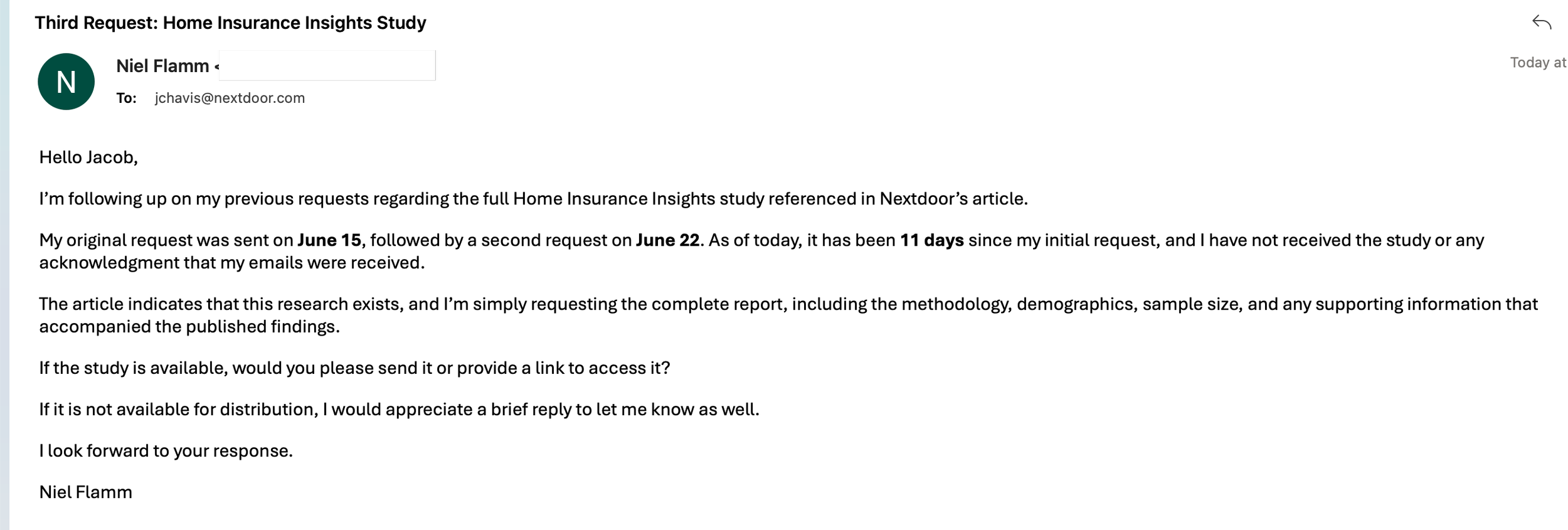
Today I sent my third request for the Home Insurance Insights study referenced by Nextdoor.
Here’s the timeline:
June 15: Initial request for the full study.
June 22: Follow-up request.
Today: Third request.
As of today, it’s been 11 days since my original email.
The result?
No acknowledgment.
No explanation.
This isn’t about whether I agree or disagree with the findings.
It’s about transparency.
If a company publicly references research, it seems reasonable to expect that someone requesting the underlying methodology, demographics, and supporting information would at least receive a response.
Instead, the silence has become the story.
It also raises a broader question.
If this is how an investor is treated when requesting information referenced in a public article, what should users, local businesses, advertisers, or other shareholders expect when they have a question that needs attention?
Leadership sets expectations.
Culture determines whether those expectations are met.
At some point, a simple reply becomes less about one email and more about how an organization values communication and accountability.
If the study arrives tomorrow, I’ll gladly share that update too.
Join the discussion on NielFlamm.com.
I came across a Facebook video today that immediately reminded me why Nextdoor's unpaid moderator model doesn't work.
Watch it here:
https://www.facebook.com/share/v/1LCFC3TzYb/
The video shows what can happen when someone believes they have authority beyond what was intended. The result is an environment where people stop engaging because they don't feel heard or treated fairly.
That's exactly the risk of relying on unpaid neighborhood moderators with inconsistent oversight and accountability.
The frustrating part is that this is fixable.
I've repeatedly suggested that Nextdoor implement a Quality Assurance scoring program similar to those used in customer service organizations, where moderator decisions are routinely reviewed for consistency, policy adherence, professionalism, and bias. I even suggested that Karen Romero lead such an initiative through coaching, calibration sessions, and measurable quality metrics.
I've also raised another question that I believe deserves an answer.
What vetting and ongoing safeguards exist to protect users if an unpaid moderator becomes unhinged and decides to retaliate against a local neighbor?
Moderators operate within communities tied to real identities and local information. If someone abuses that position, what oversight exists? What audit trail is reviewed? What protections are in place for the people they moderate?
I've asked these questions repeatedly at multiple levels within Nextdoor.
So far, the response has been silence.
I'm not simply saying the model is broken and walking away. I'm proposing practical improvements and asking reasonable governance questions.
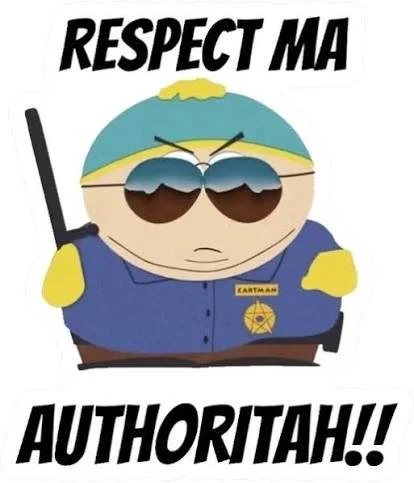
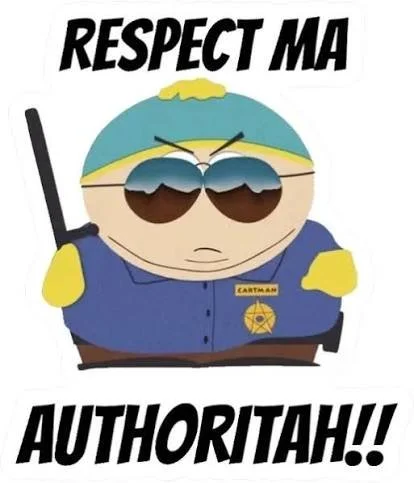
For a little humor, I added a picture of Eric Cartman and his famous catchphrase, "Respect my authoritah!" While it's meant to be comedic, it's often the image that comes to mind when I think about unpaid moderators sitting behind a monitor, wearing an imaginary badge and sunglasses, convinced they've been granted far more authority than they actually have.
Leadership doesn't have to agree with every suggestion, but acknowledging thoughtful feedback and explaining existing safeguards would go a long way toward building trust with users and shareholders alike.
The issue isn't the volunteers themselves.
The issue is a moderation model that lacks the transparency, oversight, and quality controls necessary to inspire confidence.
Communities deserve consistency. Volunteers deserve coaching. Users deserve answers.
And great leaders don't ignore difficult questions.
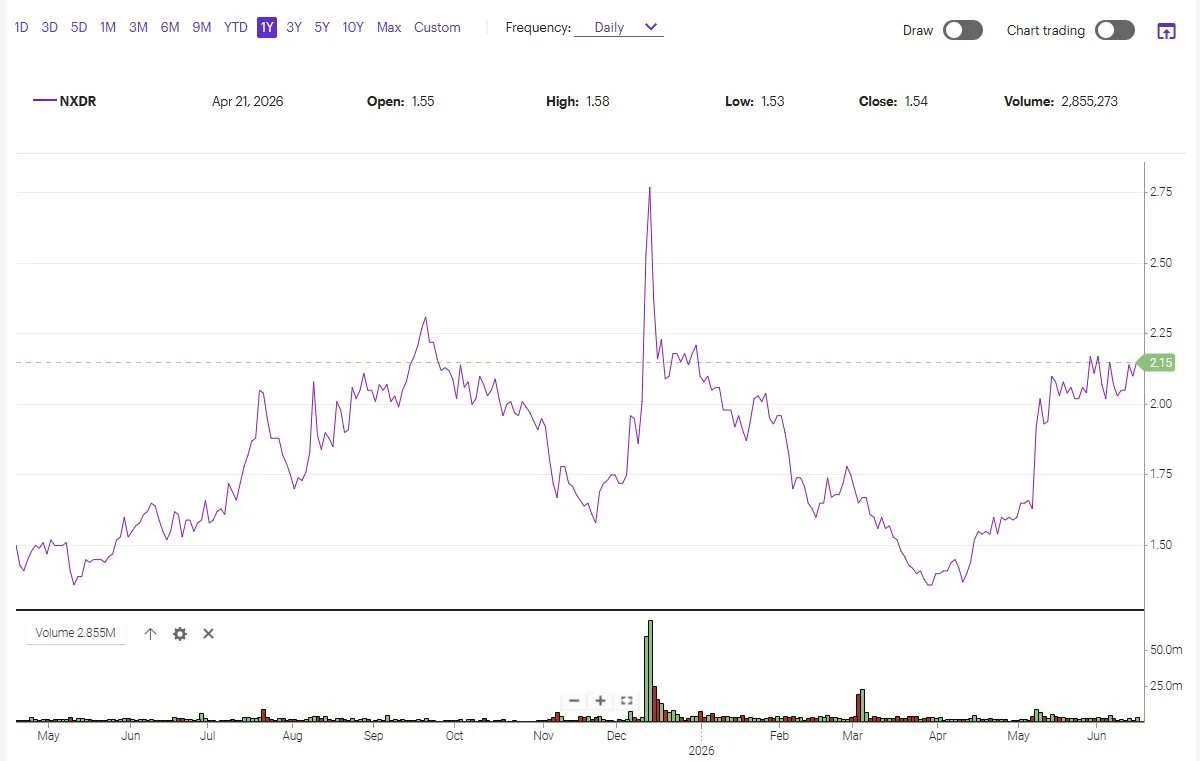
NXDR and The Gambler: Know When to Hold 'Em... and Know When to Walk Away
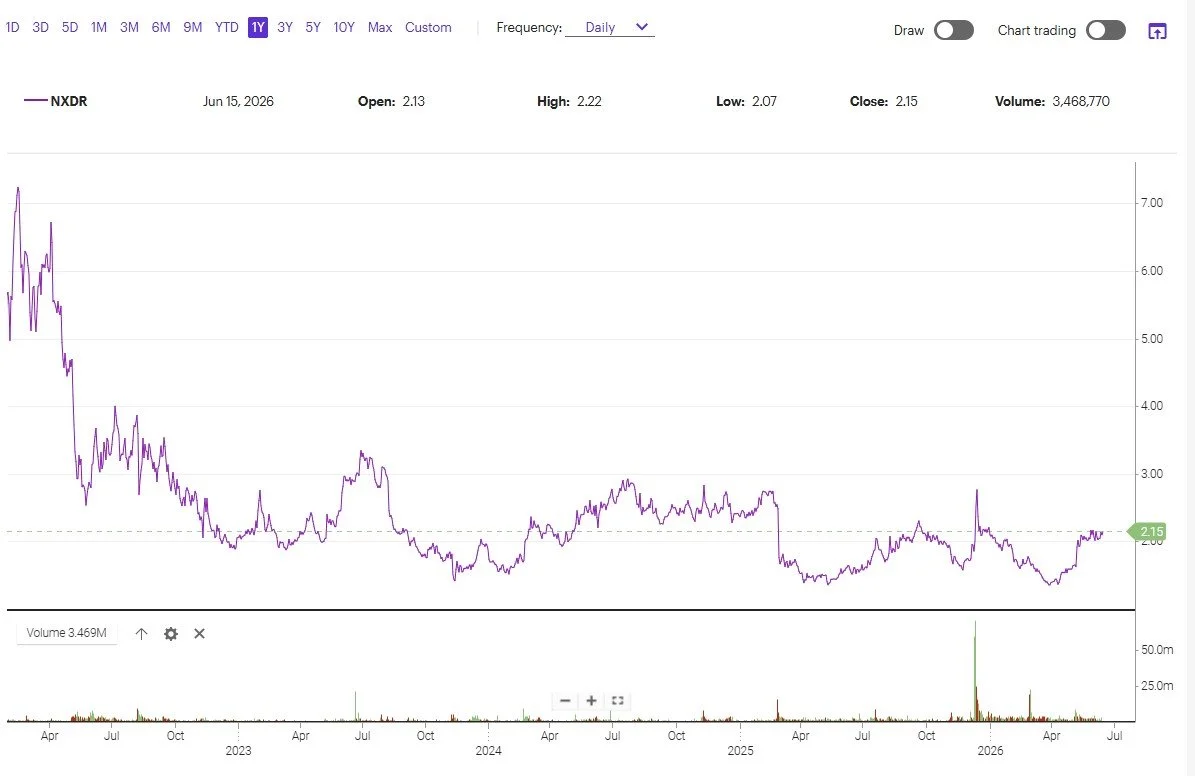
Looking at the 1-year chart of Nextdoor Holdings (NYSE: NXDR), the stock is up roughly $0.60 year over year, rewarding investors who bought during periods of pessimism.
Based on the historical trading patterns I've observed over the past four years, I believe July could bring another round of profit-taking as short-term investors lock in gains.
Kenny Rogers' The Gambler offers timeless investing wisdom: "Know when to hold 'em" and "know when to walk away." For investors, knowing the difference can mean everything.
That brings me to a larger question.
What is CEO Nirav Tolia doing to ensure minority shareholders receive a meaningful return on their investment?
If AI is truly the future of Nextdoor, why aren't users seeing a steady stream of innovative features that strengthen neighbor relationships and make communities more useful?
Instead, the public conversation often revolves around disputes over moderation, neighborhood division, sponsored surveys, and advertising initiatives.
Likewise, the recent publicity campaign featuring appearances on podcasts and interviews may generate headlines, but has it materially changed user engagement, revenue growth, or investor sentiment? The stock chart suggests investors are still waiting for stronger evidence of execution.
Nirav Tolia graduated from Stanford with a degree in English, and he is clearly an effective communicator. But public companies ultimately succeed by delivering measurable results, not compelling narratives. We expect a strategy supported by transparent metrics and product execution.
Some questions I'd like leadership to answer:
Where are the AI features that materially improve the neighbor experience?
How is AI translating into shareholder value?
Why does the platform still appear more divisive than connective?
What measurable milestones should investors expect over the next 12 months?
How will management demonstrate that AI investments are producing tangible financial returns?
As a shareholder, I want Nextdoor to succeed. But success requires more than media appearances and AI talking points. It requires products that users love, communities that thrive, and financial results that reward investors.
These are my personal opinions and observations and should not be considered financial advice. Always perform your own due diligence before making investment decisions.