
My Mother Is a Horrible Patient
My mother is a horrible patient. The irony of the word “patient” is not lost on me.
When I was in the hospital, I hardly used the call button. Yesterday, during the roughly three hours I spent visiting my mother, she used hers four times. Clearly, we have different approaches to that button.
Today, I tried to explain that she’s in a facility where everyone needs help, and more people need assistance than there are people available to provide it.
She told me she needed help right away.
I pointed out that everyone asking for help probably feels they need it right away, too. Staff has to work through those requests. She needs to have some patience.
Now, I’m not suggesting she shouldn’t ask for help when she needs it. That’s what the button is for. But needing assistance and expecting someone to appear immediately are two different things. That was the point I was trying to make.
Apparently, a different message arrived.
When we got to her room, her roommate asked how she was doing.
My mother replied, “My son said I’m a bitch.”
“What??? I didn’t say that.”
There’s quite a distance between “You need to have more patience” and what she told her roommate. Somehow, my mother covered it in record time.
I explained to her roommate that I had said she needed to be more patient because she was in a place where everyone required help. That was the conversation. No name-calling. No insult.
My mother has always had a tendency to tell stories that, from where I’m standing, aren’t based on the facts. This time, I was right there to hear myself become the villain in a conversation I’d actually participated in.
I understand that needing help is frustrating. Waiting when you’re uncomfortable can feel endless. I can sympathize with that and still wish she’d recognize that the people helping her are also helping everyone else.
And I’d appreciate it if, when quoting me, she used something I actually said.
I went there trying to explain patience to my mother. By the time we reached her room, I was getting a lesson in how much of it I still needed.

Day 97: The Stock Is Moving. My Email Is Moving. But Is the Company Learning?

Welcome to Day 97.
Let's start with some good news for Nextdoor shareholders.
NXDR had a good week. It moved from roughly $2.38 to $2.49, up about 4.6%. Investing.com
That's progress.
But perspective matters. NXDR remains below its 52-week high, and it's also below Citigroup's $2.85 price target. Citi raised that target from $2.30 in August while maintaining its Neutral rating. Yahoo Finance
As a shareholder, I'll happily take an up week.
Now, back to our regularly scheduled programming.
Another Email Is Coming
I will be sending another email asking Nextdoor for the detailed Insights studies I've now been requesting for 97 days.
Not the public blog posts.
Not links back to the summaries.
The detailed data that Nextdoor's own posts told readers they could request.
The question hasn't changed.
But after 97 days, maybe there's another question worth asking.
What Is the Cost of an Unfinished Task?
I've encountered this repeatedly during my career in Learning & Development.
People tend to measure the cost of doing something.
We don't always measure the cost of not finishing it.
Think about what's happened here.
One unanswered request became a follow-up.
The follow-up became another email.
Then another.
It became blog posts.
LinkedIn posts.
A 97-day running case study.
And now we're approaching Day 100.
That's organizational debt.
Every time an issue gets passed along, ignored, misunderstood or left without an owner, the organization doesn't necessarily make it disappear.
Sometimes it accumulates interest.
Imagine the Alternative
Imagine if somewhere around Day 3 someone had simply written:
“Niel, here's the data.”
Or:
“Niel, we're sorry, but we're not providing the detailed study.”
Or:
“Here's who handles these requests.”
Three sentences.
Done.
Instead, I'm preparing another email on Day 97.
That's why this stopped being merely about two Insights studies a long time ago.
For me, it has become a fascinating real-world example of organizational follow-through.
You can have talented employees.
You can have executives appearing on podcasts.
You can have AI strategies.
You can have a rising stock price.
But organizations are also judged by something much less glamorous:
Can somebody just finish the task?
NXDR had a good week.
I'm glad.
I'm a shareholder. I want more good weeks.
But I'm also still waiting for an answer to a question that should never have survived for 97 days.
Another email is coming.
Three more days until Day 100.
At this point, I'm genuinely curious which arrives first:
The studies—or triple digits.
👉 Follow the continuing case study at NielFlamm.com/blog
Southern Hello Comes with a Recipe
Yesterday, I hobbled across the parking lot into the Harris Teeter at Rivertowne, focused on getting from my car to a scooter cart.
Behind me, a gentleman older than I am said hello. He wore jeans, a T-shirt, and a large checkered long-sleeve shirt, which struck me as a lot of clothing for the temperature. I was already working up a sweat just watching him.
Naturally, I said hello back.
It’s the South. You say hello. What you don’t always realize is that you’ve just agreed to attend a presentation.
“I love Bojangles rice and red beans,” he announced.
No introduction. No transition. We went straight from greetings to side dishes.
Great! I hadn’t known he didn’t like them, but I was pleased we’d cleared that up.
I kept hobbling. He kept talking.
He explained that he buys the family size.
This man really loves his rice and beans, I thought. We hadn’t even reached the store, and I already knew his preferred restaurant, his preferred side, and his purchasing strategy.
Then he said he keeps them for a few days.
Then he said he doesn’t.
At this point, I wasn’t sure whether we were discussing leftovers or taking sworn testimony.
What he does, he explained, is put the rice and beans in a pan. Then he cracks an egg into it, scrambles it, and mixes the whole thing together.
And that, friends, is where he lost me.
“I don’t eat eggs,” I told him. “Eggs are gross.”
Now, I could have stopped there. A person with a functioning conversational brake pedal probably would have.
Instead, I explained that I think of eggs as chicken menstruation. An unfertilized egg. Yes, I know that’s not a technically accurate description. It is, however, the description my brain has committed to, and my brain is not accepting public comment.
He had offered me a recipe. I had responded with poultry reproductive concerns.
Neither of us had asked for any of this.
By then, we’d made it to the produce section—the whole-food portion of Harris Teeter, where a banana could simply be a banana without either of us cracking an egg over it.
We parted ways among the fruit.
“It was nice chatting with you,” I said. “Have an awesome day!”
And I meant it.
He went off to do his shopping. I hobbled off to do mine, now carrying a recipe I would never make and more information about a stranger’s rice-and-bean habits than I have about several members of my own family.
That’s the South.
Sometimes “hello” means “hello.”
Sometimes it means, “Walk with me. There’s something you need to know about Bojangles.”
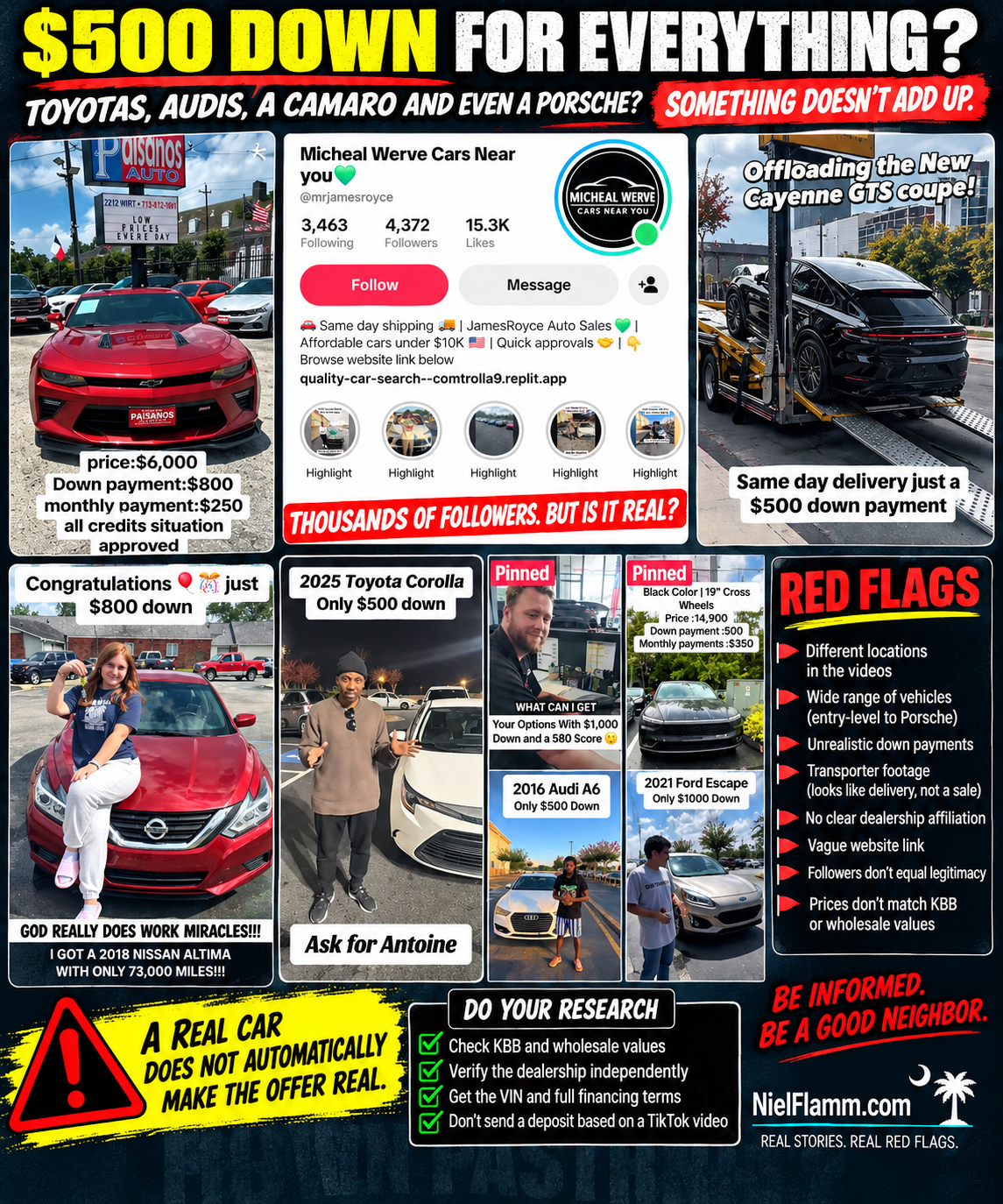
$500 Down for Everything? This TikTok Car Account Raised More Questions the Longer I Watched
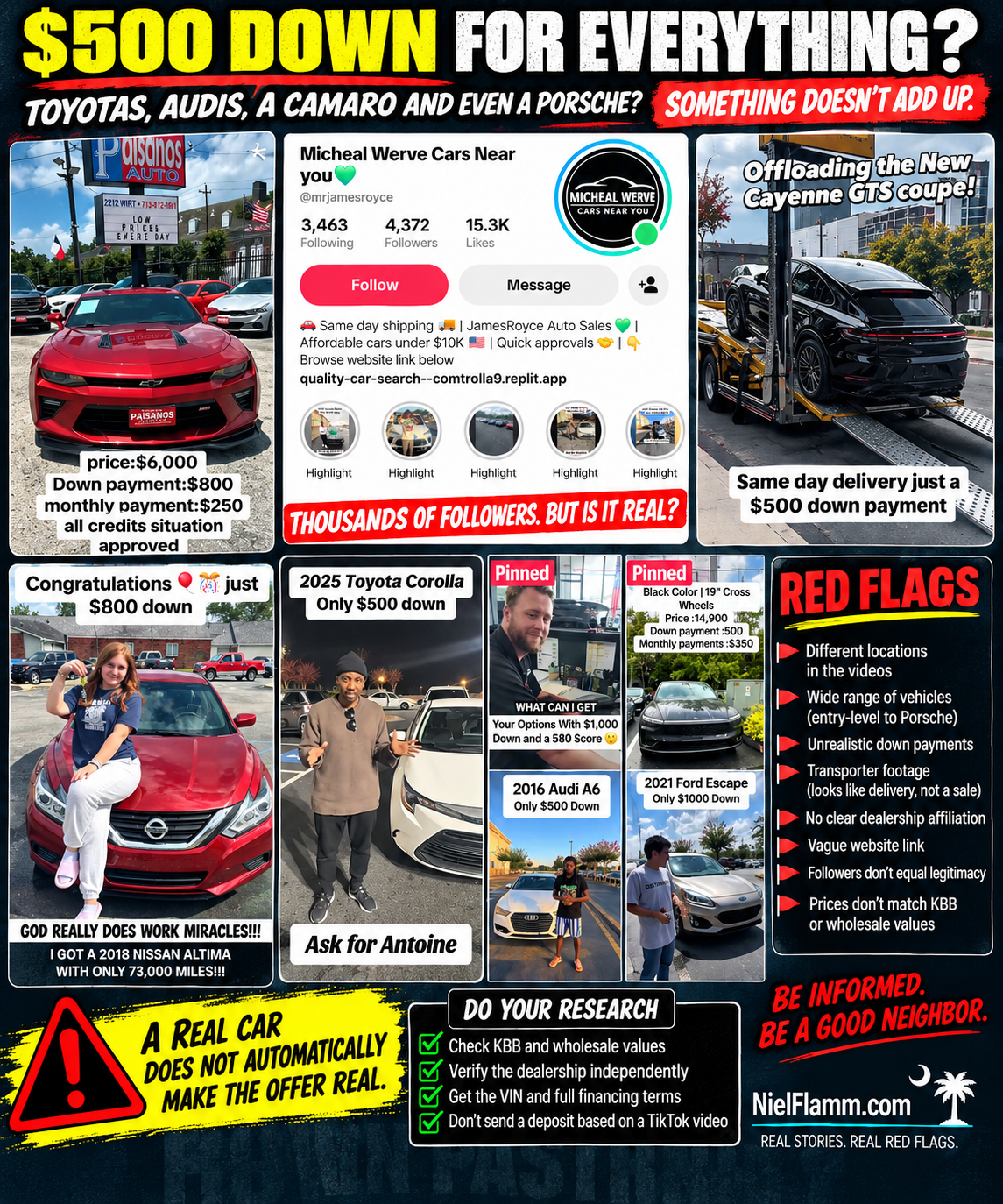
Apparently, TikTok still thinks I need a car.
At this point, I'm starting to think the algorithm wants me to open a dealership.
This time I came across an account calling itself “Michael Werve Cars Near You” with more than 4,300 followers and 15,000 likes shown on the profile when I took the screenshot.
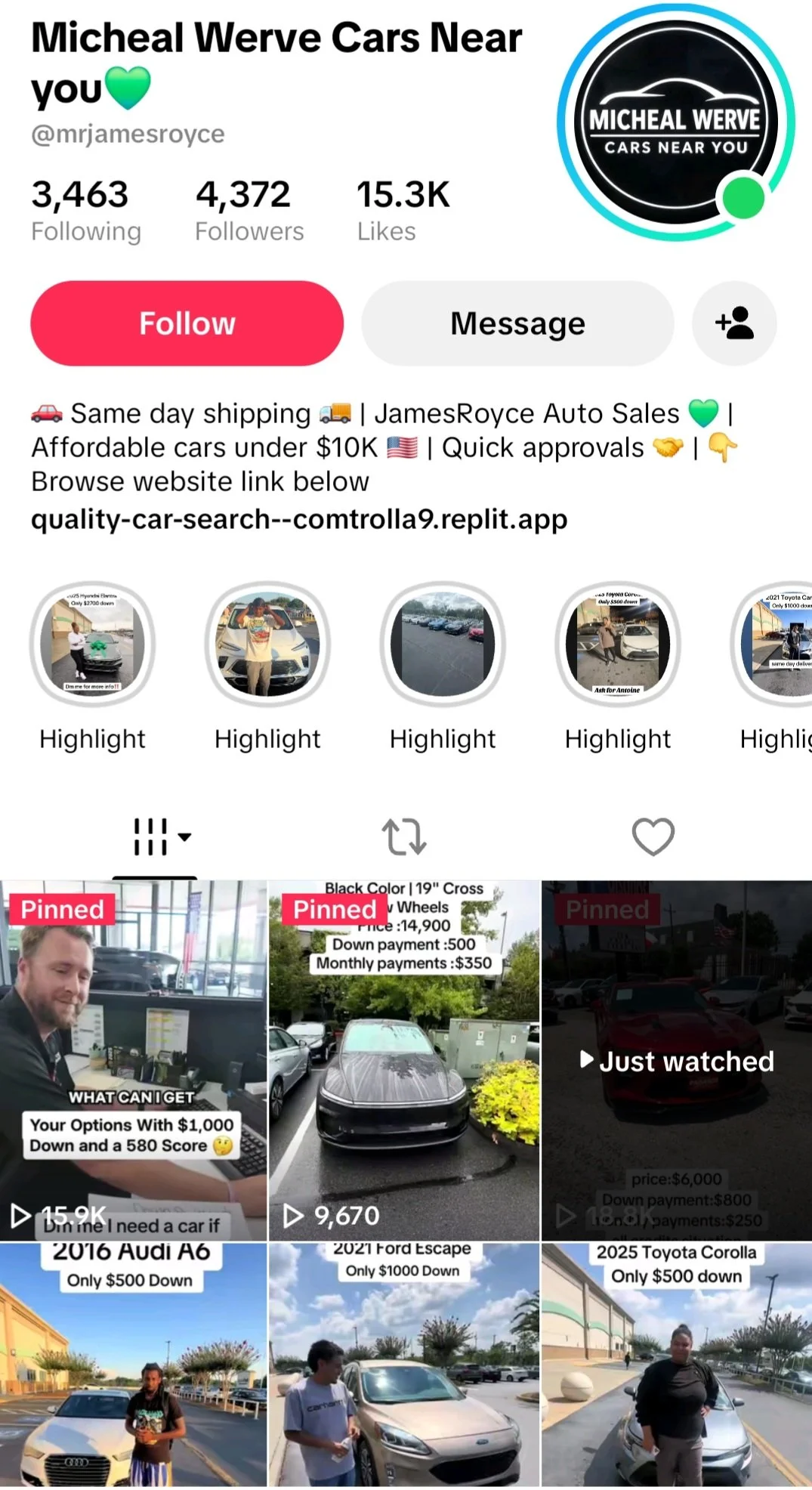
The bio promises:
“Same day shipping”
“Affordable cars under $10K”
“Quick approvals”
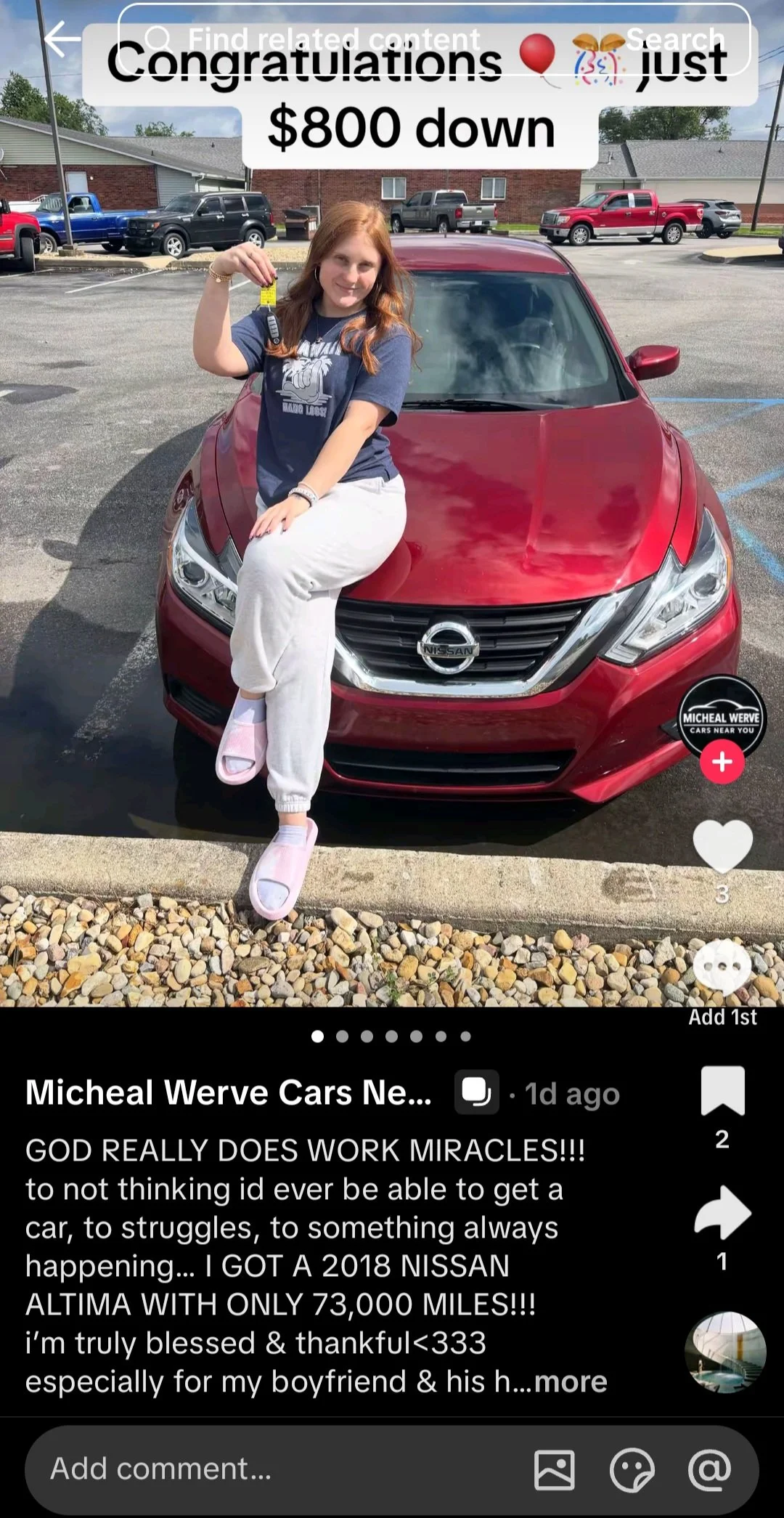
And, of course, the magic number that keeps appearing in these TikTok vehicle posts:
$500 DOWN
But the more videos I watched, the more questions I had.
🚩 This Isn't Just a Few Cheap Used Cars
The account shows a surprisingly broad assortment of vehicles.
There's a 2016 Audi A6 advertised with only $500 down.
There's a 2021 Ford Escape with $1,000 down.
There's a 2025 Toyota Corolla with only $500 down.
There's a woman pictured with a 2018 Nissan Altima with 73,000 miles, accompanied by text saying:
“Congratulations 🎈🎊 just $800 down.”
Then we jump to something much more interesting:
“Offloading the New Cayenne GTS coupe!”
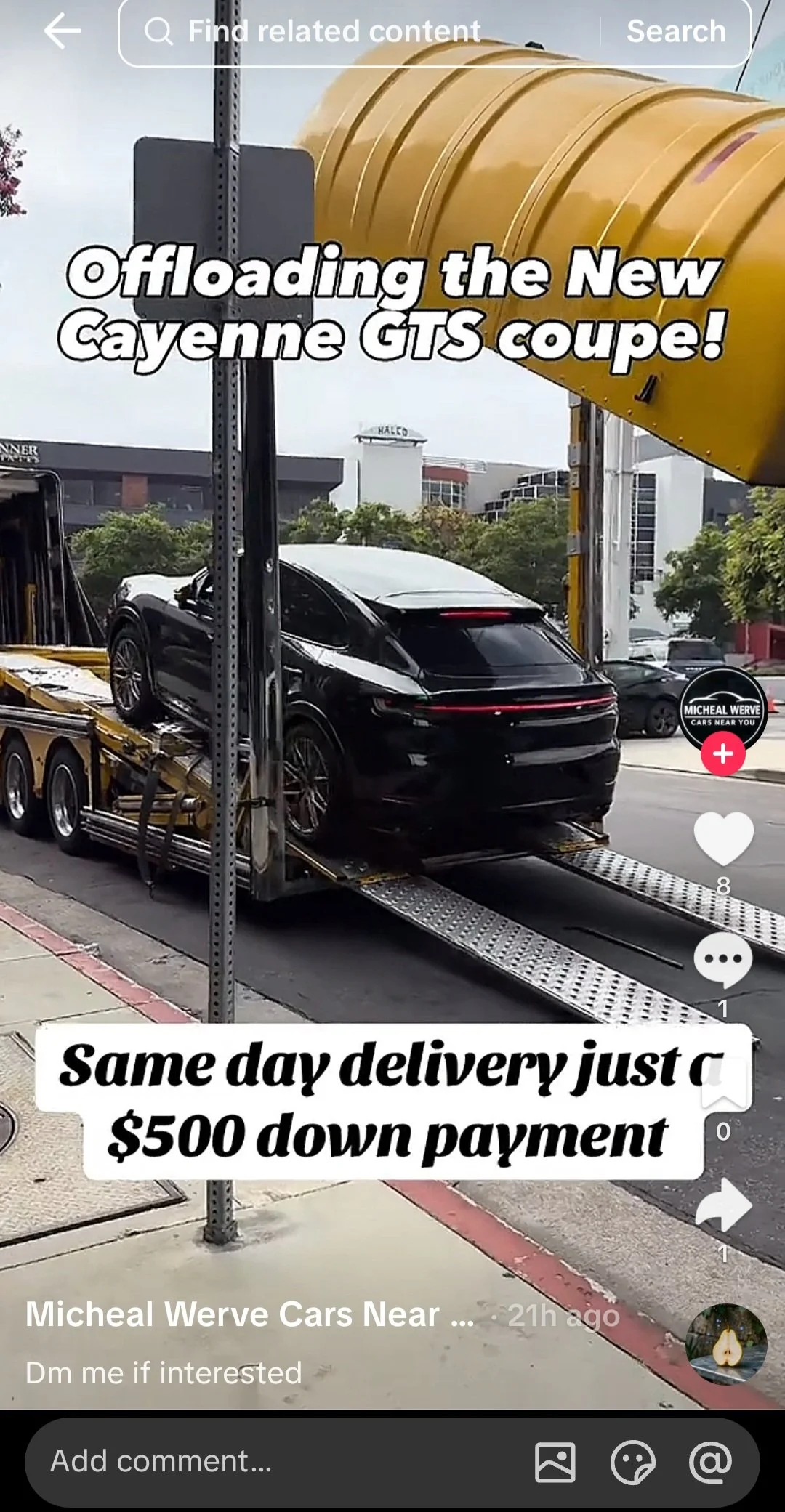
The video shows a Porsche being unloaded from a vehicle transporter and says:
“Same-day delivery with just a $500 down payment.”
That's quite a range of inventory.
Entry-level cars.
Used luxury cars.
SUVs.
Nearly new Toyotas.
And a Porsche Cayenne GTS Coupe.
All apparently tied together by remarkably small down payments.
🚩 Then There's the Camaro
One video caught my attention because the vehicle is sitting directly in front of a dealership.
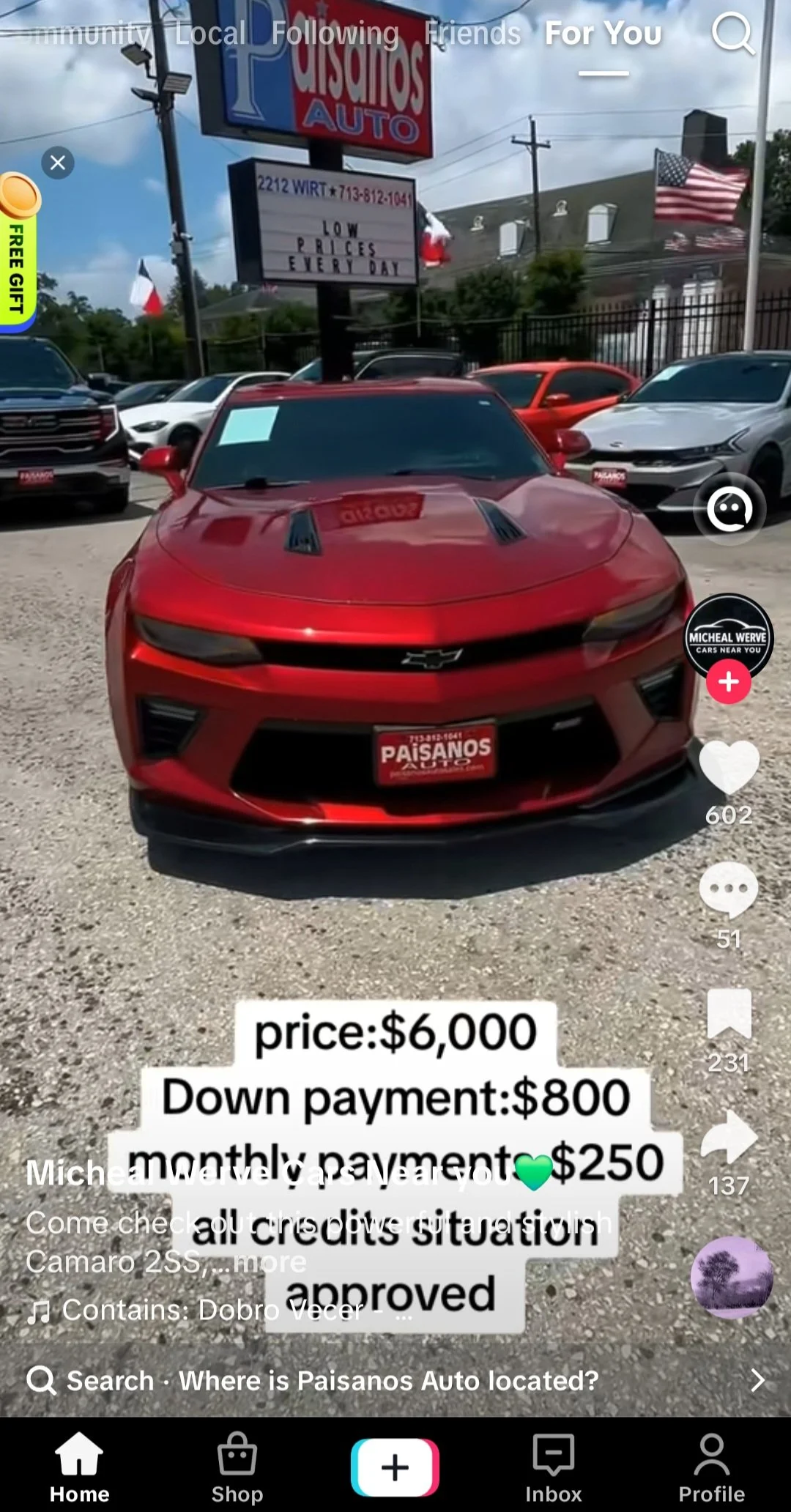
The TikTok overlay says:
Price: $6,000
Down payment: $800
Monthly payment: $250
All credit situations approved
But look behind the Camaro.
The dealership sign says Paisanos Auto.
That gave me something I could actually verify.
Paisanos Auto is a real used-car dealership at 2212 Wirt Road in Houston, Texas. Its own website confirms that address and says it has operated for more than 20 years. Paisano's Auto Sales
Here's where it gets much more interesting.
I found actual listings associated with Paisanos for Camaro 2SS models. One listing for a 2020 Camaro 2SS didn't advertise a $3,500 purchase price—it advertised $3,500 DOWN. Another 2023 Camaro listing similarly advertised $3,000 DOWN. OfferUp
Paisanos' own website makes the distinction even clearer. Its disclaimer says that prices advertised on Facebook Marketplace may represent the down payment, while the actual cash price and financing terms are separate. Paisano's Auto Sales
So a photograph or video of a real vehicle at a real dealership does not establish that the TikTok account showing it is authorized to sell that vehicle for the price it puts on the screen.
That's a very important distinction.
🚩 Then I Started Paying Attention to the Locations
This was another thing that bothered me.
I watched several of the account's shorts.
The scenery changes.
Dramatically.
One vehicle is clearly sitting at Paisanos Auto in Houston.
Another shows what looks like a transporter unloading a Porsche on a city street.
Another vehicle is photographed in a parking lot surrounded by brick, residential-looking buildings.
Another Corolla appears in a completely different retail parking lot at night.
Different backgrounds by themselves don't prove anything. A legitimate broker, multi-location dealership or delivery operation could certainly photograph vehicles in different places.
But when an account presents a stream of vehicles as available for extraordinarily small down payments, those changing locations become another reason I'd want to know:
Where is the actual dealership?
Who owns these vehicles?
Where can I physically inspect them?
What dealer license is the seller operating under?
What's the VIN?
And why do these videos appear to come from so many different places?
🚩 The Porsche Video Looks Like Transportation—not a Sale
The Cayenne video particularly caught my attention.
The text says:
“Offloading the New Cayenne GTS coupe!”
And:
“Same day delivery just a $500 down payment.”
But what I'm looking at is a Porsche coming off what appears to be a commercial vehicle transporter.
That establishes that somebody was transporting a Porsche.
It does not establish that the TikTok account owns that Porsche, sold that Porsche or can deliver that Porsche to me for $500 down.
That's the recurring problem with social-media vehicle content:
A real car doesn't automatically mean a real offer.
A real transporter doesn't prove a sale.
A real dealership in the background doesn't prove affiliation.
A real customer photograph doesn't independently establish the terms of a transaction.
Pictures prove what's visible in the pictures.
Not necessarily the story wrapped around them.
💰 Let's Talk About the Actual Values
This is where the economics become difficult to ignore.
Take the 2025 Toyota Corolla shown with “Only $500 down.”
Kelley Blue Book currently puts the Fair Purchase Price of a 2025 Corolla at roughly $21,400 to $26,600, depending on trim, with original MSRP ranging from $23,460 to $29,175. Kbb.com
Then there's the 2021 Ford Escape.
KBB currently shows Fair Purchase Prices ranging from about $13,900 to $18,050, depending on configuration. Even KBB trade-in estimates run roughly $7,550 to $12,200. Kbb.com
The 2016 Audi A6?
KBB's current Fair Purchase Price ranges from approximately $11,350 to $14,600, depending on trim. Kbb.com
And the 2018 Nissan Altima supposedly purchased with $800 down?
KBB currently puts dealer Fair Purchase Prices around $10,200 to $11,750, depending on trim, before adjusting for the specific 73,000-mile vehicle shown in the post. Kbb.com
None of this means a legitimate dealer can't finance a vehicle with a small down payment.
They absolutely can.
But a down payment isn't a purchase price.
That's precisely why the rest of the financing information matters.
📊 What About MMR Wholesale?
I also wanted to compare these offers with MMR—Manheim Market Report- because retail KBB values only tell part of the story.
MMR is a wholesale benchmark based on actual Manheim auction transactions. Manheim says its database draws from millions of auction transactions across the United States and Canada. Manheim
Here's the problem with giving one blanket “MMR price”: MMR is vehicle-specific. Mileage, trim, condition, region and the date of the transaction matter. Without the VINs and exact specifications of these TikTok vehicles—and direct MMR access—I don't want to manufacture wholesale numbers and pretend they're precise.
But we can find real-world examples.
A 2018 Nissan Altima 2.5 S with about 150,000 miles recently showed an MMR median of $4,275, with a range of roughly $3,225–$5,350. AUTOMAX
For 2021 Ford Escape examples, recent Manheim-linked data varies dramatically with mileage and condition. One high-mileage SE showed an MMR median of $3,425, while another better-condition example showed $8,225. A recent SEL example showed $6,000. AUTOMAX
That's exactly why VIN, mileage and condition matter.
And it's also why a vague “$500 down” tells a consumer almost nothing about what they're actually agreeing to pay.
🚩 The Math Is What Matters
Let's say somebody genuinely finances a $20,000 vehicle with $500 down.
They haven't bought a $500 car.
They've put $500 toward a transaction that could ultimately cost tens of thousands of dollars after the remaining principal, interest, taxes, registration, documentation fees, and other charges.
That's why I want to know:
What's the actual selling price?
What's the APR?
What's the loan term?
What's the monthly payment?
What's the total of payments?
Who's the lender?
Are there additional dealer fees?
What credit qualifications apply?
Is the $500 refundable?
And—before we get to any of that—
Does this account actually own or represent the vehicle?
Those aren't annoying questions.
Those are $20,000 questions.
🚩 Followers Don't Equal Verification
The account had thousands of followers when I looked at it.
That can create credibility.
“Four thousand people follow this person. It must be legitimate.”
No.
Follower counts aren't dealer licenses.
Likes aren't vehicle titles.
Views aren't VINs.
A polished TikTok profile isn't proof that the person behind it owns the vehicles appearing in the videos.
And a link in a bio doesn't become trustworthy simply because thousands of people follow the account.
🏡 Don't Be Passive—Be a Good Neighbor
This is the part I keep coming back to.
Someone desperately needs transportation.
They've been rejected for financing.
Their credit isn't great.
They need to get to work Monday.
Then TikTok serves them:
2025 COROLLA — $500 DOWN
or:
SAME DAY DELIVERY — $500 DOWN
Suddenly, something that seemed financially impossible looks possible.
That's exactly when another person asking questions can make a difference.
If you see a friend or family member getting excited about an offer like this, don't mock them.
Help them verify it.
Ask for the VIN.
Look up the dealership independently.
Call the dealership using the phone number on its official website, not a number supplied in a TikTok DM.
Check the vehicle's value.
Get the complete financing terms.
And don't send somebody a deposit simply because they say they can deliver the vehicle today.
The real Paisanos Auto, for example, has an independently verifiable Houston address, website, and phone number. Paisano's Auto Sales. That's the kind of information I'd use to verify whether someone posting a vehicle photographed on its property actually represents the dealership.
Because there is one sentence I keep repeating throughout this experiment:
A real car does not automatically make the offer real.
And neither do 4,000 followers.
Before sending $500, $800—or one dollar—verify who's actually on the other side of the screen.
Follow along at NielFlamm.com/blog for more questionable vehicle offers, suspicious emails, recruiting scams and whatever TikTok decides I need to investigate next.
Thank You for Your Order! What Did I Buy? Apparently, I Have to Open the Mystery Attachment
Oh, this one barely even tries. 😂
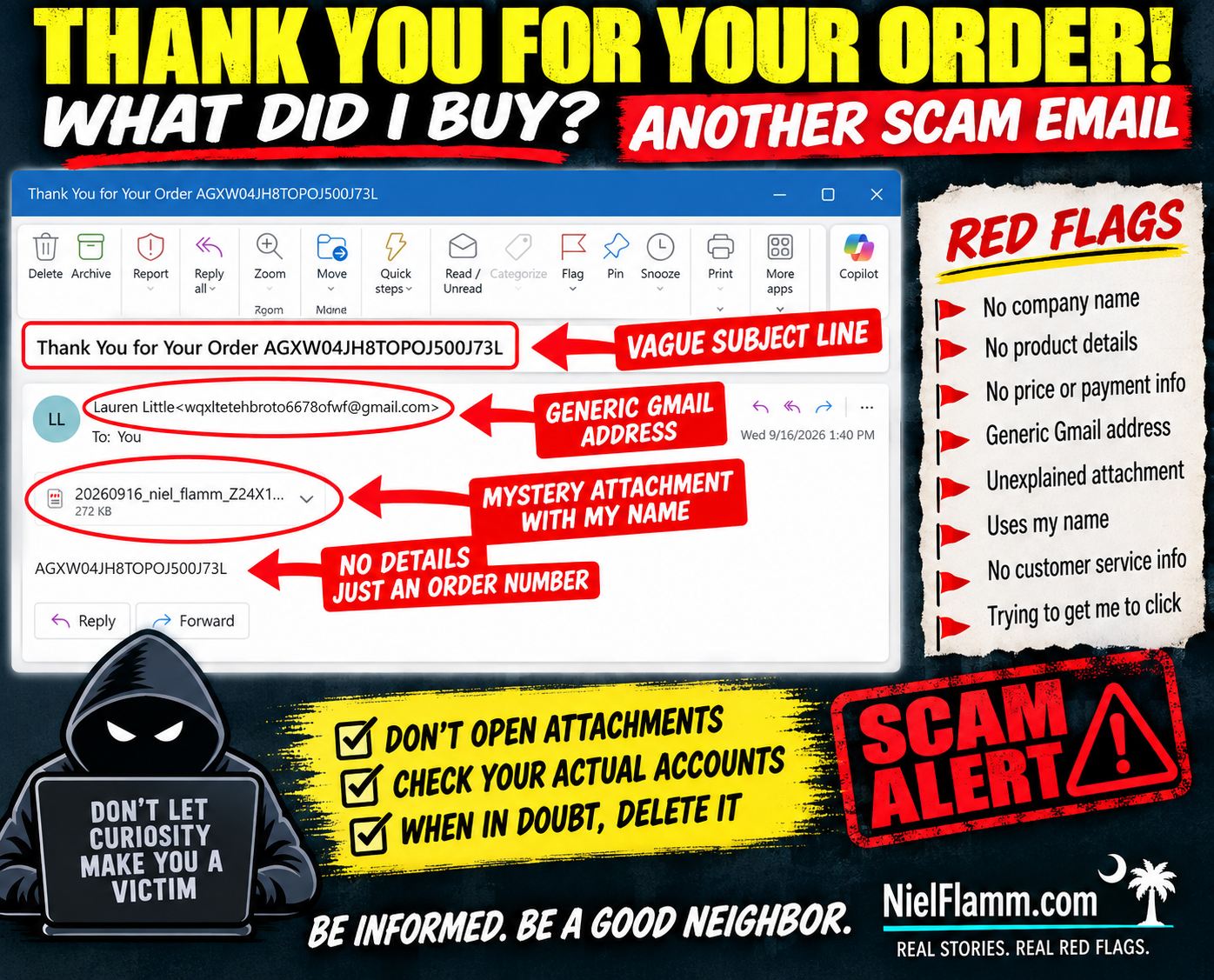
Another suspicious email landed in my inbox with the subject:
“Thank You for Your Order AGXW04JH8TOPOJ500J73L”
Well, thank you!
There's just one small problem.
WHAT DID I ORDER?
The email doesn't tell me.
No company name.
No product.
No price.
No payment method.
No shipping information.
No customer-service information.
Nothing.
The sender is Lauren Little, using a Gmail address that doesn't identify any recognizable merchant.
But don't worry—they did give me an order number.
And, more importantly, a 272 KB mystery attachment.
How thoughtful.
🚩 The Attachment IS the Email
The actual body contains essentially nothing except the same mysterious order number.
So if I want to know what I supposedly purchased, there's an obvious temptation:
Open the attachment.
And that's exactly what I'm not going to do.
I don't know what's inside that file, because I didn't open it. I'm not going to claim it's malware, a malicious document or anything else I haven't verified.
I also don't need to find out.
An unexpected email from an unknown sender telling me about an unidentified purchase and giving me an unexplained attachment has already failed my trust test.
🚩 Apparently Scammers Have Discovered Personalization
Here's another nice touch.
The attachment's filename includes:
“niel_flamm”
Ahhh.
They know my name!
That changes everything.
Actually, no.
Putting my name in the attachment doesn't make me more likely to open it. It makes me more likely to delete it.
Personalization isn't proof of legitimacy.
Names, email addresses, and other basic information can come from countless places online.
🧠 Curiosity Is the Hook
That's what makes these minimalist emails interesting.
They don't need an elaborate story.
They want me to create the story:
Did I accidentally buy something?
Did someone use my credit card?
How much did they charge me?
What company is this?
What's in that attachment?
And there's the trap.
Instead of giving me information, the email creates an information gap and gives me a file that supposedly fills it.
No thanks.
If I'm concerned about an unauthorized purchase, I'll check my bank and credit-card accounts myself.
I don't need to open a mystery attachment to discover whether I've spent money.
🏡 Don't Be Passive. Be a Good Neighbor.
If you receive something like this and recognize the warning signs, share them.
Someone else may see “Thank You for Your Order” and immediately panic.
Before they open the attachment, tell them:
Check your actual financial accounts first.
Sometimes being a good neighbor means preventing someone from making that one curious click.
Because sometimes the safest attachment is the one you never open.
Follow along at NielFlamm.com/blog for more suspicious emails, questionable vehicle offers, recruiting scams and whatever strange thing lands in my inbox next.