
The Power of Attorney Is Signed: Welcome to My Real-Life Version of The Traitors
Well, we have an update.
If you read my previous post about caring for my mother, money, control, and family boundaries, you know we’ve had some difficult conversations about what happens next.
My mother has made her wishes known. I’ve been working on making sure those wishes are heard and respected.
Now, there’s a new development:
I have a signed South Carolina Power of Attorney.
Yep.
The paperwork is signed.
The next step?
I need to give my father a copy.
And then we see what happens.
Previously, on NielFlamm.com...
In the last episode, my father and I had some very different views about my mother's money and how it should be used for her care.
When I asked about accessing information concerning money she had earned and saved, I heard:
“I’ll think about it.”
Later, I heard:
“Prove it.”
Well, I didn't exactly set out to turn this into a cliffhanger, but here we are.
The Power of Attorney is signed.
Now comes the part where I hand him a copy.
Cue dramatic music.
This Isn't 90 Day Fiancé
I've been trying to figure out exactly what kind of reality show my life has become.
It's definitely not 90 Day Fiancé.
Nobody is getting a rose, so The Bachelor is out.
I'm thinking we're getting closer to a real-life version of The Traitors.
We've got family.
We've got money.
We've got disagreements.
We've got questions about who controls what.
We've got people wondering what someone else will do next.
And we've got me standing in the middle of it thinking:
How did I get cast in this show?
Unfortunately, unlike reality television, nobody yells “CUT!” and sends everyone back to their trailers.
This is real life.
What Happens Next?
That's the interesting part.
I don't know.
I'm going to give my father Power of Attorney and see what happens next.
Maybe the document changes the conversation.
Maybe it doesn't.
Let’s move forward with figuring out my mother's finances and how her resources can support the care she wants.
Maybe we're headed for another episode.
Whatever happens, my objective remains the same: listen to my mother and advocate for what she wants.
The Power of Attorney isn't the finish line. It's another step in a much bigger process.
Stay Tuned
So that's today's update.
South Carolina Power of Attorney: signed.
Copy for Dad: next.
Dad's reaction: TBD.
And apparently, that's my teaser for the next episode.
Keep coming back to NielFlamm.com/blog because I have a feeling this story isn't finished.
Forget 90 Day Fiancé.
Forget The Bachelor.
Welcome to my real-life version of The Traitors.
Except there's no cash prize at the end.
Just family, paperwork, boundaries, and hopefully doing what's best for Mom.
Stay tuned.
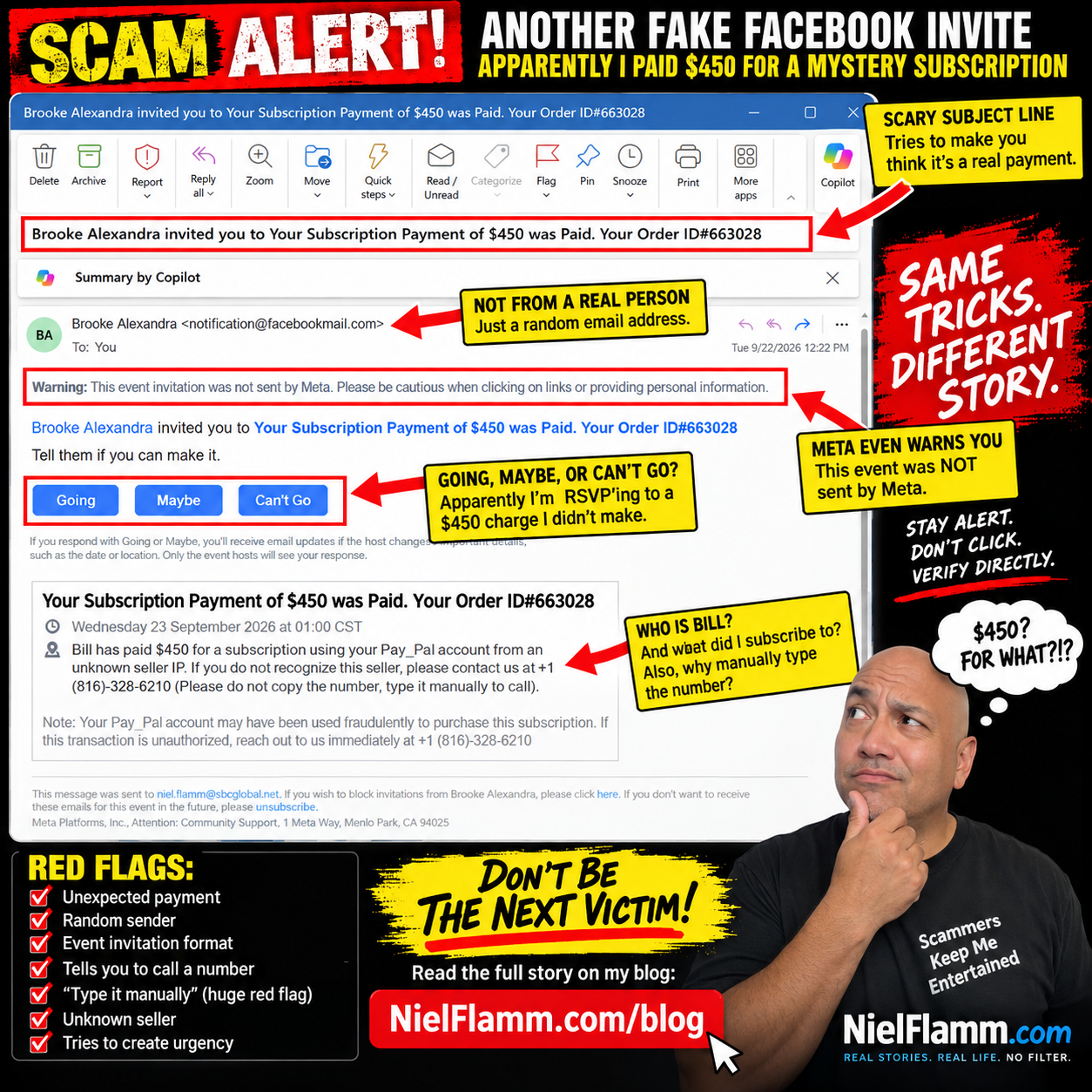
They’re Back! Apparently I Paid $450 for Another Mystery Subscription
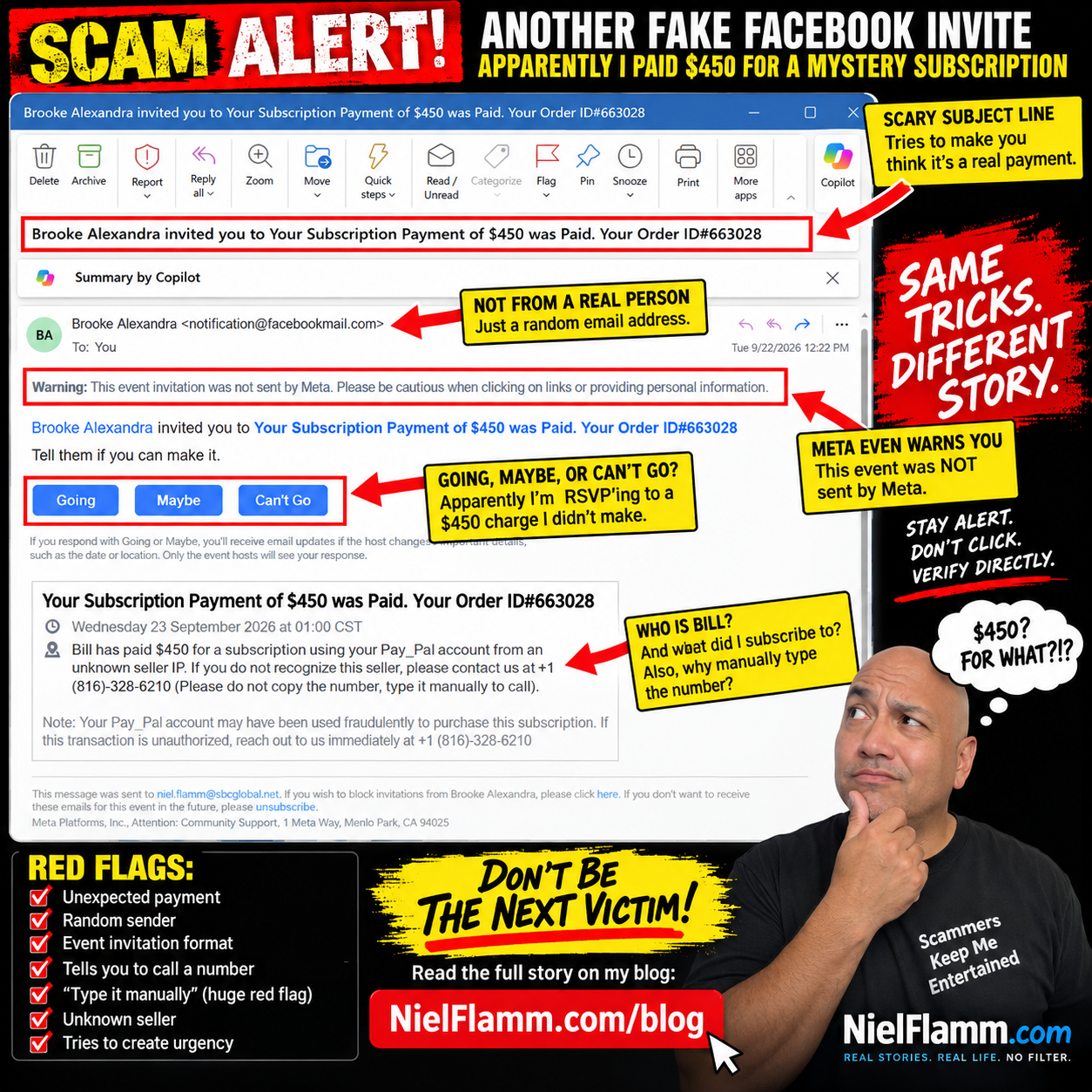
It’s been a little while, but apparently my scam social calendar is back in action.
For those who haven’t been following along, I’ve received some interesting emails over the past few months. According to my inbox, I’ve bought Bitcoin, renewed Geek Squad protection—more than once—and even had a watch repaired that I never sent anywhere.
Today, we return to an old favorite:
The Facebook Event Invitation Scam.
This time, “Brooke Alexandra” has invited me to an exciting event called:
“Your Subscription Payment of $450 was Paid. Your Order ID#663028”
Well, Brooke, thank you for the invitation.
Unfortunately, I have absolutely no idea what I supposedly subscribed to.
Going, Maybe, or Can’t Go?
My favorite part of these scams is still Facebook’s event format.
I’ve supposedly just discovered an unauthorized $450 PayPal transaction, and immediately underneath this alarming news, I’m asked:
Tell them if you can make it.
My choices?
Going.
Maybe.
Can’t Go.
Decisions, decisions.
I’m going with Can’t Go.
Not because I have another commitment. I try not to attend celebrations for fraudulent purchases.
Meet Bill, My Apparently Very Generous Alter Ego
The description gets even better.
It says:
“Bill has paid $450 for a subscription using your Pay_Pal account from an unknown seller IP.”
Who is Bill?
I have no idea.
Bill, please stop spending my imaginary money.
The message then provides a phone number and tells me to call if I don’t recognize the seller.
And then comes my favorite instruction:
“Please do not copy the number, type it manually to call.”
Oh, absolutely.
I'm not comfortable trusting a financial alert that asks me to type a phone number manually.
That’s practically the international symbol for:
“Nothing suspicious happening here!”
Meta Is Literally Warning Me
As with the previous versions, there’s an important message sitting prominently near the top:
“Warning: This event invitation was not sent by Meta. Please be cautious when clicking on links or providing personal information.”
That deserves more attention than the scary $450 headline.
The formula hasn’t changed much:
Create an alarming transaction.
Use a recognizable brand name like PayPal.
Please let me know if my account may have been compromised.
Give me a telephone number.
Please create urgency so I call before I stop to think.
And package everything inside a Facebook event invitation so the resulting notification looks more familiar.
The Scam Has One Big Problem
If my PayPal account really has a mysterious $450 transaction, I don’t need Brooke Alexandra—or Bill—to help me investigate it.
I can go directly to PayPal through its official app or website and check my account.
The same rule applies to suspicious emails claiming to come from a bank, credit card company, retailer, Geek Squad, or practically anyone else.
Don’t let the suspicious message tell you how to verify the suspicious message.
Verify it independently.
And don’t call a mystery number just because someone put “PayPal” next to it.
My Imaginary Spending Spree Continues
So let’s add another purchase to the growing list.
Bitcoin? ✔️
Mystery subscriptions? ✔️
Geek Squad? ✔️
Watch repair? ✔️
Another mystery $450 subscription? ✔️
At this point, the person living inside my spam folder has a considerably more exciting financial life than I do.
I’m just disappointed that after all this imaginary spending, nobody has emailed me to say I’ve purchased a beachfront condo in Thailand.
Scammers, if you’re reading this, at least make the next fake purchase interesting.
Have a Scam Story? Send It My Way
Now I want to hear what’s landing in your inbox.
If you’ve received a scam email, suspicious text, social media message, fake invoice, questionable refund notice, or something that made you think, “There is no way this is legitimate,” send it to me.
Please send me your screenshots and let me know what happened. I may feature some of them in future posts as we look at the creative—and sometimes hilariously bad—ways scammers try to separate people from their money.
Please remove or cover passwords, account numbers, addresses, phone numbers, or other sensitive personal information before sending screenshots.
Maybe it’s time to turn my scam collection into our scam collection.
And until then, Brooke...
Can’t Go.
My Nextdoor Petition Has One Signature. Mine. So…What Am I Missing?
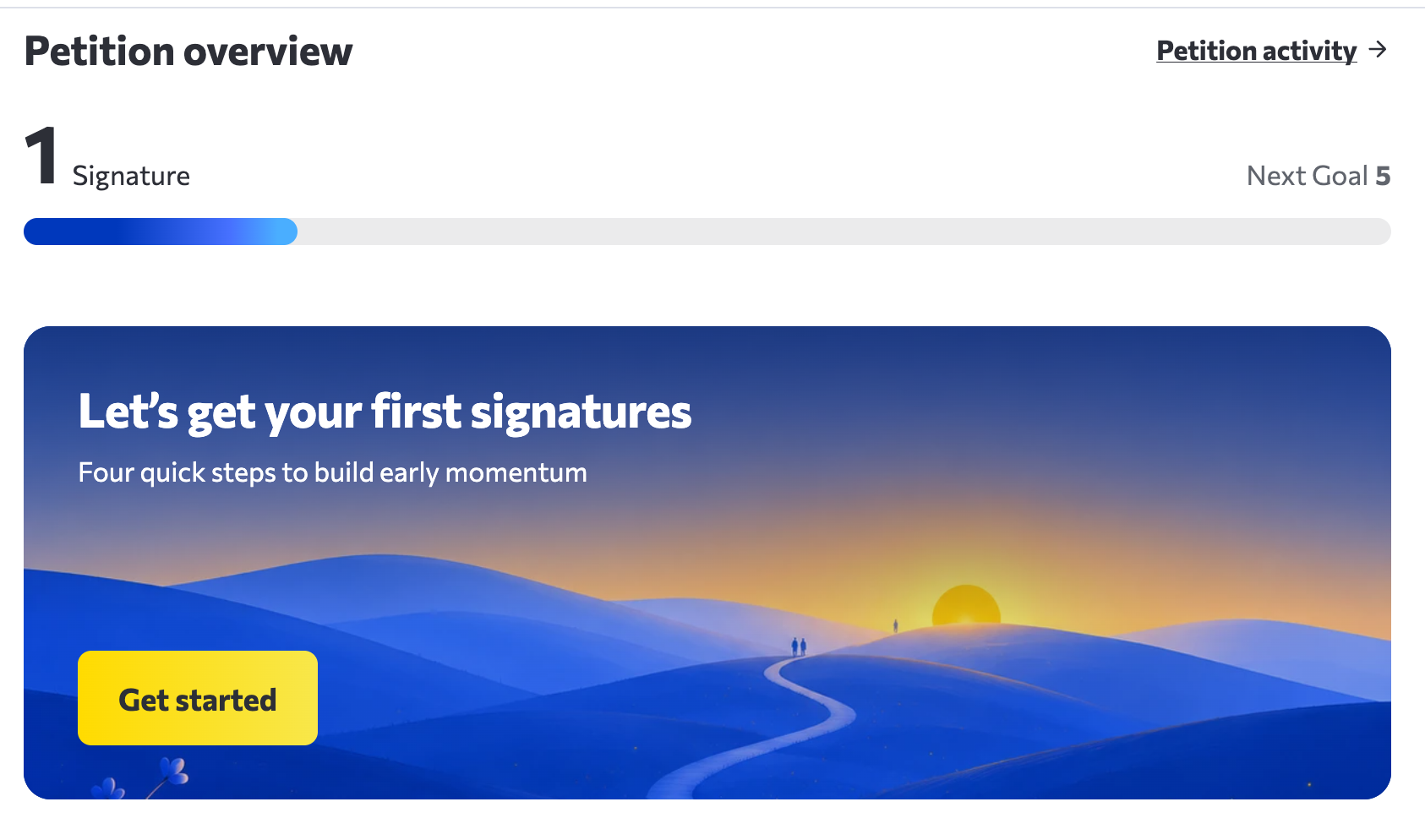
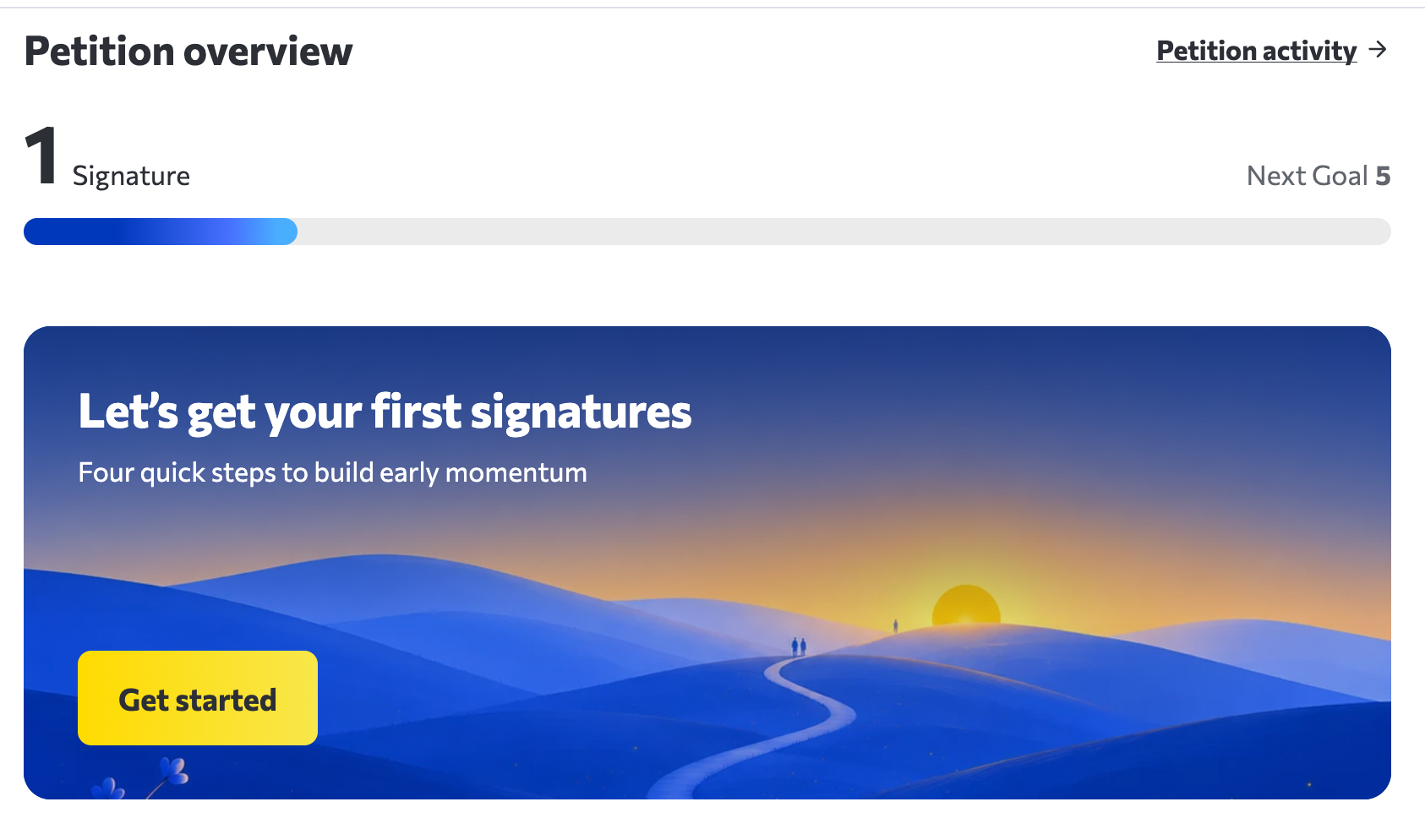
Time for a little open-book transparency.
I launched my petition asking Nextdoor to create a meaningful value-sharing model for the neighbors whose reviews, recommendations, advice and local knowledge help make the platform valuable.
How's it going?
One signature.
Mine. 😂
So clearly, I'm not exactly storming the gates with an angry mob.
But instead of pretending it's gaining traction when it isn't, I'd rather ask why.
Maybe I Got the Petition Wrong
The basic idea still makes sense to me.
Nextdoor provides the platform. Neighbors provide enormous amounts of information and local knowledge. If that information can ultimately be organized, analyzed, used by AI, and turned into commercial value, why shouldn't the people helping create that value participate in some of the upside?
I mean some form of profit or value sharing tied to what users contribute and what the platform ultimately earns from it.
Nextdoor should make money.
I'm a shareholder. I want Nextdoor to make money.
But why does it have to be either platform profits or users’ benefit?
Why not both?
Now I Need Your Feedback
Maybe the petition is too complicated.
Maybe the ask isn't clear enough.
Maybe people like the concept but don't want to sign a petition.
Maybe asking users to pause business reviews and recommendations is the wrong approach.
Or maybe people simply disagree with me.
Tell me.
I spend plenty of time asking Nextdoor to listen to feedback, so I'd better be willing to do the same.
Read the petition and tell me what you'd change. What would make you sign it? What part doesn't work? Is there a better model for sharing the value neighbors create?
And if you do agree with the idea, I need two things:
First, sign it. Then share it.
Right now, the petition has exactly one supporter—and I already know what that guy thinks. 😂
Read and sign the Nextdoor Neighbor Value-Sharing Petition
Our information. Our time. Our value. Why not share?
Caring for My Mother: Money, Control, and Family Boundaries
There is another side to the story I shared about visiting my mother. If I’m going to be transparent about the coffee, the conversations, and the importance of showing up, I need to be honest about the harder part, too.
My mother is in a skilled nursing facility after two strokes in three months. She wants to move into assisted living. Eventually, when she’s mobile enough, the plan is to get her to Thailand.
She has also made something else clear: she does not want to return to Rivertowne to live with her husband, my father.
That is a difficult sentence to write. It is also necessary to understand what’s happening.
The Cost of Care
Assisted living is expensive. The places I’m looking at start around $6,000 a month for somewhere “nice.” We are not talking about the Four Seasons. At that price, though, I wouldn’t mind a mint on the pillow.
When my mother was in the hospital and expressed that she didn’t want to return home, my father’s first response was:
“Who is going to pay for it?”
I understand that hearing your spouse doesn’t want to live with you can hurt. I’m divorced. I received my own invitation to leave the home, and I left. I didn’t return. I understand that conversation carries feelings.
But my mother still needs care. Her wishes still deserve to be heard.
During a trip to Costco, before all of this, my mother told me she had a 401(k) through her employer. She gave me a rough idea of the balance during a conversation about things involving my father that were upsetting her.
Apparently, a Costco trip can include bulk groceries and information that becomes very important later.
When my father balked at assisted living, I remembered that account. My mother had worked and saved money over time. I wanted to explore using those savings for her care.
I asked him for the information to start that process.
His response was:
“I’ll think about it.”
Money and Control
I’ve heard stories about families coming apart over money. About a parent needing care and the conversations turning into arguments over accounts, expenses, and who gets to decide.
Now I’m experiencing that family strife myself.
From where I stand, this is all about money and control.
My mother has expressed where she wants to live and what she wants her next chapter to look like. Yet my conversations with my father keep coming back to whether money will be made available and who gets the final say.
When I hear “I’ll think about it” in response to a request for information about her savings, I hear him positioning himself as the person who decides whether her wishes can move forward.
That is why this feels like more than a disagreement about an expensive facility. Access to money affects my mother’s choices. Whoever controls that access has enormous influence over where she can go and how she can live.
I understand that $6,000 a month requires planning. I’m willing to work through the costs, the account details, and the practical questions.
What I’m struggling with is having to argue for taking my mother’s wishes seriously in the first place.
Taking Responsibility for Her Wishes
As of today, I am officially my mother’s power of attorney. I am also her designated proxy.
I let my younger brothers know my intentions because I wanted them informed. They know the plan: assisted living, then Thailand when Mom is mobile enough.
I want my mother’s wishes to guide the decisions about her care. There are details to work through, but I don’t want her voice getting lost in arguments about money or what someone else prefers.
Yesterday, my father began what I experienced as a negotiation over her care.
I told him I didn’t see this as a negotiation. I was talking about money my mother had earned and saved, and using it to care for her.
His response was:
“Prove it.”
Those two words changed how I saw him.
I was trying to move a conversation about my mother’s care forward. Instead, I felt pulled into a contest over authority and control.
My mother is recovering from two strokes. She has enough work ahead of her without her wishes becoming another thing she has to fight for.
What This Has Brought Up for Me
In that moment, I lost respect for my father.
I can acknowledge that he helped give me life, taught me things, and supported me at different points. Those parts of our history exist.
So does the pain I carry from childhood into adulthood. This crisis has brought some of that pain back to the surface. His responses now are affecting a relationship that already has a complicated history.
Hearing “I’ll think about it,” followed by “prove it,” while trying to help my mother get the care she wants has left me angry, hurt, and deeply disappointed.
I have been passionate in these conversations. My mother’s care and happiness matter to me, and I haven’t had many quiet feelings about either.
I also still live in the house my parents co-own. I go back there after visiting my mother, attending recovery meetings, going to dialysis, watching a movie, and doing the other things that make up my life.
My routine hasn’t changed much.
My connection with my father has.
Since hearing “I’ll think about it,” I’ve had less to say. I’ve been less engaged. I’m trying to live in that space while being honest about what I feel and what I can give.
I Still Believe in Showing Up
I meant what I wrote in my earlier post.
I believe in visiting people in hospitals and skilled nursing facilities. I believe in calling, listening, and making time for people, especially older people who may have fewer opportunities for connection.
I believe God created us to be in community with one another. We need people. We need conversation, care, and the experience of knowing someone remembered us.
I also have limits.
I cannot do all the work of maintaining a relationship. I cannot create mutual care by myself. And I have to be able to sleep at night with the choices I make about who receives my time and energy.
Right now, I am showing up for my mother, listening to what she wants, and working toward her next step. I’m also continuing my recovery, taking care of my health, and figuring out what boundaries I need with my father.
None of that feels particularly tidy.
But it is open and transparent.
I’ve heard how money can divide a family. Experiencing it myself has made me painfully aware of how closely money and control can become connected—and how much damage that can do when someone needs care.
Time is the one resource I know I will never get back. I want to spend mine helping my mother live the life she is asking for, while taking care of the life I’m responsible for, too.
Today, I want my mother to know that I hear her—and that I’m taking her wishes seriously.
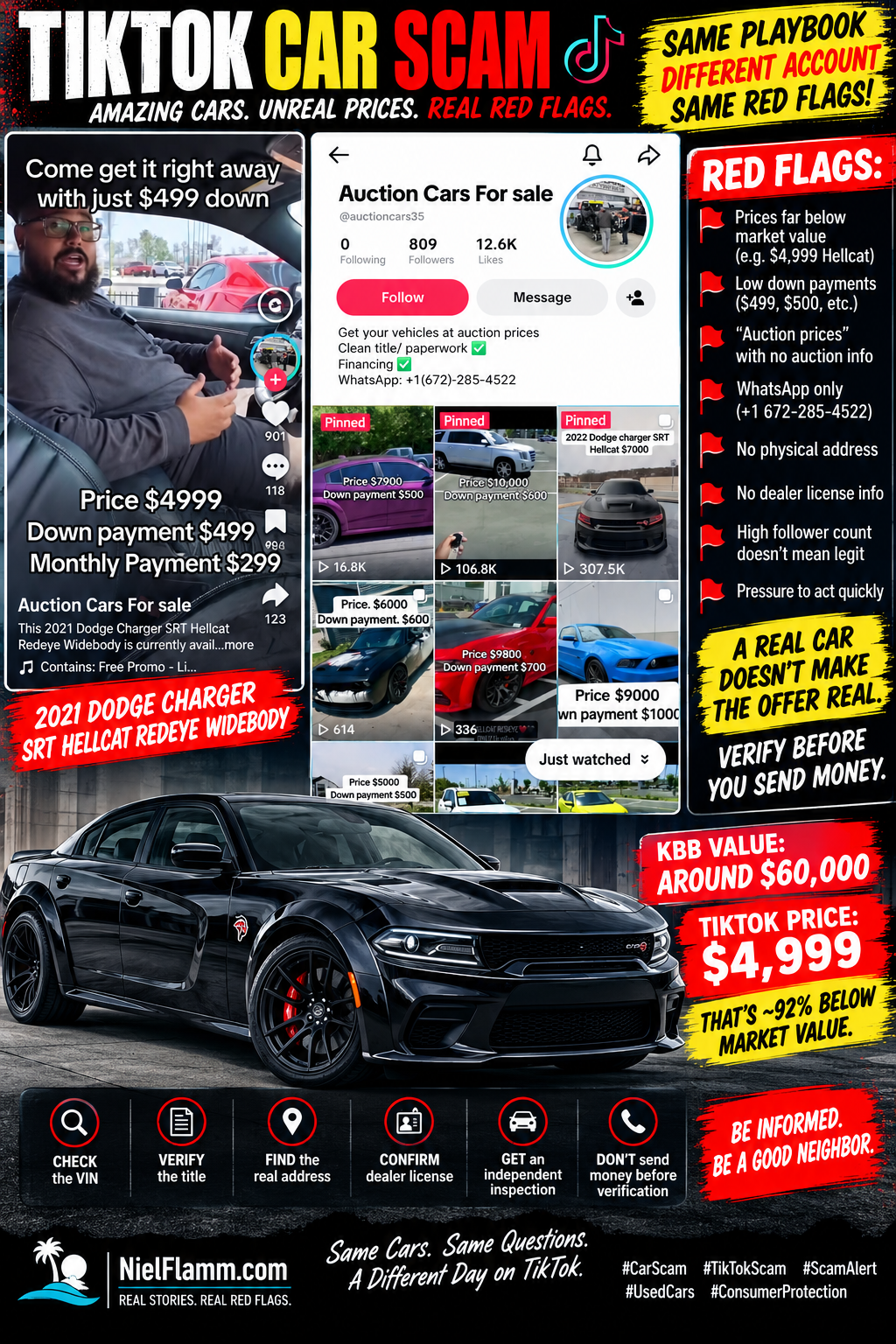
Another TikTok “Auction Car” Deal: A $60,000 Hellcat for $4,999? Here We Go Again
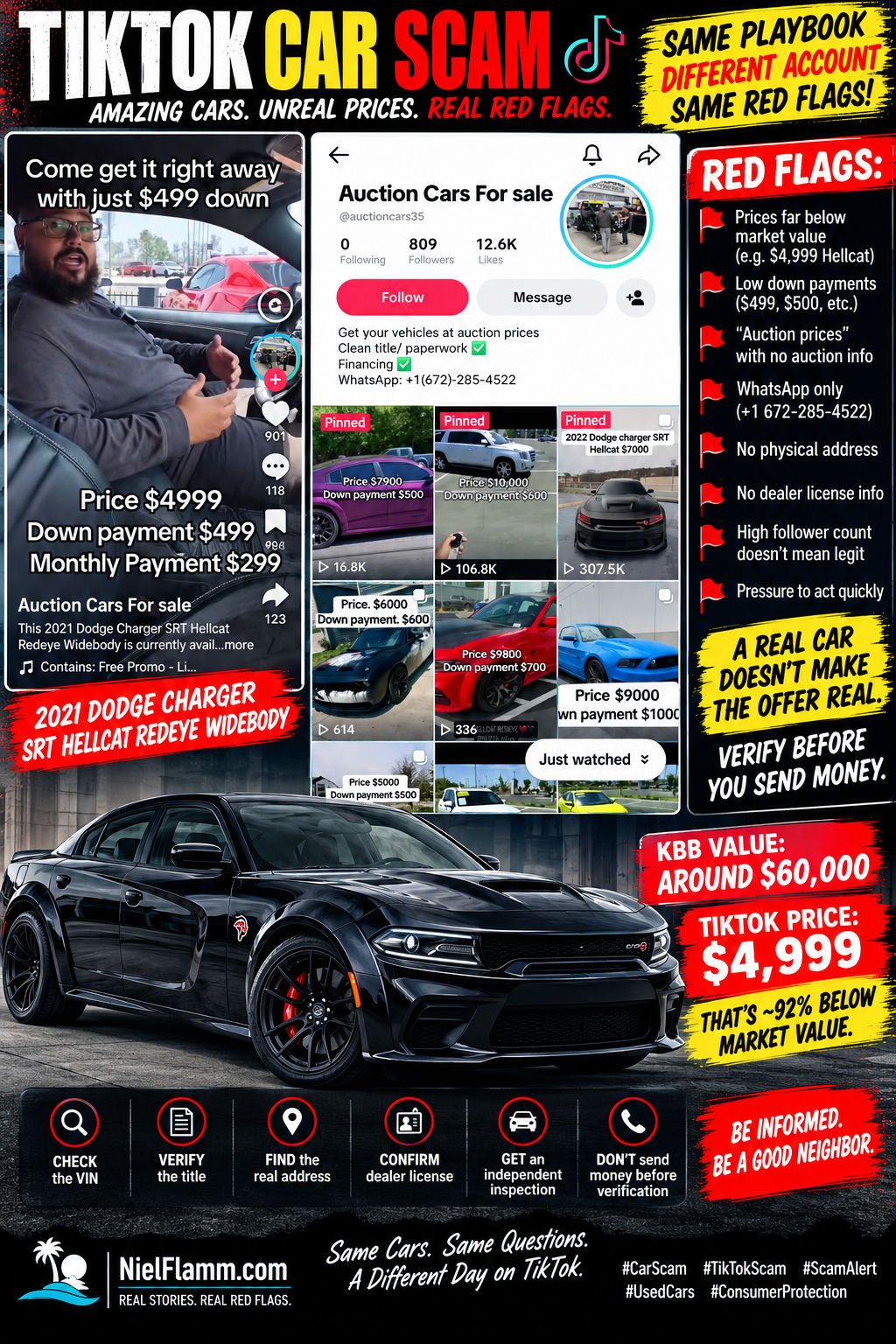
Apparently TikTok has decided I need another car.
Actually, based on what keeps showing up in my feed, TikTok apparently thinks I need an entire dealership.
After documenting accounts advertising $4,000 Scat Packs, $7,000 Camrys, $10,000 BMW M3S, and other remarkably inexpensive vehicles, another account landed in my “For You” feed.
This one calls itself:
Auction Cars For Sale — @auctioncars35
And we've got another Hellcat.
According to the video:
2021 Dodge Charger SRT Hellcat Redeye Widebody
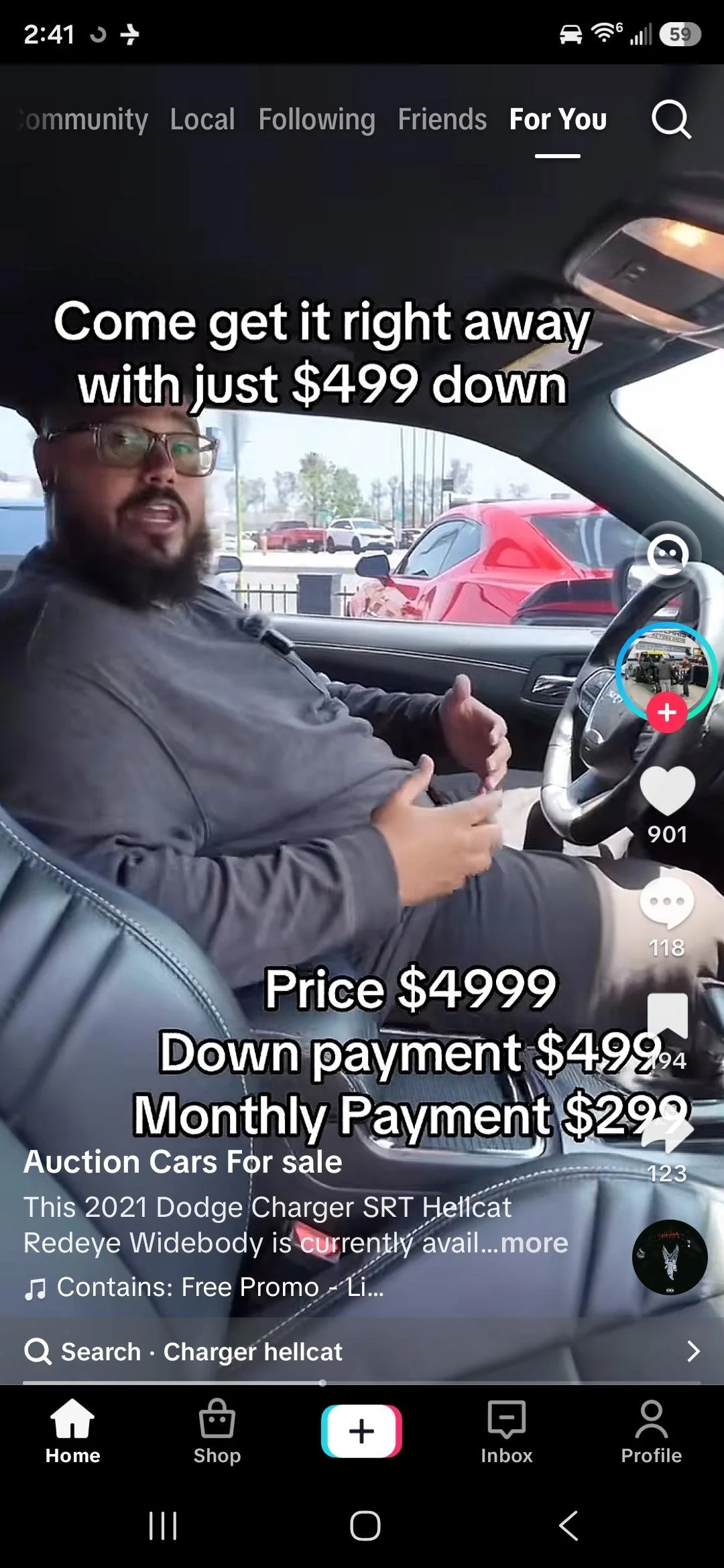
Price: $4,999
Down payment: $499
Monthly payment: $299
Come get it right away!
Well, hold on.
🚩 A $4,999 Hellcat Redeye?
This isn't just an inexpensive used Dodge Charger.
The post specifically identifies it as a 2021 Dodge Charger SRT Hellcat Redeye Widebody.
Kelley Blue Book currently puts the Fair Purchase Price for that model around $60,500, with estimated private-party values ranging roughly from $52,000 to $60,000, depending on condition. KBB also notes that mileage, condition, location, and equipment can significantly affect an individual vehicle's value. Kelley Blue Book
The TikTok price?
$4,999
That's roughly 92% below KBB's $60,500 Fair Purchase Price.
Now, could an extraordinarily cheap Hellcat exist?
Absolutely.
It could have major damage. It could have mechanical problems. It could have a branded title. There could be circumstances we can't see from a TikTok video.
But if you're asking me to believe a vehicle worth tens of thousands of dollars is available for less than $5,000, I need an explanation.
And documentation.
Lots of documentation.
💰 $499 Down, $299 a Month... For How Long?
Then we have the financing.
Price: $4,999
Down payment: $499
Monthly payment: $299
Okay.
If $4,999 is truly the purchase price, subtracting the $499 down payment leaves $4,500.
At $299 per month, ignoring interest, taxes, and every other fee, that would pay off the remaining balance in only about 15 months.
But where are the complete financing terms?
What's the APR?
What's the loan term?
Who's the lender?
What are the taxes and fees?
What credit qualifications apply?
Is $4,999 actually the cash selling price?
Those details matter considerably more than the giant $499 DOWN floating across the TikTok video.
👀 Then I Looked at the Profile
The account had 809 followers and 12,600 likes when I took the screenshot.
Its profile says:
“Get your vehicles at auction prices”
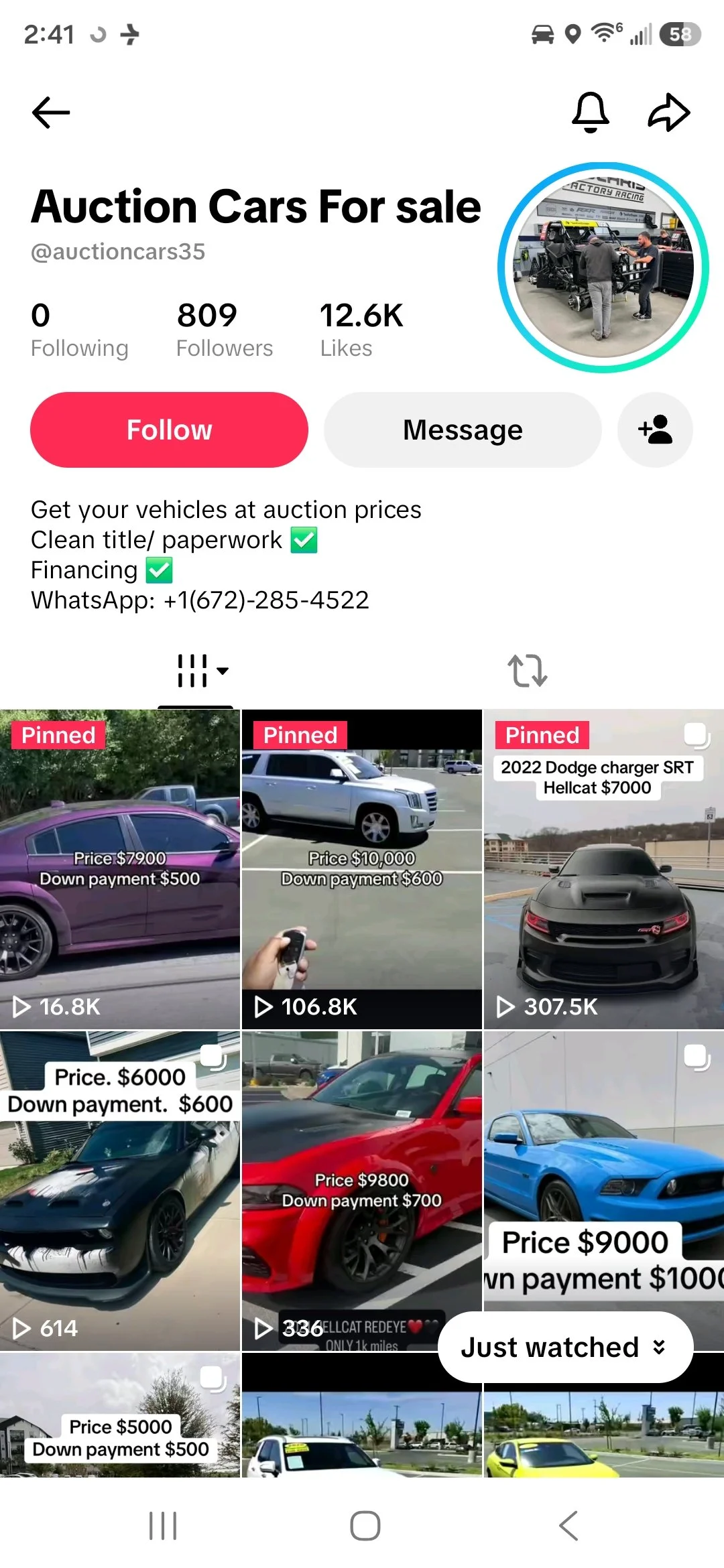
“Clean title/paperwork ✅”
“Financing ✅”
And then:
WhatsApp: +1 (672)-285-4522
There's that familiar move to WhatsApp again.
WhatsApp itself isn't evidence of a scam. Legitimate businesses use it every day.
But if I'm buying a $60,000-class performance car, I want a little more than a TikTok profile and a WhatsApp number.
Where is the business?
What's the legal company name?
What's the physical address?
What's the dealer license number?
What auction is supplying these vehicles?
What's the VIN?
Who's providing the financing?
Can I see the title?
Can I have an independent mechanic inspect the car?
Those questions aren't unreasonable.
They're called buying a car.
😂 Apparently Hellcats Are Having a Clearance Sale
Then I looked at the rest of the profile.
This isn't a one-car phenomenon.
One pinned video appears to advertise a vehicle for:
$7,900 — $500 down
Another:
$10,000 — $600 down
And another pinned video says:
“2022 Dodge Charger SRT Hellcat $7000”
Seven thousand dollars.
For another Hellcat.
Elsewhere, I can see vehicles advertised at:
$6,000 with $600 down
$9,800 with $700 down
$9,000 with $1,000 down
$5,000 with $500 down
Once again, we're seeing the same basic formula I've been documenting across multiple TikTok accounts:
Desirable vehicle.
Extraordinarily low advertised price.
Small down payment.
Financing.
WhatsApp.
Act now.
Different account.
Same questions.
📊 For Perspective: Even Ordinary Chargers Cost More
KBB's current national averages illustrate just how unusual these numbers are.
A regular 2021 Charger SXT has a Fair Purchase Price around $18,500. A Scat Pack is around $32,300, a Scat Pack Widebody around $38,000, and a Hellcat Redeye Widebody around $62,300 on KBB's broader 2021 Charger pricing page. Kelley Blue Book
So the $4,999 TikTok asking price isn't merely inexpensive compared with another Redeye.
It's dramatically below KBB's current Fair Purchase Price for even the least expensive 2021 Charger trim.
That doesn't independently prove anything about this particular vehicle.
It does give me an excellent reason to investigate before reaching for my wallet.
🏷️ But They're “Auction Cars”
That's presumably supposed to explain the prices.
Auctions absolutely can produce vehicles below retail value.
I've discussed the Manheim Market Report (MMR) in previous posts because wholesale value and retail value aren't the same thing.
Dealers buy at wholesale and try to sell at retail. Condition, mileage, title history, location, demand, and vehicle configuration all matter.
But “auction price” isn't a magic phrase that makes market economics disappear.
If a supposedly clean-title Hellcat has a retail value around $60,000 and someone is selling it for $4,999, I'd still like to know:
What did the seller pay for it?
Which auction did it come from?
What's the VIN?
What's the title status?
What's wrong with it?
Why is it being sold for a fraction of its market value?
A legitimate explanation can be checked.
🚗 And Yes, That's a Real Car in the Video
We've encountered this issue repeatedly in this series.
A man sits inside a Charger.
We can see the interior.
There's another vehicle outside.
It looks like a real dealership or automotive environment.
That's visually persuasive.
But here's the line I'm going to keep repeating:
A real car doesn't automatically make the offer real.
A TikTok account showing footage of an actual automobile doesn't, by itself, establish that the account owns the vehicle, has authority to sell it, or can deliver it under the advertised terms.
Videos can be reposted.
Dealer footage can be reused.
Auction footage can be copied.
Customer-delivery videos can be repurposed.
I'm not saying that's necessarily what happened here. I haven't established where this particular footage originated.
I'm saying the video itself isn't proof of ownership.
🚩 Followers and Views Aren't Verification Either
One of this account's pinned videos shows more than 300,000 views.
Another has more than 100,000.
That creates powerful social proof.
If 300,000 people watched it, it may feel legitimate.
If hundreds of people liked it, it may feel legitimate.
If other people are commenting that they're interested, maybe it feels legitimate.
But we've learned this lesson already:
Followers aren't a dealer license.
Likes aren't a vehicle title.
Views aren't a VIN.
And 300,000 views don't transform a $60,000 vehicle into a $4,999 vehicle.
🧮 Show Me the Economics
This remains one of my favorite tests.
Forget TikTok for a moment.
Forget the music.
Forget the guy sitting inside the car.
Forget the giant $499 DOWN text.
Explain the transaction economically.
If a dealer can legitimately acquire a clean-title 2021 Hellcat Redeye Widebody cheaply enough to sell it for $4,999 and make money, I want to understand how.
Maybe there's an explanation.
Great.
Show me.
Give me the VIN.
Show me the title.
Tell me the auction.
Give me the physical location.
Show me the purchase agreement.
Let me independently verify the dealership.
Let me arrange an independent inspection.
Give me the financing disclosures.
Those things interest me far more than a TikTok follower count.
🚨 Don't Let the Deposit Become the Decision
This is where these advertisements concern me most.
The headline isn't:
“Please conduct a comprehensive examination of this vehicle's ownership, title history, and financing.”
It's:
$499 DOWN
That's a psychologically manageable number.
Someone who can't afford a $60,000 Hellcat might be able to find $499.
And once someone sends that first $499, the psychology changes.
They've committed.
That's why verification needs to happen before money changes hands.
The FTC has repeatedly warned consumers about online vehicle-related scams and emphasizes caution when someone online asks you to send money in transactions that can't be independently verified. Consumer Advice
🏡 Be a Good Neighbor
This is also why I keep posting these.
Someone looking at this advertisement might not see what I see.
They might see:
2021 Hellcat Redeye.
$4,999.
$499 down.
$299 a month.
And think:
“I can actually afford my dream car.”
Don't make fun of that person.
Help them.
Before they send $499, ask for 15 minutes.
Check the VIN.
Check KBB.
Check the title.
Find the business independently.
Verify the dealer license.
Call a telephone number obtained independently.
Ask for the physical address.
Arrange an inspection.
Read the financing agreement.
And if the seller starts creating urgency because somebody else is supposedly about to buy the car?
Let the other imaginary customer have it.
Different Account. Same Playbook?
That's what I'm trying to document.
I've now encountered multiple social-media accounts advertising remarkably inexpensive cars with tiny down payments.
The names change.
The cars change.
The phone numbers change.
The prices change.
But I keep seeing familiar ingredients.
Unusually cheap vehicles.
Tiny deposits.
Social-media storefronts.
Private messaging.
WhatsApp.
Financing claims.
Shipping or delivery.
And vehicles priced far below ordinary retail values.
Does that automatically prove this particular TikTok account is fraudulent?
No.
But $4,999 for a vehicle KBB values at around $60,000 is more than enough reason for me to start asking questions. Kelley Blue Book
And judging by my recent experiences, I seem to be getting pretty good at making TikTok car sellers uncomfortable with one particularly difficult question:
What's the address?
Follow the continuing investigation at NielFlamm.com/blog.