

NielFlamm.com Keeps Going Global: 19 Million Characters and Counting
A few days ago, I shared the translation activity for NielFlamm.com. The numbers impressed me then—and apparently the translation engine decided it was just getting warmed up.
Here is how the latest 30-day statistics compare:
Translated characters: 18 million to 19 million
Translated words: Holding steady at 3 million
Input bandwidth: 1.2 GB to 1.24 GB
Translation requests: 4,000 to 5,000
That means another one million characters were translated, while requests increased by 25%. Not bad for a website operated by one bald guy in South Carolina.
The language rankings also shifted.
Italian remains firmly in first place, although its share decreased from 75.8% to 71.5% as other languages gained ground. Russian moved into second place at 4.4%, followed by Chinese at 4.0% and Spanish at 3.3%. Dutch and Vietnamese were tied at 3.1%, with French close behind at 3.0%.
Previously, Italian was followed by Spanish and Vietnamese. Seeing Russian and Chinese climb the rankings shows that the audience is becoming more geographically diverse—which was the entire reason for adding translation options.
What I really want to know is: Which posts are all these readers translating?
Are they reading my movie reviews, health updates, travel stories, scam warnings, Nextdoor adventures, or dating-app experiments? Perhaps somewhere in Italy, someone is translating one of my posts and wondering, “What exactly is going on with this bald American?”
If you use the translation feature, please let me know which posts brought you to the website and which language you selected.
I recently added Thai and Czech. They have not cracked the top rankings yet, but I’ll give them time. Rome wasn’t translated in a day.
Thank you to everyone reading, watching, and exploring NielFlamm.com in whichever language feels most comfortable. These may be numbers on a dashboard, but each request shows that the content is reaching beyond its original language.
I appreciate every one of you.

Day 102: Transparency Shouldn’t Be This Difficult

Day 102.
Earlier today, I posted something on NielFlamm.com/blog that I think connects directly to this entire Nextdoor journey:
My own numbers.
Not just the flattering ones.
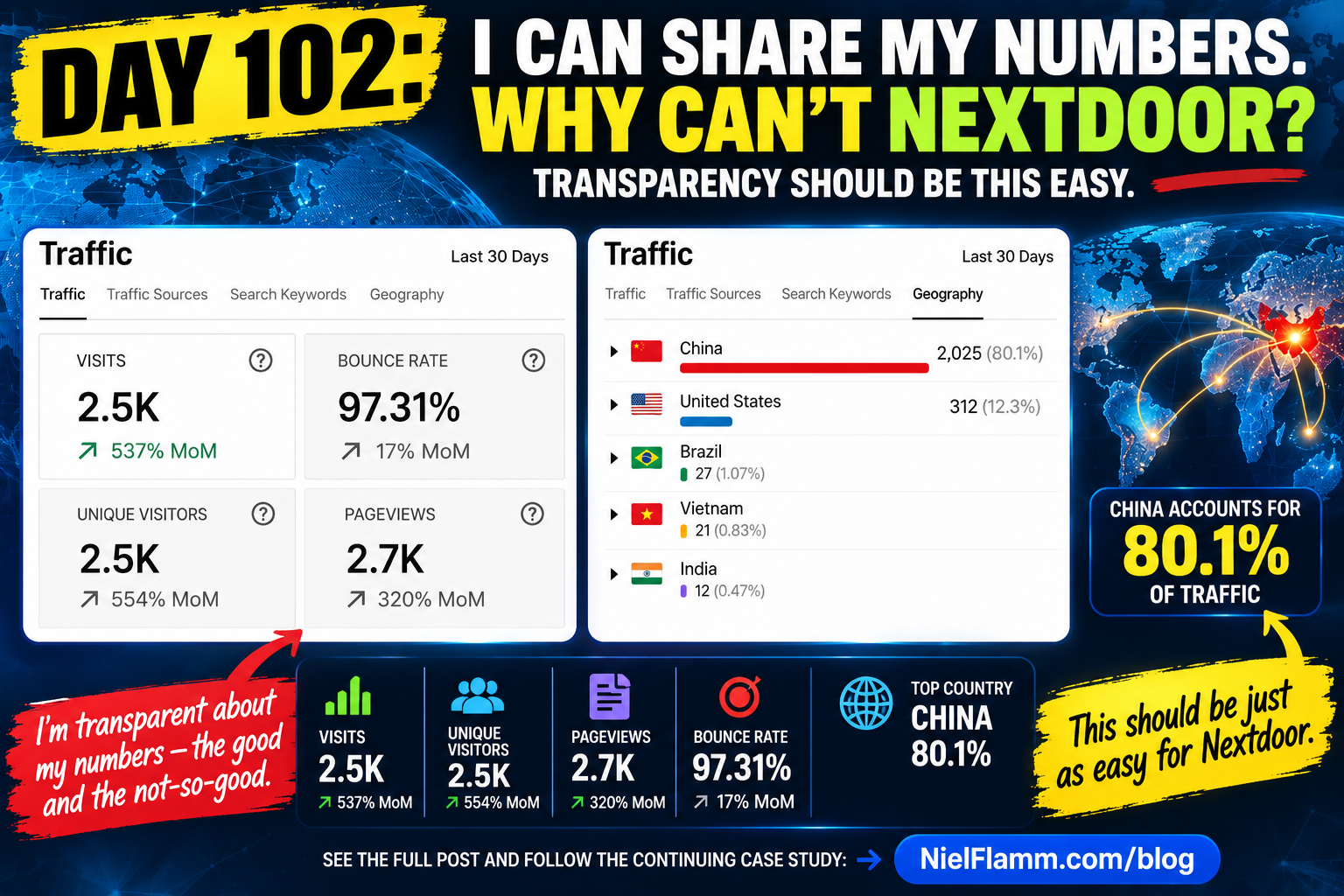
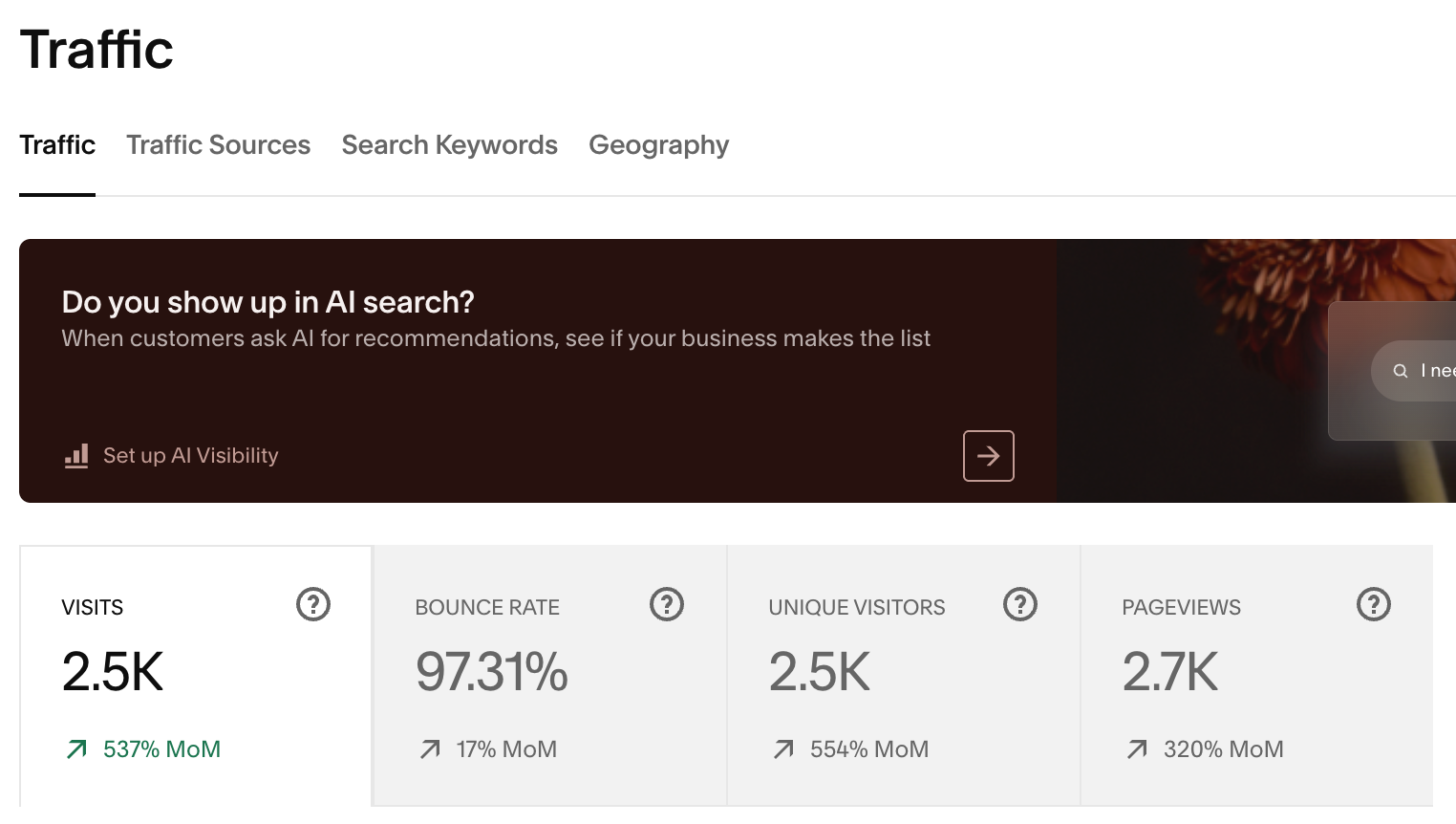
My latest 30-day website metrics show approximately 2,500 visits, 2,500 unique visitors, and 2,700 pageviews. Visits are up 537% month over month, unique visitors are up 554%, and pageviews are up 320%.
Sounds fantastic.
Then there's the 97.31% bounce rate.
Not exactly something I'm putting on a trophy. 😂
And I'm showing that number too.
China? Apparently, I’m Huge in China.
The geography surprised me even more.
Of the traffic shown in my analytics:
China: 2,025 visits — 80.1%
United States: 312 — 12.3%
Brazil: 27 — 1.07%
Vietnam: 21 — 0.83%
India: 12 — 0.47%
Do I completely understand why China represents 80% of the traffic?
Nope.
Could some traffic be automated, routed strangely, or otherwise not represent 2,025 people sitting in China eagerly awaiting my next blog post?
Absolutely.
That's the point.
I don't know everything happening behind the numbers.
So I'm showing them, asking questions and asking readers for feedback.
,
Why Is That So Difficult?
This brings me back to Nextdoor.
I've asked about WAU—Weekly Active Users.
I've asked for the detailed Insights reports that Nextdoor itself told readers were available upon request.
I've asked questions about methodology, engagement, communication, and other metrics.
And after 102 days, what have I received?
Links to information that was already publicly available and responses that, from my perspective, haven't answered the underlying questions.
That's not the transparency I'm talking about.
Transparency isn't:
“Here's the number we want you to see.”
It's also:
“Here's the number. Here's what we know about it. Here's what we don't know. Here's how we calculated it. Ask us questions.”
I Don't Know Everything
That's an easy sentence for me to write.
I don't know why my traffic suddenly jumped.
I don't know exactly why China dominates it.
I don't know how many visitors read every word versus those who accidentally land on the site and disappear.
And I certainly don't know what's going on inside the minds of my readers and viewers.
So I ask.
What are you reading?
What isn't working?
Why did you leave?
What should I change?
What would make you come back?
That's useful feedback.
And if a guy running NielFlamm.com can publish both the pretty numbers and the ugly ones, ask questions about them and admit what he doesn't know, I don't think it's unreasonable to expect a publicly traded neighborhood platform to engage seriously when a shareholder asks questions about its metrics and research.
I'm not asking Nextdoor to know everything.
I'm asking it to explain what it does know.
Day 102.
👉 See the metrics and follow the continuing case study:
NielFlamm.com/blog
I Asked a Question. I Got the Director’s Cut.
Today, while hanging out with Mom at the skilled nursing facility, I was reminded that my preferred conversation speed isn’t necessarily everyone else’s.
Especially with people older than me. I have to say “older than me” because, at this point, I’m old, too. I’m just wearing a Yankees pullover and hoping nobody checks the paperwork.
I didn’t see my friend Donna Woods today. With all the talking she does, I’m beginning to wonder whether she knows Elle Woods from Legally Blonde. I have no evidence of a connection, but I suspect Donna could keep a courtroom occupied.
In her absence, I got better acquainted with Mom’s roommate, Miss Jenny.
I remember the roommate setup from my own days in skilled nursing. A shared room gives you plenty of opportunities to get to know someone. Sometimes more opportunities than you had scheduled.
Miss Jenny asked me a question. I asked her a question.
And that’s how I received the ten-minute answer.
I had already told her I’m a native New Yorker. Just in case she forgot, I was wearing a lightweight New York Yankees quarter-zip pullover. I felt I had provided both verbal notice and supporting documentation.
My preferred answer is fewer than ten words. About five seconds. Enough information to move forward, with perhaps a little time left to blink.
Some of the Southern folks I meet have a more generous approach to conversation. My question gets an answer, a backstory, introductions to supporting characters, and enough local history to qualify for a walking tour.
Meanwhile, my New York brain is standing by the door with its keys out.
This reminded me of a former colleague. I once asked a yes-or-no question about our learning management system, SumTotal.
Before I got the answer, I received a refresher on Kirkpatrick, Maslow’s hierarchy of needs, and the post-training assessments. All of them.
I was waiting for “yes” or “no.” Somehow, I had enrolled in continuing education.
By the time we reached the answer, my most urgent need in Maslow’s hierarchy was for the conversation to end.
It drove me bonkers.
And today, sitting with Mom and listening to Miss Jenny, I recognized that same feeling. I had asked a small question and apparently selected the extended warranty on the response.
I now know more about Miss Jenny than I expected to learn during this visit. Sometimes, the less I know, the better off I am. My brain already has enough open tabs, and several of them are playing music I can’t locate.
Of course, I can hear the irony.
I’ve spent the last few days writing about taking time to listen, visiting people, and making room for conversation.
I still mean every word.
I’m also discovering that I can believe in all of that while occasionally wishing an answer came with a table of contents.
Some days, I have the patience to follow every detour. Other days, I’m silently trying to remember what I asked in the first place. That probably says as much about me as it does about the person talking.
Today, I got to spend time with Mom and learn a little more—okay, considerably more—about Miss Jenny.
Next visit, I’ll wear the Yankees pullover again.
Apparently, it’s a fashion statement, not a speed limit.

From 1,000 to 2,500 Visitors in 18 Days—Thank You!
Eighteen days ago, I published “Thank You for Reading My Stupidity,” after traffic had dropped by almost 50% and then finally returned to its previous level.
At that time, the previous 30-day figures showed approximately:
1,000 visits
1,000 unique visitors
1,300 page views
The newest 30-day report shows:
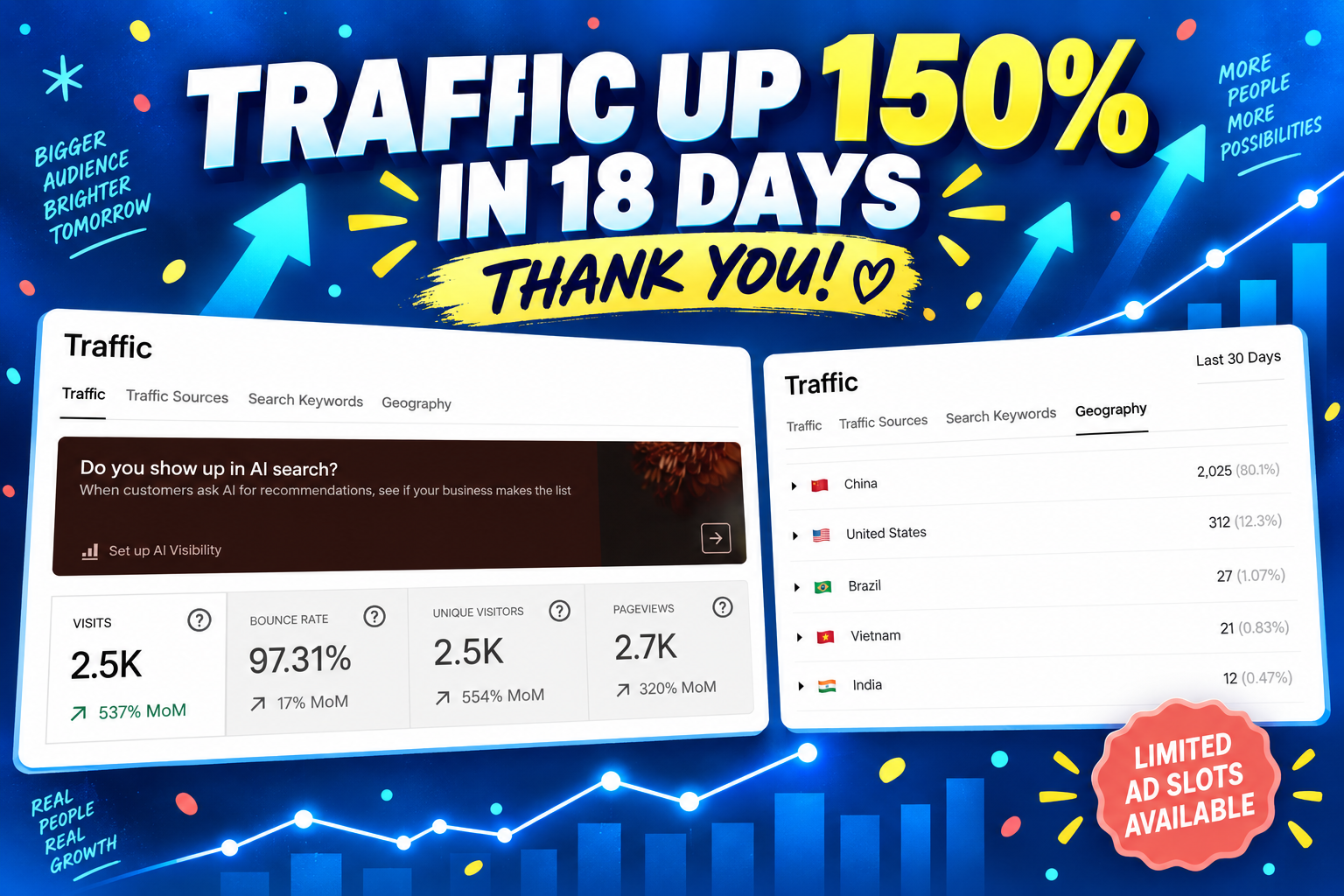
2,500 visits—an increase of approximately 150% since the last post
2,500 unique visitors—also up approximately 150%
2,700 page views—an increase of approximately 108%
These comparisons are based on rounded figures, but the direction is unmistakable: considerably more people are finding and viewing the site.
I want to thank everyone who has visited, read a post, shared a link, or simply stopped by to see what kind of stupidity I’ve posted lately. I’m genuinely grateful for every visit.
The China Is Still Leading the Way
In the previous post, I thanked the 710 visitors from The China. The latest report shows 2,025 visits from The China—an increase of approximately 185% in just 18 days.
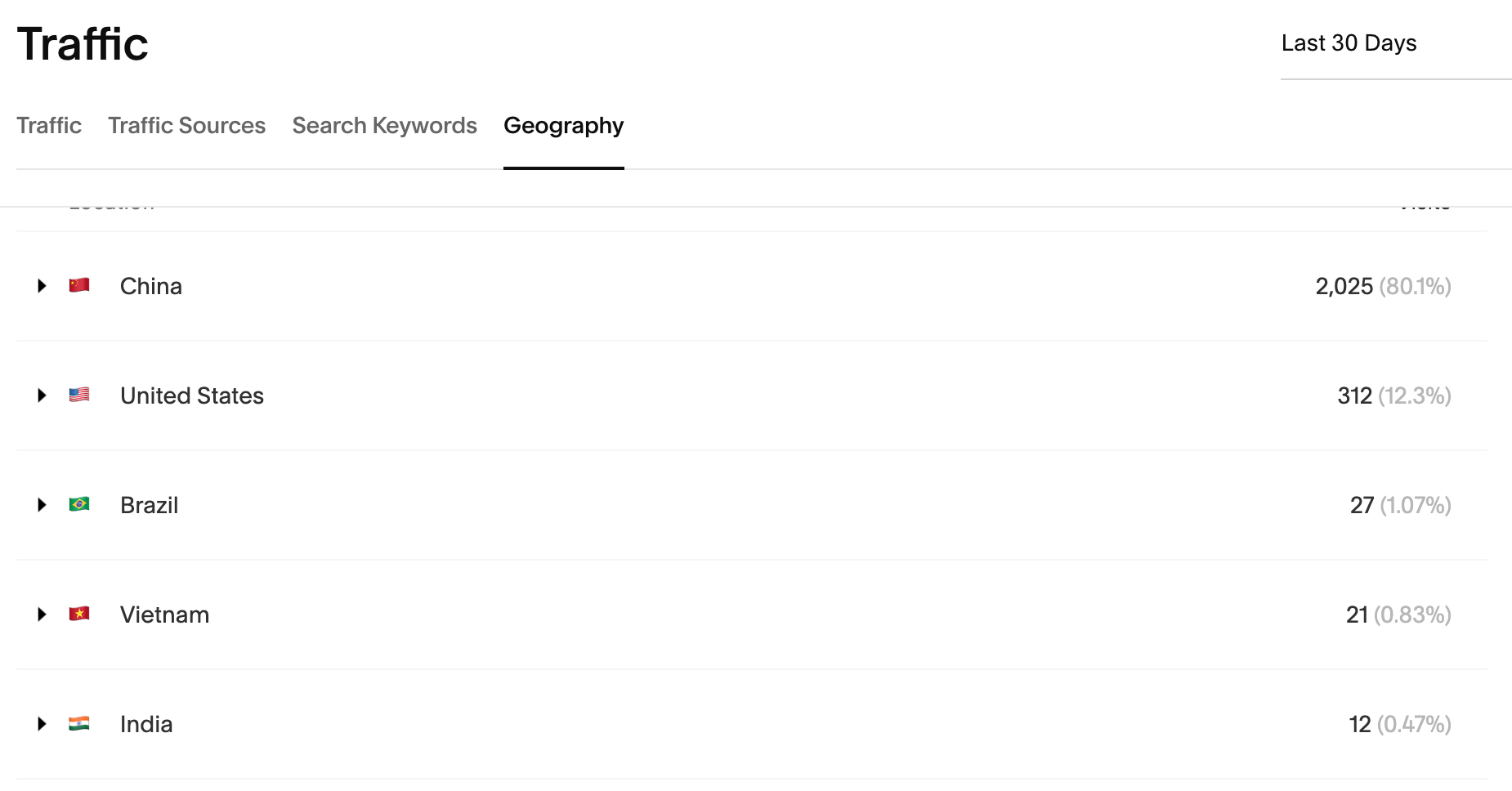
The United States increased from 249 to 312 visits, or approximately 25%. Brazil rose from 24 to 27 visits, and the latest report also includes visitors from Vietnam, India, and other places worldwide.
The bounce rate is currently 97.31%, so many visitors appear to stop by, look at one page, and continue on with their day. Whether you read one page or ten, I appreciate you spending some of your time here.
Limited Advertising Opportunities
With the audience continuing to grow, I’m offering a limited number of advertising slots on the site.
This is an opportunity for businesses, creators, and organizations to reach a growing international audience without being buried among dozens of competing advertisements. Availability will remain intentionally limited so the site stays uncluttered and participating advertisers receive meaningful visibility.
If you’re interested in advertising on the site, please get in touch before the available spaces are filled.
Thank you again to everyone visiting—from The China to the United States and everywhere in between. Seeing visits rise by roughly 150% in only 18 days is unexpected, humbling, and greatly appreciated.
Thank you for continuing to read my stupidity.

When Guilt Feels Real: Recovery, Mental Health and Making Amends
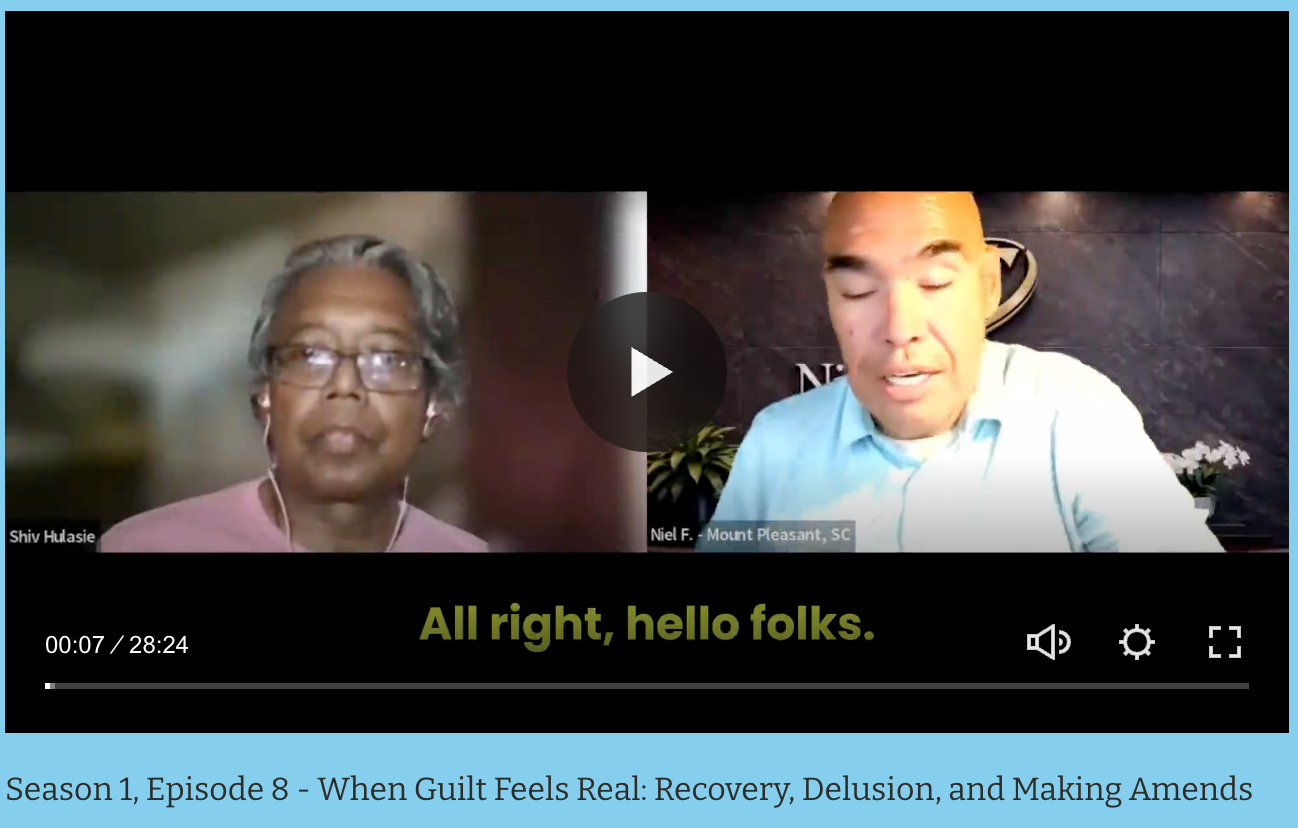
The Down a Hole podcast is back, and Fish and I are tackling a difficult question: What happens when someone feels genuine guilt about events experienced during psychosis—even after realizing those events never actually happened?
In this episode, we discuss a man in recovery who believed he had three daughters and had failed them as a father. The daughters were not real, but his memories and guilt still felt very real to him. Should he make amends to people who never existed? Could doing so provide relief, or would it reinforce the delusion?
There is no simple answer. Our conversation explores the complicated intersection of sobriety, mental health, guilt, accountability, and spirituality. We also discuss why someone facing these questions should not try to work through them alone. A therapist, psychiatrist, sponsor or another qualified and trusted person can help determine the healthiest next step.
Watching this episode may offer a different perspective on recovery and a better understanding of how real another person’s experiences can feel—even when those experiences do not match our reality. It also reminds us that listening without immediately judging or dismissing someone can create the safety needed for an honest conversation.
The full podcast is available at NielFlamm.com/podcast.
While you are there, check out the other podcast episodes available on the site. Each conversation explores different experiences, perspectives, and challenges. Watching them may help viewers feel less alone, understand someone else’s journey or begin a meaningful conversation of their own.
Sometimes the greatest benefit of a podcast is not that it provides every answer. It encourages us to ask better questions—and to listen when someone is brave enough to share a vulnerable part of their life.