

Touring The Bridge: A Smaller Community and an Unexpected Cookie Inheritance
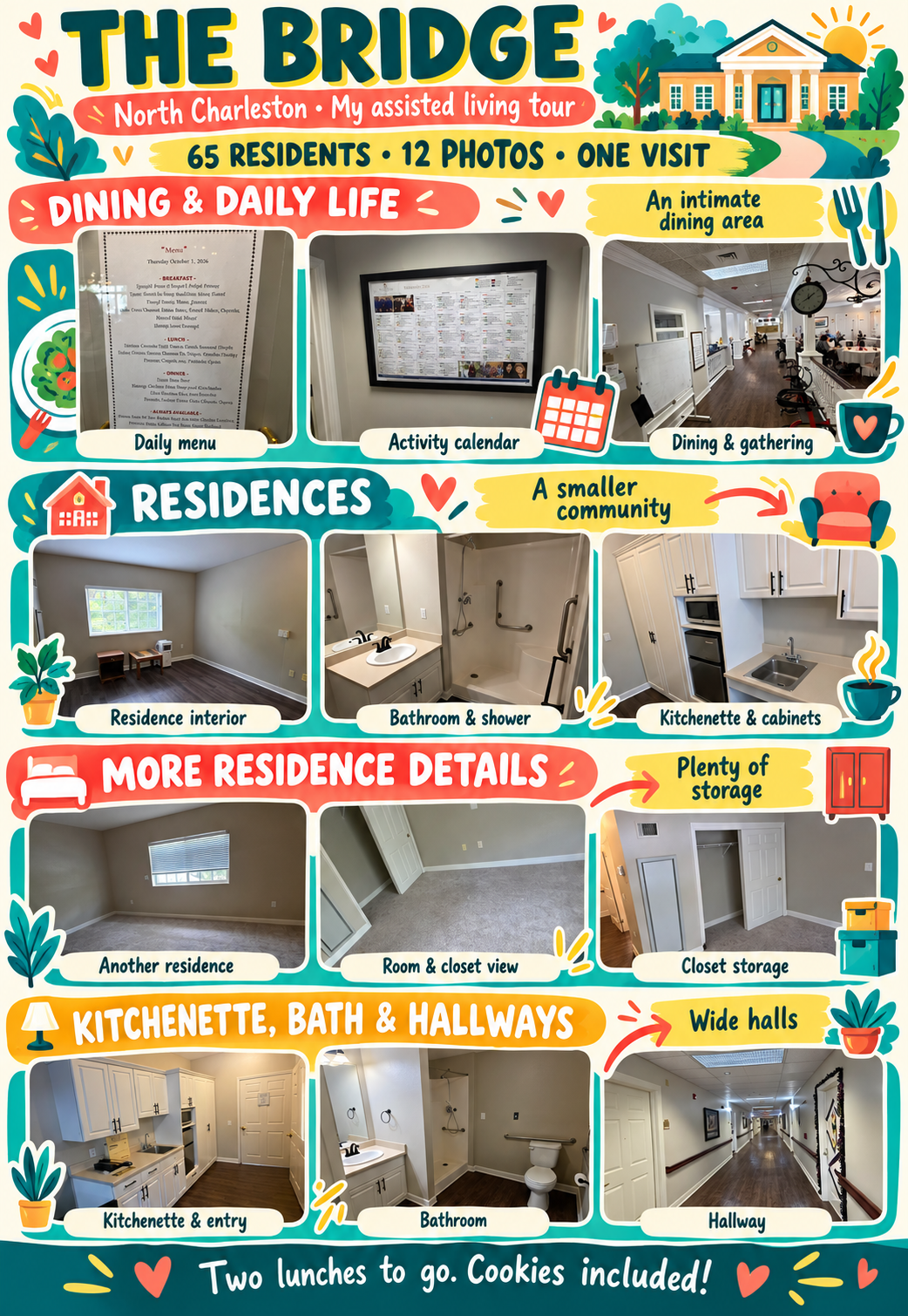
Today started with taking a car in for routine service, followed by a stop at Sam’s Club, and then another assisted living tour for Mom.
This time, I visited The Bridge in North Charleston.
It’s a smaller community with 65 residents, arranged in a square around an open courtyard. I liked the layout, and my overall impression was more positive than at The Palms.
The hallways were wide, the dining area felt intimate, and the residences seemed well laid out. They weren’t too big, but they had plenty of storage.
After a stop at Sam’s Club, I was especially prepared to appreciate storage. Buying in bulk can make a person look at cabinets differently.
As I walked through, I tried to picture Mom settling into one of the rooms. Where would her things go? Would the space feel comfortable? Could I imagine her heading to a meal and recognizing the people around her?
The smaller community appealed to me. I could picture her getting familiar with the place and finding her people over time.

The location also comes with some recognizable landmarks: Waffle House, Zaxby’s, and Trident Hospital.
I know Trident from having a stent put in and undergoing my retinal surgery involving a silicone bubble. So I’m already familiar with the area, although I would welcome future trips with fewer procedures and more time visiting Mom.
The Bridge is farther from home than the other places I’ve toured. That’s something to consider, especially since I’ll probably make most of the trips while Mom gets settled.
Fortunately, I like to drive.
If she ends up there, I expect I’ll be going back and forth while she develops a routine and gets to know people. I want her to have support during that adjustment, while also having the opportunity to build a life in the community.
And yes, I brought food.
At this point, leaving an assisted living tour without a to-go box would feel like skipping part of the inspection.
I took two lunches: collard greens, Brussels sprouts, mac and cheese, and a chicken thigh.
I’m generally not a dark-meat person. The chicken thigh was okay. The rest was great.
The vegetables had made a much better impression on me this time. After my recent disagreement with peas, I was glad to restore diplomatic relations with the side dishes.
I also received two bags of cookies.
Mom doesn’t want hers.
I respect her right to decide what to do with her own food, especially when those decisions create an unexpected cookie inheritance.
The food matters, of course, but I also left thinking about the size of the community, the dining area, and how well the rooms used their space. I liked a lot about this visit.
I’m still comparing options. A good first impression gives me something to work with, and I want to keep considering what would suit Mom’s needs and preferences over time.
I have at least one more community to tour in a few weeks.
For now, The Bridge gave me another option I feel good about exploring—and more to share with Mom and the family as we work through this together.
Today’s errands covered car maintenance, bulk shopping, assisted living, and lunch.
The cookies were an unplanned development. I’m handling it.

The Feeding (2020): A Family Secret That Needs to Be Fed

There’s something I love about a good short horror story. The buildup starts right away, every minute counts, and the ending lands exactly where it should. The Feeding doesn’t disappoint.
Set during a pandemic, this roughly 15-minute short introduces a disturbing problem: raw meat is becoming difficult to come by, and a woman has a family secret that needs to be fed. That premise alone is enough to pull you in. What is she hiding—and what happens when feeding it becomes impossible?
I don’t want to give too much away. Part of the pleasure of a short like this is letting the story unfold without knowing where it’s headed. But if you enjoy horror that builds quickly and delivers a satisfying ending, this is well worth your time.
One recommendation: if you can watch YouTube on a big screen with big sound, do it. Turn down the lights and give this little nightmare your full attention.


Sam’s Club: Buy in Bulk, Invent Your Own Parking Spot
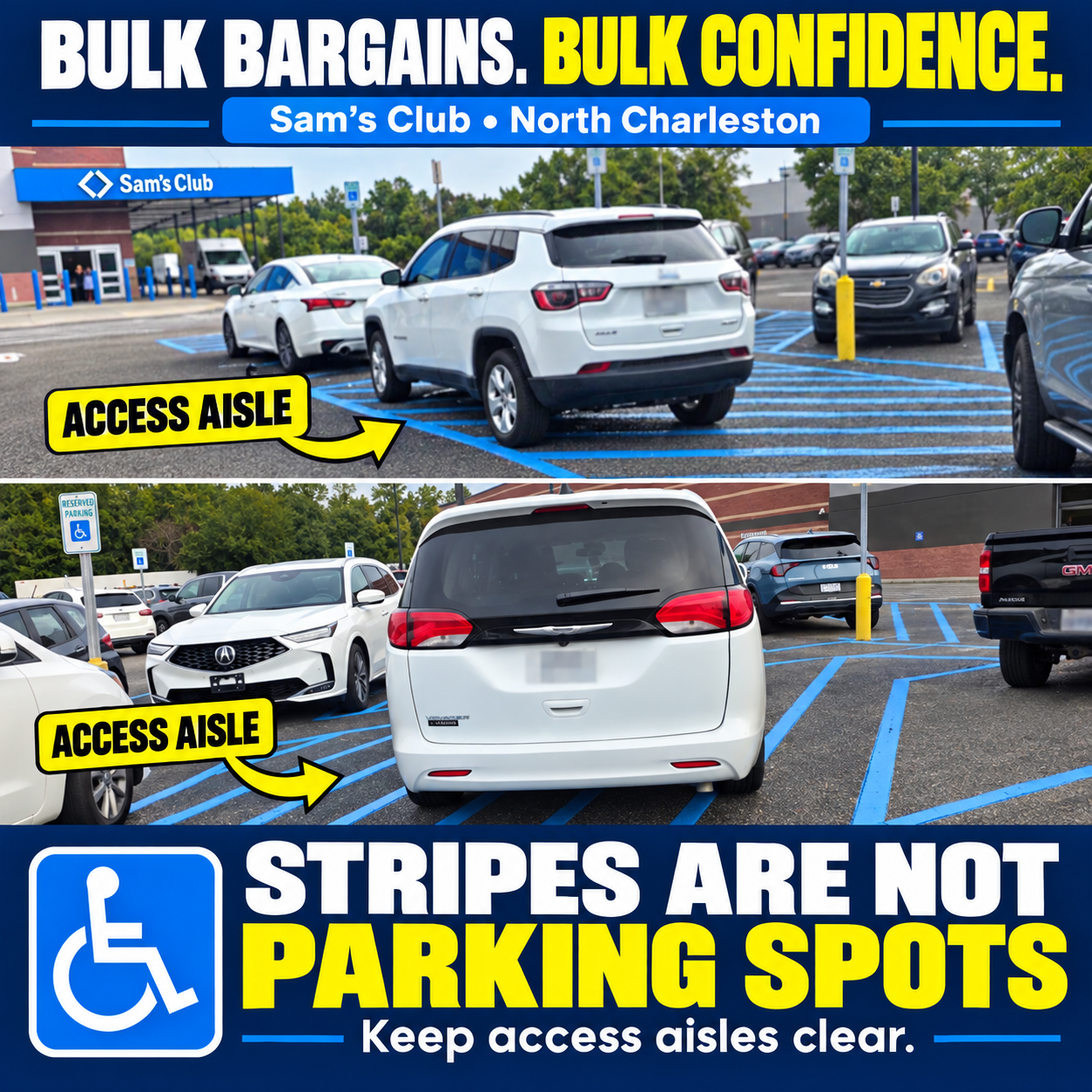
Today, October 1, around 10:45 a.m., I stopped at Sam’s Club in North Charleston before heading over to visit The Bridge assisted living. Along with the usual bulk bargains, I spotted something apparently available at no extra charge: creative parking.
Two drivers had apparently decided the marked spaces weren’t meeting their needs and set up their own accommodations in the blue-striped areas.
Apparently, those stripes looked like a welcome mat. “Reserved for people with exceptional confidence.”
Now, those areas serve a purpose. People using wheelchairs, walkers, or vehicle ramps need room to get in and out safely. That thought felt especially relevant as I headed to an assisted living community. A little convenience for one person can become a major obstacle for someone else.
But here’s the part that made me do a double take: a North Charleston police officer was at the Sam’s Club entrance, maybe 20 feet away.
Twenty feet. We’re talking sample-table distance.
I don’t know what the officer saw or whether anything happened afterward, but the scene certainly had the ingredients for an awkward parking lesson.

Sam’s Club sells plenty of things in bulk. Apparently, on this particular morning, confidence was one of them.
Please use an actual parking space and leave the striped access areas clear. Your jumbo pack of paper towels can handle a slightly longer ride in the cart.

Nextdoor Published a Study About Trust. This Is More Like It.
I have spent a lot of time providing feedback about Nextdoor's Insights reports, so when the company does something substantially better, I think it's important to say so.
Nextdoor's new “The State of Neighborhood Trust” report, produced with The Harris Poll, is much closer to what I've been asking to see.
This looks and reads like an actual research report.
Not simply a blog post with percentages and a statement that more information exists somewhere else.
The report is 24 pages long. It identifies the research partner, describes the sample, discusses methodology, presents findings in context, includes statistical analysis, identifies outside sources, and provides a research contact. Nextdoor Blog
Read Nextdoor and The Harris Poll's full Neighborhood Trust study
Bravo, Nextdoor.
Yes, I actually said that.
Screenshot it before somebody blocks me. 😂
This Is What I've Been Asking For
Nextdoor commissioned the research, and The Harris Poll fielded it in April 2026 among about 1,000 U.S. adults age 18 and older. Respondents came through The Harris Poll's online panel and were weighted to reflect the U.S. adult population. Nextdoor says it then analyzed the findings and conducted statistical modeling examining factors associated with trust and outcomes including safety, belonging, civic participation and reliance on neighbor recommendations. Nextdoor Blog

The accompanying Nextdoor article provides even more methodological detail: the survey was conducted April 16–20 among 1,003 adults, weighting included age within gender, region, race/ethnicity, marital status, household size, income, education and political affiliation where necessary, and the reported Bayesian credible interval is ±3.8 percentage points at a 95% confidence level. Nextdoor also acknowledges other potential sources of survey error. Nextdoor Blog
That's transparency.
Could there be more?
Sure.
I'd love to see an appendix containing the questionnaire, complete crosstabs and additional demographic breakouts. Since The Harris Poll fielded the survey, it would also be useful to provide a Harris Poll contact or link explaining whether additional demographic information, questionnaires or crosstabs can be obtained.
But that's me asking for the cherry on top rather than wondering where the sundae went.
This report gives readers enough information to begin understanding where the numbers came from and how the research was conducted.
And the Subject Is…Trust
This is where things become particularly interesting given my recent experience with Nextdoor.
The entire report revolves around trust.
One finding says 66% identify friendly day-to-day interactions as something that builds neighborhood trust. Meanwhile, the leading factor respondents identified as weakening neighborhood trust was lack of communication, at 46%. Nextdoor Blog
Read that again.
Lack of communication: 46%.
I've been writing about communication for more than 100 days.
You couldn't script this better.
The study says trust grows through regular opportunities to communicate, interact, and rely on one another. It also says the strongest predictors include how easy people feel reaching their neighbors and how often they actually interact. Nextdoor Blog
That's not my interpretation of what Nextdoor should believe.
That's in Nextdoor's own report.
Then Nirav Tolia Says This
The report includes a statement from CEO Nirav Tolia:
“The difference between a neighborhood and a community is trust.”
That's a powerful statement. Nextdoor Blog
And that's precisely why I can't ignore the contrast with my experience.
Yesterday I discovered that Nirav had blocked me on X.
Again.
For the second time in roughly six months.
I don't know why Nirav blocked me. Only he knows his reason, and I'm not going to pretend otherwise.
He also doesn't have an obligation to personally engage with every person who comments on his social media account.
But I'm allowed to ask what message the action sends to me.
Because I'm not some anonymous account that appeared yesterday screaming at the CEO.
I'm a shareholder.
I've spent months publicly documenting questions about Nextdoor.
I've repeatedly offered to have an actual conversation.
I've said I'd rather talk than type.
And for more than 100 days I've been pursuing detailed research that Nextdoor itself told readers was available by contacting its Insights representative.
Now I'm reading a Nextdoor report telling me:
Trust depends on communication.
You can't make this stuff up.

Trust Has to Work in Both Directions
Another line in the report fascinates me.
Nextdoor writes that trust is built through repeated interactions, communication, and confidence that others will respond when it matters. Nextdoor Blog
Exactly.
That shouldn't only apply neighbor to neighbor.
I think it's a valuable principle for company-to-customer, leadership-to-shareholder, platform-to-user, and executive-to-stakeholder relationships too.
Trust isn't created by saying the word trust repeatedly.
It isn't created by putting trust in the title of a 24-page PDF.
And it isn't automatically created because a company commissions a reputable polling organization.
Trust grows when words and experiences begin matching.
That's what makes this new report simultaneously encouraging and fascinating to me.
The Research Is Actually Helping Build Trust
Here's where I give Nextdoor genuine credit.
This report increases my confidence in these findings because Nextdoor told me how the research was conducted.
That's exactly how transparency builds trust.
Compare:
“67% of Americans say, X.”
Okay. Where did that number come from?
Versus:
Here's who conducted the survey. Here's when it was conducted. Here's the population. Here's the sample. Here's how respondents were recruited. Here's how weighting worked. Here's the statistical approach. Here are limitations. Here are outside sources. Here's a research contact.
Now we're talking.
Interestingly, the PDF once again lists Jacob Chavis, Senior Manager, Customer Insights, along with his Nextdoor email address as the research contact. Nextdoor Blog
Jacob and I already have some history.
😂
Maybe This Is Progress
I've said throughout this case study that if Nextdoor does something I think is good, I'll say it's good.
This report is progress.
I don't know whether my months of posts had anything whatsoever to do with the format. I have no evidence that they did, so I'm not taking credit.
Maybe Nextdoor was already moving toward more comprehensive research reports.
Maybe working with The Harris Poll resulted in a more rigorous presentation.
Maybe somebody inside Nextdoor independently said, We should probably show people how we got these numbers.
Whatever the reason:
Keep doing this.
And take it one step further.
Provide a Harris Poll link or research contact.
Make additional demographic tables available.
Publish questionnaires where appropriate.
Provide downloadable crosstabs.
Let researchers, journalists, advertisers, shareholders, and curious bald bloggers dig deeper.
That's how confidence in research grows.
Now Apply the Research to Leadership
That's my bigger challenge to Nextdoor.
The report says communication matters.
It says repeated interaction matters.
It says accessibility matters.
It says trust helps communities function.
And its CEO says the difference between a neighborhood and a community is trust. Nextdoor Blog
Great.
Apply those principles internally and externally.
When somebody asks a difficult question, communicate.
When somebody provides feedback, listen.
When somebody requests information that you've advertised as available, answer.
When a shareholder repeatedly offers to have a conversation, perhaps conversation is more consistent with the company's message than another block button.
Nirav doesn't have to agree with me.
Nextdoor doesn't have to agree with me.
Jacob doesn't have to agree with me.
Nobody has to like my posts.
But if we're going to talk about rebuilding trust through communication and interaction, then I think it's fair to ask Nextdoor's leadership to demonstrate the same behavior it celebrates in its research.
Trust is a great research topic.
It's an even better leadership practice.
And this time, Nextdoor, on the research itself:
Bravo. Keep going.
👉 Read my continuing Nextdoor case study at NielFlamm.com/blog
After Dialysis, Assisted Living Tours and Complaints: I Need the Ocean and Bacon
Today was one of those days when my internal battery was already flashing red before I walked through the door.
After dialysis, I toured The Palms, an assisted living facility I'm considering for Mom.
Today's dialysis was a little more difficult than Monday's. By the time everything was finished, I didn't even make it to my recovery meeting.
Instead, I had another mission:
Deliver Mom's dinner.
Ham, grits, and peas.
Gross.
I'm sure someone loves that combination. That someone is not me.
So, after dialysis and touring The Palms, I headed over to the skilled nursing facility with Mom's meal.
And then the complaining began.
Apparently, Everything Is Terrible
It was nonstop.
The food.
Physical therapy.
Nursing.
This.
That.
Something else.
At times, Mom was saying things that, from my perspective, didn't line up with what had actually happened. I've experienced that before with both of my parents, and today I didn't have much energy left to sort through what was accurate, what was frustration, and what might have been something else entirely.
I could feel myself reaching my limit.
That's when H.A.L.T. popped into my head.
Hungry.
Angry.
Lonely.
Tired.
I was feeling three out of the four.
I'll let everyone guess which three.
Actually, don't think about it too hard.
The important part was recognizing what was happening before I allowed myself to get dragged into an argument that wasn't going to accomplish anything.
See You Tomorrow
I finally told Mom I was going to leave and that I'd see her tomorrow.
Tomorrow, I'm touring another assisted living facility.
Her response?
“Don't come.”
My response?
“See you tomorrow.”
At this point, it felt less like a discussion and more like defiance.
Ugh.
Yesterday, I wrote about needing to establish boundaries. Today was another opportunity, actually, to practice one.
I didn't argue.
I didn't address every complaint.
I didn't stay there until I was completely exhausted and angry.
I left.
Sometimes that's the healthiest option available.
I'm Still Doing the Work
The frustrating part is that behind all these conversations, I'm still trying to do what Mom has said she wants.
She wants assisted living.
So I'm touring assisted living facilities.
I'm looking at rooms.
I'm learning about services.
I'm figuring out costs.
I'm asking questions.
I'm trying to imagine what her life might look like in each place.
Then I walk into the skilled nursing facility and hear complaint after complaint about the place she's currently living.
I understand that she's frustrated. She's been through a lot.
But I've been through a few things myself.
Today alone started with dialysis, moved into an assisted living tour, and ended with me delivering ham, grits, and peas while listening to a review of practically every department in the building.
Eventually, the tank is empty.
Mine was empty.
So I went home.
Tomorrow, I'll get up and do it again.
Another facility.
Another tour.
Another visit with Mom, regardless of today's “don't come.”
And hopefully another reminder to myself that I don't have to solve everything in one day.
I Need the Ocean and Bacon
Fortunately, I have something waiting for me at the end of October.
I'm going on a cruise.
And after the last few weeks, I think I've identified exactly what I need:
The ocean and bacon.
Lots of ocean.
An unreasonable amount of bacon.
Maybe I'll sit somewhere, looking out over the water, holding a plate stacked with bacon and doing absolutely nothing for anyone.
No assisted living tours.
No skilled nursing complaints.
No ham, grits, and peas.
No problem-solving.
Just me, the ocean, and enough breakfast meat to concern a cardiologist.
But first, tomorrow.
Another assisted living facility.
Another visit with Mom.
Because even when she says, “Don't come,” sometimes I know what she really needs is for me to keep showing up.
So...
See you tomorrow, Mom.