

Day 107: Nirav Tolia Blocked Me Again. Apparently, We’re Doing This Twice.
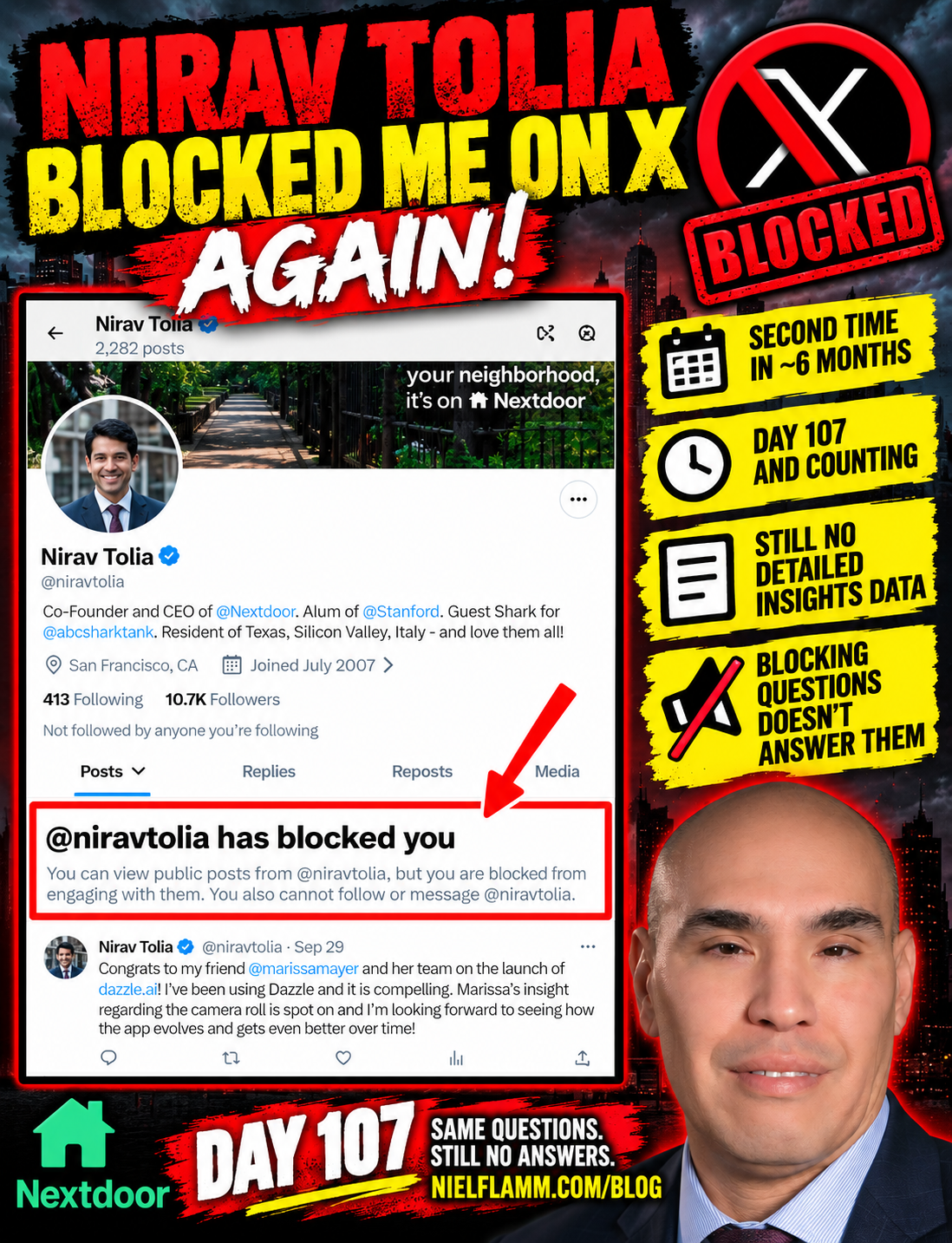
Nirav, you got me. 😂
I've been posting about my request for the detailed Nextdoor Insights research that the company said readers could get by contacting Jacob Chavis.
While making my rounds across the various platforms and Nextdoor accounts, I came across CEO Nirav Tolia's X profile.
And there it was:
“@niravtolia has blocked you.”
Again.
Yes, again.
This is the second time in roughly six months that I've found myself blocked by Nextdoor's CEO.
I have to admit, that's almost impressive.
A Speed Bump, Not a Roadblock
The screenshot says I can still view Nirav's public posts, but I can't engage with them, follow him, or message him from that account.
Okay.
I'm resourceful.
This is a speed bump. It won’t end the conversation.
More importantly, blocking me doesn't answer the question I've been asking.
And this story didn't actually begin 107 days ago.
How Did I Even Get Here?
Long before the Insights report became part of this case study, I was a Nextdoor user in my local neighborhood.
I was eventually banned.
One issue involved my posting multiple personal items for sale. I questioned where the applicable restrictions appeared in Nextdoor's terms and policies and sought clarification.
From my perspective, meaningful communication eventually stopped.
So I started writing about my dissatisfaction on LinkedIn.
Then the discussion expanded.
I started looking more closely at Nextdoor's moderation model, communications, small-business experience, research, leadership, shareholder value, and other aspects of the company.
Eventually I came across Nextdoor's Home Insurance Insights research.
That’s where things got almost comical.

Nextdoor Told Readers to Contact Jacob
The June 15 Home Insurance Insights article says the research came from a survey of 1,000 U.S. adults.
Other Nextdoor Insights articles have been even more explicit about how to get additional research. For example, its summer-travel report tells readers who want the complete findings and detailed data to contact Jacob Chavis, Customer Analytics & Insights Manager.
So I did what Nextdoor told readers to do.
I contacted Jacob.
And then I followed up.
And followed up.
And followed up.
We're now at Day 107 of this particular chapter.
Communications eventually responded, and I've publicly acknowledged that. I didn't receive the complete, detailed material I requested.
Last week, I expanded my email to Nextdoor's Executive Team.
Now, as I continue to post about the experience, I discovered that Nirav has blocked me on X again.
Blocking Is Certainly an Option
Let's be fair about something.
Nirav has every right to decide whom he wants to interact with on his social media accounts.
Being CEO of a public company doesn't mean he owes me a personal conversation every time I have a question.
And I can't tell you why he blocked me.
Maybe he's tired of seeing my posts.
Maybe he thinks they're repetitive.
He may not like my approach.
Maybe he doesn't want to engage.
Only Nirav knows.
But here's where I think this becomes interesting from a leadership perspective.
Nextdoor's own leadership page identifies Nirav as its CEO, President, Chairperson of the Board, and co-founder.
That's a lot of leadership hats.
So when the person wearing all those hats blocks a shareholder who has been publicly questioning the company's communication, I think it's fair for me to write about the experience.
I'd Rather Have a Conversation
I've said this repeatedly:
I would rather talk than type.
Phone.
Video.
Virtual coffee.
An actual conversation.
I'm not asking Nirav to agree with me.
I'm not expecting Nextdoor to implement every idea I throw at it.
I'm not even expecting Nextdoor to enjoy my posts.
Some of them probably aren't particularly enjoyable from their side of the screen.
But if you're going to lead a company built around neighbors communicating with neighbors, criticism and uncomfortable questions come with the territory.
That's leadership.
I've Got Time
I've also joked before that Nextdoor may have picked the wrong person for a waiting contest.
My medical circumstances mean I have more downtime than I once did.
I can write.
I can research.
I can ask questions.
I can follow up.
And apparently I can periodically discover that I've been blocked again. 😂
I prefer Nextdoor to focus on building the business, improving the product, and creating long-term shareholder value.
Yesterday I wrote about NXDR closing at $2.43.
As a shareholder, I'd love to see the company deliver the kind of sustained performance that sends that number substantially higher.
I'd like to see a business return capital to shareholders through a dividend, if and when its financial position and board determine that makes sense.
That's a much more interesting use of corporate energy than this 107-day saga.
Leadership Includes Taking Some Heat
I don't think a CEO needs to respond personally to every critic on social media.
That's unrealistic.
I also don't think blocking someone proves their criticism is correct.
It doesn't.
Leaders of public-facing companies should expect scrutiny.
Especially when they're highly visible themselves.
Especially when they're talking publicly about community, connection, listening, and the “power of we.”
Sometimes leadership means standing behind the product and the rhetoric when somebody says:
“Okay. I have some questions.”
And sometimes those questions aren't flattering.
I don't prefer Nirav to have “thicker skin” because I have no insight into how he personally feels. I don't.
My point is about the leadership behavior I'd prefer to see:
Engage with difficult questions.
Delegate them to someone who will.
Answer them.
Disagree with them.
Explain why they're wrong.
Or say, “We're not providing that information.”
Any of those outcomes would be more interesting than another block button.
So, Nirav, You Got Me
Blocked for the second time.
I laughed when I saw it.
Then I took a screenshot.
And now, naturally, I'm writing about it.
Because after everything I've documented, this has become part of the case study too.
Day 107.
The detailed research question remains.
The Executive Team has my latest email.
And Nirav Tolia has blocked me on X.
Again.
I'm still here.
👉 NielFlamm.com/blog

Day 107: NXDR Ends at $2.43 — What Is the Market Telling Us?

Day 107.
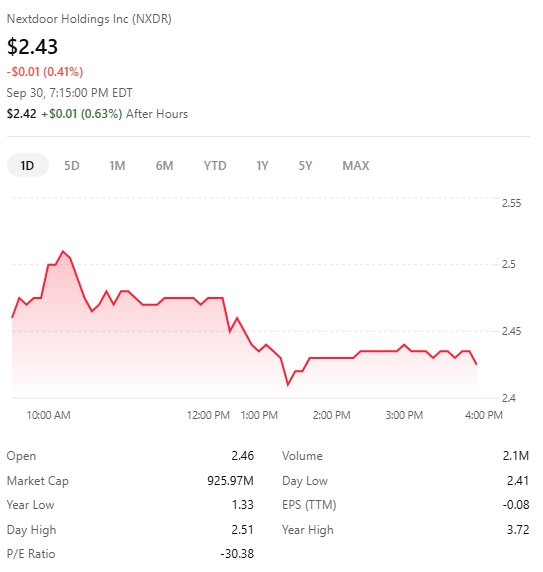
Today, Nextdoor Holdings (NXDR) finished at $2.43 per share, down slightly from Tuesday's $2.45 close. The stock traded between $2.41 and $2.52 during the session, with roughly 2.14 million shares changing hands.
One day doesn't tell the whole story.
The longer-term picture in the chart I've been watching is considerably more interesting.
A Year of Ups, Downs and Plenty in Between
Look at the one-year chart I included with this post.
NXDR has spent portions of the period down around the $2 range, while at other points it approached the upper $2.60s.
More recently, the movement has been just as interesting.
NXDR closed at $2.15 on September 9. By September 21, it had climbed to $2.64. It then fell to $2.38 on September 23, recovered to $2.51 on September 25, and finished September at $2.43.
That's quite a ride for a stock trading for less than $3.
And as a shareholder, it raises a question I've been asking throughout this Nextdoor case study:
What ultimately moves confidence in a company?
A Stock Price Isn't a Corporate Report Card
I want to be careful here.
A stock going up doesn't automatically mean management is doing everything right.
A stock going down doesn't automatically mean management is doing everything wrong.
And I'm certainly not going to look at today's two-cent decline and announce:
“The market has spoken about Nirav Tolia!”
😂
That's not how markets work.
Stock prices can move because of company financial results, expectations about future results, analyst opinions, broader market conditions, trading activity, liquidity, news, investor sentiment, and countless other factors.
NXDR itself demonstrates how quickly those expectations can change. In August, following its second-quarter results, analysts changed their views and price targets. More recently, NXDR has continued moving around considerably from session to session.
I can't attribute a specific Nextdoor decision to a particular movement on this chart.
No one else can either without evidence connecting the two.
But Confidence Still Matters
The chart still matters for my longer-term case study.
Markets ultimately involve people deciding what they believe something is worth.
And those decisions can include much more than yesterday's closing price.
Investors can consider:
Results. Strategy. Growth. Profitability. Execution. Leadership. Communication. Governance. Risk. And expectations about what happens next.
That's where confidence comes in.
A company can announce a brilliant strategy, but eventually investors can look for evidence that it worked.
A CEO can communicate a compelling vision, but eventually shareholders can compare that vision with results.
Management can make decisions that look strange today and brilliant two years from now.
Or the reverse.
Time has an interesting way of grading decisions.

That's Why I Keep Coming Back to Results
I've spent 107 days documenting my experience with Nextdoor.
I've asked about the detailed Insights data.
I've written about communication.
I've questioned transparency.
I've discussed moderation.
I've written about small businesses.
I've questioned how awards are judged.
I've discussed the economic value of neighbor-generated information.
I've praised Nextdoor when I thought it deserved praise.
I've provided feedback when I saw room for improvement.
That doesn’t mean today's $2.43 closing price validates my opinions.
It doesn't.
Likewise, if NXDR jumps to $3 tomorrow, that wouldn't suddenly invalidate the questions I've been asking.
What matters to me as a shareholder is what happens over time.
Decisions → Results → Confidence
Maybe that's the simplest way I can describe what I'm watching.
Leadership makes decisions.
Those decisions eventually produce results.
Those results can influence expectations.
And expectations can affect how investors value the company.
Not necessarily today.
Not necessarily tomorrow.
And certainly not because of one blog post, one executive interview, one Insights report, or one awkward email exchange.
But over time, execution has consequences.
That's why I'm interested in more than whether NXDR is green or red when I open the chart.
I'm interested in the decisions underneath it.
$2.43 Is Just Today's Number
Tomorrow it could be $2.35.
It could be $2.55.
Eventually it could be considerably higher—or considerably lower.
I don't know.
What I do know is that today's number becomes another point on that purple line.
$2.43.
Another trading day.
Another data point.
And another opportunity to remember that the market doesn't permanently value a company based on what leadership says it intends to accomplish.
Over the long run, investors also get to examine what actually happened.
That's the part of the chart I'll continue watching.
Day 107.
NXDR closes September at $2.43.
Let's see where the decisions, results, and confidence take it next.
👉 NielFlamm.com/blog

Touring The Palms: Nice Grounds, Friendly People, and Unfortunately, Peas

After dialysis today, I toured The Palms as I continue looking at assisted living options for Mom.
Dialysis followed by a facility tour makes for a full day, but I’m learning something useful at each stop. Seeing these places in person gives me a better sense of what daily life might look like for her—and what the differences are beyond the monthly price.
The Palms is in a building that’s about 50 years old and is being renovated. I learned the HVAC system was recently updated and needed adjustments to work properly.
I appreciate hearing about those details. Renovations are part of the picture, and I want to understand both what’s already been done and what’s still being worked on.
Compared with Somerby, The Palms didn’t feel as open and airy to me. It has a different atmosphere, and I noticed that as I walked through the common areas and rooms.
But I also noticed friendly staff and people who seemed happy.
That was only my impression during one visit, but it matters to me. I’m trying to imagine Mom living somewhere, spending time with people, asking for help, and finding a routine. A place's feel includes the people in it.
The grounds were another positive. There were trees, shaded paths, and places to sit outside. After recently spending time outdoors with Mom at the skilled nursing facility, I could appreciate having pleasant outdoor space available.
Then came the food.
You knew I was getting there.
In my opinion, the meal wasn’t as good as what I brought back from Somerby. And there were peas mixed with the corn and carrots.
Peas.
The corn and carrots had been doing perfectly well without that kind of interference.
I understand some people enjoy peas. I respect their right to be wrong at lunch.
My personal vegetable grievances aside, food is still an important part of this search. Mom has made her opinions about facility meals very clear, and I want to pay attention to what she might actually enjoy eating.
One meal gives me a sample, and this sample didn’t impress me as much as Somerby’s did.

The Palms does have another meaningful difference: it costs less per month.
That deserves consideration. These are substantial ongoing expenses, and I’m trying to weigh the cost alongside the setting, the people, the food, and how well a place could meet Mom’s needs.
So my impression today was mixed, with some real positives. The building is older and undergoing updates. The interior felt less open than Somerby. I preferred Somerby’s food. But the staff was friendly, the people I saw seemed happy, the grounds were nice, and the monthly cost was lower.
I’m glad I went.
I’ve also been sharing my thoughts with my brothers and their wives, and posting pictures in a shared Google Drive so everyone can see what I’m seeing. I want them included as we think through the options for Mom. The photos give us something concrete to discuss, and their perspectives help me consider things I might have missed. My opinion of peas, however, is already firmly established.
Each tour is helping me figure out which questions to ask and which details I want to bring back to Mom. I want her involved in thinking about where she could feel comfortable and what matters most to her.
Tomorrow, I tour another place.
I’ll keep asking questions, looking around, and tasting the food.
And quietly hoping the vegetables have made better decisions.

Another Scam Invitation: Apparently I’m Invited to Give Away $399.99
My inbox has once again extended a very generous invitation.
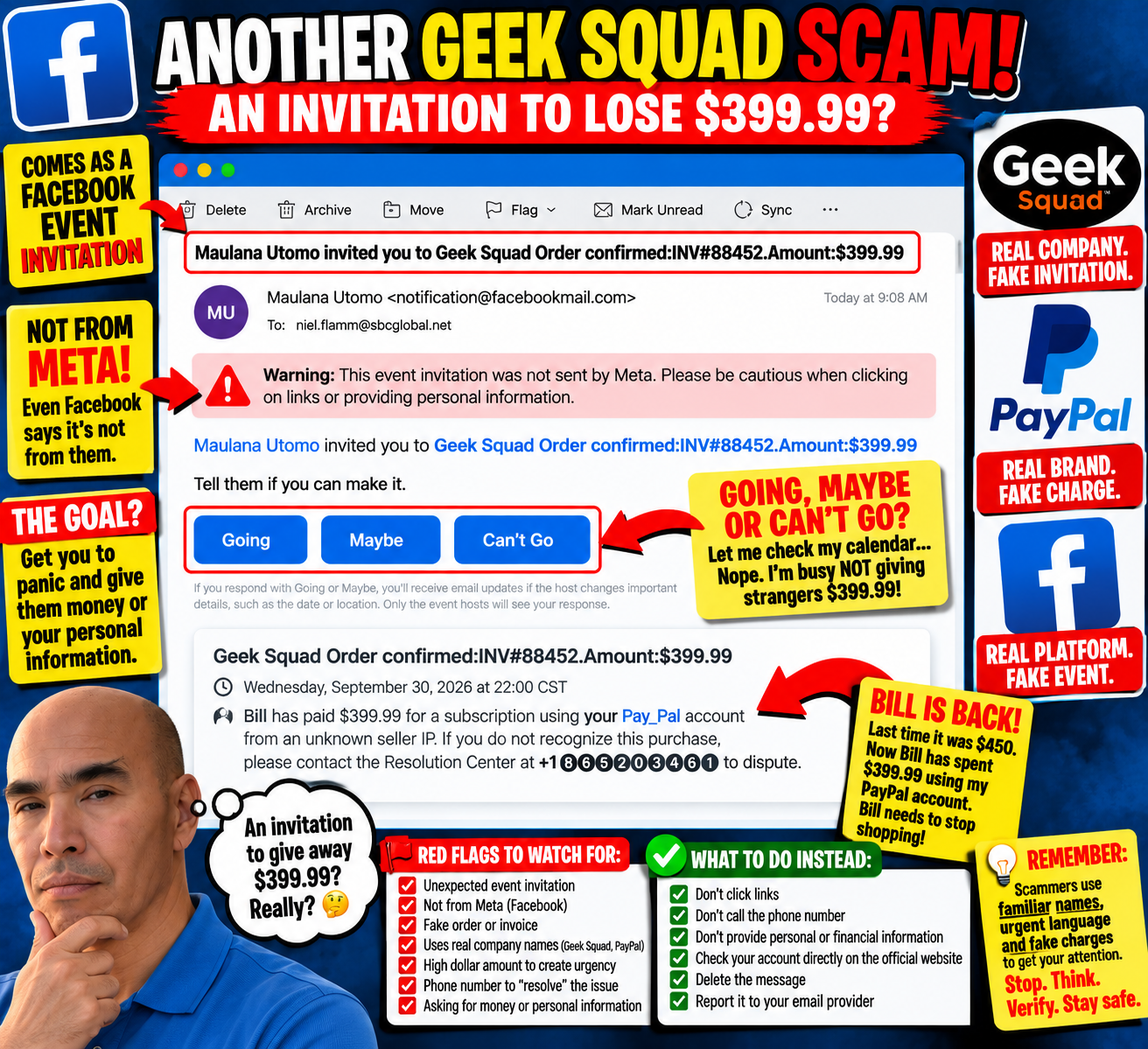
This time, Maulana Utomo has invited me to an event called:
“Geek Squad Order confirmed: INV#88452. Amount: $399.99”
How thoughtful.
Some people get invited to weddings.
Some people get invited to birthday parties.
Apparently, I get invited to give scammers money or personal information.
I really need a better social life.
Going, Maybe, or Can’t Go?
This is my favorite part of these fake Facebook event invitations.
According to the message, I supposedly have a $399.99 Geek Squad order.
Naturally, The Facebook gives me three options:
Going
Maybe
Can’t Go
Let me check my calendar...
Nope.
Unfortunately, I'm busy that evening, not giving strangers $399.99.
I'm going with Can’t Go.

Bill Is Back!
Then I read the description, and an old friend has apparently returned.
Bill.
The invitation says:
“Bill has paid $399.99 for a subscription using your Pay_Pal account from an unknown seller IP.”
Bill!
We've talked about this.
In one of my previous mystery-subscription emails, Bill supposedly spent $450 using my PayPal account.
Now he's back for another $399.99.
At this point, Bill has more subscriptions than I do.
Someone needs to take away his imaginary credit card.
Geek Squad, PayPal and Facebook Walk Into a Scam...
This one throws several recognizable names into the blender.
The event title references Geek Squad.
The description references PayPal—although creatively written as “Pay_Pal.”
The email itself comes from a Facebook event invitation.
And then there's a phone number supposedly belonging to a “Resolution Center.”
That's a lot of recognizable branding packed into one message.
But there's also something else sitting prominently near the top of the email:
“Warning: This event invitation was not sent by Meta. Please be cautious when clicking on links or providing personal information.”
That's probably the most useful sentence in the entire email.

What Exactly Am I Being Invited To?
That's what makes these messages funny to me.
The email literally says:
“Tell them if you can make it.”
Make it to what?
My $399.99 unauthorized transaction?
Is there going to be cake?
Should I bring a gift?
Do I need to RSVP?
Because from where I'm sitting, this looks like an invitation to worry about a fake charge, call the number provided, and potentially hand over money, account information, personal information—or some combination of the three.
That's one party I'm happy to miss.
The Urgency Is the Point
The $399.99 isn't there because someone necessarily charged me $399.99.
It's there to get my attention.
The recognizable company names get my attention.
The “unknown seller” creates concern.
The telephone number gives me an immediate action to take.
Put everything together, and the hope seems pretty obvious:
React first. Investigate later.
I'm doing the opposite.
If I ever receive a suspicious message claiming I've been charged by a company, I can check the account independently through the company's legitimate app or website rather than using the contact information in the suspicious message.
I don't need Bill's help.
Thanks for the Invitation
So, Maulana, thank you for thinking of me.
Unfortunately, I must respectfully decline your invitation to potentially hand over $399.99 and my personal information.
I already have plans.
I'm going to hit Delete.
And Bill?
Please stop shopping.
Have a Scam Story? Send It My Way
These messages keep coming, and I'll keep documenting them.
If you've received a strange scam email, fake invoice, suspicious Facebook invitation, mystery purchase, phishing text, or another creative attempt to get your money or information, send it to:
Send a screenshot and tell me what happened. Be sure to remove or cover any sensitive personal or financial information first.
Maybe your scammer can meet Bill.
They apparently have similar interests.
The Facebook Experiment Continues: Amy Messaged Me, and Now I Have More Questions
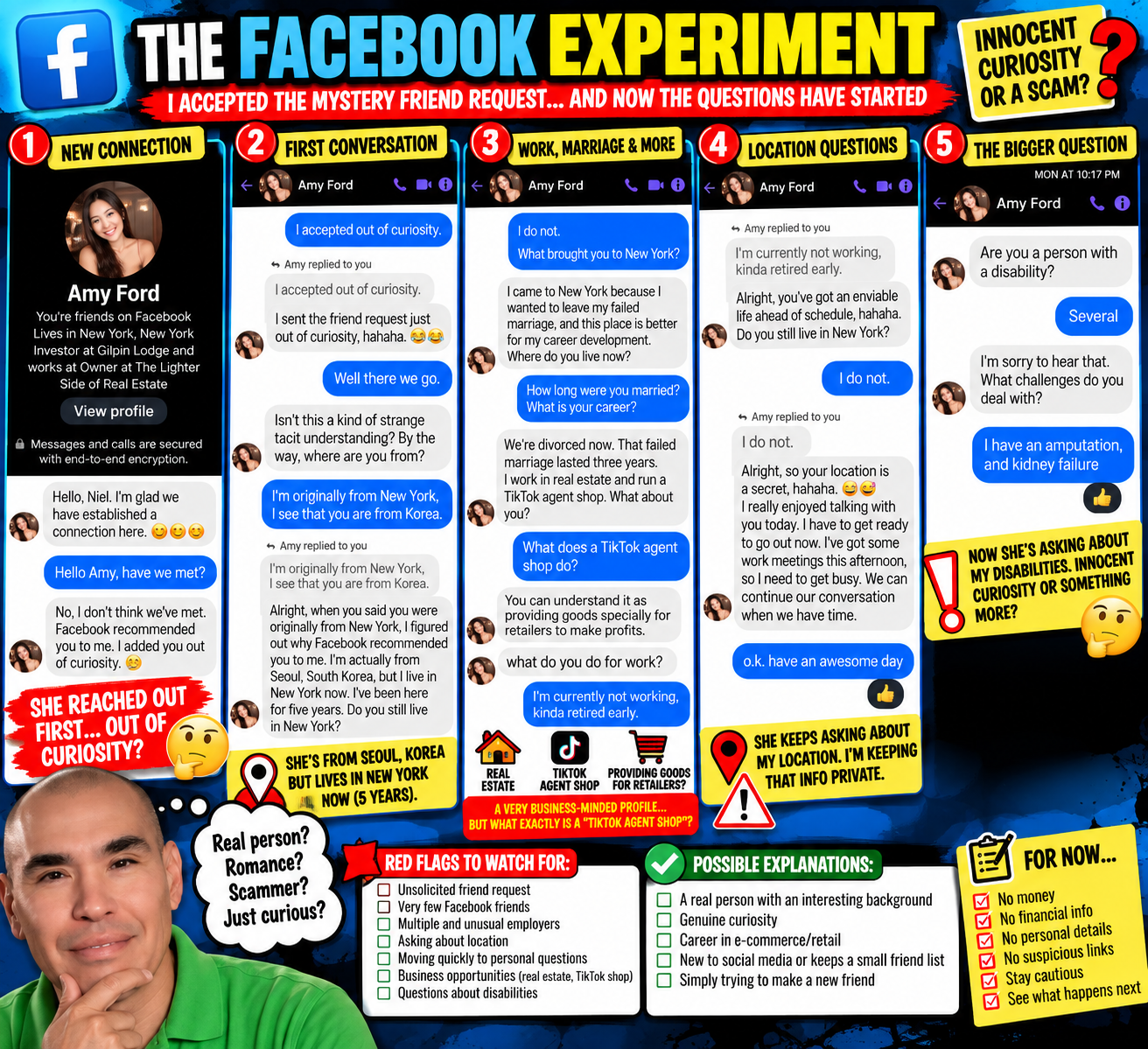
Well, that didn't take long.
In my last update, I shared that I finally accepted the mysterious friend request from Amy Ford on Facebook.
I didn't know Amy. We had one mutual friend. Her profile caught my attention for several reasons, including a rather impressive collection of jobs. Still, none of that proved anything was wrong with the account.
So curiosity won.
I accepted.
And shortly afterward, Amy messaged me.
“I Added You Out of Curiosity”
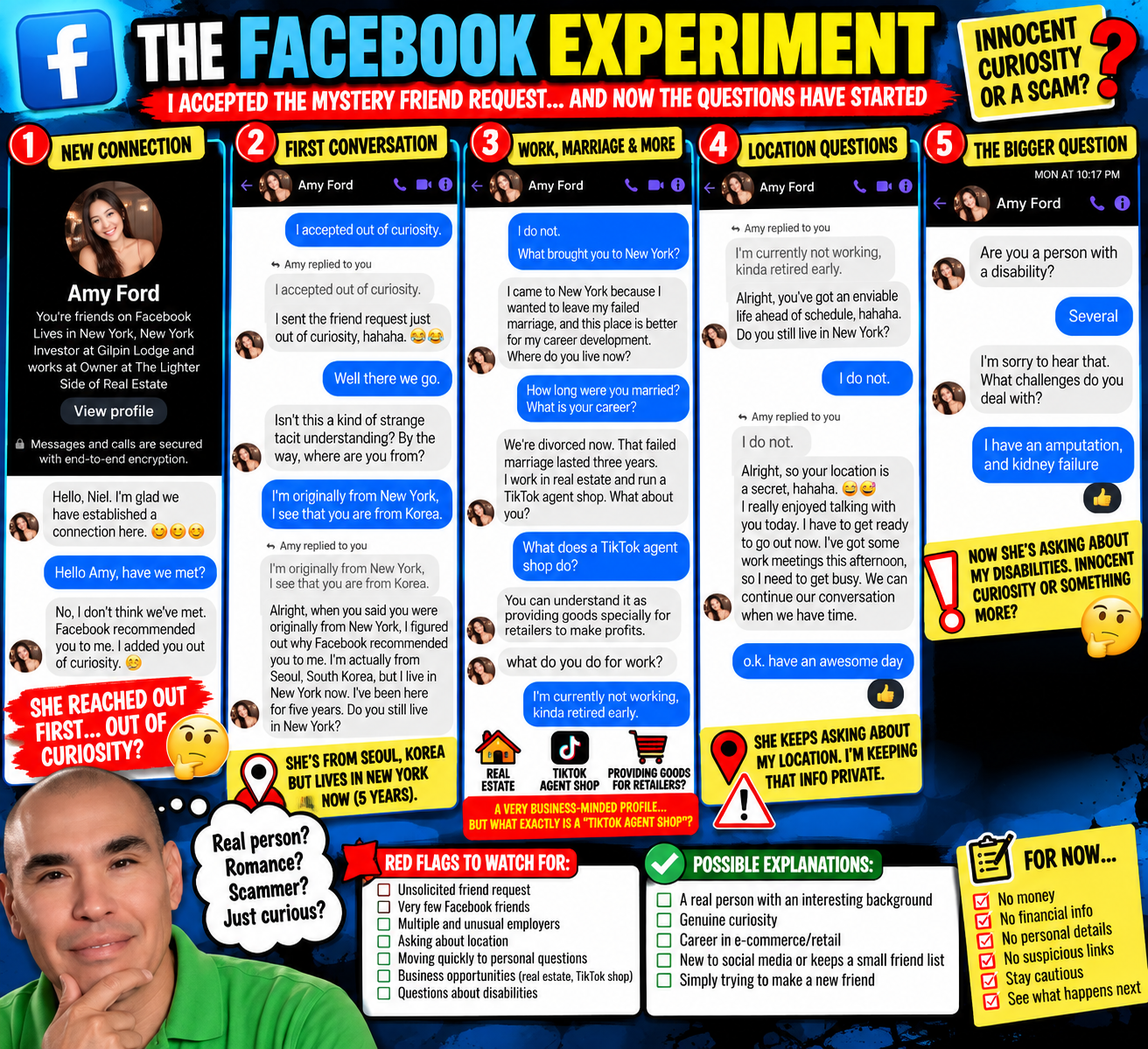
Amy opened with:
“Hello, Niel. I'm glad we have established a connection here.”
I asked the obvious question:
“Hello, Amy, have we met?”
Nope.
She said Facebook recommended me and that she added me “out of curiosity.”
That made me laugh because curiosity was exactly why I accepted her.
I told her:
“I accepted out of curiosity.”
Her response?
“I sent the friend request just out of curiosity, hahaha.”
Well, there we go.
Two strangers brought together by the powerful matchmaking algorithm of The Facebook—and apparently mutual curiosity.
What could go wrong?
Then Came the Questions
Amy asked where I was from.
I told her I was originally from New York and mentioned that I saw she was from Korea.
She explained that she's originally from Seoul, South Korea, has lived in New York for five years, and then asked whether I still lived in New York.
I said I didn't.
She asked where I live now.
I didn't answer.
Instead, I asked what brought her to New York.
According to Amy, she moved there after leaving a failed marriage because New York offered better career opportunities.
I asked how long she had been married and what she did for work.
She said the marriage lasted three years and told me:
“I work in real estate and run a TikTok agent shop.”
Now I had another question.
What's a TikTok Agent Shop?
Remember, her Facebook profile already showed several professional roles, including investor, real estate business owner, and an HR-related position.
Now I had a TikTok agent shop to add to the résumé.
So I asked what a TikTok agent shop does.
Her explanation was:
“You can understand it as providing goods specifically for retailers to make profits.”
Okay.
I still don’t entirely understand it.
Then the conversation turned back toward me.
She asked what I do for work.
I told her:
“I'm currently not working, kinda retired early.”
Her response caught my attention:
“Alright, you've got an enviable life ahead of schedule.”
Then she asked again:
“Do you still live in New York?”
I answered:
“I do not.”
And that was it.
No location.
Amy joked that my location was apparently a secret.
For now, it is.
Then the Conversation Took an Unexpected Turn
Amy said she had enjoyed talking with me but needed to get ready for some work meetings. We exchanged pleasantries, and the conversation ended.
Or so I thought.
Later that night, at 10:17 p.m., another message arrived:
“Are you a person with a disability?”
That's certainly a conversation starter.
I answered:
“Several.”
She asked what challenges I deal with.
I told her about my amputation and kidney failure.
And that's where the screenshots currently leave us.
So, Is This a Scam?
I still don't know.
And I think that's important to say.
Nothing in this conversation proves that Amy is running a scam or that the person behind the account isn't who they claim to be.
At the same time, I'm paying attention.
An unsolicited friend request from a stranger.
Very few Facebook friends.
Several different professional descriptions.
Questions about where I live.
Questions about my employment.
A business involving retailers making profits.
And now questions about my disabilities.
Each one can have a perfectly innocent explanation.
Taken together, they're enough for me to continue being cautious.
I'm Also Curious About Where This Goes
This has become a little social-media experiment for me.
I'm not sending money.
I'm not providing financial information.
I'm not sharing passwords or account information.
I'm not clicking mystery links.
And I'm not rushing to provide personal details simply because someone asks.
I'm having a conversation.
If Amy is simply a friendly person in New York who found my profile through Facebook recommendations, that may be all this ever is.
If the conversation eventually turns into:
“Niel, have you ever considered cryptocurrency?”
Well...
I may have another blog post to write.
For now, The Facebook Experiment continues.
And I have a feeling this story isn't finished yet.