
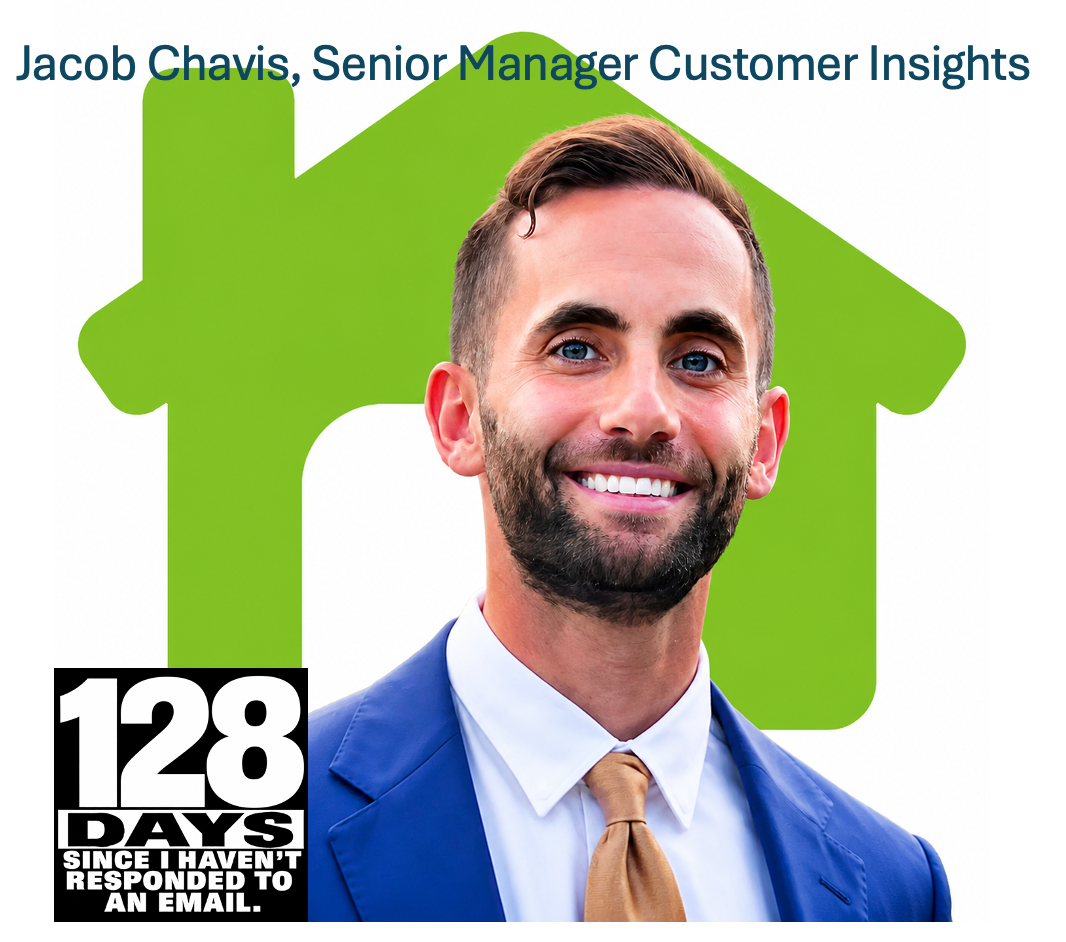
Day 128: Control Is Not the Same as Leadership — What Nirav Tolia Could Learn About Scaling Nextdoor
The interesting thing about scaling a company is that the very habits that build it can eventually hinder its growth.
Control can help establish consistency. Clear rules can help an organization operate. But when control outweighs adaptability, feedback, and accountability, a company risks losing sight of what it needs to improve.
That’s why this Inc. article caught my attention: To Scale Your Company Without Losing Control, Follow These 3 Hard-Won Lessons.
It raises a question I think is relevant to Nirav Tolia and Nextdoor:
When does maintaining control stop helping a company—and start preventing it from changing?
I can't know Nirav's personal motivations. But I can look at the public-facing decisions, communication patterns, and business challenges I've been documenting and ask whether Nextdoor is responding to feedback as effectively as it could.
Lesson 1: You Can't Control What the Market Thinks
The Inc. article emphasizes choosing investors carefully, treating them as teammates, and recognizing that raising money comes with responsibility.
That's a fair point. But control has another side.
You can control who invests in your company. You cannot control what the market thinks of it.
Nextdoor went public in 2021. Since then, the company has faced questions about growth, engagement, profitability, and the platform's reputation. When Nirav returned as CEO in 2024, he took on the challenge of moving the business forward.
You can't fix those problems by controlling the message.
They require results.
Lesson 2: Know When to Let Go
One of the most revealing points in the Inc. article is Tolia's acknowledgment that the CEO he needed to be when he returned wasn't the CEO he had been when Nextdoor was starting out.
He discussed moving from doing work himself to accomplishing work through other people—hiring the right team, aligning leadership and establishing meaningful metrics.
That's an important admission: scaling requires changing how you lead.
So here's my question: Does that same willingness to change extend to how Nextdoor handles criticism, user feedback, and accountability?
I've spent months raising concerns about moderation, communication, and transparency. I've requested detailed research that Nextdoor's own posts described as available. I've offered to talk.
Nirav has blocked me on social media. He's entitled to do that, and I can't claim to know his reasons.
But blocking an individual doesn't resolve the underlying questions.
A CEO doesn't have to answer every criticism personally for a company to have a process that addresses legitimate questions.
The test of leadership isn't whether you can keep criticism out of your feed. It's whether your organization can learn from feedback.

Lesson 3: Growth Isn't Everything
The article also emphasizes that growth alone isn't enough. A company needs a path to profitability and the ability to sustain itself.
That matters for Nextdoor.
The company has spent years building a neighborhood network, collecting recommendations and developing local advertising opportunities. Its Neighborhood Intelligence initiative is an example of trying to turn that distinctive asset into a stronger commercial business.
I want that to work.
But a new product doesn't automatically solve a business problem. Nextdoor still has to demonstrate that it can translate its reach and data into sustainable profitability and long-term shareholder value.
It also needs to retain the trust of the people who make the platform useful.
Control over a platform isn't the same as control over its future.
Day 128: Where Has Nextdoor Lost Control?
I'm not claiming Nirav has lost operational control of the company. I don't have evidence for that.
But I see several areas where Nextdoor appears to have less control than its leadership might want:
Its public narrative: Nextdoor can publish its message, but it can't dictate how customers, shareholders, and former users interpret their experiences.
Its reputation: Concerns about moderation and platform usefulness aren't automatically erased by a redesign or a new marketing campaign.
Its relationship with users: Neighbors can stop contributing, stop participating, or decide another platform better meets their needs.
Its financial future: Investors judge the business on performance and prospects, not just the story management tells.
Its feedback loop: When people raise concerns and don't see a clear resolution, those questions can persist and become a public case study of their own.
These don't prove every Nextdoor decision is wrong. They're risks any company faces when its ambition outpaces its ability to respond to feedback.
The Lesson for Nirav Tolia
Nirav, I think this article offers a useful framework:
Choose the right people. Adapt as the company grows. Focus on sustainable business results.
I'd add one more lesson:
Don't confuse control with the absence of disagreement.
A strong leader doesn't need everyone to agree. A strong organization needs ways to hear feedback, distinguish useful criticism from noise, and take action when something genuinely needs fixing.
I'm no longer a Nextdoor shareholder, but I still want to see the company succeed.
I'd like to see it become the kind of business that can accept difficult questions without treating the questions themselves as the problem.
Because sometimes, the thing a leader most needs to control is not the conversation.
It's the instinct to shut the conversation down.
👉 Read more of my ongoing Nextdoor case study at NielFlamm.com/blog
What I Can See, What I Can’t Control
I’ve written before about the struggle with my mother and her second stroke, about setting boundaries with my father, and most recently about the way his home is becoming more cluttered. I want to share what I’ve been noticing—and what I’m learning to do with it.
I’m an alcoholic in recovery. I’ve been sober for 17 years. I believe I’ve always had an addictive mind. Alcohol was my main way of dealing with life—or avoiding it—but food, television, and other things could take hold, too. At one point, I weighed at least 350 pounds. I say “at least” because that’s where the scale stopped.
I understand that alcoholism is a disease, and that genetics can play a part. We inherit genes from both parents. But recovery has also taught me not to point fingers or label someone else. Only a person can identify their own addiction. I can speak about my experience and notice similarities, but I can’t diagnose my father.
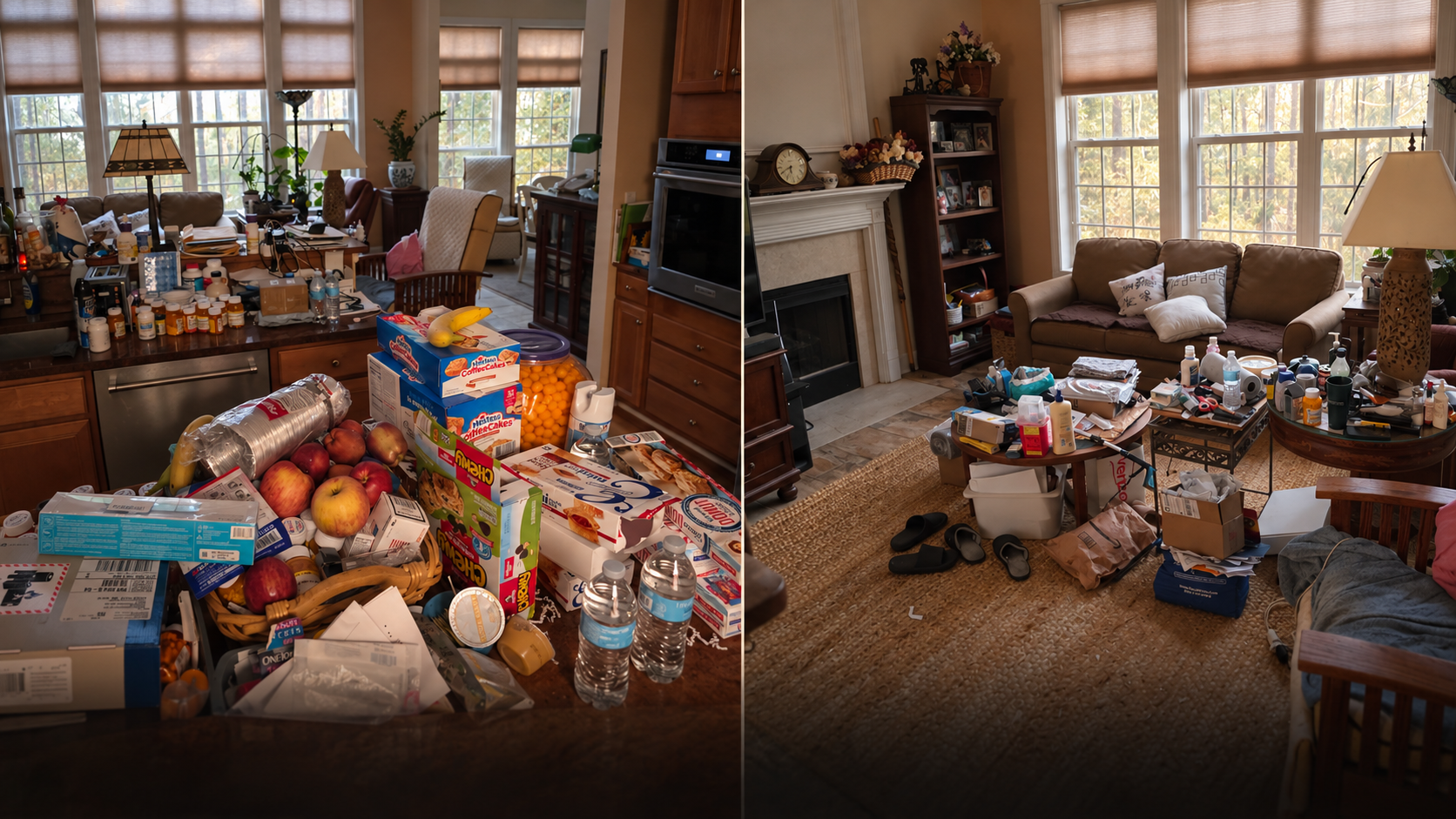
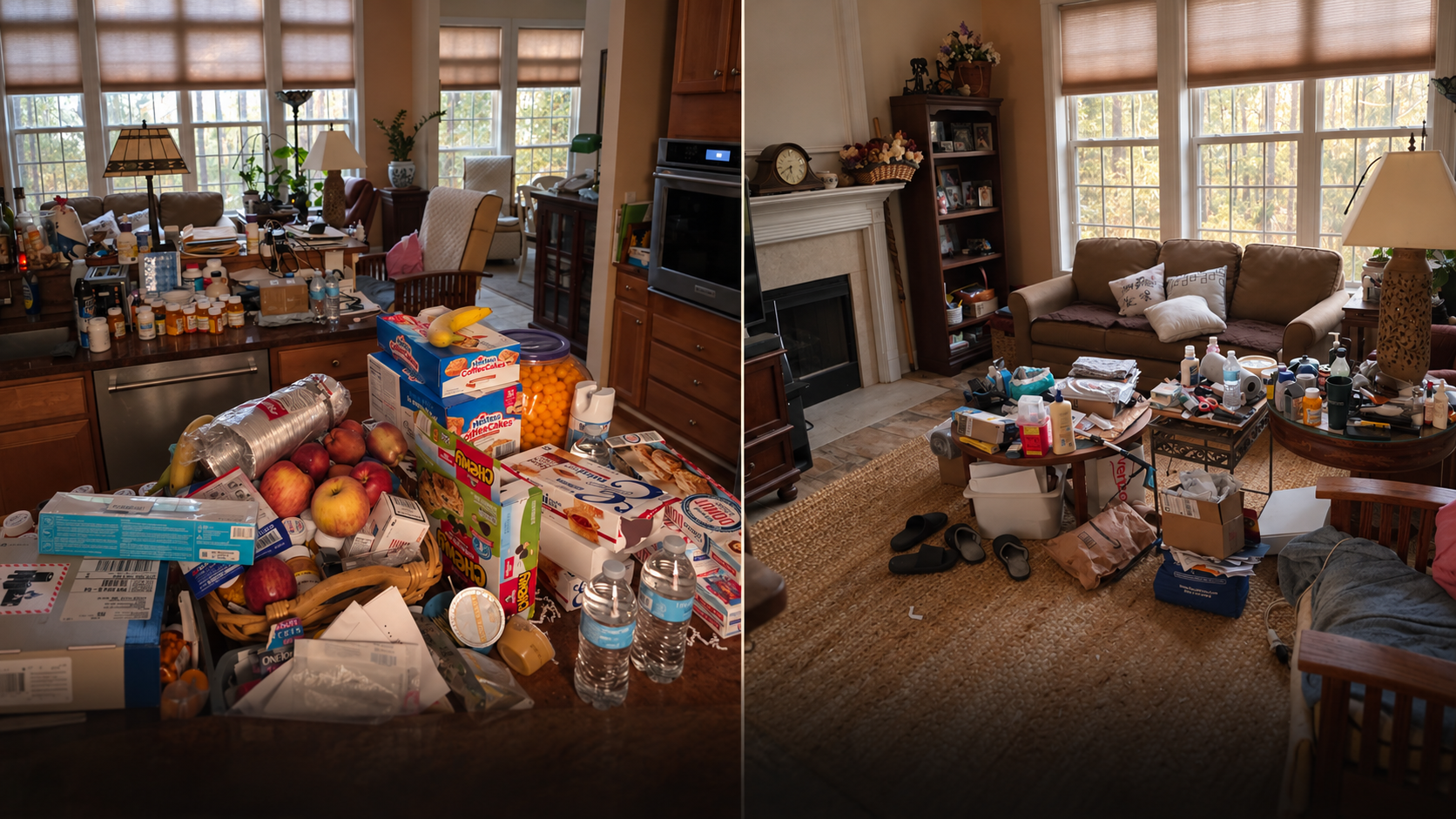
For a long time, I’ve noticed that he holds on to things “just in case.” There are expired medications, papers stacked near his computer that never seem to get looked at, and old mail. Lately, I’ve also noticed more processed food coming into the house through Amazon.
When my mother was living at home, she wouldn’t have bought this much junk food. Without her there, my father’s choices seem to be changing. I’m not going to police what he buys or try to manage his home.
This morning, I took a picture of the first floor—the kitchen and the TV area. It was never a Better Homes & Gardens photo, but it used to be tidier and stocked with healthier options. Seeing the difference was hard.
Still, noticing something doesn’t mean I can control it. I’ve set my boundary. My father’s choices are his to make, and my recovery and well-being are mine to protect.
It is what it is. I can care, be honest about what I see, and let go of what isn’t mine to manage.
A Leg Amputee Magnet
Somehow, I’ve become a magnet for leg amputees.
After my pain appointment, I visited a sister-assisted living facility in North Charleston, and as I made my way to the entrance, a resident caught up to me from behind. I don’t remember what he said first, but he noticed my prosthetic and mentioned he had one too. I was wearing shorts; he had on long pants. We chatted briefly, then he went on his way.
After touring the facility, I waited in the lobby for lunches I’d requested from the places I visited. Then another man rolled up. He also had an above-the-knee amputation. He mumbled something, showed me his residual limb, and rolled away.
Later, I delivered the lunches to Mom and waited in a main hallway. A resident who had approached me before asked how I drive. I shared my experience and offered a few suggestions.
Three encounters in one day, each with its own quick connection. I guess my prosthetic has become an unexpected conversation starter—and a way to meet people who understand a part of my life without needing much explanation.

Don't Move: A Church Camping Trip That Goes VERY Wrong 😱
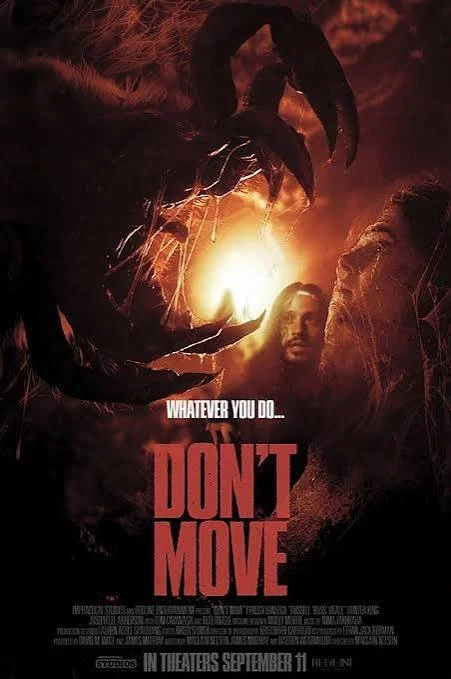
What do you get when you mix A Quiet Place, Arachnophobia, and a little Alien?
Apparently… a church camping trip that takes a VERY unexpected turn. 😂
In Don't Move, a group heads out for a retreat, gets lost, and ends up somewhere they definitely weren't supposed to be.
It has a pastor, a bus driver played by Rob Riggle, some questionable decisions, and a mystery that slowly reveals why a detour can have serious consequences.
Starring Lyndsy Fonseca, Tom Cavanagh, and Rob Riggle, this movie mixes comedy with creepy moments and a little horror.
Did I find it terrifying? Did it make me laugh? And did that ending leave me thinking there could be a part two?
Let's just say I had ONE jump scare. 😳
It's not Oscar material, but sometimes you just want a movie that gets in, tells its story, and gets out.
But did Don't Move deliver?
🎬 Want to hear my thoughts? Watch my video review!
👉 https://NielFlamm.com/videos
🌎 Watch Don't Move in More Languages!
My Don't Move video review is now available with translations in Chinese, Dutch, and Arabic! 🌍
Head over to https://NielFlamm.com/videos to watch a
Watch it, then let me know what YOU think!
Or don't. 😉

Day 126: Another Email to Nextdoor. The Request Hasn't Changed.
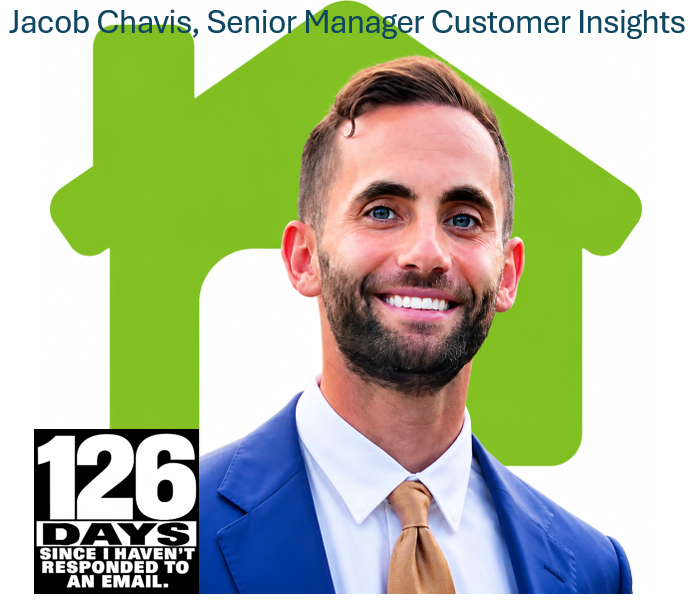
📧 Day 126. Another email sent. Another opportunity for Nextdoor to close the loop.
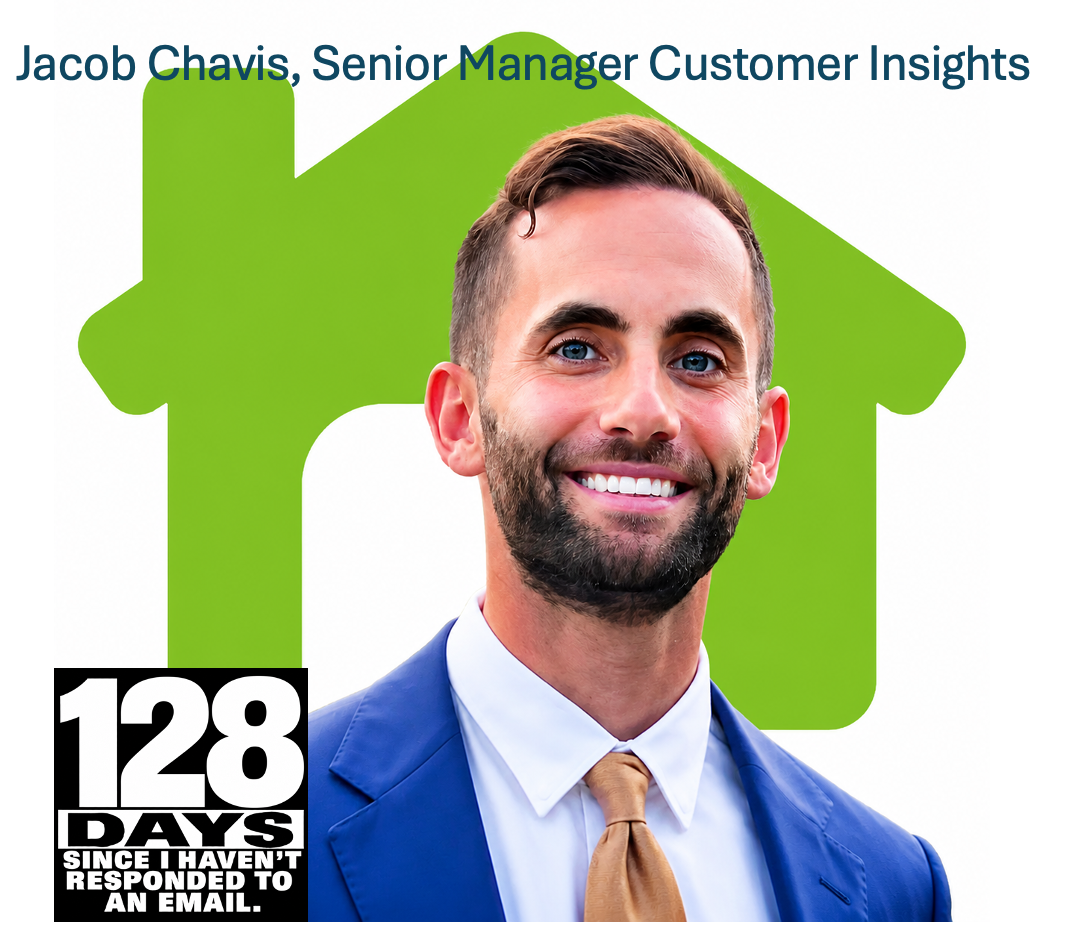
Today, I sent another email to the usual group of Nextdoor contacts, including Communications, Jacob Chavis, CEO Nirav Tolia, and members of the leadership team.
The subject line was straightforward:
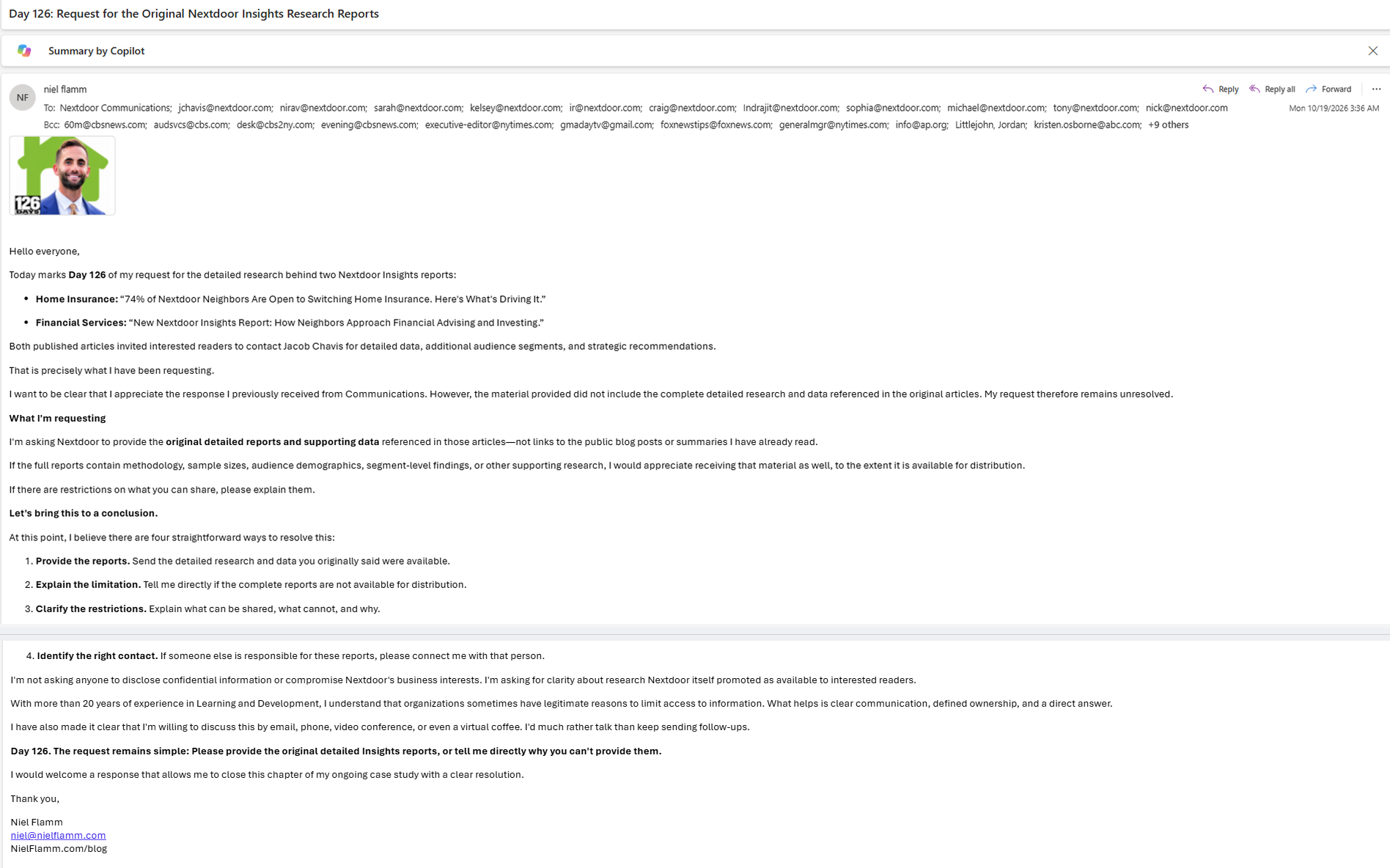
Day 126: Request for the Original Nextdoor Insights Research Reports
No new accusations. No complicated demands. Just a request that has sat unresolved for 126 days.
What Am I Asking For?
Let's go back to the beginning.
Nextdoor published two Insights articles that invited interested readers to contact Jacob Chavis for detailed data, additional audience segments, and strategic recommendations.
The two reports were:
🏠 Home Insurance: “74% of Nextdoor Neighbors Are Open to Switching Home Insurance. Here's What's Driving It.”
💰 Financial Services: “New Nextdoor Insights Report: How Neighbors Approach Financial Advising and Investing.”
I didn't ask Nextdoor to create a new study for me. I didn't ask it to build a custom research project. I asked for the detailed research that the original articles said was available.
That distinction matters.
Communications Responded. But the Request Remains Unresolved.
I want to acknowledge that Nextdoor Communications previously responded. I'm not claiming the company has never communicated with me.
However, the material I received did not include the complete detailed reports and supporting data I originally requested.
Being sent links to public blog posts isn't the same as receiving the detailed research those posts reference.
I'm not asking for the same summary again. I'm asking for the underlying reports.
If those reports aren't available for distribution, please tell me. If there are restrictions, explain them. If someone else handles the request, connect me with that person.
Any of those responses would be more useful than leaving the central question unresolved.
Four Ways to Close This Case
In today's email, I laid out four straightforward options:
Provide the reports. Send the detailed research and data you originally said were available.
Explain the limitation. Please tell me directly if you can't distribute the complete reports.
Clarify the restrictions. Explain what can be shared, what cannot, and why.
Identify the right contact. Connect me with the person responsible for these reports.
That's it.
I'm not asking Nextdoor to disclose confidential information or compromise its business interests. I'm asking for clarity about research the company itself promoted as available to interested readers.
If some portions contain confidential information, perhaps you can share a version that excludes those portions. If that isn't possible, I'd like to understand why.
A Learning and Development Perspective
I've spent more than 20 years working in Learning and Development, including instructional design, facilitation, management, and organizational processes.
One lesson from that experience is that when a task gets stuck, it helps to identify the owner, define the expected outcome, and clarify what needs to happen next.
A request shouldn't require an endless chain of follow-ups simply because nobody has clearly communicated the answer or the next step.
Sometimes the answer is yes. Sometimes it's no. Sometimes there are conditions.
But clear communication and defined ownership help people move forward.
That's the perspective I'm bringing to this situation. I'm not claiming to know what's happening inside Nextdoor or why this request hasn't been resolved. I can only describe what I've requested, what I've received, and what remains outstanding.
I'd Rather Talk Than Keep Typing
I've made it clear that I'm willing to discuss this by email, phone, video conference, or even a virtual coffee.
I'd much rather talk than keep writing follow-up emails and documenting another day in this case study.
I don't expect a CEO to respond to every shareholder question personally. But I do believe someone within an organization should be able to take ownership of a straightforward request and provide a clear answer.
And if the reports cannot be shared, I can accept a direct explanation of that decision—even if it's not the answer I hoped to receive.
Day 126: The Clock Keeps Ticking
I'm still interested in understanding Nextdoor's research, its methodology, and how the company develops insights from its neighborhood community.
I also want Nextdoor to succeed. I've said that repeatedly, and I mean it.
But wanting a company to succeed doesn't mean ignoring every unanswered question. Asking questions and providing feedback help businesses identify gaps and improve their processes.
So, here's where things stand.
Day 126. The request remains simple: Please provide the original detailed Insights reports, or tell me directly why you can’t.
I would love for the next update in this case study to be about a resolution rather than another follow-up.
Nextdoor, the ball is in your court.
👉 Follow the continuing case study at NielFlamm.com/blog