

Day 131: Election Day Is Coming. Is Nextdoor Prepared for the Worst?

When political disagreements turn personal, who protects the neighbors—and who holds the moderators accountable?
Election Day is Tuesday, November 3, 2026.
As we approach another election, emotions are running high. Neighbors disagree on candidates, political parties, policies, and the country's direction. People who live next door to each other can hold completely different beliefs, and those disagreements don't magically disappear when they close an app.
That's precisely why I'm raising questions about Nextdoor, its moderation system, and the safeguards that protect the people using the platform.
Let's consider a scenario.
A neighbor publishes a political discussion. Another neighbor strongly disagrees. The discussion escalates. A moderator—who is also a local resident with personal opinions and relationships—disagrees with the original post.
What happens if that moderator stops acting impartially? What if the disagreement becomes personal? What if someone takes the conflict off-screen and retaliates physically against the neighbor?
This is a hypothetical scenario, not a claim that a particular Nextdoor moderator has committed physical violence.
But the questions are real.
What safeguards does Nextdoor have in place before an online disagreement becomes a real-world safety issue?
1. Moderators Are People, Too. That's Both a Strength and a Risk.
Nextdoor relies on a combination of community volunteers, technology and its internal Neighborhood Operations team to moderate content. The company's public resources describe a network of volunteer reviewers who help evaluate reports, while Nextdoor's internal staff handle certain sensitive issues, including discrimination and misinformation.
There are benefits to local moderation. Neighbors understand their communities, local context, and the nuances of conversations that outsiders might miss.
But local knowledge doesn't automatically produce impartial judgment.
Moderators have personal beliefs, political preferences, relationships, and disagreements just like everyone else. Someone trusted to enforce community rules can also have a personal stake in a dispute.
That creates some important questions:
What happens when a moderator has a personal conflict with the person whose content they're reviewing?
Can a moderator be required to recuse themselves from a dispute involving a personal disagreement?
How does Nextdoor identify patterns of biased or retaliatory moderation?
Can a neighbor report a moderator without fearing retaliation?
Who independently reviews a complaint when the moderator is part of the problem?
Nextdoor's public training materials say that moderators are expected to follow the Community Guidelines and that moderation privileges can be removed when there is a pattern of voting against those guidelines. They also state that neighbors can report concerns about moderators to Nextdoor Operations.
That's a starting point.
But I want to understand how those protections work in practice, how consistently they're enforced, and how quickly the company responds when someone reports a serious problem.
A written policy is only as effective as the process behind it.
2. What Happens When Online Conflict Becomes Physical?
Let's return to our hypothetical scenario.
A neighbor posts about politics. A moderator disagrees. The exchange becomes increasingly hostile. Perhaps the moderator uses their position to remove the neighbor's content, publicly targets them, or escalates the personal dispute.
Then imagine the conflict spilling into the real world.
A confrontation occurs. Someone threatens the neighbor. Or, in the most serious scenario, someone physically retaliates.
At that point, this is no longer simply a disagreement about content moderation.
It's a question of personal safety.
Nextdoor's published Community Guidelines prohibit harmful activity, including physical harm and threats of violence. Its moderator training also directs users to report threats to Nextdoor Support.
But what safeguards exist to identify escalating patterns of harassment before they reach that point?
Does Nextdoor have a clear process for assessing credible threats, preserving relevant reports, and escalating serious cases? How does it respond when the person reported is a moderator? How does it ensure that someone with moderation privileges cannot use them to target someone with whom they have a personal dispute?
And what happens after an incident?
I'm not suggesting that Nextdoor can prevent every act of violence. No social media company can guarantee that. Nor should a platform be expected to replace law enforcement.
But it should have clear procedures for handling threats, investigating abuse of moderator privileges, and cooperating appropriately with authorities when necessary.
If a person faces an immediate physical threat, the priority is getting to safety and contacting emergency services—not waiting for an online moderation appeal.
The critical question is whether Nextdoor's safeguards are designed only to manage posts, or also to respond appropriately when online behavior creates credible risks to people.

3. What Annual Compliance Training Must Moderators Complete?
Here's another question I want Nextdoor to answer.
What mandatory training must community moderators complete every year, if any?
I'm not asking whether Nextdoor has training materials. Its public Moderator Academy includes guidance on community rules, respectful conduct, confidentiality, and the appropriate handling of reports.
I'm asking something more specific.
Is annual refresher training mandatory for every volunteer moderator?
Are moderators required to demonstrate that they understand the rules before continuing to exercise their privileges?
Does training cover political neutrality, conflicts of interest and recusal?
Are moderators trained to recognize harassment, threats and signs that a dispute is escalating?
Does the training address confidentiality, privacy and the appropriate use of information available through moderator tools?
Are there consequences for repeatedly abusing privileges or retaliating against neighbors?
How does Nextdoor verify that training has been completed and remains current?
I could not find in the public training materials I reviewed evidence that every volunteer moderator must complete annual compliance training covering all these topics.
That doesn't prove such training doesn't exist. It means Nextdoor should clarify its requirements.
Volunteer moderators are not the same as Nextdoor employees, and their training obligations may differ. That's why the company should explain what each group is required to do.
If moderators have access to additional information or tools that ordinary neighbors don't, the company should ensure they understand the responsibilities that come with those privileges.
A moderation role is a responsibility, not a license to impose personal opinions on a neighborhood.
4. What Is Nextdoor Doing to Protect Nonpublic Information?
This issue deserves more attention.
Nextdoor's Moderator Academy explicitly says that access to additional information is a privilege and that moderators must not disclose details about other neighbors or moderators.
That's an important expectation. But I want to know what safeguards back that up.
What information can volunteer moderators actually access? How is that access limited to what they need for their role? What controls prevent someone from using information obtained through moderation tools to pursue a personal dispute?
Does Nextdoor regularly review access to sensitive information? Does it maintain appropriate records of access and investigate suspected misuse? What happens when a moderator violates confidentiality?
How are neighbors informed when their information has been improperly accessed or disclosed, when notification is required or appropriate?
These are not abstract technical questions. They go to the heart of trust.
A platform built around verified neighbors and local relationships can involve sensitive information about people's identities, locations and community interactions. Users should understand how that information is protected and what accountability exists when access is abused.
Nextdoor's public filings describe a broader security program that includes privacy risk management, security monitoring, incident response and employee training on cybersecurity and data protection. The company also acknowledges that security measures cannot eliminate every risk of unauthorized access.
Those disclosures are useful, but they don't answer every question about volunteer moderators' access, training or safeguards against personal misuse.
I'm asking for a clear explanation of the controls that apply specifically to community moderation.
If access to nonpublic information is a privilege, protecting that information must be more than a sentence in a training module.

5. Nirav Tolia, Let's Talk About Relevant Matters
Nirav Tolia is Nextdoor's co-founder and CEO. Under his leadership, the company continues to develop new products, pursue advertising opportunities, and talk about technology and AI.
Innovation has its place. New products and better technology can help a company grow.
But as Election Day approaches, I think more immediate questions deserve public attention.
How does Nextdoor protect neighbors from harassment and threats? How does it prevent moderators from abusing their positions? What training is mandatory? What protections exist for confidential information? And how does the company investigate allegations when the person being reported is part of the moderation system?
These aren't questions you can answer by announcing another product feature.
They're questions about the safety of the community Nextdoor says it wants to strengthen.
Nirav doesn't need to personally adjudicate every neighborhood dispute. But leadership is responsible for ensuring that the systems, policies, and oversight processes are appropriate for the risks the platform faces.
I want Nextdoor to explain those systems in concrete terms.
Not just that it takes safety seriously. Not just that it has Community Guidelines. Not just that technology helps identify problematic content.
I want to understand the safeguards, training requirements, escalation procedures, and accountability mechanisms.
6. Election Season Is a Test of the Platform
Political disagreements are inevitable. People will argue about candidates, policies, and the country's future.
A neighborhood platform cannot eliminate those disagreements, nor should it attempt to eliminate every civil political discussion.
But it can establish clear rules, enforce them consistently, and provide meaningful ways to report misconduct.
It can distinguish disagreement from harassment, and criticism from threats. It can prevent moderators from treating their personal opinions as the standard everyone else must follow. It can protect confidential information and investigate credible allegations of abuse.
And it can explain to its users how those safeguards work.
I don't expect Nextdoor to prevent every bad interaction. I do expect a platform built around real neighbors and real addresses to take the potential consequences of online conflict seriously.
Election Day is November 3. The need for responsible moderation doesn't end when the ballots are counted.
My Questions for Nextdoor
I'd like Nextdoor and Nirav Tolia to address the following:
Moderator training: Is annual compliance or refresher training mandatory for all volunteer moderators? If so, what does it cover?
Conflicts of interest: What safeguards prevent moderators from handling reports involving personal disputes or political disagreements in which they have a stake?
Threats and escalation:
Confidentiality: What limits are placed on moderators' access to nonpublic information, and how is misuse detected and addressed?
Accountability: How can neighbors report a moderator safely, and what independent review occurs when serious allegations are made?
Transparency: Where can users find clear, current information about these protections and how they are enforced?
These are practical questions. They deserve practical answers.
I'm not asking Nextdoor to abandon innovation. I'm asking the company to put its users' safety, privacy, and trust alongside its growth ambitions.
Stop telling us what technology might do for the platform. Start explaining what the company is doing to protect the people on it.
Because a neighborhood network is only as strong as the trust between its neighbors—and the safeguards that protect them when that trust breaks down.
👉 Follow my ongoing Nextdoor case study at NielFlamm.com/blog.
Another Day, Another Freebie: Apparently the USPS Wants to Give Me a Cart
My inbox has done it again.
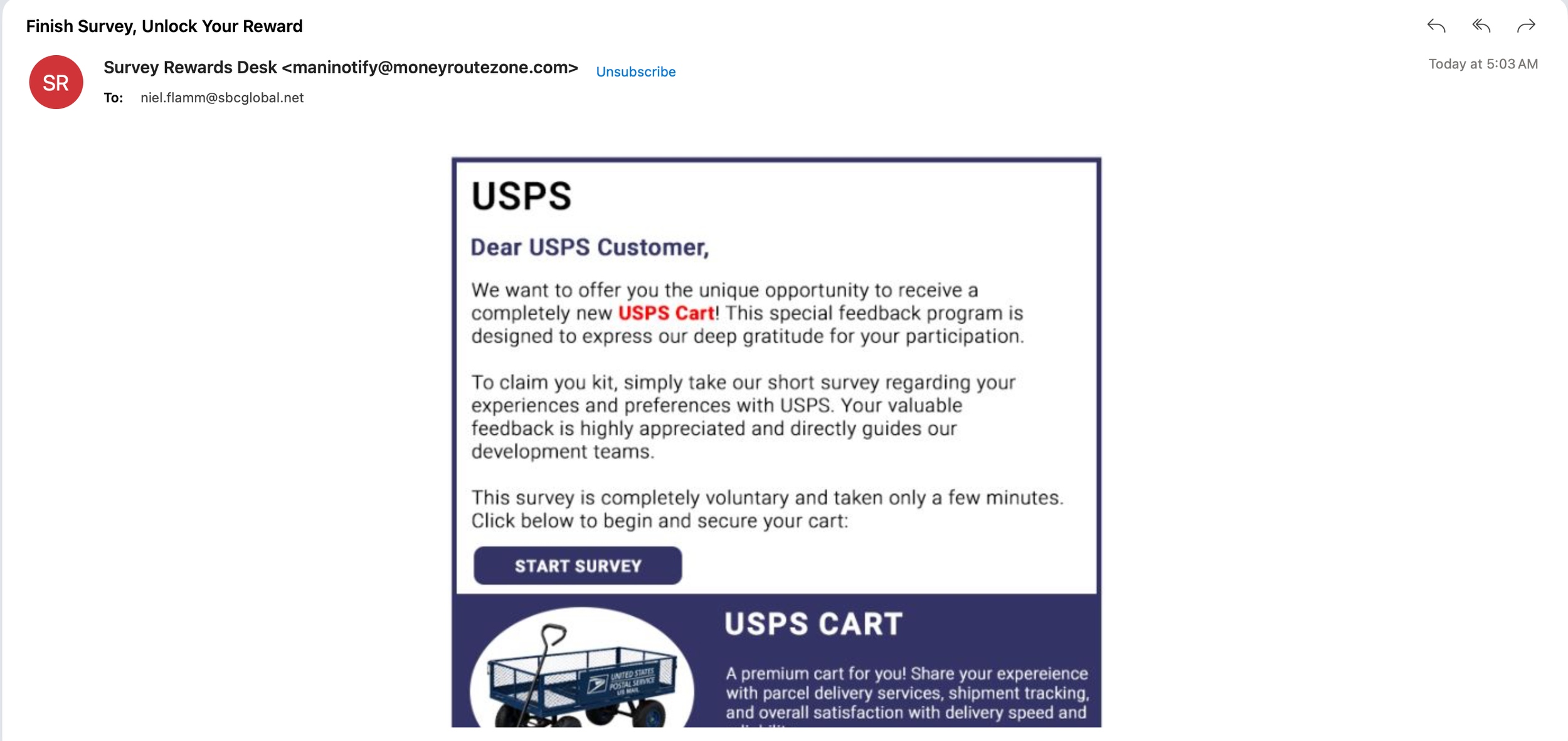
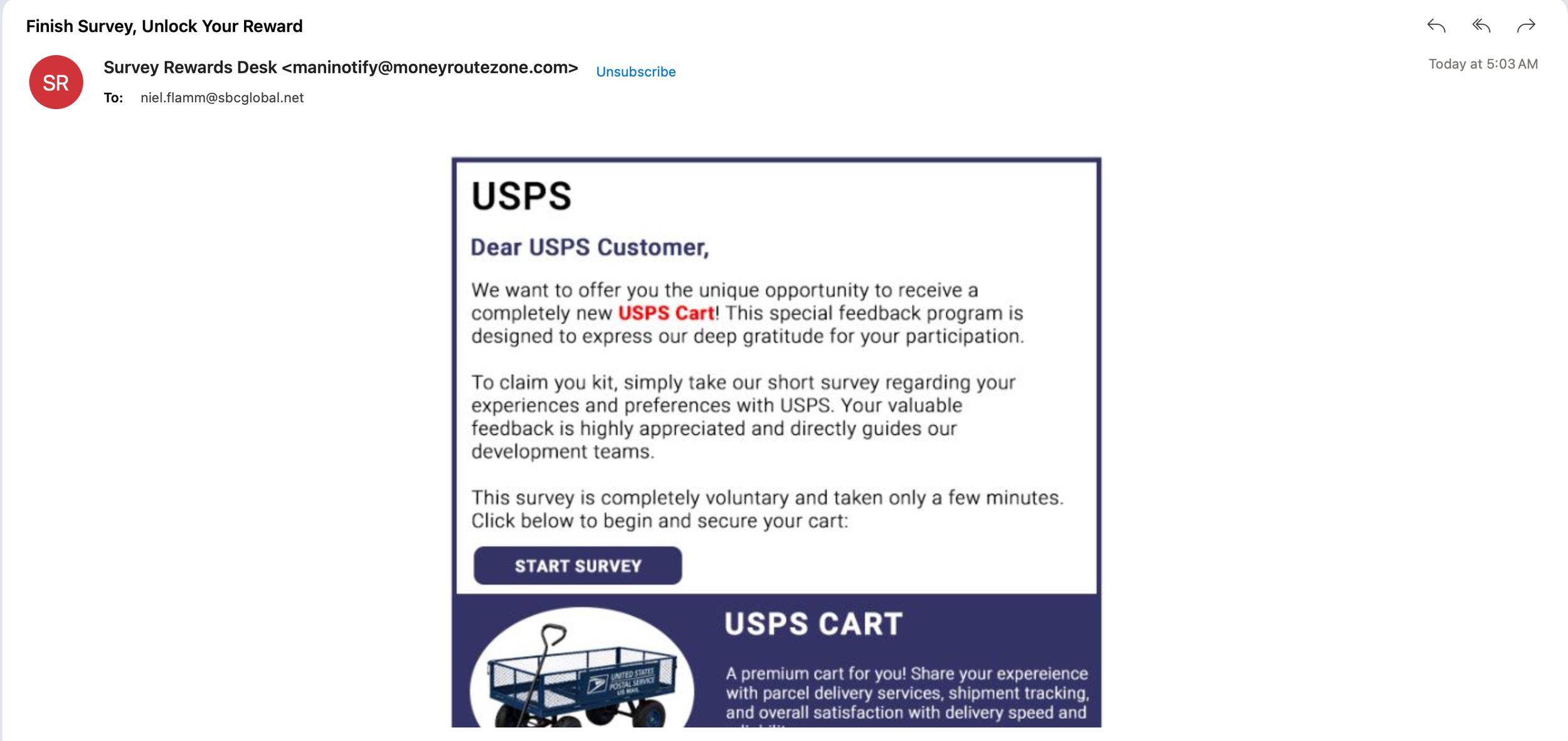
This time, I've apparently been selected for a special opportunity: a brand-new USPS cart for completing a short survey.
A free cart! From the United States Postal Service!
I can only assume this is the beginning of my rise to postal greatness. Perhaps my next promotion will involve delivering mail, driving a truck, or becoming Postmaster General.
There's just one small problem: I strongly suspect this email is a scam.
The Email That Wants My Opinion
The message arrived with the subject line:
“Finish Survey, Unlock Your Reward”
It came from a sender calling itself “Survey Rewards Desk,” using the email address maninotify@moneyroutezone.com.
Inside is a message styled to look like a USPS promotion. It addresses me as “Dear USPS Customer” and offers a supposedly new USPS Cart in exchange for completing a survey about my postal delivery experience.
The email even includes a “START SURVEY” button.
Apparently, my opinions about package tracking and delivery speeds are so valuable that I deserve a premium postal cart.
I'm touched.
But before I start imagining myself rolling around the neighborhood with my new postal equipment, let's look at what this message is actually telling me.
The Red Flags Are Arriving Faster Than the Mail
1. The sender's email address doesn't match USPS.
The message uses moneyroutezone.com, not an official USPS domain. The sender's display name may sound convincing, but display names are easy to invent.
That alone doesn't prove who sent the email, but it is a significant reason to be cautious.
2. The greeting is generic.
“Dear USPS Customer” isn't a personalized message. It doesn't identify a specific transaction, delivery, or legitimate USPS program.
Scammers often send messages to large numbers of people and hope that enough recipients will take the bait.
3. The free gift is designed to get me clicking.
The offer claims I can receive a new USPS Cart by answering a few questions. The message describes the survey as voluntary and says it will take only a few minutes.
That's a familiar formula: offer something appealing, make the task sound easy, and encourage the recipient to click a button.
What happens after clicking? The screenshot doesn't tell us. It could lead to a phishing page, a request for personal information, a data-collection survey, or another misleading offer. I can't confirm the destination or the sender's intentions from the screenshot alone.
4. The branding doesn't establish legitimacy.
The message uses the USPS name and a postal-cart image to make the offer look official.
But putting a recognizable organization's name on an email doesn't mean that organization sent it.
5. The sender wants me to take action.
The big “START SURVEY” button is the centerpiece of the email. That's where the sender wants my attention.
I'm not going to click it just to discover whether the promised cart exists.
What Is a USPS Cart, Anyway?
The email describes the reward as a “premium cart” and mentions parcel delivery, shipment tracking, and overall satisfaction with delivery speed.
Maybe the image is supposed to make the reward seem tangible and exciting. But the offer raises a pretty obvious question: why would USPS give away equipment to random email recipients in exchange for a few minutes of survey feedback?
I can't rule out every possible legitimate promotional program based on a screenshot. However, this message provides no convincing evidence that the offer is an official USPS promotion.
If USPS really is conducting a survey or offering a reward, I should be able to verify it independently through the official USPS website or a trusted customer-service channel.
I don't need to use the link in this email to find out.

What I'm Going to Do
I'm leaving that survey button alone.
Here's my approach when an email offers a gift from a familiar company:
Don't click links or buttons in an unexpected message.
Don't open unexpected attachments.
Check the sender's actual email address, not just the display name.
Visit the company's official website independently to verify the offer.
Never provide passwords, payment details or sensitive personal information to claim an unverified reward.
Report suspicious messages through the appropriate official channel and delete them.
And no, I'm not going to reply to the sender to ask where my cart is.
I suspect that conversation would be about as productive as asking a suspicious email to verify itself.
My Inbox Thinks I'm Very Special
Between surprise prizes, suspicious loan offers, unbelievable job opportunities, and mystery rewards, my inbox seems convinced I'm someone of extraordinary importance.
Today, I'm apparently one short survey away from becoming the proud owner of a USPS Cart.
Tomorrow, who knows? Maybe the postal service will offer me a free sorting facility.
I'll try not to get carried away.
The point isn't that every survey or promotional offer is fraudulent. It's that an unexpected reward, familiar branding, and a prominent button are not proof that an offer is legitimate.
Scammers know that free things get our attention. They also know that people are more likely to click when a message looks like it came from a company they recognize.
So, before you take a survey, claim a prize, or hand over personal information, stop and verify.
As for me, I'll continue getting my mail the old-fashioned way.
Through the mailbox—not through a suspicious email promising free postal equipment.
Have you received a similar “free gift” or survey-reward email? Send your screenshots and experiences to niel@nielflamm.com. Please remove personal information, account details, and other sensitive data before sending.
Let's compare notes and help other people recognize the warning signs.
The Hinge Experiment: Saturday in Columbia and Meeting Actual People!
Another Saturday, another trip to Columbia, South Carolina. At this point, I should probably start looking into frequent-driver miles. 😂
After visiting Mom, I'm heading to Columbia to hang out with Airica at a birthday party. Sounds simple enough, right?
Well, there's one small detail that makes this feel a little different.
I'm being introduced to people. Actual people!
Wait, We're Meeting People Now?
When I started this Hinge experiment, I figured I'd meet someone, go on a few dates, have some interesting conversations, and maybe find a restaurant or two worth recommending.
I didn't necessarily plan on becoming a regular on the Columbia social scene.
But here I am, getting ready to attend a birthday party with Airica, meeting people in her world, and trying not to overthink what any of it means.
I said trying.
I'm not analyzing this. Or, at least, I'm trying not to analyze it. Unfortunately, the committee in my head has apparently called an emergency meeting, and nobody remembered to send me the agenda.
What does it mean when someone invites you to a birthday party? Am I just there to enjoy the party? Am I being introduced to people because we're spending time together? Is this simply another opportunity for us to get to know each other?
The possibilities are endless, and my brain wants to explore every single one.
Meanwhile, the sensible part of me is saying, "Niel, just go to the party!"
Thank you, sensible part of my brain. I'll try to get you a promotion.
Four O'Clock to Six O'Clock... And Then?
The birthday party runs from 4 p.m. to 6 p.m.
What happens afterward? I have absolutely no idea.
Maybe we'll grab something to eat. Maybe we'll spend more time together. Maybe we'll say our goodbyes and head home. I'm not going to pretend I know how the rest of the day will unfold.
And that's something I'm working on: letting things happen without trying to write the next five chapters in my head before I've finished the current one.
I'm 54 years old. I've lived enough life to know that not everything comes with a roadmap. Sometimes you just have to show up, participate, and see what happens.
Apparently, learning that lesson through online dating is part of my continuing education.
Where's my certificate?
The Part I'm Grateful For
Here's what I do know.
I'm glad I get to spend time with Airica. I'm grateful for the opportunity to learn more about her, share experiences, and meet some of the people in her life.
That matters to me.
I'm also learning that getting to know someone isn't limited to the conversations you two have over dinner. Sometimes it's seeing how they interact with friends, sharing a social experience, and getting a little glimpse into their world.
And yes, there's something else I'm looking forward to.
Airica gives awesome hugs.
There. I said it.
I'm not going to overanalyze the hugs. I'm not going to develop a spreadsheet to measure hug quality, duration, or emotional impact.
Still, given my professional background, I could probably create a performance evaluation form.
Hug quality: Exceeds expectations.
Repeatability: Highly recommended.
Overall satisfaction: Five stars.
Okay, maybe I shouldn't be allowed to manage this experiment without adult supervision.
But seriously, those hugs make me smile, and I'm looking forward to another one.
Letting the Hinge Experiment Happen
I've written quite a bit about dating, the awkward moments, the funny experiences, and the uncertainty that comes with getting to know someone new.
This experience with Airica has been different in ways I'm still figuring out. We've shared meals, taken trips, laughed together, and now I'm meeting people in her life.
I'm not predicting where this is going. I don't know what the future holds, and I don't need to have every answer today.
My goal is to be present, enjoy the experience, and give us both the opportunity to learn more about each other.
Will I succeed at not overthinking everything?
Let's be realistic. I'm going to overthink at least some of it. I'm me.
But I'm trying.
Today, I'm going to visit Mom, drive to Columbia, attend a birthday party, meet some actual people, spend time with Airica, and hopefully get one of those awesome hugs.
That's a pretty good Saturday if you ask me.
If my brain insists on another emergency meeting, I'll remind it the party ends at 6 p.m. There's plenty of time to overanalyze things tomorrow.
For now, I'm just glad to be invited along for the ride.
The Hinge Experiment continues. And apparently, the next phase involves meeting actual human beings. Wish me luck! 😂
From Carrying Groceries Home to Fighting for Independence: Watching Mom Change
I'm at the skilled nursing facility, spending a bit of time with Mom. We're outside right now, enjoying some fresh air and talking.
This morning reinforced a decision I made a long time ago: I was right not to pursue a career in healthcare. I don't think I have the personality for it.
And that's not a criticism of people who work in healthcare. Quite the opposite. Watching what the CNAs, nurses, and physical therapists do has given me a greater appreciation for the patience required to do their jobs.
Because it’s an easy patient.
She's difficult. She's demanding. And when she wants something, she makes sure everyone knows it.
I'm pretty much the opposite.
"I Want"
While talking with Mom, I noticed how often she uses those two words: "I want."
She wants to get out of the day room. She doesn't want to spend her time sitting there. She wants to go to the physical therapy gym.
I understand it.
The day room sounds like a prison to her. She's in a facility where other people have schedules, where she depends on staff to help her move around, and where she can't simply get up and do whatever she wants whenever she wants.
And when you think about it, that's a significant loss of independence.
I want things, too. We all do. The difference is that I'm generally more inclined to work around circumstances rather than keep pushing until I get what I want.
Mom has a different approach.
Sometimes I get frustrated with her demands. Then I have to remind myself that she's the one living there. She has to spend her days in that environment. What feels like another complaint to me might represent something much bigger to her.
That doesn't mean we can meet every demand immediately. The staff has other patients to care for, and practical limitations limit what can happen.
But I can understand why Mom wants more control over her day.
The Woman I Remember
What's particularly difficult is remembering the woman Mom used to be.
I remember seeing her carry groceries from Post Avenue in Westbury, New York, to our house. It was only three or four blocks, but she made that trip with the groceries she had purchased for our family.
That was the Mom I knew.
She went out, did what needed to be done, and brought the groceries home.
Today, she's in a skilled nursing facility. Her mobility is limited; she needs help, and she wants to get to the physical therapy gym to get stronger.
It's sad to see that change.
I'm not suggesting that the woman I remember has disappeared. She's still Mom. She still has opinions, preferences, and a very clear idea of what she wants.
But the circumstances of her life have changed dramatically.
The woman who once carried groceries home now has to depend on other people to help her get where she wants to go.
And I imagine that's frustrating for her in ways I can't fully appreciate.

A New Appreciation for Healthcare Workers
This is also why I know I made the right decision not to pursue a healthcare career.
I can help Mom. I can visit, advocate for her, ask questions, and try to help her figure out the next chapter of her life.
But can I handle the demands of patient care all day, every day? That's a different story.
Healthcare workers have to balance compassion with practical realities. They need patience, resilience, and the ability to deal with people who may be frightened, frustrated, demanding, or simply unhappy with their circumstances.
I don't think I could do that job well enough to make it my career.
I have limits, and recognizing them matters.
It also makes me appreciate the people who show up and do this work every day.
What Comes Next?
Mom wants to leave the skilled nursing facility and move into assisted living. I'm continuing to explore options and figure out what might work for her.
But beneath all the complaints about the day room, the food, and getting to physical therapy, I want to see past something.
Mom wants to’.
Mom wants to have some control over her life again.
I want things, too. I want her to be safe. I want her to have the opportunity to regain as much independence as possible. And I want to help her find a living situation where she can have a better quality of life.
Those goals don't always align with what she wants in the moment, and there will undoubtedly be harder conversations.
For now, we're outside together.
I'm listening, thinking, and writing.
And I'm remembering those trips from the grocery store on Post Avenue to our house in Westbury.
Life can change in ways none of us anticipate. Sometimes the hardest part isn't figuring out what to do next. It's accepting how much has changed while still trying to help someone move forward.
That's where I am today: sitting outside with Mom, remembering who she was, seeing who she is now, and hoping for what's possible next.

Five Days Until Radiance of the Seas 🌙🌊

Only five days to go! I’m looking forward to being out on the ocean, watching the waves roll by, then sitting on the balcony at night and gazing up at the stars or moon. Those quiet moments at sea are a big part of what makes a cruise special.
Mom is still in a skilled nursing facility. I hope things stay steady from embarkation day until I return. My brother is nearby and can help if needed, and I’ll be reachable while I’m away.
The countdown is on for the next cruise, too: 83 days until MSC Seaside sails from Miami on January 15. I’ll be heading to the Bahamas for what I think will be my fourth visit, including a stop at MSC’s private island, Ocean Cay Marine Reserve. I’ve read and watched videos saying it’s phenomenal, and I’m excited to see it for myself.
MSC Seaside is supposed to be gorgeous. Reviews of the food and service seem mixed, so I’m curious to experience it firsthand. Two cruises to look forward to—one day at a time. 🚢