

Please Support Tracey and Her Family
I’m sharing this fundraiser for Tracey Rivera, a sister of Delta Phi Epsilon (D Phi E) from Hunter College, part of the City University of New York system.
Tracey is raising funds on behalf of her family for their beloved Aunt Miriam, who is terminally ill and in her final days. I hope you’ll join me in keeping Tracey and her family in your thoughts and, if you’re able, offering support. A donation or a simple share can mean a lot during such a difficult time.
You can find the fundraiser here: https://gofund.me/4bdb58234
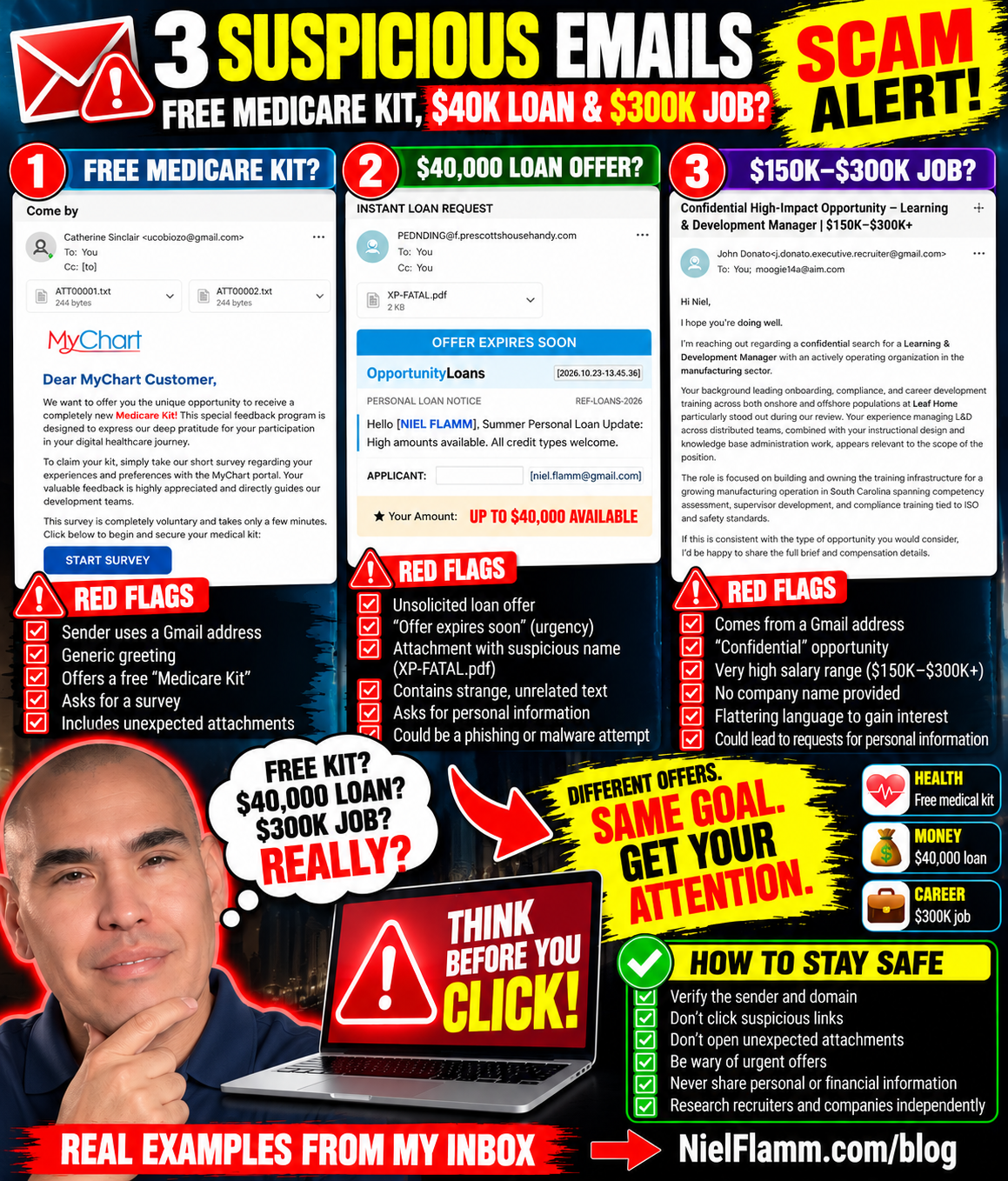
Three Emails, Three Red Flags: Free Medical Kits, $40,000 Loans and a $300K Job?
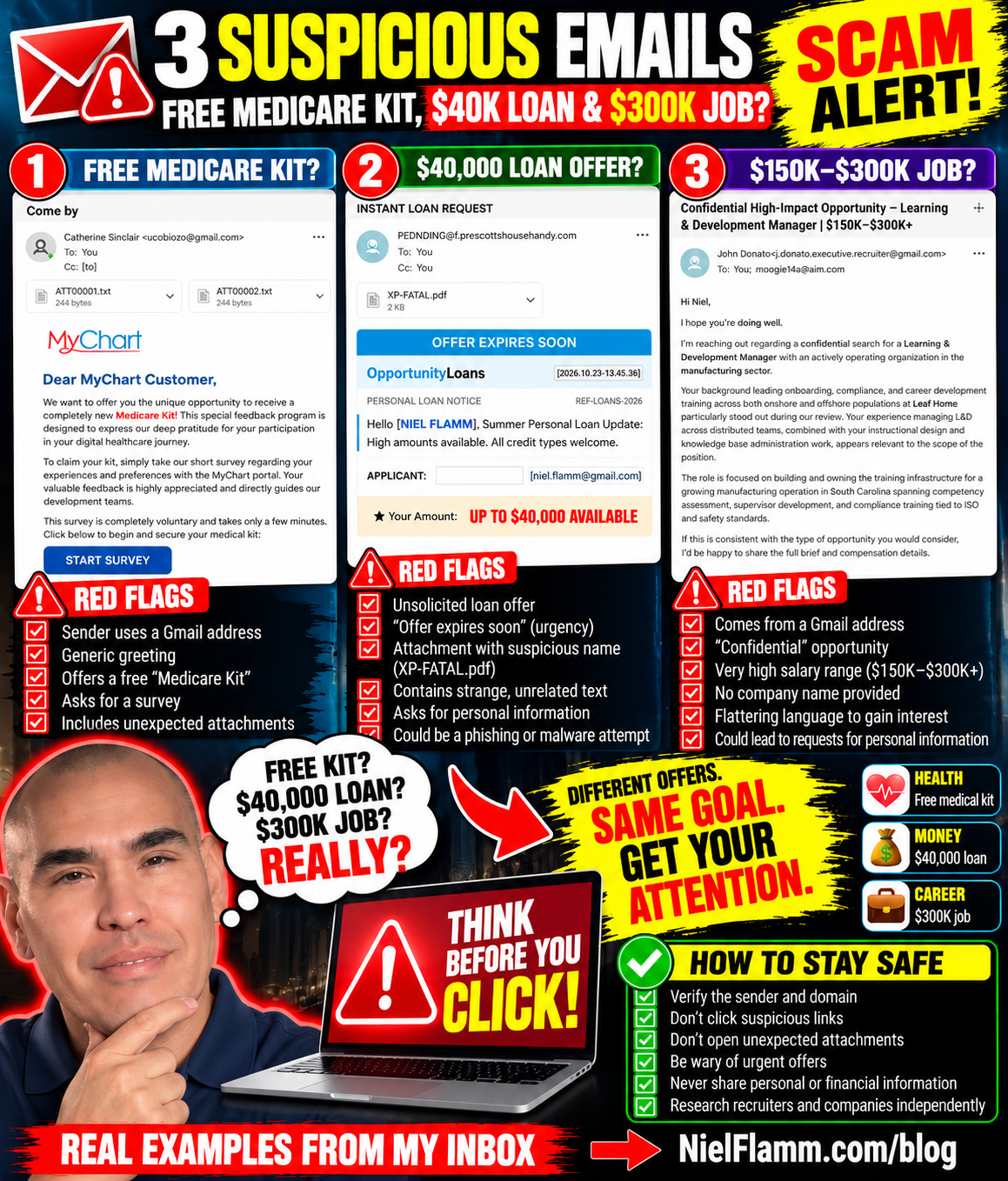
My inbox has been busy again. Apparently, the internet thinks I'm either entitled to a free medical kit, desperately need a $40,000 personal loan, or am the perfect candidate for a $300,000 Learning & Development job.
It's nice to be so popular.
One problem: these emails raise some serious questions.
Let's take a look at three messages that landed in my inbox on October 22 and 23, 2026.
1. A Free Medicare Kit From “MyChart”?
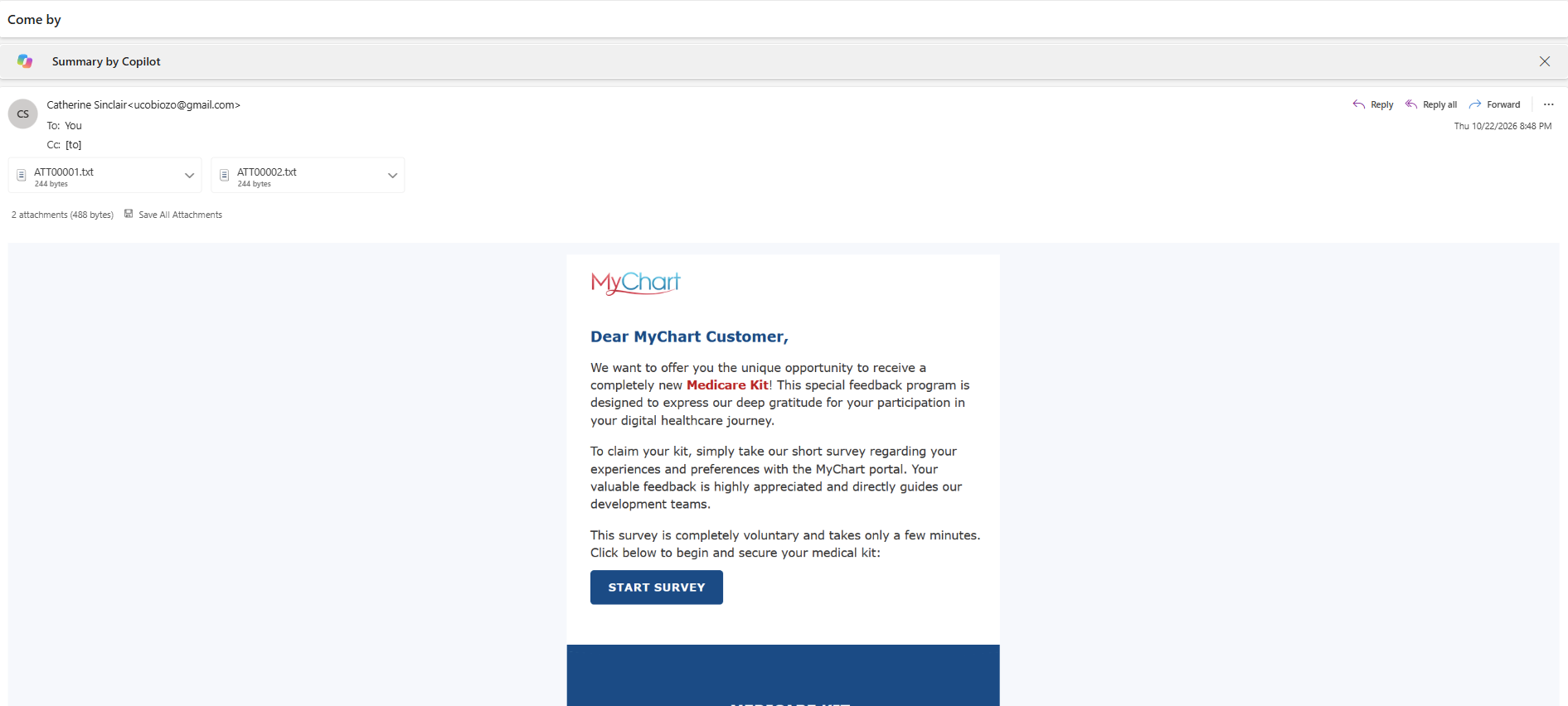
Email subject: “Come by”
The first email came from an address listed as Catherine Sinclair and used a Gmail address. It included two tiny text attachments and an image styled to look like a MyChart message.
The message addressed me as a “MyChart Customer” and offered a supposedly new “Medicare Kit” in exchange for completing a short survey about my MyChart portal experience.
How generous!
A free medical kit just for answering a few questions? What could go wrong?
Well, a few things caught my attention:
The sender's Gmail address doesn't establish any connection to MyChart or a healthcare provider.
The email uses a generic greeting rather than identifying a specific healthcare organization.
The offer combines a medical-related brand with a gift and a survey link.
The email includes unexpected attachments.
I can't establish from this screenshot alone who sent the message or what the attachments contain. But I certainly wouldn't click the survey button or open unexpected files to find out.
If a healthcare portal genuinely offers a survey or patient benefit, I'll check the official portal or contact my healthcare provider using contact details I already trust.
My medical information is not a prize to be claimed through a mystery email.
2. An “Instant Loan” Offering Up to $40,000
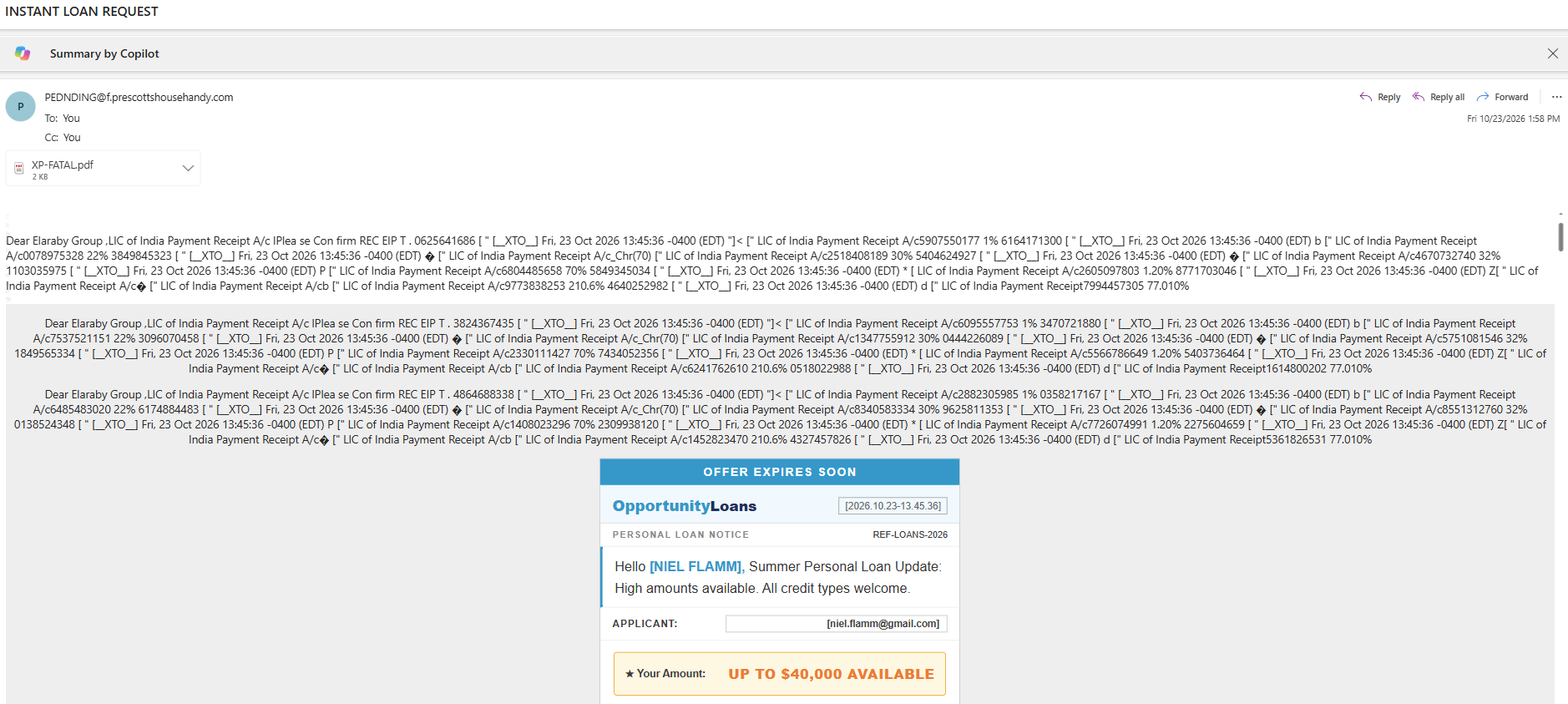
Email subject: “INSTANT LOAN REQUEST”
The second email takes a different approach. This one appears to be about money—specifically, money someone supposedly wants to lend me.
The message contains a banner that says “OFFER EXPIRES SOON” and promotes something called OpportunityLoans. It addresses me by name and advertises personal loans of up to $40,000.
The email also includes a PDF attachment named XP-FATAL.pdf.
Wait a minute. Someone I don't recognize wants to offer me up to $40,000, and there's a PDF attachment with a filename that looks like it wandered out of a computer-security nightmare?
I think I'll pass.
Here are the red flags I noticed:
Urgency: “Offer expires soon” encourages a quick decision.
Unsolicited credit offer: I didn't request this loan information.
Unusual formatting: The message contains a jumble of apparent payment-receipt text that has little to do with the loan offer.
Unexpected attachment: There's no reason for me to open a suspicious PDF just because an email tells me money is available.
Personal information: The email displays identifying information, which can make a message feel more convincing without proving it's legitimate.
I can't determine from the screenshot alone whether this is an outright scam, an unsolicited marketing message, or something else. But I wouldn't use the email's links or contact details to investigate it.
If I ever need a personal loan, I'll research lenders independently, check their credentials, and carefully review the terms. I won’t let a countdown banner drive my financial decisions.
A loan offer isn't free money. And “up to $40,000” doesn't mean I'm approved for $40,000.
3. A $150K–$300K Learning & Development Job?
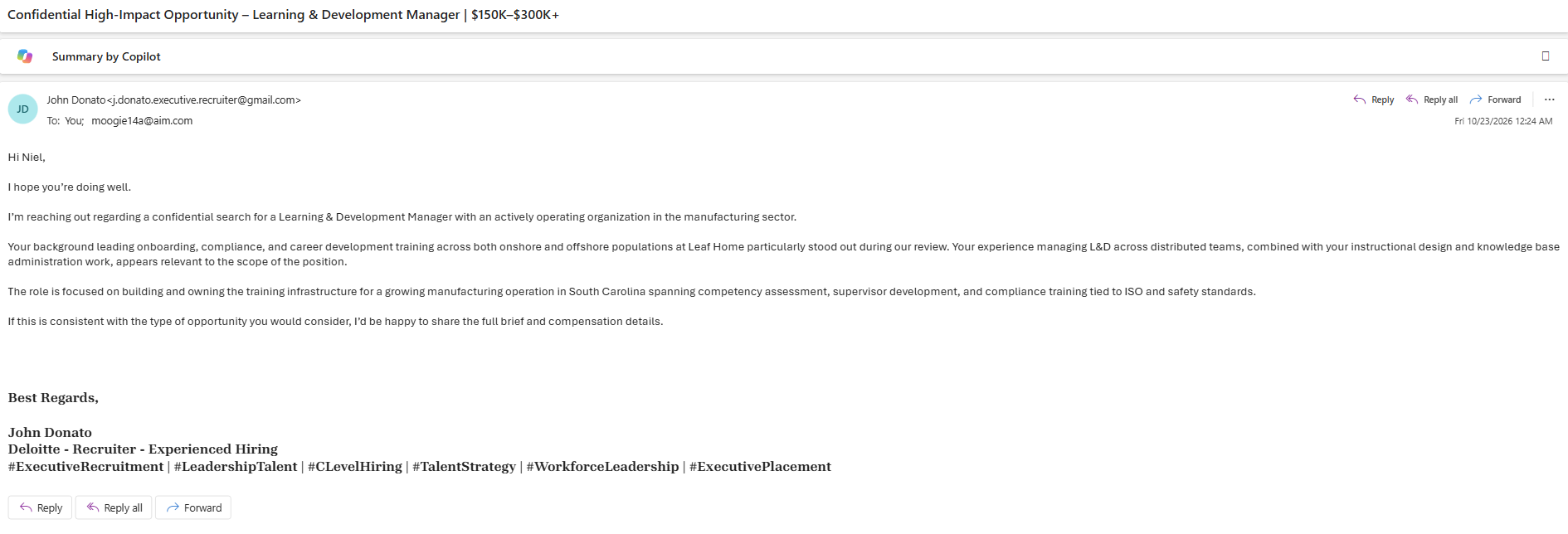
Email subject: “Confidential High-Impact Opportunity – Learning & Development Manager | $150K–$300K+”
Now this one caught my professional eye.
The email came from someone named John Donato, using a Gmail address that includes the words “executive recruiter.”
The sender claims to be contacting me about a confidential search for a Learning & Development Manager at a manufacturing organization in South Carolina.
The message references my professional background, including onboarding, compliance, career development training, instructional design, and knowledge base work. Those are relevant to my career experience.
And then comes the compensation range:
$150,000–$300,000+.
Well, hello there!
After all, who wouldn't want to hear about a potential six-figure opportunity?
The sender says my experience stood out during a review and offers to share the full brief and compensation details if I’d consider the opportunity.
Unlike the other two emails, this one doesn't immediately ask me to pay a fee or open an attachment. The message itself is reasonably polished and references aspects of my professional background.
But that doesn't prove the recruiter, job, or opportunity is legitimate.
Here's what I'd want to verify:
The recruiter's identity: Does this person have a verifiable professional presence and a credible recruiting history?
The company: Which manufacturing organization is hiring? Why isn't it named?
The job: Is there a genuine position matching the description?
The compensation: Is the advertised range supported by a real employer and a defined role?
The next step: Will the recruiter ask for personal information, identification documents, banking details, or money before providing verifiable information?
Using a Gmail address isn't proof of fraud. Independent recruiters sometimes use noncorporate email accounts. But a high salary, flattering language, and references to my experience don’t prove legitimacy either.
The broader issue is that fake recruiting approaches can collect personal information, direct candidates to malicious links, or eventually introduce fraudulent payments and fees.
So I'll treat this as unverified until I can establish who is contacting me and which organization is hiring.
If the opportunity is real, reasonable verification shouldn't ruin it.

Three Emails, Three Different Hooks
What's interesting about these messages is how differently they try to attract attention.
The healthcare hook
A supposedly free Medicare Kit in exchange for survey participation.
The temptation: a free benefit tied to a familiar healthcare name.
The money hook
A supposedly available personal loan of up to $40,000, with an offer that expires soon.
The temptation: easy access to money and FOMO.
The career hook
A confidential Learning & Development role with a potential salary of $150,000–$300,000+.
The temptation: professional recognition and a potentially life-changing opportunity.
These messages target different motivations: health, financial need, and career ambition.
That's why I don't judge an email solely by how professional it looks. A polished message can still be misleading, and a legitimate-looking logo doesn't prove that the sender represents the organization.
What I'm Doing Instead
I don't click suspicious links, open unexpected attachments, or provide sensitive information just because an email promises something appealing.
My approach is straightforward:
Verify independently. Visit the official website or app yourself instead of using a link in the message.
Check the sender. Look beyond the display name and examine the actual email address and domain.
Be wary of urgency. “Offer expires soon” is a reason to slow down, not speed up.
Protect personal information. Don't provide Social Security numbers, banking details, passwords, or identity documents to an unverified sender.
Research recruiters and employers. Confirm the person, company, and job opening independently before sharing sensitive information.
Don't open suspicious attachments. An attachment doesn't become safe just because the email has a convincing explanation.
If you've already clicked something or shared information, don't panic. The appropriate next steps depend on what happened, but they may include changing compromised passwords, contacting your financial institution, or reporting the message.
My Inbox Is Apparently a Career Fair, a Bank and a Healthcare Portal
I started with three emails and ended up with three very different offers.
A free medical kit.
A loan of up to $40,000.
A job that might pay $300,000.
I appreciate the variety. My inbox apparently believes in diversification.
But I don't need to claim that every suspicious message is definitely a scam to recognize that each one deserves scrutiny.
The healthcare offer needs verification. The loan offer needs verification. The recruiter needs verification.
And none of them gets a free pass just because the offer sounds good.
Have you received an email offering a gift, a too-good-to-be-true loan, or an unbelievable job opportunity? I'd like to hear about it.
Send your screenshots and experiences to niel@nielflamm.com. Please remove sensitive personal, financial, and account information before sending them.
I'll keep documenting what comes into my inbox, because the more we recognize these tactics, the less likely we are to get caught off guard.
Remember: Verify first. Click later—if at all.

Day 130: Maybe the “Unhinged Neighbor” Wants a Little Credit

There's a different way to look at the so-called unhinged neighbor.
Maybe the person who keeps asking questions, pointing out problems, and refusing to let an issue disappear isn't necessarily trying to destroy the company.
Maybe that person sees potential that the company isn't fully realizing.
Maybe the frustration comes from watching an organization repeatedly miss opportunities to improve—and wondering why nobody seems interested in addressing the problem.
And maybe, just maybe, that person wants the company to succeed.
Welcome to Day 130 of my Nextdoor case study.
The Unhinged Neighbor
I've spent roughly a year documenting my experience with Nextdoor, its leadership, moderation practices, communication, and the gap between what the company promises and what people experience.
I've asked questions. I've provided feedback. I've followed up on unanswered requests. I've examined public statements, product announcements, and earnings reports. I've questioned whether the company is maximizing its potential.
I've also been persistent. I know that.
From the outside, persistence can look like an obsession. Repeated questions can become annoying. And when someone keeps returning to the same issues, it's easy to label them rather than deal with what they're saying.
But here's another perspective.
What if the so-called unhinged neighbor is doing some of the work a company needs done?
What if that person is identifying weaknesses that management has overlooked, questions customers are asking, and processes that deserve another look?
That doesn't mean every point I make is automatically correct. It doesn't mean you should adopt every suggestion. And it certainly doesn't mean that being persistent entitles me to get my way.
It means the feedback’s substance deserves to be evaluated separately from the personality of the person delivering it.
You don't have to like the messenger to recognize a problem worth fixing.
I Said I Didn't Want Public Praise
Throughout this journey, I've said that I wasn't looking for public praise or recognition from Nextdoor.
I wasn't expecting a parade. I wasn't looking for a plaque to hang on my wall. I wasn't asking Nirav Tolia to put my face on a billboard in the middle of a neighborhood.
I wanted the company to address the issues I was raising.
But something happened while I was shopping at Harris Teeter.
I was standing there looking for a salad when I paused to reflect.
Was I kidding myself?
I'd spent months documenting problems, writing posts, researching the company, and trying to get answers. I'd repeatedly said that I didn't want public recognition.
But standing there, thinking about the time and energy I'd put into this project, I realized something.
Maybe I do want acknowledgment.
There. I said it.
Not because I need a participation trophy. Not because I expect Nextdoor to declare me the greatest neighborhood watchdog in social media history.
I want acknowledgment that my work has helped surface deficiencies in the company and brought attention to questions that deserve answers.
There's a difference between demanding applause and wanting recognition for my contribution.
I can want Nextdoor to improve for its users, employees, advertisers, and investors—and also want someone to acknowledge that my efforts have contributed something meaningful to that conversation.
Those two things aren't mutually exclusive.

What Would Acknowledgment Look Like?
I'm not asking Nextdoor to agree with every criticism I've made. I'm not asking the company to validate every opinion I've expressed.
I'd welcome something much simpler.
Recognition that an outsider spent considerable time examining the platform, identifying potential deficiencies, and raising questions about how the company operates.
A willingness to discuss which concerns are valid, which aren't, and what the company is doing about them.
Perhaps even an acknowledgment that some of the questions raised deserve more attention than they initially received.
That would mean more to me than a generic thank-you or a carefully worded corporate statement.
And if Nextdoor believes I've misunderstood something, I'd welcome a fact-based explanation.
Acknowledgment doesn't require agreement. It requires taking the contribution seriously enough to respond.
Did I Actually Make Nextdoor Better?
That's the question I can't definitively answer.
I don't have access to Nextdoor's internal discussions. I can't prove that a particular product decision, policy change, or business initiative happened because of something I published.
I won’t claim credit for changes I can't connect to my work.
But I can document the questions I've raised, the public information I've examined, and the concerns I've brought into the open.
I've challenged the company's communication and moderation practices. I've questioned its transparency around research. I've examined how it commercializes neighborhood knowledge. I've discussed leadership accountability, corporate governance, and the distinction between promising business metrics and long-term shareholder value.
Whether those efforts have changed Nextdoor internally is something only the people involved in those decisions could establish.
Still, I believe surfacing deficiencies has value—even when the person doing the surfacing isn't invited into the room.
Companies don't improve solely because leadership identifies every problem on its own. Sometimes customers, former users, employees, investors, and outsiders see things that deserve a closer look.
The important question is what the organization does with that information.
Nirav Tolia Doesn't Owe Me a Trophy
Let me be clear: Nirav Tolia doesn't owe me a personal relationship. He doesn't have to agree with me, follow me on social media, or invite me for coffee.
He can block me, just as I can keep expressing my views within the rules of the platforms I use.
But that doesn't make the underlying questions disappear.
I'm interested in whether Nextdoor can build better processes for listening to feedback, explaining its decisions, and addressing legitimate concerns. Those are organizational questions, not demands for personal attention.
And if Nextdoor has already addressed some of the deficiencies I've raised, I'd like to understand what changed and why.
That would be useful.
It would also be a much more meaningful outcome than an argument over whether a persistent critic deserves a particular label.

The Salad Was a Moment of Clarity
I went to Harris Teeter to buy a salad. I didn't go there to have an existential crisis about my ongoing Nextdoor case study.
Yet there I was, realizing I'd told myself I didn't want public praise when I really meant I didn't want empty praise.
I want my work to matter.
I want the deficiencies I've surfaced to be taken seriously. I want the company to improve. And yes, I'd like some acknowledgment if my efforts have helped move that process forward.
There's nothing contradictory about wanting a company to succeed while also wanting it to recognize the value of feedback.
So perhaps it's time to rethink the label of the unhinged neighbor.
Sometimes, the person who won't stop asking questions believes the organization can do better.
Sometimes, that person is irritating. Sometimes, they're mistaken. Sometimes, they point to a problem everyone else would prefer to avoid.
And sometimes, they're asking a question worth answering.
Day 130: I still want Nextdoor to succeed. But I'm no longer going to pretend that acknowledgment wouldn't mean something to me.
Even if I realized it while shopping for a salad.
👉 Follow the continuing case study at NielFlamm.com/blog.

Day 129: NXDR Is at $2.64. I've Seen This Movie Before.

The stock is rising, earnings are approaching, and I'm watching the same story unfold again.
I checked where Nextdoor Holdings (NXDR) was trading as I wrote this post: $2.64 per share.
Am I shocked? Not at all.
In fact, I expect the price to continue rising as we approach the next earnings report, scheduled for November 2. My theory is that short-term buyers are positioning themselves ahead of the announcement, hoping to benefit from the excitement and whatever numbers Nextdoor puts on the table.
That's my expectation, not a certainty. The market can always surprise us.
But here's what I think may happen.
The Run-Up to November 2
I expect NXDR to keep climbing through the earnings announcement and potentially for a few days afterward.
I also expect the earnings narrative to paint a glorious picture of Nextdoor-land.
Weekly active users are up. Revenue is up. Sales are up. The company will likely emphasize its progress, its advertising opportunities, and the potential of its neighborhood platform.
And those numbers may well show genuine progress. I'm not suggesting that improved metrics are meaningless.
But there's a bigger question that doesn't get answered by a polished earnings presentation:
What does all that progress mean for the long-term investor?
A company can report improving metrics and still leave investors waiting for a meaningful return. Revenue growth, user engagement, and operational progress are important, but they don't automatically translate into sustained stock appreciation or shareholder distributions.
That's the distinction I keep coming back to.

Why I Sold My Shares
I sold my NXDR shares on October 12.
I could only hold on for so long, waiting for the promise to turn into execution and for the long-term investment case to become more compelling.
I reached a point where I decided to sell at the price available to me rather than continue waiting for a future that might or might not arrive.
I don't regret that decision, even though the stock is now at $2.64.
Could it rise further? Absolutely.
Could it fall after earnings? That's possible, too.
I don't have a crystal ball, and I won't pretend to know what the market will do. I based my decision on my own assessment of the investment and how long I was willing to wait.
A rising stock price doesn't automatically answer the long-term questions.
A Facebook Reminder Took Me Back a Year
A few days ago, Facebook reminded me of something I had posted about a year earlier.
That reminder took me back to the beginning of my study of Nextdoor, Nirav Tolia, and the gap between the company's promises and its execution.
I began looking beyond the marketing messages and asking questions about users' experience on the platform.
What happens when the company removes posts and comments? How consistent is moderation? Where does accountability sit? How does the company respond when people raise questions? And how effectively does leadership listen to feedback?
Over time, my focus expanded to include research transparency, commercializing neighborhood knowledge, corporate governance, and the relationship between company performance and long-term shareholder value.
What started as a closer look at one platform became an ongoing case study of a public company and its leadership.
And here I am, roughly a year later, still asking some of the same questions.
The CEO, the X Posts and the Questions That Remain
One thing I documented early in this project was that Nirav Tolia hadn't reached out to the public in response to the issues I raised. I even started a countdown to track how much time passed.
Since then, Nirav has posted on X, but he has also blocked me twice from participating in conversations on his posts.
He has every right to control his own social media account. I don't know why he blocked me, and I won't pretend to.
But I do find the contrast interesting.
There are public conversations about topics that don't necessarily change the landscape of the platform, while questions about moderation, communication, accountability, and execution remain unresolved from my perspective.
Posting on X is communication. Blocking someone is a personal choice. Neither action, by itself, tells us whether the organization is listening to difficult feedback or fixing underlying problems.
The question isn't whether a CEO posts. It's whether the company learns, adapts, and follows through.

What About the Board?
This brings me to Nextdoor's board of directors.
A board has responsibilities that extend beyond supporting the CEO's strategy. Directors are expected to exercise independent judgment, oversee management, and consider the company's long-term interests.
I have questions about whether Nextdoor's governance provides enough visible accountability and whether leadership is effectively challenged when execution falls short.
I don't have evidence that the board is improperly aligned with Nirav, and I won't claim that it is. Directors can support a CEO while still exercising independent oversight.
But from the outside, shareholders and the public have limited visibility into the substance of those internal discussions.
If the board believes the current direction is working, it should be able to point to measurable results and explain how it evaluates progress, risk and leadership performance.
If problems persist, shareholders should understand how those concerns are being addressed.
A board's job isn't simply to stand behind the CEO. It's to help ensure the company delivers.
The Same Story, Another Earnings Report
As November 2 approaches, I expect the conversation around Nextdoor to focus on its numbers.
How many weekly active users? How much revenue? How strong are sales? What is management saying about the future?
Those are all reasonable questions.
But I will also be looking for evidence that the company is addressing the issues that don't fit neatly into a quarterly earnings slide: user trust, moderation, transparency, accountability, and the ability to turn a promising platform into a durable business.
I'm no longer a shareholder, but I still want Nextdoor to succeed. I would like to see it build a stronger business and deliver lasting value.
For now, I see a stock at $2.64, an earnings report approaching, and a year-old set of questions that still deserves attention.
The market may reward the next earnings narrative. The more important test is whether Nextdoor can sustain its progress beyond the announcement.
A good earnings report can move a stock. Consistent execution is what builds a business.
I'll be watching what Nextdoor reports on November 2—and, just as importantly, what happens after the headlines fade.
👉 Follow the continuing Nextdoor case study at NielFlamm.com/blog.
A Bittersweet Trip to the Eye Doctor
I’m sitting at the eye doctor’s office today—not for myself, but for my dad. He has a regularly scheduled appointment to help manage the macular degeneration in both eyes.
I drove him in his car. He can’t get into mine, a BMW X6, so he bought a Chevrolet Blazer. I’m happy to take him. He’s driven me to plenty of appointments over the years.
But today feels bittersweet.
Dad got ready on his own. He got dressed, made it down the stairs, climbed into the car, buckled his seat belt, got out at the office, and walked inside. It was good to see him manage something important to him.
And it left me thinking about what else seems important. Seeing the TV and scrolling on his phone appear to matter. But he hasn’t seen his wife since around the end of August.
He made one attempt. I didn’t take him, and I own that. But there hasn’t been another attempt since. He says he’s in too much pain to go.
Today, he made it to this appointment.
I’m not saying his pain isn’t real. I’m sitting with the contradiction, and with the sadness of watching him make the effort for one thing while the distance from his wife continues. I can’t make that choice for him.