
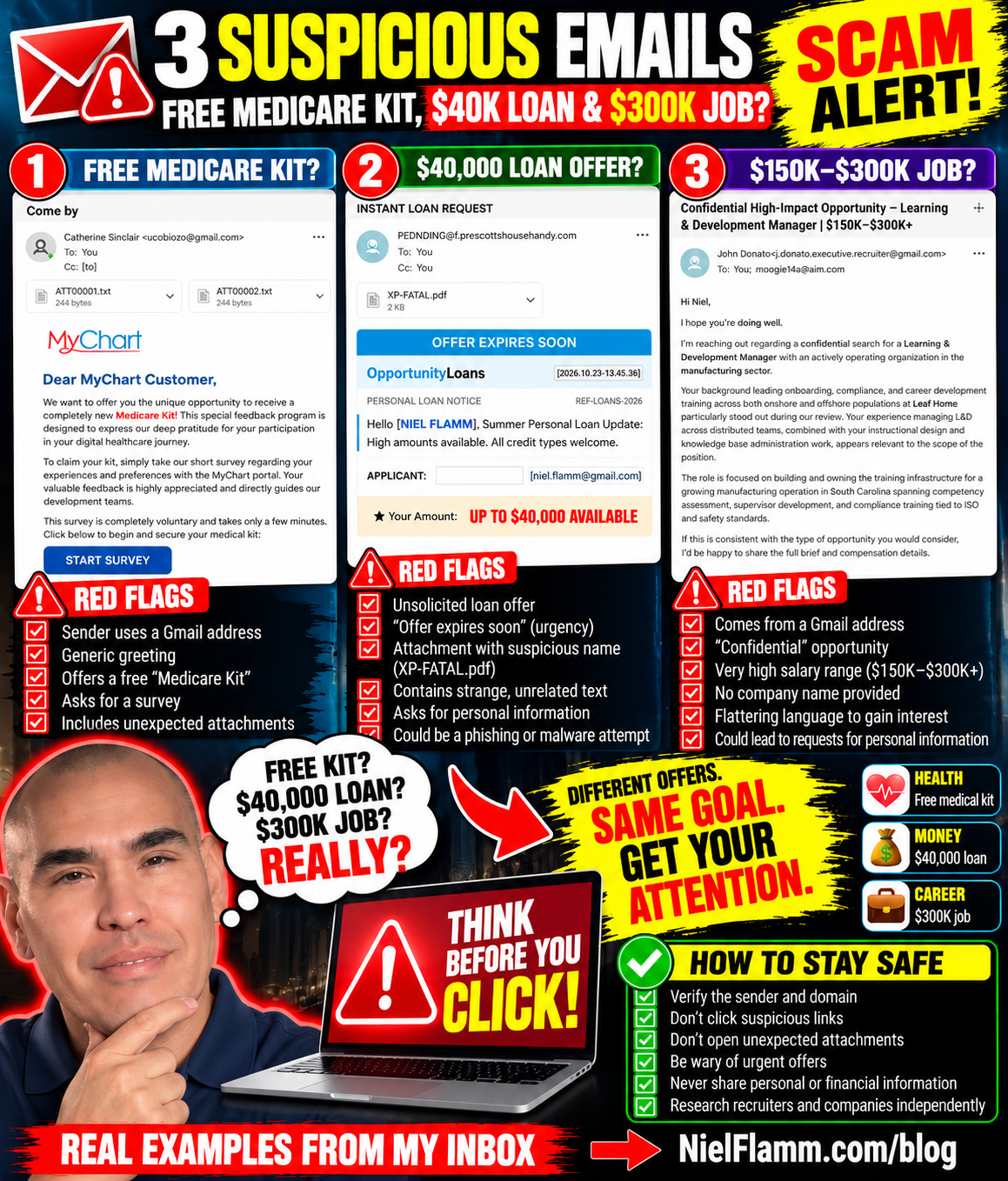
My inbox has been busy again. Apparently, the internet thinks I'm either entitled to a free medical kit, desperately need a $40,000 personal loan, or am the perfect candidate for a $300,000 Learning & Development job.
It's nice to be so popular.
One problem: these emails raise some serious questions.
Let's take a look at three messages that landed in my inbox on October 22 and 23, 2026.
1. A Free Medicare Kit From “MyChart”?
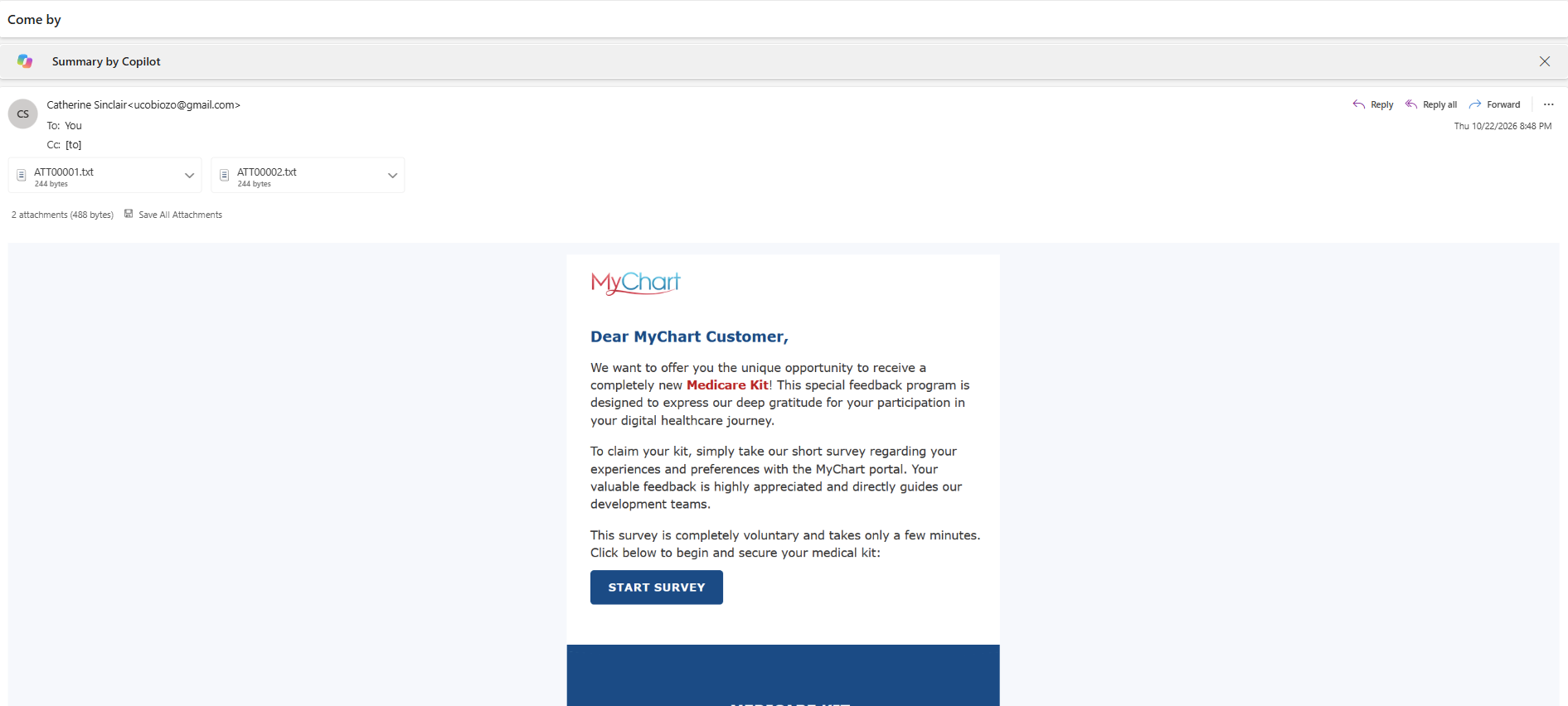
Email subject: “Come by”
The first email came from an address listed as Catherine Sinclair and used a Gmail address. It included two tiny text attachments and an image styled to look like a MyChart message.
The message addressed me as a “MyChart Customer” and offered a supposedly new “Medicare Kit” in exchange for completing a short survey about my MyChart portal experience.
How generous!
A free medical kit just for answering a few questions? What could go wrong?
Well, a few things caught my attention:
The sender's Gmail address doesn't establish any connection to MyChart or a healthcare provider.
The email uses a generic greeting rather than identifying a specific healthcare organization.
The offer combines a medical-related brand with a gift and a survey link.
The email includes unexpected attachments.
I can't establish from this screenshot alone who sent the message or what the attachments contain. But I certainly wouldn't click the survey button or open unexpected files to find out.
If a healthcare portal genuinely offers a survey or patient benefit, I'll check the official portal or contact my healthcare provider using contact details I already trust.
My medical information is not a prize to be claimed through a mystery email.
2. An “Instant Loan” Offering Up to $40,000
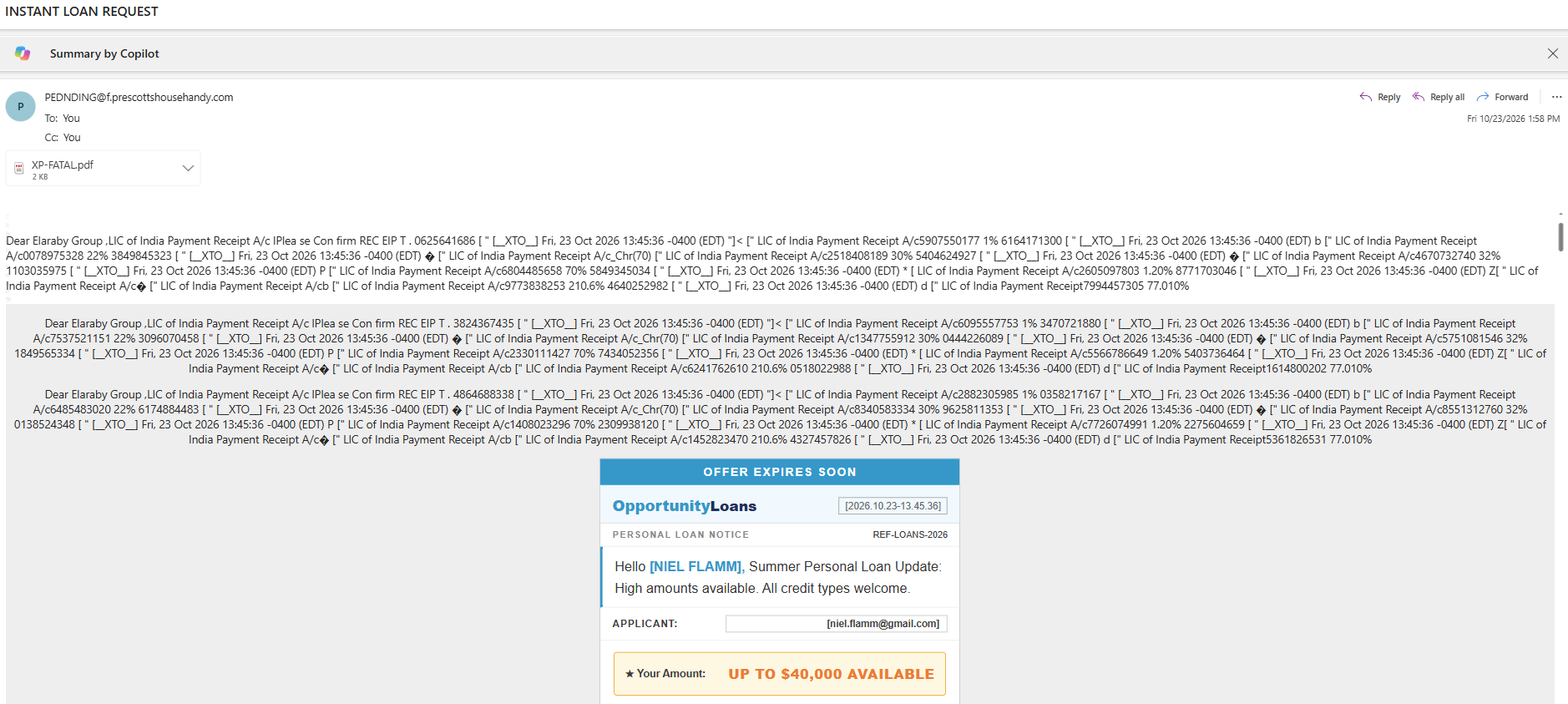
Email subject: “INSTANT LOAN REQUEST”
The second email takes a different approach. This one appears to be about money—specifically, money someone supposedly wants to lend me.
The message contains a banner that says “OFFER EXPIRES SOON” and promotes something called OpportunityLoans. It addresses me by name and advertises personal loans of up to $40,000.
The email also includes a PDF attachment named XP-FATAL.pdf.
Wait a minute. Someone I don't recognize wants to offer me up to $40,000, and there's a PDF attachment with a filename that looks like it wandered out of a computer-security nightmare?
I think I'll pass.
Here are the red flags I noticed:
Urgency: “Offer expires soon” encourages a quick decision.
Unsolicited credit offer: I didn't request this loan information.
Unusual formatting: The message contains a jumble of apparent payment-receipt text that has little to do with the loan offer.
Unexpected attachment: There's no reason for me to open a suspicious PDF just because an email tells me money is available.
Personal information: The email displays identifying information, which can make a message feel more convincing without proving it's legitimate.
I can't determine from the screenshot alone whether this is an outright scam, an unsolicited marketing message, or something else. But I wouldn't use the email's links or contact details to investigate it.
If I ever need a personal loan, I'll research lenders independently, check their credentials, and carefully review the terms. I won’t let a countdown banner drive my financial decisions.
A loan offer isn't free money. And “up to $40,000” doesn't mean I'm approved for $40,000.
3. A $150K–$300K Learning & Development Job?
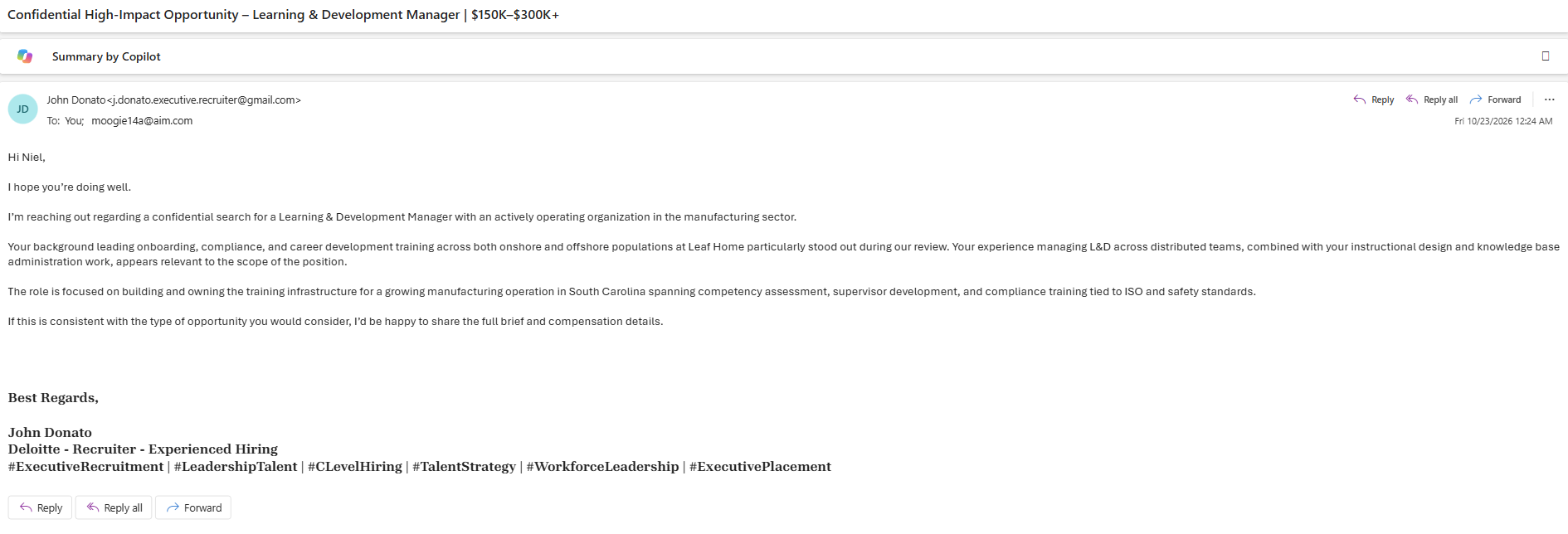
Email subject: “Confidential High-Impact Opportunity – Learning & Development Manager | $150K–$300K+”
Now this one caught my professional eye.
The email came from someone named John Donato, using a Gmail address that includes the words “executive recruiter.”
The sender claims to be contacting me about a confidential search for a Learning & Development Manager at a manufacturing organization in South Carolina.
The message references my professional background, including onboarding, compliance, career development training, instructional design, and knowledge base work. Those are relevant to my career experience.
And then comes the compensation range:
$150,000–$300,000+.
Well, hello there!
After all, who wouldn't want to hear about a potential six-figure opportunity?
The sender says my experience stood out during a review and offers to share the full brief and compensation details if I’d consider the opportunity.
Unlike the other two emails, this one doesn't immediately ask me to pay a fee or open an attachment. The message itself is reasonably polished and references aspects of my professional background.
But that doesn't prove the recruiter, job, or opportunity is legitimate.
Here's what I'd want to verify:
The recruiter's identity: Does this person have a verifiable professional presence and a credible recruiting history?
The company: Which manufacturing organization is hiring? Why isn't it named?
The job: Is there a genuine position matching the description?
The compensation: Is the advertised range supported by a real employer and a defined role?
The next step: Will the recruiter ask for personal information, identification documents, banking details, or money before providing verifiable information?
Using a Gmail address isn't proof of fraud. Independent recruiters sometimes use noncorporate email accounts. But a high salary, flattering language, and references to my experience don’t prove legitimacy either.
The broader issue is that fake recruiting approaches can collect personal information, direct candidates to malicious links, or eventually introduce fraudulent payments and fees.
So I'll treat this as unverified until I can establish who is contacting me and which organization is hiring.
If the opportunity is real, reasonable verification shouldn't ruin it.
Three Emails, Three Different Hooks
What's interesting about these messages is how differently they try to attract attention.
The healthcare hook
A supposedly free Medicare Kit in exchange for survey participation.
The temptation: a free benefit tied to a familiar healthcare name.
The money hook
A supposedly available personal loan of up to $40,000, with an offer that expires soon.
The temptation: easy access to money and FOMO.
The career hook
A confidential Learning & Development role with a potential salary of $150,000–$300,000+.
The temptation: professional recognition and a potentially life-changing opportunity.
These messages target different motivations: health, financial need, and career ambition.
That's why I don't judge an email solely by how professional it looks. A polished message can still be misleading, and a legitimate-looking logo doesn't prove that the sender represents the organization.
What I'm Doing Instead
I don't click suspicious links, open unexpected attachments, or provide sensitive information just because an email promises something appealing.
My approach is straightforward:
Verify independently. Visit the official website or app yourself instead of using a link in the message.
Check the sender. Look beyond the display name and examine the actual email address and domain.
Be wary of urgency. “Offer expires soon” is a reason to slow down, not speed up.
Protect personal information. Don't provide Social Security numbers, banking details, passwords, or identity documents to an unverified sender.
Research recruiters and employers. Confirm the person, company, and job opening independently before sharing sensitive information.
Don't open suspicious attachments. An attachment doesn't become safe just because the email has a convincing explanation.
If you've already clicked something or shared information, don't panic. The appropriate next steps depend on what happened, but they may include changing compromised passwords, contacting your financial institution, or reporting the message.
My Inbox Is Apparently a Career Fair, a Bank and a Healthcare Portal
I started with three emails and ended up with three very different offers.
A free medical kit.
A loan of up to $40,000.
A job that might pay $300,000.
I appreciate the variety. My inbox apparently believes in diversification.
But I don't need to claim that every suspicious message is definitely a scam to recognize that each one deserves scrutiny.
The healthcare offer needs verification. The loan offer needs verification. The recruiter needs verification.
And none of them gets a free pass just because the offer sounds good.
Have you received an email offering a gift, a too-good-to-be-true loan, or an unbelievable job opportunity? I'd like to hear about it.
Send your screenshots and experiences to niel@nielflamm.com. Please remove sensitive personal, financial, and account information before sending them.
I'll keep documenting what comes into my inbox, because the more we recognize these tactics, the less likely we are to get caught off guard.
Remember: Verify first. Click later—if at all.
