
My inbox has done it again.
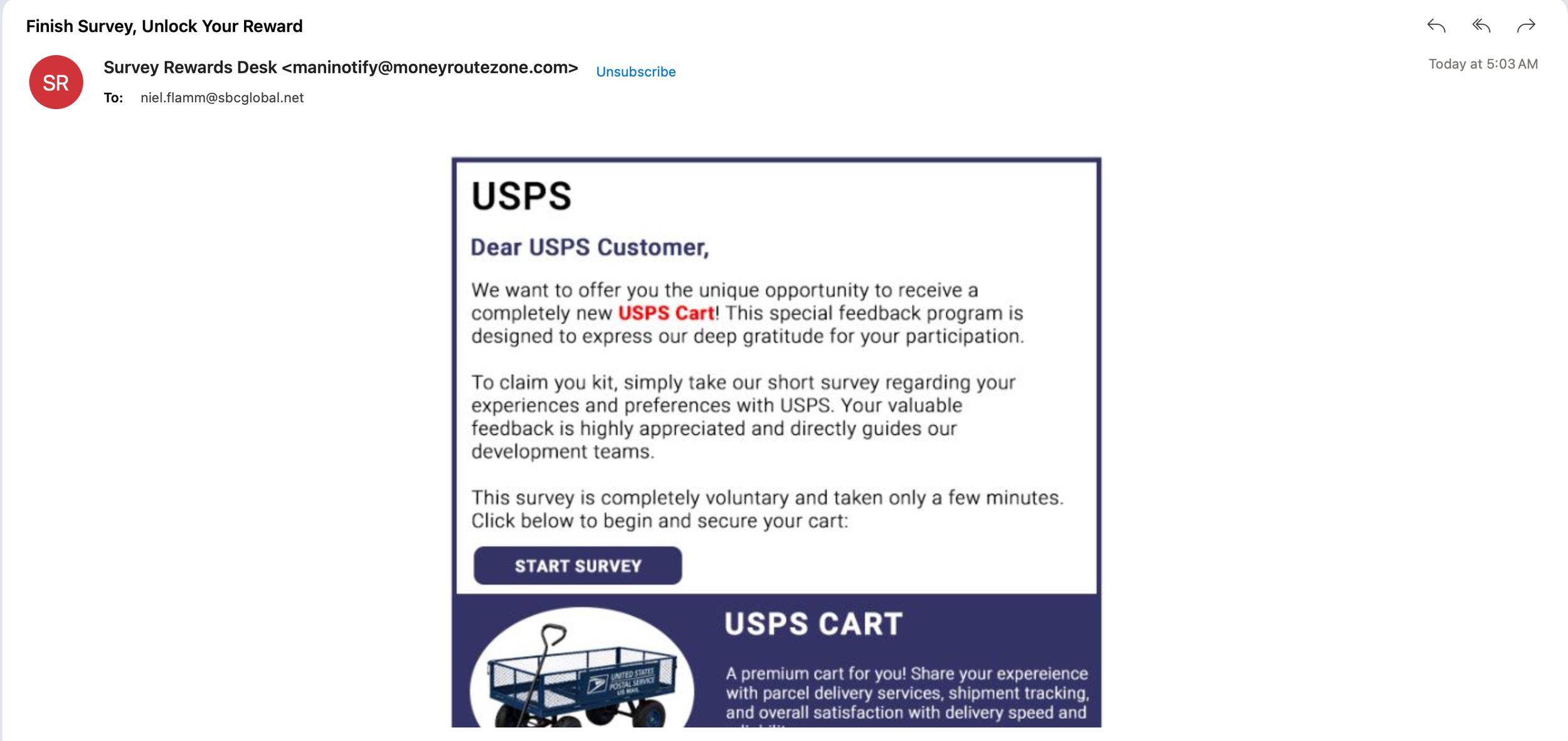
This time, I've apparently been selected for a special opportunity: a brand-new USPS cart for completing a short survey.
A free cart! From the United States Postal Service!
I can only assume this is the beginning of my rise to postal greatness. Perhaps my next promotion will involve delivering mail, driving a truck, or becoming Postmaster General.
There's just one small problem: I strongly suspect this email is a scam.
The Email That Wants My Opinion
The message arrived with the subject line:
“Finish Survey, Unlock Your Reward”
It came from a sender calling itself “Survey Rewards Desk,” using the email address maninotify@moneyroutezone.com.
Inside is a message styled to look like a USPS promotion. It addresses me as “Dear USPS Customer” and offers a supposedly new USPS Cart in exchange for completing a survey about my postal delivery experience.
The email even includes a “START SURVEY” button.
Apparently, my opinions about package tracking and delivery speeds are so valuable that I deserve a premium postal cart.
I'm touched.
But before I start imagining myself rolling around the neighborhood with my new postal equipment, let's look at what this message is actually telling me.
The Red Flags Are Arriving Faster Than the Mail
1. The sender's email address doesn't match USPS.
The message uses moneyroutezone.com, not an official USPS domain. The sender's display name may sound convincing, but display names are easy to invent.
That alone doesn't prove who sent the email, but it is a significant reason to be cautious.
2. The greeting is generic.
“Dear USPS Customer” isn't a personalized message. It doesn't identify a specific transaction, delivery, or legitimate USPS program.
Scammers often send messages to large numbers of people and hope that enough recipients will take the bait.
3. The free gift is designed to get me clicking.
The offer claims I can receive a new USPS Cart by answering a few questions. The message describes the survey as voluntary and says it will take only a few minutes.
That's a familiar formula: offer something appealing, make the task sound easy, and encourage the recipient to click a button.
What happens after clicking? The screenshot doesn't tell us. It could lead to a phishing page, a request for personal information, a data-collection survey, or another misleading offer. I can't confirm the destination or the sender's intentions from the screenshot alone.
4. The branding doesn't establish legitimacy.
The message uses the USPS name and a postal-cart image to make the offer look official.
But putting a recognizable organization's name on an email doesn't mean that organization sent it.
5. The sender wants me to take action.
The big “START SURVEY” button is the centerpiece of the email. That's where the sender wants my attention.
I'm not going to click it just to discover whether the promised cart exists.
What Is a USPS Cart, Anyway?
The email describes the reward as a “premium cart” and mentions parcel delivery, shipment tracking, and overall satisfaction with delivery speed.
Maybe the image is supposed to make the reward seem tangible and exciting. But the offer raises a pretty obvious question: why would USPS give away equipment to random email recipients in exchange for a few minutes of survey feedback?
I can't rule out every possible legitimate promotional program based on a screenshot. However, this message provides no convincing evidence that the offer is an official USPS promotion.
If USPS really is conducting a survey or offering a reward, I should be able to verify it independently through the official USPS website or a trusted customer-service channel.
I don't need to use the link in this email to find out.

What I'm Going to Do
I'm leaving that survey button alone.
Here's my approach when an email offers a gift from a familiar company:
Don't click links or buttons in an unexpected message.
Don't open unexpected attachments.
Check the sender's actual email address, not just the display name.
Visit the company's official website independently to verify the offer.
Never provide passwords, payment details or sensitive personal information to claim an unverified reward.
Report suspicious messages through the appropriate official channel and delete them.
And no, I'm not going to reply to the sender to ask where my cart is.
I suspect that conversation would be about as productive as asking a suspicious email to verify itself.
My Inbox Thinks I'm Very Special
Between surprise prizes, suspicious loan offers, unbelievable job opportunities, and mystery rewards, my inbox seems convinced I'm someone of extraordinary importance.
Today, I'm apparently one short survey away from becoming the proud owner of a USPS Cart.
Tomorrow, who knows? Maybe the postal service will offer me a free sorting facility.
I'll try not to get carried away.
The point isn't that every survey or promotional offer is fraudulent. It's that an unexpected reward, familiar branding, and a prominent button are not proof that an offer is legitimate.
Scammers know that free things get our attention. They also know that people are more likely to click when a message looks like it came from a company they recognize.
So, before you take a survey, claim a prize, or hand over personal information, stop and verify.
As for me, I'll continue getting my mail the old-fashioned way.
Through the mailbox—not through a suspicious email promising free postal equipment.
Have you received a similar “free gift” or survey-reward email? Send your screenshots and experiences to niel@nielflamm.com. Please remove personal information, account details, and other sensitive data before sending.
Let's compare notes and help other people recognize the warning signs.
