
Well, well, well. Look what showed up in my inbox today.
Remember that email I received offering me a supposedly free Medicare Kit in exchange for completing a short survey about my MyChart experience?
Apparently, the first invitation wasn't enough.
They're back for another round!
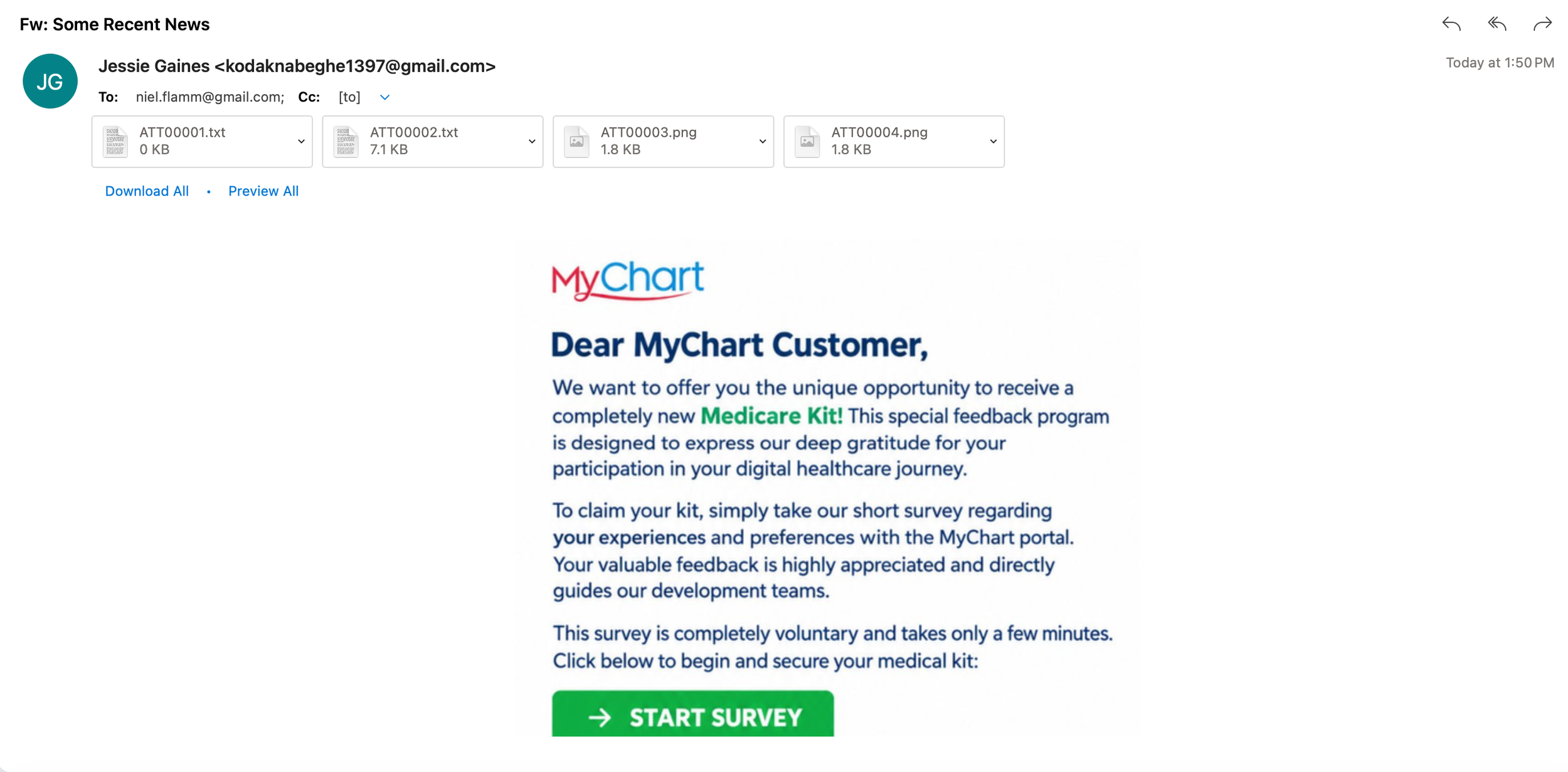
This time, the email arrived with the subject line “Fw: Some Recent News.” It came from someone named Jessie Gaines, using a Gmail address, and included four attachments—two text files and two PNG images.
And right there in the message is the familiar offer:
A completely new Medicare Kit!
All I have to do is complete a short survey about my experiences and preferences with the MyChart portal.
How thoughtful.
My inbox is apparently determined to improve my healthcare experience, one suspicious email at a time.
Déjà Vu: The Medicare Kit Edition
The message uses the MyChart name and logo, addresses me as “Dear MyChart Customer,” and claims the survey is part of a special feedback program designed to thank people for participating in their digital healthcare journey.
The promised reward? A Medicare Kit.
The call to action? A big green START SURVEY button.
The pitch is simple: answer a few questions, share your feedback, and claim your reward.
But here's the thing: the email doesn't establish that MyChart or any healthcare provider actually sent it.
The sender's Gmail address doesn't demonstrate an official connection to MyChart. The message also doesn't identify a specific healthcare organization sponsoring the promotion.
And the fact that it arrived as a forwarded message doesn't make it any more trustworthy.
Why Does This Raise Red Flags?
A few things caught my attention.
1. The sender isn't using an official healthcare domain.
The email comes from a Gmail address. That doesn't automatically prove it's fraudulent, but it certainly doesn't verify the sender's claimed connection to MyChart.
2. The offer uses a familiar healthcare brand.
MyChart is a recognizable patient portal. A familiar name and logo can make an unsolicited message seem more credible than it is.
3. The reward encourages me to click.
Who doesn't like a free gift? The promise of a Medicare Kit gives the recipient a reason to act before asking whether the offer is legitimate.
4. The email includes unexpected attachments.
There are four attachments, including text files and images. I haven't confirmed what's in each attachment, and I'm not going to open suspicious files just out of curiosity.
5. This offer has appeared before.
I've now encountered a very similar Medicare Kit pitch in another email. Repeated messages using the same reward and survey formula make me even more cautious.
I can't confirm the sender's identity or where the survey button goes from this screenshot alone. I also can't say definitively what happens if someone clicks it.
But I don't need to click it to recognize that the offer deserves independent verification.

What Would I Do If I Really Wanted to Check?
I'd open the official MyChart app or go directly to my healthcare provider's website.
If I had questions about a promotion, I'd contact the provider through a phone number or contact method I already knew was legitimate.
I would not use the link in this email to verify the email itself.
And I certainly wouldn't provide my login credentials, Medicare information, payment details or other sensitive personal information to claim an unverified reward.
If the offer is legitimate, I should be able to verify it without trusting the message that brought it to my attention.
My Inbox Is Becoming a Rewards Department
Let's review the recent opportunities my inbox has presented:
A supposedly free Medicare Kit for completing a survey.
A USPS Cart offered in exchange for feedback.
An unsolicited loan offer advertising up to $40,000.
A mysterious recruiting message promising an exciting job opportunity.
Now the Medicare Kit has returned for an encore.
I'm starting to wonder whether my inbox has mistaken me for a professional survey participant with an unlimited appetite for suspicious freebies.
Maybe next I'll receive an email offering me a free hospital, a complimentary postal truck, and a corner office with a $300,000 salary.
One can dream.
But I prefer to keep my personal information, my healthcare accounts, and my money out of these little adventures.
The Bottom Line
An email featuring the MyChart logo is not proof that MyChart sent it. A free gift is not proof of a legitimate promotion. And a survey button is not an invitation I need to accept.
Verify the offer independently. Don't click first and ask questions later.
Have you received an email offering a free Medicare Kit or another reward in exchange for completing a survey? I'd like to hear about it.
Send screenshots and your experiences to niel@nielflamm.com. Please remove sensitive personal information before sending anything.
I'll keep documenting what shows up in my inbox. Apparently, the freebie department isn't going out of business anytime soon.
Until next time: stay curious, stay cautious, and don't let a green button make decisions for you.
