
Day 55: What Does 55 Days of Silence Actually Say?

I'm up early this morning.
It's not a dialysis day. I received a tetanus shot Thursday morning; the vaccine appears to be doing its job. I feel miserable, and I haven't slept much.
So naturally, at an unreasonable hour on a Saturday, my mind wandered back to Nextdoor, Nirav Tolia, Jacob Chavis, Investor Relations, and Communications.
Welcome to Day 55.
Fifty-five days since I requested a study.
At this point, I'm less interested in repeating the timeline and more interested in this:
What does saying absolutely nothing communicate?
Because silence communicates, too.
I don't know what's happening internally at Nextdoor, so let's consider some possibilities.
Maybe the strategy is:
Don't engage.
Maybe someone believes that if nobody responds, eventually I'll move on.
Maybe acknowledging my request gives my questions attention they'd rather avoid.
Perhaps no one wants ownership of the response.
Maybe responding creates more questions.
I don't have the study yet, and I haven't received an explanation.
Maybe it's bureaucracy.
Maybe it's indifference.
Or maybe there isn't a strategy at all.
I don't know.
That's the fascinating part.
When an organization refuses to communicate, outsiders fill the vacuum themselves.
After 55 days, the story isn't simply, "Niel hasn't received the study."
The story becomes:
Why won't anyone respond?
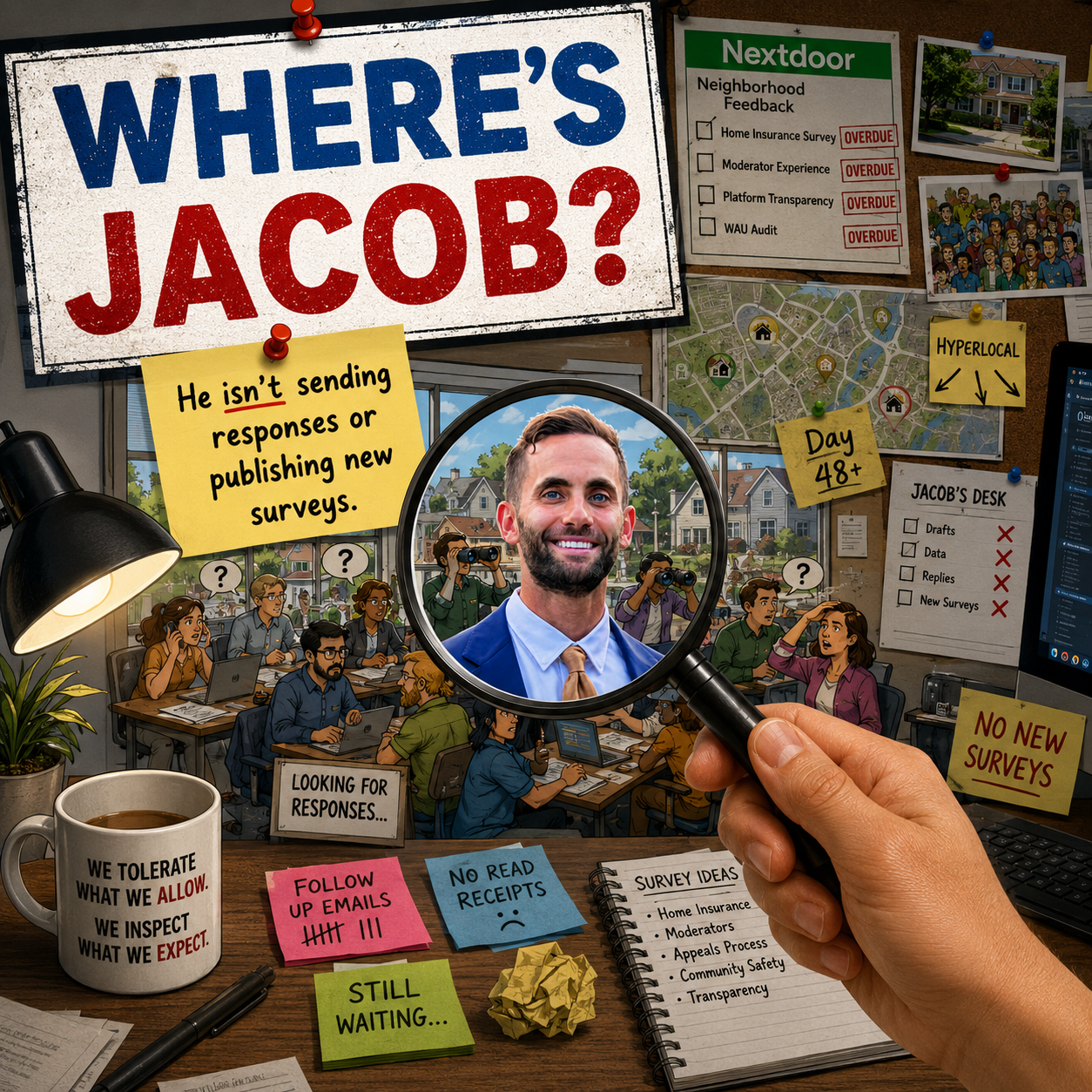
I've emailed Jacob Chavis, Investor Relations, and Communications. I've addressed CEO Nirav Tolia. I've publicly documented the experience.
People at Nextdoor have viewed my LinkedIn profile.
Yet the response remains:
Nothing.
From my perspective, pretending something isn't happening doesn't make it disappear. It can make the original issue larger.
A two-sentence email weeks ago could have changed this:
"Niel, thank you for reaching out. Unfortunately, we're unable to provide the study."
I might have disagreed. I probably would have asked why.
But at least we'd be communicating.
Instead, we're on Day 55.
And now I'm studying the silence itself.
Accountability doesn't require agreeing with me.
It doesn't require giving me the answer I want.
It requires acknowledging the question and owning the response.
Because when leadership says nothing long enough, people eventually stop asking only about the original issue.
They start asking what the silence says about the culture behind it.
It seems someone at Nextdoor may believe ignoring this is the safest strategy.
From where I'm sitting, 55 days later, I'm not sure it's working.
Now I'm going to attempt to get some sleep.
Join the discussion at NielFlamm.com/blog. What do you think 55 days of silence communicates?
